
Mapa mental
PRINCIPLES OF MARKETING
Conteúdo do mapa
PRINCIPLES OF MARKETING
CHAPTER 1: Marketing Creating and Capturing Customer Value
- Marketing: The process by which companies create value for customers and build strong customer relationships in order to capture value from customers in return.
- Needs
- Wants
- Demands
- Market offerings: Some combination of products, services, information, or experiences offered to a market to satisfy a need or want
- Marketing myopia: The mistake of paying more attention to the specific products a company offers than to the benefits and experiences produced by these products.
- Exchange
- Market
- Modern Marketing System
- Marketing management: The art and science of choosing target markets and building profitable relationships with them.
- Production concept: The idea that consumers will favor products that are available and highly affordable; therefore, the organization should focus on improving production and distribution efficiency.
- Product concept: The idea that consumers will favor products that offer the most quality, performance, and features; therefore, the organization should devote its energy to making continuous product improvements.
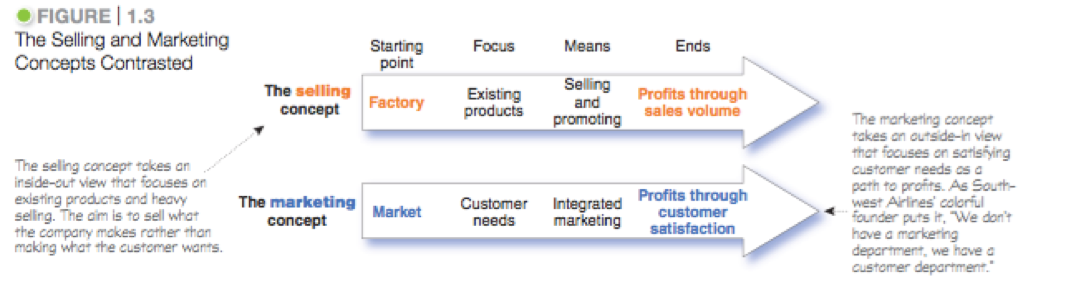
- Selling concept: The idea that consumers will not buy enough of the firm’s products unless the promotion effort.
- Marketing concept: A philosophy in which achieving organizational goals depends on knowing the needs and wants of target markets and delivering the desired satisfactions better than competitors do.
- Societal marketing concept: The idea that a company’s marketing decisions should consider consumers’ wants, the company’s requirements, consumers’ long-run interests, and society’s long-run interests.
- Customer relationship management
- Customer-managed relationships
- Consumer-generated marketing
- Customer-managed relationships
- Customer satisfaction
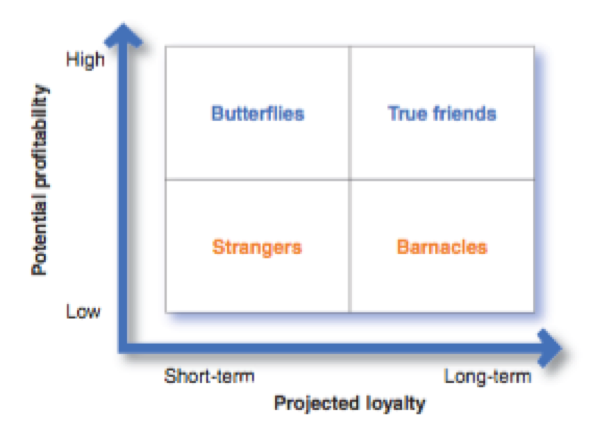
- Customer lifetime value
- Share of customer
- Customer equity
- Customer lifetime value
- Partner relationship management
- Internet
- Customer relationship management
- Marketing management: The art and science of choosing target markets and building profitable relationships with them.
- Marketing: The process by which companies create value for customers and build strong customer relationships in order to capture value from customers in return.
CHAPTER 2: Company and Marketing Strategy Partnering to Build Customer Relationships
- Strategic Planning: The process of developing and maintaining a strategic fit between the organization’s goals and capabilities and its changing marketing opportunities.
- Mission statement: A statement of the organization’s purpose—what it wants to accomplish in the larger environment
- Business portfolio: The collection of businesses and products that make up the company
- Portfolio analysis: The process by which management evaluates the products and businesses that make up the company.
- Growth – share matrix: A portfolio-planning method that evaluates a company’s SBUs in terms of market growth rate and relative market share
- Product/market expansion grid: A portfolio-planning tool for identifying company growth opportunities through market penetration, market development, product development, or diversification.
- Portfolio analysis: The process by which management evaluates the products and businesses that make up the company.
- Market penetration: Company growth by increasing sales of current products to current market segments without changing the product
- Market development: Company growth by identifying and developing new market segments for current company products
- Product Development: Company growth by offering modified or new products to current market segments
- Diversification
- Product Development: Company growth by offering modified or new products to current market segments
- Market development: Company growth by identifying and developing new market segments for current company products
- SWOT analysis: An overall evaluation of the company’s strengths (S), weaknesses (W), opportunities (O), and threats (T).
- Marketing implementation: Turning marketing strategies and plans into marketing actions to accomplish strategic marketing objectives
- Marketing control
- Return on marketing investment (or marketing ROI)
- Marketing implementation: Turning marketing strategies and plans into marketing actions to accomplish strategic marketing objectives
- Value chain: The series of internal departments that carry out value-creating activities to design, produce, market, deliver, and support a firm’s products.
- Value delivery network: The network made up of the company, its suppliers, its distributors, and, ultimately, its customers who partner with each other to improve the performance of the entire system.
- Marketing strategy
- Market Segmentation
- Market Segment
- Market target
- Positioning
- Differentiation
- Marketing Mix: The set of tactical marketing tools— product, price, place, and promotion— that the firm blends to produce the response it wants in the target market.
- Strategic Planning: The process of developing and maintaining a strategic fit between the organization’s goals and capabilities and its changing marketing opportunities.
CHAPTER 3: Analyzing the Marketing Environment
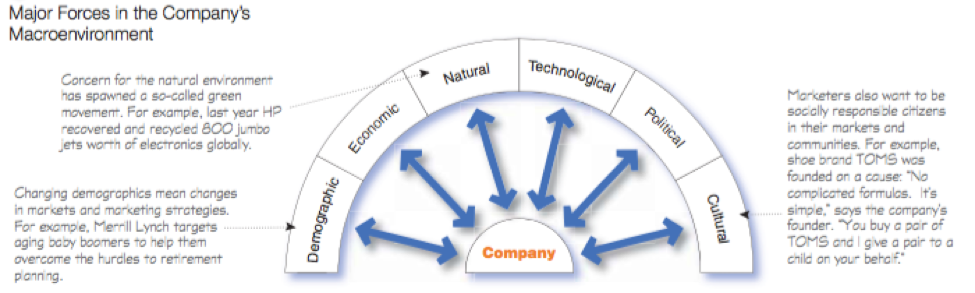
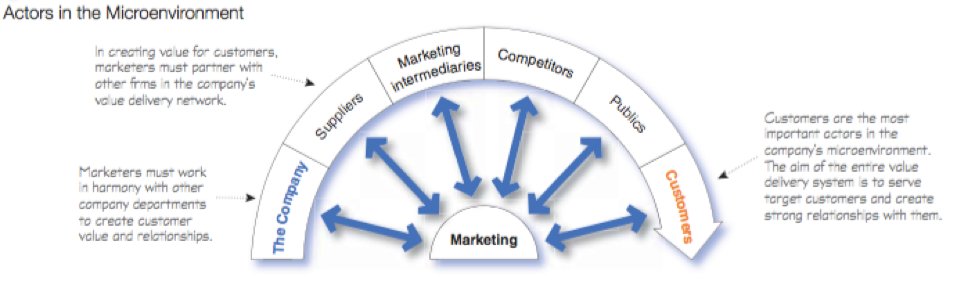
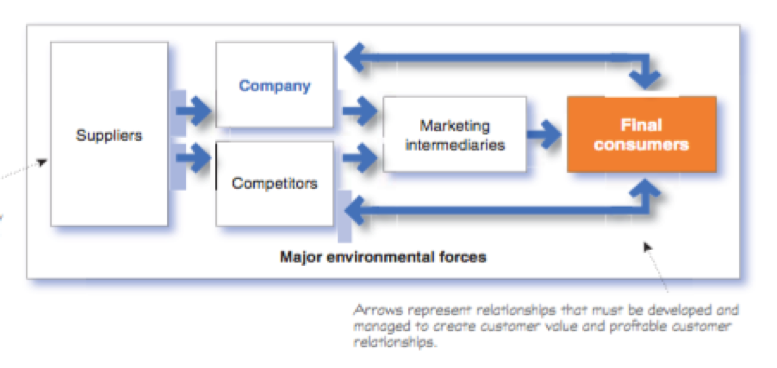
- Marketing environment: The actors and forces outside marketing that affect marketing management’s ability to build and maintain successful relationships with target customers.
- Microenvironment
- Macroenvironment
- Microenvironment
- Marketing intermediaries: Firms that help the company to promote, sell, and distribute its goods to final buyers.
- Public
- Demography: The study of human populations in terms of size, density, location, age, gender, race, occupation, and other statistics.
- Millenials (or Generation Y): The 83 million children of the baby boomers born between 1977 and 2000
- Generation X: The 49 million people born between 1965 and 1976 in the “birth dearth” following the baby boom.
- Baby Boomers: The 78 million people born during the years following World War II and lasting until 1964.
- Demography: The study of human populations in terms of size, density, location, age, gender, race, occupation, and other statistics.
- Public
- Environments
- Environmental sustainability: Developing strategies and practices that create a world economy that the planet can support indefinitely.
- Technological environment: Forces that create new technologies, creating new product and market opportunities.
- Political environment: Laws, government agencies, and pressure groups that influence and limit various organizations and individuals in a given society.
- Cultural environment: Institutions and other forces that affect society’s basic values, perceptions, preferences, and behaviors.
- Marketing environment: The actors and forces outside marketing that affect marketing management’s ability to build and maintain successful relationships with target customers.
CHAPTER 4: Managing Marketing Information to Gain Customer Insights
- Customer insights: Fresh understandings of customers and the marketplace derived from marketing information that become the basis for creating customer value and relationships.
- Focus group interviewing: Personal interviewing that involves inviting 6 to 10 people to gather for a few hours with a trained interviewer to talk about a product, service, or organization. The interviewer “focuses” the group discussion on important issues.
- Sample: A segment of the population selected for marketing research to represent the population as a whole.
- Customer relationship management (CRM): Managing detailed information about individual customers and carefully managing customer touch points to maximize customer loyalty
- Focus group interviewing: Personal interviewing that involves inviting 6 to 10 people to gather for a few hours with a trained interviewer to talk about a product, service, or organization. The interviewer “focuses” the group discussion on important issues.
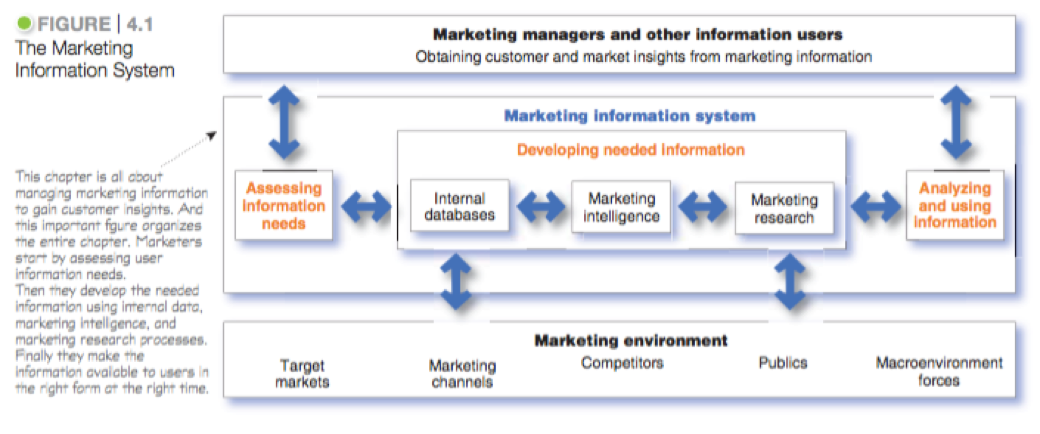
- Marketing information system (MIS): People and procedures dedicated to assessing information needs, developing the needed information, and helping decision makers to use the information to generate and validate actionable customer and market insights.
- Internal databases: Electronic collections of consumer and market information obtained from data sources within the company network
- Competitive marketing intelligence: The systematic collection and analysis of publicly available information about consumers, competitors, and developments in the marketing environment.
- Marketing research: The systematic design, collection, analysis, and reporting of data relevant to a specific marketing situation facing an organization.
- Exploratory research: Marketing research to gather preliminary information that will help define problems and suggest hypotheses.
- Descriptive research: Marketing research to better describe marketing problems, situations, or markets, such as the market potential for a product or the demographics and attitudes of consumers.
- Causal research: Marketing research to test hypotheses
- Secondary data
- Primary data
- Online marketing research: Collecting primary data online through Internet surveys, online focus groups, consumers’ online behavior
- Online focus groups: Gathering a small group of people online with a trained moderator to chat about a product, service, or organization and gain qualitative insights about consumer attitudes and behavior
- Online marketing research: Collecting primary data online through Internet surveys, online focus groups, consumers’ online behavior
- Observational research: Gathering primary data by observing relevant people, actions, and situations.
- Ethnographic research: A form of observational research that involves sending trained observers to watch and interact with consumers in their “natural environments.”
- Survey research: Gathering primary data by asking people questions about their knowledge, attitudes, preferences, and buying behavior.
- Customer insights: Fresh understandings of customers and the marketplace derived from marketing information that become the basis for creating customer value and relationships.
Greta Morrill Zaragoza A01335228
Imagens e arquivos do mapa















Informações
- Descrição
- Mind Map of the Chapters 1 to 4 of the book Principles of Marketing
- Criado por
- Greta Morrill
- Visualizações
- 3.294
- Tags
- Avaliação