
Mapa mental
Exchange and transport
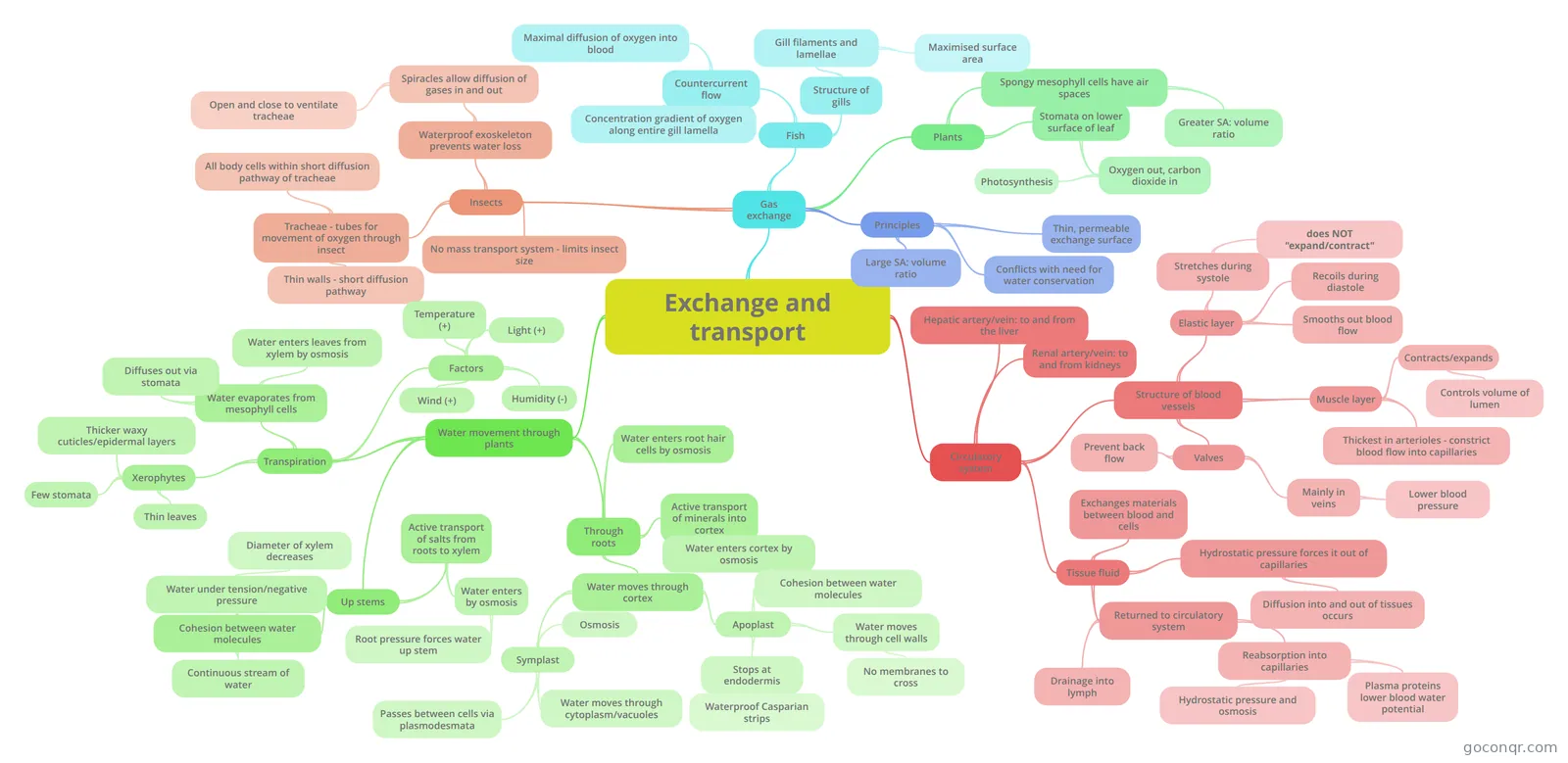
Mind map: Exchange and transport
Conteúdo do mapa
Exchange and transport
Gas exchange
- Principles
- Large SA: volume ratio
- Thin, permeable exchange surface
- Conflicts with need for water conservation
- Fish
- Structure of gills
- Gill filaments and lamellae
- Maximised surface area
- Gill filaments and lamellae
- Countercurrent flow
- Concentration gradient of oxygen along entire gill lamella
- Maximal diffusion of oxygen into blood
- Structure of gills
- Plants
- Stomata on lower surface of leaf
- Oxygen out, carbon dioxide in
- Photosynthesis
- Oxygen out, carbon dioxide in
- Spongy mesophyll cells have air spaces
- Greater SA: volume ratio
- Stomata on lower surface of leaf
- Insects
- Waterproof exoskeleton prevents water loss
- Spiracles allow diffusion of gases in and out
- Open and close to ventilate tracheae
- Spiracles allow diffusion of gases in and out
- Tracheae - tubes for movement of oxygen through insect
- All body cells within short diffusion pathway of tracheae
- Thin walls - short diffusion pathway
- No mass transport system - limits insect size
- Waterproof exoskeleton prevents water loss
- Principles
Circulatory system
- Structure of blood vessels
- Elastic layer
- Stretches during systole
- does NOT "expand/contract"
- Recoils during diastole
- Smooths out blood flow
- Stretches during systole
- Muscle layer
- Contracts/expands
- Controls volume of lumen
- Thickest in arterioles - constrict blood flow into capillaries
- Contracts/expands
- Valves
- Mainly in veins
- Lower blood pressure
- Prevent back flow
- Mainly in veins
- Elastic layer
- Tissue fluid
- Exchanges materials between blood and cells
- Hydrostatic pressure forces it out of capillaries
- Diffusion into and out of tissues occurs
- Returned to circulatory system
- Reabsorption into capillaries
- Plasma proteins lower blood water potential
- Hydrostatic pressure and osmosis
- Drainage into lymph
- Reabsorption into capillaries
- Hepatic artery/vein: to and from the liver
- Renal artery/vein: to and from kidneys
- Structure of blood vessels
Water movement through plants
- Through roots
- Water enters root hair cells by osmosis
- Active transport of minerals into cortex
- Water enters cortex by osmosis
- Water moves through cortex
- Symplast
- Osmosis
- Water moves through cytoplasm/vacuoles
- Passes between cells via plasmodesmata
- Apoplast
- Cohesion between water molecules
- Water moves through cell walls
- No membranes to cross
- Stops at endodermis
- Waterproof Casparian strips
- Symplast
- Up stems
- Active transport of salts from roots to xylem
- Water enters by osmosis
- Root pressure forces water up stem
- Water enters by osmosis
- Cohesion between water molecules
- Continuous stream of water
- Water under tension/negative pressure
- Diameter of xylem decreases
- Active transport of salts from roots to xylem
- Transpiration
- Xerophytes
- Thin leaves
- Few stomata
- Thicker waxy cuticles/epidermal layers
- Water evaporates from mesophyll cells
- Diffuses out via stomata
- Water enters leaves from xylem by osmosis
- Factors
- Temperature (+)
- Light (+)
- Humidity (-)
- Wind (+)
- Xerophytes
- Through roots
Informações
- Descrição
- A-Level Biology (Exchange and transport (unit 2)) Mapa Mental sobre Exchange and transport, criado por Stephen Cole em 29-03-2014.
- Criado por
- Stephen Cole
- Visualizações
- 144
- Tags
- Avaliação