
Mapa mental
Overview of Research Methods
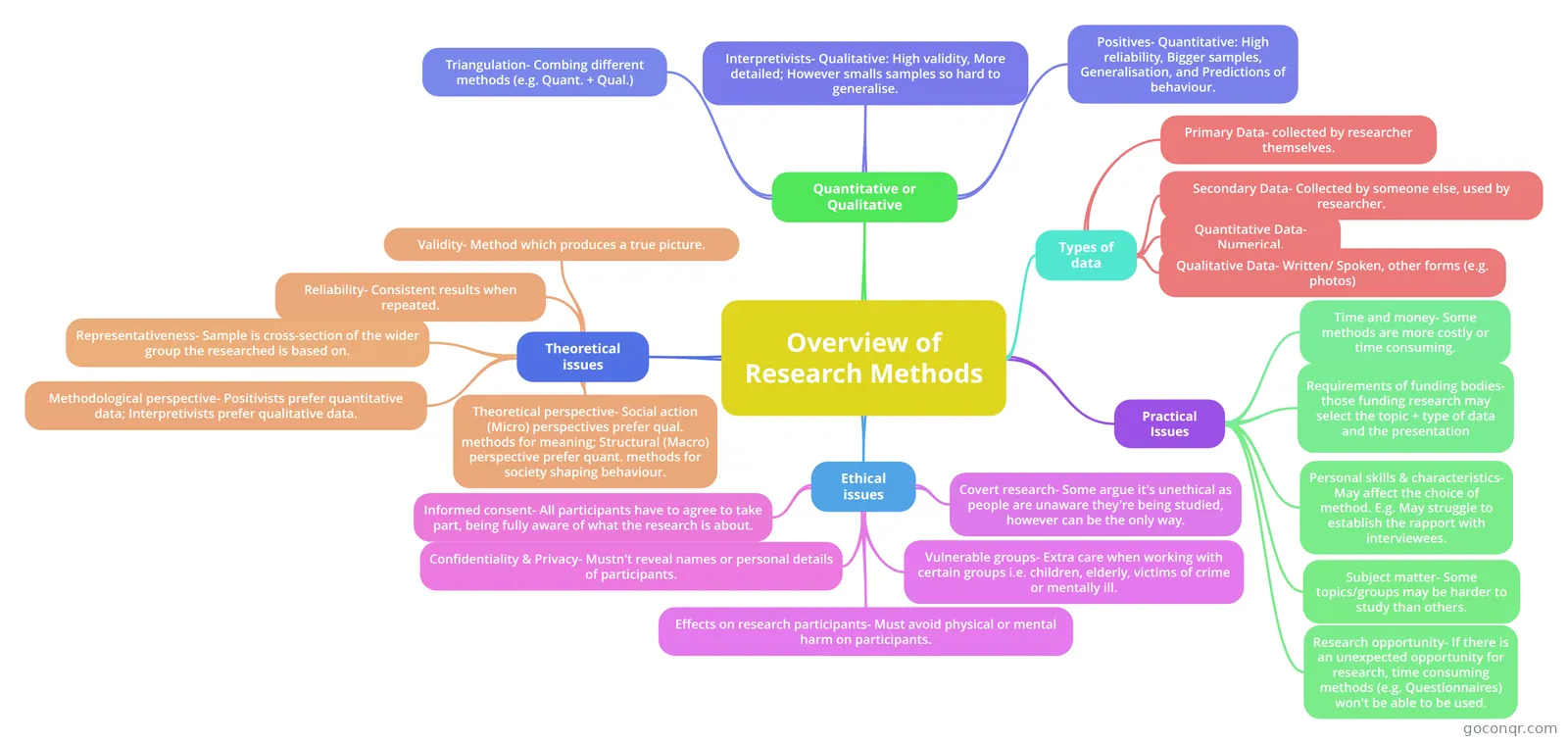
Mind map: overview of research methods
Conteúdo do mapa
Overview of Research Methods
Types of data
- Primary Data- collected by researcher themselves.
- Secondary Data- Collected by someone else, used by researcher.
- Quantitative Data- Numerical.
- Qualitative Data- Written/ Spoken, other forms (e.g. photos)
Practical Issues
- Time and money- Some methods are more costly or time consuming.
- Requirements of funding bodies- those funding research may select the topic + type of data and the presentation
- Personal skills & characteristics- May affect the choice of method. E.g. May struggle to establish the rapport with interviewees.
- Subject matter- Some topics/groups may be harder to study than others.
- Research opportunity- If there is an unexpected opportunity for research, time consuming methods (e.g. Questionnaires) won't be able to be used.
Ethical issues
- Informed consent- All participants have to agree to take part, being fully aware of what the research is about.
- Confidentiality & Privacy- Mustn't reveal names or personal details of participants.
- Effects on research participants- Must avoid physical or mental harm on participants.
- Vulnerable groups- Extra care when working with certain groups i.e. children, elderly, victims of crime or mentally ill.
- Covert research- Some argue it's unethical as people are unaware they're being studied, however can be the only way.
Theoretical issues
- Validity- Method which produces a true picture.
- Reliability- Consistent results when repeated.
- Representativeness- Sample is cross-section of the wider group the researched is based on.
- Methodological perspective- Positivists prefer quantitative data; Interpretivists prefer qualitative data.
- Theoretical perspective- Social action (Micro) perspectives prefer qual. methods for meaning; Structural (Macro) perspective prefer quant. methods for society shaping behaviour.
Quantitative or Qualitative
- Positives- Quantitative: High reliability, Bigger samples, Generalisation, and Predictions of behaviour.
- Interpretivists- Qualitative: High validity, More detailed; However smalls samples so hard to generalise.
- Triangulation- Combing different methods (e.g. Quant. + Qual.)