
Mapa mental
Kant
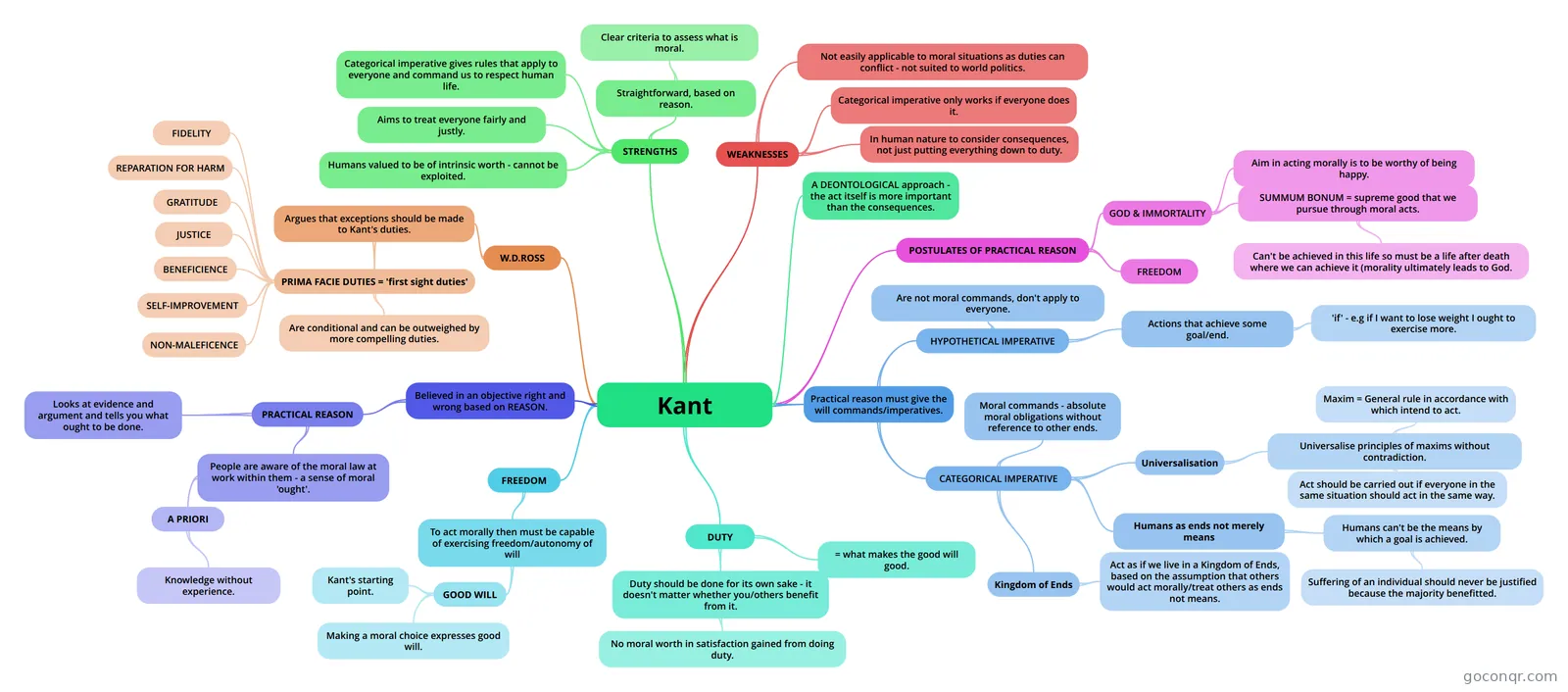
Mind map: Kant ethics
Conteúdo do mapa
Kant
Believed in an objective right and wrong based on REASON.
- PRACTICAL REASON
- Looks at evidence and argument and tells you what ought to be done.
- People are aware of the moral law at work within them - a sense of moral 'ought'.
- A PRIORI
- Knowledge without experience.
- A PRIORI
- PRACTICAL REASON
A DEONTOLOGICAL approach - the act itself is more important than the consequences.
FREEDOM
- To act morally then must be capable of exercising freedom/autonomy of will
- GOOD WILL
- Kant's starting point.
- Making a moral choice expresses good will.
- GOOD WILL
- To act morally then must be capable of exercising freedom/autonomy of will
DUTY
- = what makes the good will good.
- Duty should be done for its own sake - it doesn't matter whether you/others benefit from it.
- No moral worth in satisfaction gained from doing duty.
Practical reason must give the will commands/imperatives.
- HYPOTHETICAL IMPERATIVE
- Are not moral commands, don't apply to everyone.
- Actions that achieve some goal/end.
- 'if' - e.g if I want to lose weight I ought to exercise more.
- CATEGORICAL IMPERATIVE
- Moral commands - absolute moral obligations without reference to other ends.
- Universalisation
- Universalise principles of maxims without contradiction.
- Maxim = General rule in accordance with which intend to act.
- Act should be carried out if everyone in the same situation should act in the same way.
- Universalise principles of maxims without contradiction.
- Humans as ends not merely means
- Humans can't be the means by which a goal is achieved.
- Suffering of an individual should never be justified because the majority benefitted.
- Humans can't be the means by which a goal is achieved.
- Kingdom of Ends
- Act as if we live in a Kingdom of Ends, based on the assumption that others would act morally/treat others as ends not means.
- HYPOTHETICAL IMPERATIVE
POSTULATES OF PRACTICAL REASON
- GOD & IMMORTALITY
- Aim in acting morally is to be worthy of being happy.
- SUMMUM BONUM = supreme good that we pursue through moral acts.
- Can't be achieved in this life so must be a life after death where we can achieve it (morality ultimately leads to God.
- FREEDOM
- GOD & IMMORTALITY
STRENGTHS
- Straightforward, based on reason.
- Clear criteria to assess what is moral.
- Categorical imperative gives rules that apply to everyone and command us to respect human life.
- Aims to treat everyone fairly and justly.
- Humans valued to be of intrinsic worth - cannot be exploited.
- Straightforward, based on reason.
WEAKNESSES
- Not easily applicable to moral situations as duties can conflict - not suited to world politics.
- Categorical imperative only works if everyone does it.
- In human nature to consider consequences, not just putting everything down to duty.
W.D.ROSS
- Argues that exceptions should be made to Kant's duties.
- PRIMA FACIE DUTIES = 'first sight duties'
- FIDELITY
- REPARATION FOR HARM
- GRATITUDE
- JUSTICE
- BENEFICIENCE
- SELF-IMPROVEMENT
- NON-MALEFICENCE
- Are conditional and can be outweighed by more compelling duties.
- PRIMA FACIE DUTIES = 'first sight duties'
- Argues that exceptions should be made to Kant's duties.
Informações
- Descrição
- Ethics Mapa Mental sobre Kant, criado por jenny_allen em 04-05-2013.
- Criado por
- jenny_allen
- Visualizações
- 123
- Tags
- Avaliação