
Mapa mental
Vitamins II
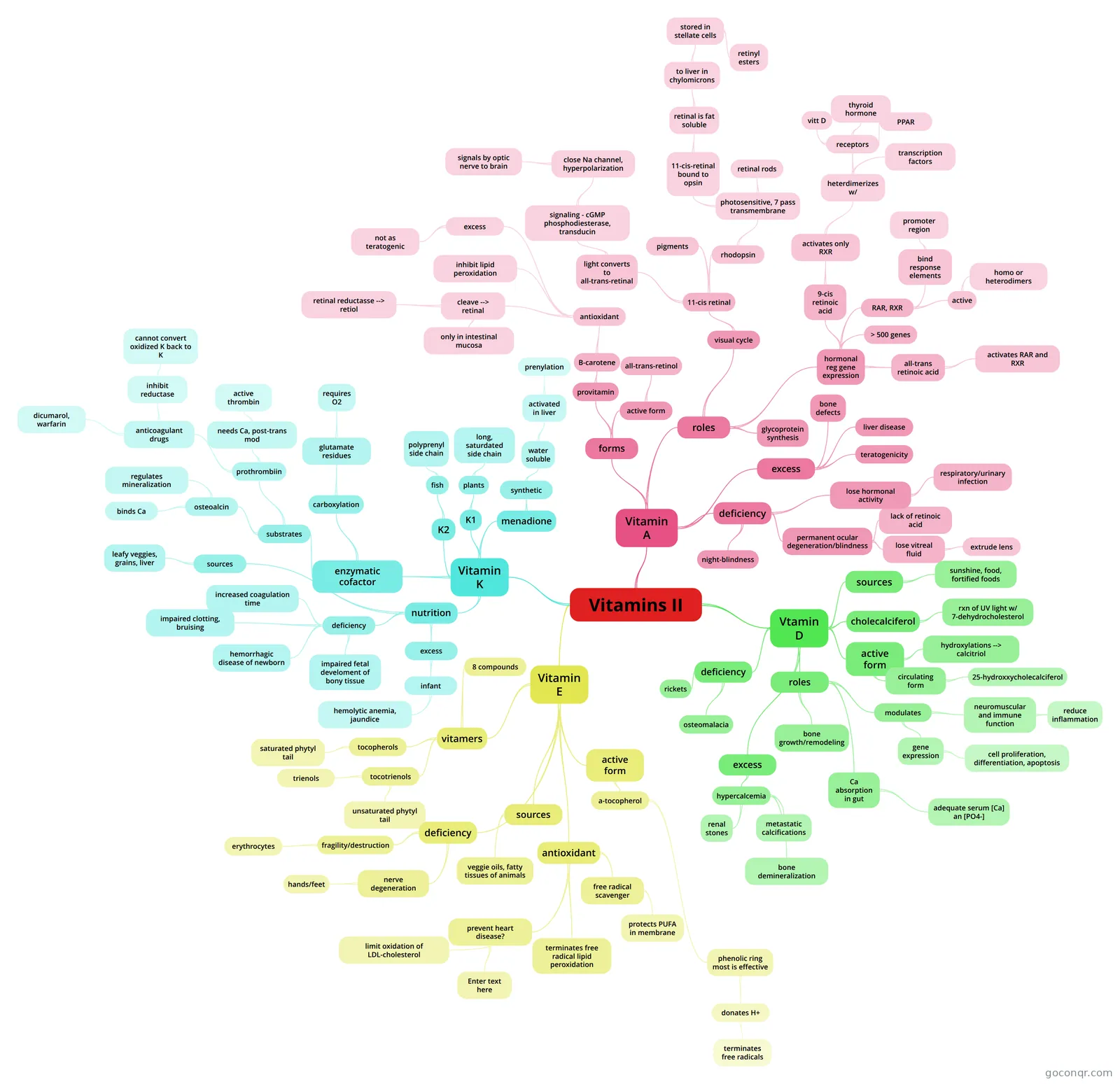
Mind map: Vitamins II
Conteúdo do mapa
Vitamins II
Vitamin K
- K1
- plants
- long, saturdated side chain
- plants
- K2
- fish
- polyprenyl side chain
- fish
- menadione
- synthetic
- water soluble
- activated in liver
- prenylation
- activated in liver
- water soluble
- synthetic
- enzymatic cofactor
- carboxylation
- glutamate residues
- requires O2
- glutamate residues
- substrates
- prothrombiin
- needs Ca, post-trans mod
- active thrombin
- anticoagulant drugs
- dicumarol, warfarin
- inhibit reductase
- cannot convert oxidized K back to K
- needs Ca, post-trans mod
- osteoalcin
- binds Ca
- regulates mineralization
- prothrombiin
- carboxylation
- nutrition
- sources
- leafy veggies, grains, liver
- deficiency
- increased coagulation time
- impaired clotting, bruising
- hemorrhagic disease of newborn
- impaired fetal develoment of bony tissue
- excess
- infant
- hemolytic anemia, jaundice
- infant
- sources
- K1
Vitamin A
- forms
- active form
- all-trans-retinol
- provitamin
- B-carotene
- antioxidant
- cleave --> retinal
- retinal reductasse --> retiol
- only in intestinal mucosa
- excess
- not as teratogenic
- inhibit lipid peroxidation
- cleave --> retinal
- antioxidant
- B-carotene
- active form
- roles
- visual cycle
- 11-cis retinal
- pigments
- rhodopsin
- photosensitive, 7 pass transmembrane
- retinal rods
- 11-cis-retinal bound to opsin
- retinal is fat soluble
- to liver in chylomicrons
- stored in stellate cells
- retinyl esters
- stored in stellate cells
- to liver in chylomicrons
- retinal is fat soluble
- photosensitive, 7 pass transmembrane
- light converts to all-trans-retinal
- signaling - cGMP phosphodiesterase, transducin
- close Na channel, hyperpolarization
- signals by optic nerve to brain
- close Na channel, hyperpolarization
- signaling - cGMP phosphodiesterase, transducin
- 11-cis retinal
- hormonal reg gene expression
- all-trans retinoic acid
- activates RAR and RXR
- 9-cis retinoic acid
- activates only RXR
- heterdimerizes w/
- receptors
- vitt D
- thyroid hormone
- PPAR
- transcription factors
- receptors
- heterdimerizes w/
- activates only RXR
- RAR, RXR
- bind response elements
- promoter region
- active
- homo or heterodimers
- bind response elements
- > 500 genes
- all-trans retinoic acid
- glycoprotein synthesis
- visual cycle
- deficiency
- night-blindness
- permanent ocular degeneration/blindness
- lose vitreal fluid
- extrude lens
- lack of retinoic acid
- lose vitreal fluid
- lose hormonal activity
- respiratory/urinary infection
- excess
- liver disease
- teratogenicity
- bone defects
- forms
Vtamin D
- cholecalciferol
- rxn of UV light w/ 7-dehydrocholesterol
- active form
- hydroxylations --> calcitriol
- circulating form
- 25-hydroxxycholecalciferol
- roles
- Ca absorption in gut
- adequate serum [Ca] an [PO4-]
- bone growth/remodeling
- modulates
- neuromuscular and immune function
- reduce inflammation
- gene expression
- cell proliferation, differentiation, apoptosis
- neuromuscular and immune function
- Ca absorption in gut
- sources
- sunshine, food, fortified foods
- deficiency
- rickets
- osteomalacia
- excess
- hypercalcemia
- metastatic calcifications
- bone demineralization
- renal stones
- hypercalcemia
- cholecalciferol
Vitamin E
- vitamers
- 8 compounds
- tocopherols
- saturated phytyl tail
- tocotrienols
- trienols
- unsaturated phytyl tail
- active form
- a-tocopherol
- phenolic ring most is effective
- donates H+
- terminates free radicals
- donates H+
- phenolic ring most is effective
- a-tocopherol
- sources
- veggie oils, fatty tissues of animals
- antioxidant
- free radical scavenger
- protects PUFA in membrane
- terminates free radical lipid peroxidation
- prevent heart disease?
- limit oxidation of LDL-cholesterol
- Enter text here
- free radical scavenger
- deficiency
- fragility/destruction
- erythrocytes
- nerve degeneration
- hands/feet
- fragility/destruction
- vitamers
Informações
- Descrição
- Biochemistry Mapa Mental sobre Vitamins II, criado por hardinbc em 05-05-2013.
- Criado por
- hardinbc
- Visualizações
- 147
- Tags
- Avaliação