
Mapa mental
Statutory interpretation
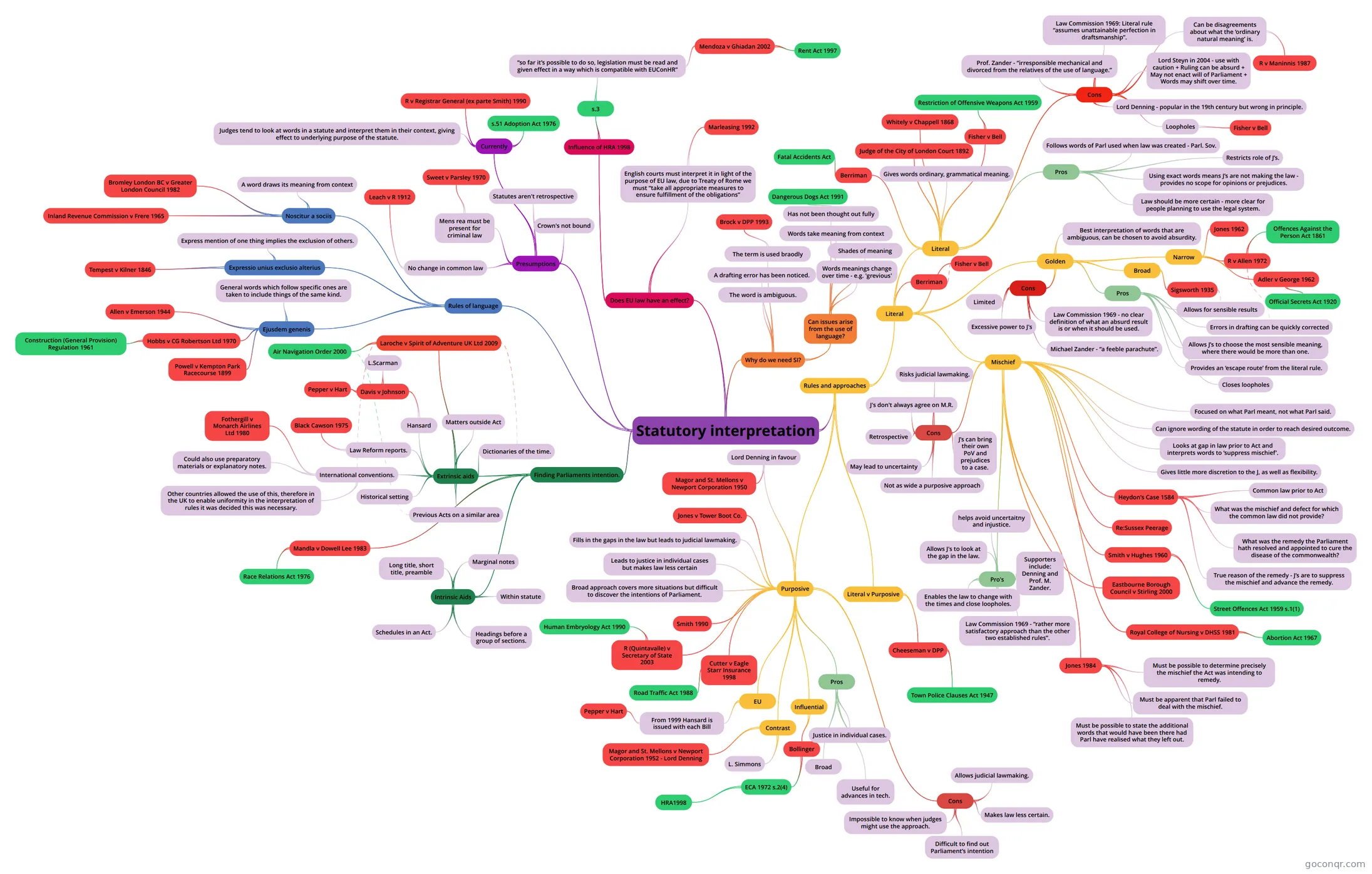
Mind map: Statutory interpretation
Conteúdo do mapa
Statutory interpretation
Why do we need SI?
- The term is used braodly
- Brock v DPP 1993
- The word is ambiguous.
- A drafting error has been noticed.
- Can issues arise from the use of language?
- Words take meaning from context
- Shades of meaning
- Words meanings change over time - e.g. 'grevious'
- Has not been thought out fully
- Dangerous Dogs Act 1991
- The term is used braodly
Rules and approaches
- Literal
- Literal
- Berriman
- Fatal Accidents Act
- Gives words ordinary, grammatical meaning.
- Judge of the City of London Court 1892
- Whitely v Chappell 1868
- Fisher v Bell
- Restriction of Offensive Weapons Act 1959
- Pros
- Follows words of Parl used when law was created - Parl. Sov.
- Using exact words means J’s are not making the law - provides no scope for opinions or prejudices.
- Restricts role of J’s.
- Law should be more certain - more clear for people planning to use the legal system.
- Cons
- Prof. Zander - “irresponsible mechanical and divorced from the relatives of the use of language.”
- Law Commission 1969: Literal rule “assumes unattainable perfection in draftsmanship”.
- Lord Steyn in 2004 - use with caution + Ruling can be absurd + May not enact will of Parliament + Words may shift over time.
- Lord Denning - popular in the 19th century but wrong in principle.
- Can be disagreements about what the ‘ordinary natural meaning’ is.
- R v Maninnis 1987
- Loopholes
- Fisher v Bell
- Berriman
- Golden
- Best interpretation of words that are ambiguous, can be chosen to avoid absurdity.
- Narrow
- Jones 1962
- R v Allen 1972
- Offences Against the Person Act 1861
- Adler v George 1962
- Official Secrets Act 1920
- Broad
- Sigsworth 1935
- Pros
- Provides an ‘escape route’ from the literal rule.
- Allows J’s to choose the most sensible meaning, where there would be more than one.
- Allows for sensible results
- Closes loopholes
- Errors in drafting can be quickly corrected
- Cons
- Law Commission 1969 - no clear definition of what an absurd result is or when it should be used.
- Limited
- Excessive power to J's
- Michael Zander - “a feeble parachute”.
- Mischief
- Looks at gap in law prior to Act and interprets words to ‘suppress mischief’.
- Focused on what Parl meant, not what Parl said.
- Can ignore wording of the statute in order to reach desired outcome.
- Gives little more discretion to the J, as well as flexibility.
- Heydon's Case 1584
- Common law prior to Act
- What was the mischief and defect for which the common law did not provide?
- What was the remedy the Parliament hath resolved and appointed to cure the disease of the commonwealth?
- True reason of the remedy - J’s are to suppress the mischief and advance the remedy.
- Re:Sussex Peerage
- Smith v Hughes 1960
- Street Offences Act 1959 s.1(1)
- Eastbourne Borough Council v Stirling 2000
- Royal College of Nursing v DHSS 1981
- Abortion Act 1967
- Jones 1984
- Must be possible to determine precisely the mischief the Act was intending to remedy.
- Must be apparent that Parl failed to deal with the mischief.
- Must be possible to state the additional words that would have been there had Parl have realised what they left out.
- Pro's
- helps avoid uncertaitny and injustice.
- Allows J's to look at the gap in the law.
- Enables the law to change with the times and close loopholes.
- Law Commission 1969 - “rather more satisfactory approach than the other two established rules”.
- Supporters include: Denning and Prof. M. Zander.
- Cons
- Risks judicial lawmaking.
- J's don't always agree on M.R.
- May lead to uncertainty
- Not as wide a purposive approach
- Retrospective
- J’s can bring their own PoV and prejudices to a case.
- Fisher v Bell
- Berriman
- Literal
- Purposive
- Lord Denning in favour
- Magor and St. Mellons v Newport Corporation 1950
- Jones v Tower Boot Co.
- Leads to justice in individual cases but makes law less certain
- Fills in the gaps in the law but leads to judicial lawmaking.
- Broad approach covers more situations but difficult to discover the intentions of Parliament.
- Smith 1990
- Cutter v Eagle Starr Insurance 1998
- Road Traffic Act 1988
- R (Quintavalle) v Secretary of State 2003
- Human Embryology Act 1990
- EU
- From 1999 Hansard is issued with each Bill
- Pepper v Hart
- From 1999 Hansard is issued with each Bill
- Contrast
- Magor and St. Mellons v Newport Corporation 1952 - Lord Denning
- L. Simmons
- Influential
- Bollinger
- ECA 1972 s.2(4)
- HRA1998
- ECA 1972 s.2(4)
- Bollinger
- Pros
- Justice in individual cases.
- Broad
- Useful for advances in tech.
- Cons
- Makes law less certain.
- Allows judicial lawmaking.
- Difficult to find out Parliament’s intention
- Impossible to know when judges might use the approach.
- Lord Denning in favour
- Literal v Purposive
- Cheeseman v DPP
- Town Police Clauses Act 1947
- Cheeseman v DPP
- Literal
Finding Parliaments intention.
- Intrinsic Aids
- Within statute
- Long title, short title, preamble
- Headings before a group of sections.
- Schedules in an Act.
- Marginal notes
- Extrinsic aids
- Matters outside Act
- Previous Acts on a similar area
- Historical setting
- Dictionaries of the time.
- Hansard
- Davis v Johnson
- Pepper v Hart
- L.Scarman
- Davis v Johnson
- Law Reform reports.
- Black Cawson 1975
- International conventions.
- Fothergill v Monarch Airlines Ltd 1980
- Could also use preparatory materials or explanatory notes.
- Other countries allowed the use of this, therefore in the UK to enable uniformity in the interpretation of rules it was decided this was necessary.
- Laroche v Spirit of Adventure UK Ltd 2009
- Air Navigation Order 2000
- Mandla v Dowell Lee 1983
- Race Relations Act 1976
- Intrinsic Aids
Rules of language
- Ejusdem genenis
- Powell v Kempton Park Racecourse 1899
- Hobbs v CG Robertson Ltd 1970
- Construction (General Provision) Regulation 1961
- Allen v Emerson 1944
- General words which follow specific ones are taken to include things of the same kind.
- Expressio unius exclusio alterius
- Tempest v Kilner 1846
- Express mention of one thing implies the exclusion of others.
- Noscitur a sociis
- Inland Revenue Commission v Frere 1965
- Bromley London BC v Greater London Council 1982
- A word draws its meaning from context
- Ejusdem genenis
Presumptions
- No change in common law
- Leach v R 1912
- Mens rea must be present for criminal law
- Sweet v Parsley 1970
- Statutes aren't retrospective
- Crown's not bound
- Currently
- Judges tend to look at words in a statute and interpret them in their context, giving effect to underlying purpose of the statute.
- R v Registrar General (ex parte Smith) 1990
- s.51 Adoption Act 1976
- No change in common law
Does EU law have an effect?
- English courts must interpret it in light of the purpose of EU law, due to Treaty of Rome we must “take all appropriate measures to ensure fulfillment of the obligations”
- Marleasing 1992
- Influence of HRA 1998
- s.3
- “so far it’s possible to do so, legislation must be read and given effect in a way which is compatible with EUConHR”
- Mendoza v Ghiadan 2002
- Rent Act 1997
- Mendoza v Ghiadan 2002
- “so far it’s possible to do so, legislation must be read and given effect in a way which is compatible with EUConHR”
- s.3
- English courts must interpret it in light of the purpose of EU law, due to Treaty of Rome we must “take all appropriate measures to ensure fulfillment of the obligations”
Informações
- Descrição
- A level Law (Legislation) Mapa Mental sobre Statutory interpretation, criado por Joy Lewry em 10-02-2017.
- Criado por
- Joy Lewry
- Visualizações
- 14
- Avaliação