Mapa mental
Human Memory

Conteúdo do mapa
Human Memory
Encoding- forming a memory code
- Attention- focusing awareness on a narrowed range of stimuli or events. Selective attention is critical to everyday functioning
- Acts as a filter to screen stimuli into conscious awareness
- High-load tasks consume our attention spans early, whereas simpler tasks allows for later processing
- Human brains can effectively handle one task at a time
- Levels-of-processing theory- deeper levels of processing result in longer-lasting memory codes
- Elaboration- linking a stimulus to other information at the time of encoding
- Visual Imagery- creating images to represent words remembered
- Dual coding theory- memory is enhanced by forming semantic and visual codes
- Mental imagery can help with memory
- Dual coding theory- memory is enhanced by forming semantic and visual codes
- Visual Imagery- creating images to represent words remembered
- Self- referent encoding- deciding how or whether information is relevant
- How information affects one personally
- Attention- focusing awareness on a narrowed range of stimuli or events. Selective attention is critical to everyday functioning
Storage- maintaining encoded information in your memory over time
- Sensory Memory- preserves information in its original sensory form for a brief time
- Allows the sensation of visual pattern, sound, or touch to linger for a moment after the stimulus is over
- People perceive an afterimage instead of the actual stimulus
- Allows the sensation of visual pattern, sound, or touch to linger for a moment after the stimulus is over
- Short-term memory- limited capacity store that can retain information for up to 20 seconds
- Rehearsal- the process of repetitively verbalizing or thinking about the information
- Working memory is a limited capacity storage system that maintains and stores information by providing an interface between perception, memory, and action
- Working memory capacity is one's ability to hold and manipulate info in conscious attention
- A chunk is a group of familiar stimuli stored as a single unit
- Long term memory is an unlimited capacity store that can hold information over a long time
- Clustering- it is easier to remember similar and related items in a group
- Schema- organized cluster of knowledge about a particular object or event abstracted from previous experience with that object or event
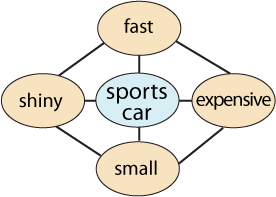
- Semantic network- nodes representing concepts joined together by pathways that link related concepts
- Sensory Memory- preserves information in its original sensory form for a brief time
Retrieval- recovering information from memory stores
- Tip-of-the-tongue phenomenon- temporary inability to remember something you know, with a feeling that it is out of reach
- Misinformation effect- occurs when participants recall of an event they witnessed is altered by introducing misleading post event info
- Reality monitoring- process of deciding whether memories are based on external sources or internal sources
- Source monitoring- making attributions about the origins of memories
- Source-monitoring error occurs when a memory derived from one source is misattributed to another source
- Destination memory involves recalling to whom one has told what
- Source-monitoring error occurs when a memory derived from one source is misattributed to another source
- Source monitoring- making attributions about the origins of memories
- Tip-of-the-tongue phenomenon- temporary inability to remember something you know, with a feeling that it is out of reach
Forgetting- adaptive way to remove unneeded information
- Retention- proportion of material retained
- A recall measure of retention requires subjects to reproduce information on their own without a cue
- A recognition measure of retention requires subjects to select previously learned information from an array of options
- A relearning measure of retention requires a subject to memorize information a second time to determine how much time or how many practice trials are saved by having already learned it
- A recognition measure of retention requires subjects to select previously learned information from an array of options
- A recall measure of retention requires subjects to reproduce information on their own without a cue
- Decay theory- forgetting occurs because memory traces fade with time
- Interference theory- people forget info because of competition from other material
- Retroactive interference occurs when new info impairs the retention of previously learned information
- Proactive interference occurs when previously learned info interferes with the retention of new info
- Transfer-appropriate processing- when the initial processing of info is similar to the type of processing required by the subsequent measure of retention
- Consolidation- process involving the gradual conversion of info into memory codes stored in long term memory
- Retroactive interference occurs when new info impairs the retention of previously learned information
- Interference theory- people forget info because of competition from other material
- Repression- keeping distressing thoughts and feelings buried in the unconscious
- Retention- proportion of material retained
Consolidation- process involving the gradual conversion of info into memory codes stored in long term memory
- Implicit memory is apparent when retention is exhibited on a task that does not require intentional remembering
- Explicit memory- involves intentional recollection of previous experiences
- Declarative memory, episodic memory, semantic memory, prospective memory, retrospective memory