
Mapa mental
Maintaining Biodiversity
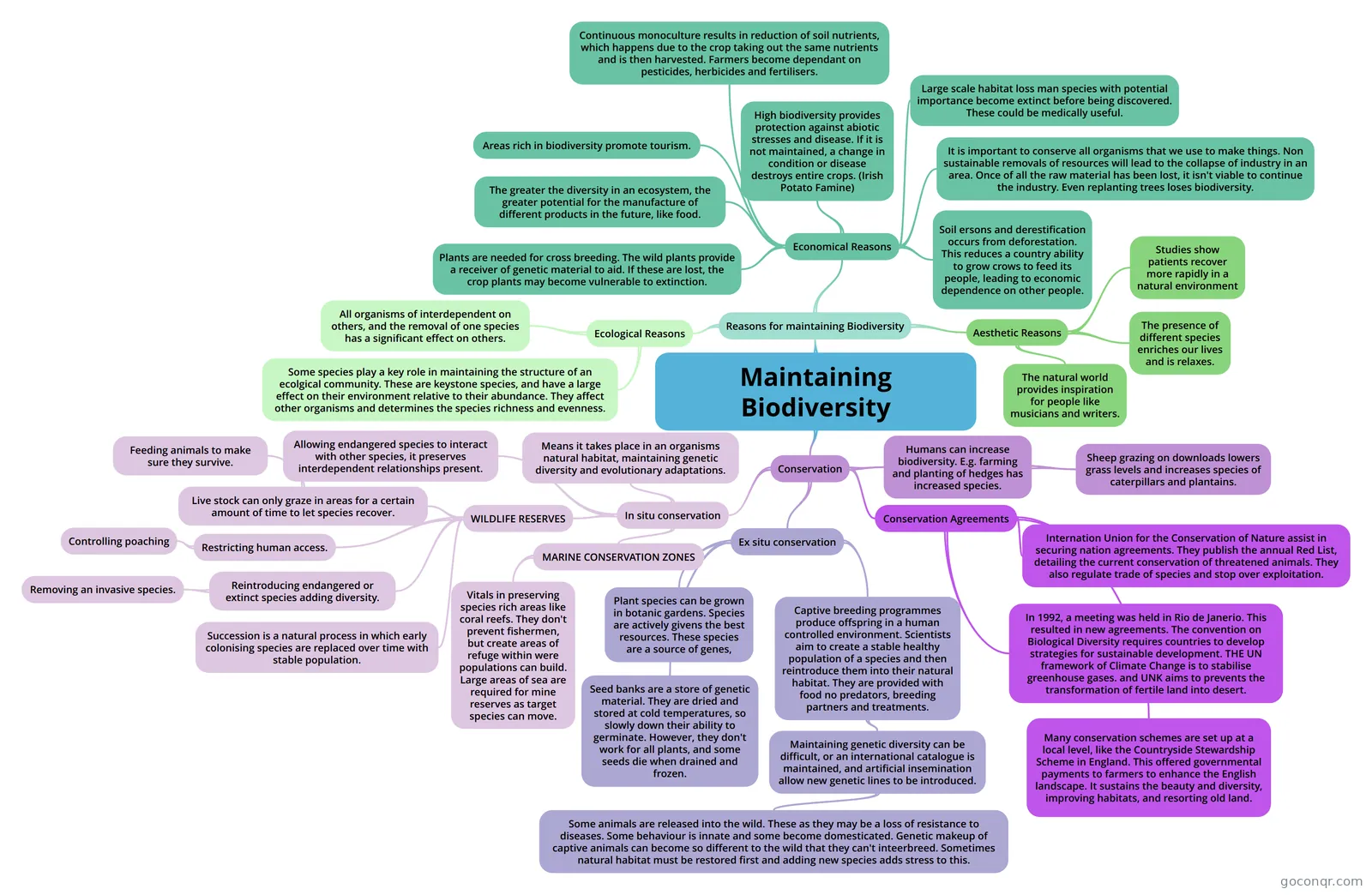
Mind map: Maintaining biodiversity
Conteúdo do mapa
Maintaining Biodiversity
Conservation
- In situ conservation
- Means it takes place in an organisms natural habitat, maintaining genetic diversity and evolutionary adaptations.
- Allowing endangered species to interact with other species, it preserves interdependent relationships present.
- WILDLIFE RESERVES
- Live stock can only graze in areas for a certain amount of time to let species recover.
- Feeding animals to make sure they survive.
- Restricting human access.
- Controlling poaching
- Reintroducing endangered or extinct species adding diversity.
- Removing an invasive species.
- Succession is a natural process in which early colonising species are replaced over time with stable population.
- Live stock can only graze in areas for a certain amount of time to let species recover.
- MARINE CONSERVATION ZONES
- Vitals in preserving species rich areas like coral reefs. They don't prevent fishermen, but create areas of refuge within were populations can build. Large areas of sea are required for mine reserves as target species can move.
- Ex situ conservation
- Plant species can be grown in botanic gardens. Species are actively givens the best resources. These species are a source of genes,
- Seed banks are a store of genetic material. They are dried and stored at cold temperatures, so slowly down their ability to germinate. However, they don't work for all plants, and some seeds die when drained and frozen.
- Captive breeding programmes produce offspring in a human controlled environment. Scientists aim to create a stable healthy population of a species and then reintroduce them into their natural habitat. They are provided with food no predators, breeding partners and treatments.
- Maintaining genetic diversity can be difficult, or an international catalogue is maintained, and artificial insemination allow new genetic lines to be introduced.
- Some animals are released into the wild. These as they may be a loss of resistance to diseases. Some behaviour is innate and some become domesticated. Genetic makeup of captive animals can become so different to the wild that they can't inteerbreed. Sometimes natural habitat must be restored first and adding new species adds stress to this.
- Maintaining genetic diversity can be difficult, or an international catalogue is maintained, and artificial insemination allow new genetic lines to be introduced.
- Conservation Agreements
- Internation Union for the Conservation of Nature assist in securing nation agreements. They publish the annual Red List, detailing the current conservation of threatened animals. They also regulate trade of species and stop over exploitation.
- In 1992, a meeting was held in Rio de Janerio. This resulted in new agreements. The convention on Biological Diversity requires countries to develop strategies for sustainable development. THE UN framework of Climate Change is to stabilise greenhouse gases. and UNK aims to prevents the transformation of fertile land into desert.
- Many conservation schemes are set up at a local level, like the Countryside Stewardship Scheme in England. This offered governmental payments to farmers to enhance the English landscape. It sustains the beauty and diversity, improving habitats, and resorting old land.
- Humans can increase biodiversity. E.g. farming and planting of hedges has increased species.
- Sheep grazing on downloads lowers grass levels and increases species of caterpillars and plantains.
- In situ conservation
Reasons for maintaining Biodiversity
- Aesthetic Reasons
- The presence of different species enriches our lives and is relaxes.
- The natural world provides inspiration for people like musicians and writers.
- Studies show patients recover more rapidly in a natural environment
- Economical Reasons
- Soil ersons and derestification occurs from deforestation. This reduces a country ability to grow crows to feed its people, leading to economic dependence on other people.
- It is important to conserve all organisms that we use to make things. Non sustainable removals of resources will lead to the collapse of industry in an area. Once of all the raw material has been lost, it isn't viable to continue the industry. Even replanting trees loses biodiversity.
- Large scale habitat loss man species with potential importance become extinct before being discovered. These could be medically useful.
- Continuous monoculture results in reduction of soil nutrients, which happens due to the crop taking out the same nutrients and is then harvested. Farmers become dependant on pesticides, herbicides and fertilisers.
- High biodiversity provides protection against abiotic stresses and disease. If it is not maintained, a change in condition or disease destroys entire crops. (Irish Potato Famine)
- Areas rich in biodiversity promote tourism.
- The greater the diversity in an ecosystem, the greater potential for the manufacture of different products in the future, like food.
- Plants are needed for cross breeding. The wild plants provide a receiver of genetic material to aid. If these are lost, the crop plants may become vulnerable to extinction.
- Ecological Reasons
- All organisms of interdependent on others, and the removal of one species has a significant effect on others.
- Some species play a key role in maintaining the structure of an ecolgical community. These are keystone species, and have a large effect on their environment relative to their abundance. They affect other organisms and determines the species richness and evenness.
- Aesthetic Reasons
Informações
- Descrição
- A level Biology (11 - BIODIVERSITY ) Mapa Mental sobre Maintaining Biodiversity, criado por Molly Butcher em 26-03-2017.
- Criado por
- Molly Butcher
- Visualizações
- 2
- Avaliação
Mais sobre Biodiversity conservation methods