
Mapa mental
B2 Topic 1

Conteúdo do mapa
B2 Topic 1
Cells
- Make up organisms -- can be animal, plant or bacterial.
- Animal
- Plant
- Chloroplasts
- Organelles that contain chlorophyll, a green substance that absorbs light energy for photosynthesis.
- Large vacuole
- A space in the cytoplasm that is filled with cell sap and helps to support the plant by keeping the cells rigid.
- Chloroplasts
- Bacteria
- Flagella
- Long, whip-like structures that bacteria can use to move themselves along in liquid.
- Chromosonal DNA
- A giant loop of DNA containing most of the genetic material.
- Plasmid DNA
- Comes in small loops and carries extra information.
- Flagella
- Cytoplasm
- Where many chemical reactions needed to carry out life processes take place; contains organelles (tiny structures that carry out specific jobs).
- Cell membrane
- Separates the contents of the cell and its surroundings; controls movement of substances (O2, C6H12O6, CO2 etc) into and out of the cell.
- Nucleus
- An organelle containing chromosomes, which are made up of DNA (genetic material); controls all activities of the cell.
- Mitochondria
- Organelles in which respiration occurs; very tiny and cannot be seen easily through a light microscope at low magnification.
- Cell wall
- In plant cells, the cell wall is made of tough cellulose to support the cell and allow it to keep its shape.
Magnification
- magnification = size of the image / size of the object 1cm = 10mm 1mm = 1000μm (micrometre)
- Microscopes
- Allows us to see objects that may not be visible to the human eye in great detail.
- Light microscopes
- Pass a beam of light through the cells.
- Electron microscopes
- Pass a beam of electrons through the cells; more detailed than light microscopes.
- Resolving power
- The greater the resolving power of a microscope, the clearer the image it forms. Electron microscopes have better resolving power than light microscopes. resolving power = wavelength / 2
DNA
- Deoxyribonucleic acid. One molecule consists of two strands of repeating units called nucleotides. These are twisted into a double helix, saving space for more information.
- Nucleotides
- Many of these join together to form a monomer.
- Extraction
- - Detergent/salt mixture used to break up membrane of cells and release chromosomes. - Protein-digesting enzyme used to break down the protein part of the chromosomes, releasing their DNA. - Cold methanol added to precipitate the DNA; the DNA will float between the layers of water and ethanol.
- Function
- Hereditary material responsible for passing genetic information from cell to cell. - Function is to code for proteins. Not all of the DNA molecule codes for protein. - The functional part of the DNA that can is called the gene.
- Discovery
- - Rosalind Franklin in the early 1950s showed that phosphate groups of DNA must lie on the outside of molecules. - Watson and Crick put foward the possible structure of the DNA in 1953. They were awarded a Nobel Prize in 1962.
- Polynucleotides
- DNA is a polymer of mononucleotides. Mononucleotides join together between the phosphate group the adjoining nucleotide.
- Sugar and phosphate units make up the backbone.
- Base pairing
- There are 4 different bases: guanine (G), cytosine (C), adenine (A) and thymine (T). G pairs with C and A pairs with T. - The two strands of the double helix are held together by hydrogen bonds between the bases. - Hydrogen bonds are singularly very weak but collectively they can be very strong.
- Adaptions
- - Stable. - Two strands can separate so it can self-duplicate. - Large molecules will carry lots of information. - Base pairing prevents corruption from outside chemicals or physical forces.
- Replication
- - DNA unwinds. - Enzyme splits the two strands. - Free nucleotides attracted to complementary base pair. - Sugar phosphate backbone is rejoined by DNA polymerase. - 2 identical strands are formed -- the strands each contain half of the original material (semi-conservative method of replication).
- When does it need to?
- - Before a cell divides DNA is replicated. - This occurs during the interphase of mitosis and meiosis. - This is so when a cell divides the two daughter cells will contain the correct amount of genetic information.
- Genetic code
- The sequences of three bases is called a codon. Each codon specifies a particular amino acid. This genetic code is universal in the cells of all living things.
- RNA
- Ribonucleic acid. Structurally different to DNA in 3 ways: - No double helix. - Urasil (U) base. - No thymine (T) base.
- Transcription
- The process in which a copy of DNA is made, which is known as mRNA. This occurs in the nucleus of the cell.
- Process
- - The DNA in the nucleus is first unwound. - The weak hydrogen bonds between the bases are broken. - The phosphate backbone remains intact. - This causes 2 DNA strands to separate -- double helix split. - Free RNA nucleotides in the nucleoplasm find their complimentary base pair on the DNA. - A hydrogen bond forms between the RNA nucleotide base and the complementary base on the DNA. - The enzyme RNA polymerase then catalyses the formation of the strong chemical bond between the ribose sugar and phosphate groups of adjoining RNA nucleotides -- phosphate backbone reforms. - mRNA is formed. - Hydrogen bonds between the bases in mRNA and the bases on DNA break. - The mRNA is ready to make its journey out of the nucleus and into the cytoplasm. - Hydrogen bonds between complementary bases on DNA reform and the DNA is wound back into a double helix.
Human Genome Project
- What is it?
- - International scientific research project; 18 countries -- US, UK, Japan, France, China, Germany, India, Canada etc. - £3 billion project. - 13 years long (1990 -- 2003). - Collected blood (female) and sperm (male).
- Ethical / moral issues
- - Fairness in the use of genetic information. - Privacy and confidentiality. - Psychological impact and stigmatisaion. - Reproductive issues. - Ethical issues. - Uncertainties. - Conceptual and philosophical implications. - Health and environmental issues. - Commercialisation of products.
- Aims
- - Identify all the approximately 20,000 -- 25,000 genes in human DNA. - Determine sequences of 3 billion chemical base pairs that make up human DNA. - Store information in databases. - Improve tools for better analysis. - Transfer related technologies to the private sector. - Address the ethical, legal and social issues (ELSI) that may arise from the project.
- Benefits
- - Better medical management of genetic disorders -- 3000 disorders. - Better diagnostic tools. - Gene therapy. - Pharmacogenomics. - Discovery of new genes. - Insight into molecular evolution. - Improved technology. - Energy sources -- biofuels. - Carbon sequestration. - Forensics. - Personalised medicines.
- What is it?
Genetic Engineering
- Modern uses
- - Manufacturing insulin. - Finding out where genes are expressed in the body. - Crops resistant to disease. - Crops which produce a greater yield.
- Manufacturing insulin
- 1. DNA taken from human cell. 2. Restriction enzyme used to cut out the gene for insulin from the DNA. 3. Lysozyme enzyme used to cut out the plasmid from a bacterial cell. 4. Same restriction enzyme used to cut a section of DNA from the plasmid. 5. Gene for insulin inserted into the plasmid. 6. Ligase enzyme used to join the ends of the DNA. 7. Plasmid with the insulin put back into the bacterial cell. 8. Bacteria left to divide and reproduce, producing insulin. 9. Insulin removed and purified. 10. Insulin ready for human use.
- Gene splicing
- The process of cutting out a gene from the DNA of one organism and inserting it into the DNA of another organism.
- Modern uses
Mitosis and Meiosis
- Cell division
- When parent cells divide, new daughter cells are formed. All complete organisms originated from a single egg. Every cell in your body started here. Through cell division, the numbers are increased. Cells then specialise and change into their various cells.
- A stem cell is a cell that has not yet been assigned a specific purpose.
- Mitosis
- Mitosis results in two daughter cells with identical chromosomes to the parent cells. If the parent cells have two sets of chromosomes (diploid) then the daughter cells will also be diploid. Mitosis is used in order for organisms to: - repair damage: damaged or old skin cells are replaces by mitosis with identical new cells. - grow: the mass of a plant root increases because the existing root cells produce more by mitosis. Asexual reproduction also happens via mitosis. It involves only one parent, which produces new cells to form offspring. The offspring are therefore genetically identical to each other and the parent. They are clones.
- 1. Interphase
- - DNA replicates. - Cells enter reproductive cycle.
- 2. Prophase
- - DNA super coils and chromosomes become visible. - Nuclear membrane breaks down. - Centrosomes migrate to poles.
- 3. Metaphase
- - Chromosomes line up centromeres on equator of cell. - Centrosomes form spinelles.
- 4. Anaphase
- - Spindles 'grip' centromeres and chromosomes migrate to poles.
- 5. Telephase
- - Nuclear membranes reform. - Chromosomes disperse. - Cytokineses (cell splitting) begins.
- Meiosis
- The process by which sex cells (gametes) are produced. It only occurs in the gonads. Instead of producing 2 identical daughter cells, meiosis produces 4 non-identical daughter cells, each with only half of the number of chromosomes (23 instead of 46 -- 23 pairs -- in humans). This results in genetically different haploid gametes.
- 1. This cell has four chromosomes in two pairs. 2. The chromosomes replicate themselves, resulting in chromosomes with two identical strands called chromatids. 3. Each chromosome pairs up with its corresponding partner along the centre of the cell. 4. The pairs of chromosome copies exchange pieces of DNA with one. 5. The cell divides in two. 6. Another division takes place, where the chromatids are split in half. Each daughter cell receives different chromosomes. This results in gametes that are haploid and genetically different from one another.
- Chromosomes
- - Each DNA strand is split into chromosomes. - All sexually reproducing animals have pairs of chromosomes. One set of each pair comes from each parent.
- Reproduction
- Gametes
- - Have half the number of chromosomes of a normal cell. - So normal cells have 46 chromosomes -- this full double set is called diploid. - Gametes only have half the number of chromosomes -- this is haploid.
- Zygote
- - During fertilisation the gametes (eggs and sperm) fuse together to form a zygote. - So gametes fuse into a zygote and a zygote develops into an embryo. - During sexual reproduction the gametes are produced by another type of cell division called meiosis.
- Gametes
- Cell division
Cloning
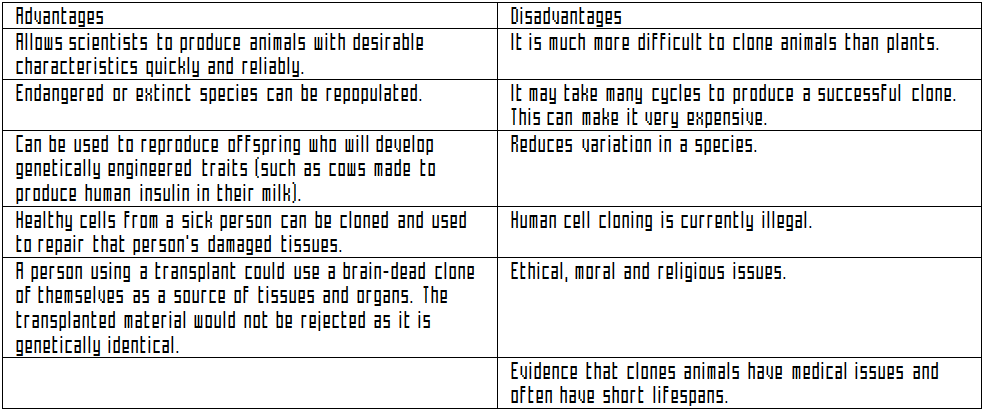
- The goal of cloning is to take control of the reproductive processes. Scientists are able to select the specific combination of genes to quickly and reliably produce organisms with desirable characteristics. Modern cloning techniques include: - Adult cell cloning (also known as Fusion Cell Cloning or Reproductive Cloning). - Embryo cloning. It appeals to: - Animal breeders. - Farmers. - Parents with ill children. - People wanting to clone pets. - The army.
- Vegetative reproduction
- - In flowering plants, parts of the root, leaf or stem can grow into new plants. This type of asexual reproduction is called vegetative reproduction. - It produces new plants which are genetically identical (clones) to the parent plant. This is useful to gardeners and farmers who want stocks of plants with preferred characteristics such as disease resistance, fruit colour, flower shape and so on. - A simple type of vegetative reproduction is to take cuttings.
- 1. A small length of stem is cut off a healthy plant (the parent plant). This stem should have leaves on it. 2. The end of the cut stem is dipped into hormone rooting powder. 3. The stem is put into a flowerpot full of damp compost. 4. The pot is covered with a plastic bag to keep it moist. 5. A new plant will grow.
- Tissue culture
- - Tissue culture is a process that involves cutting small pieces of tissue from the parent that is to be cloned. - The pieces are grown in a sterile liquid or gel, which provides all the substances needed for their development.
- Animal Cloning
- Dolly the Sheep
Imagens e arquivos do mapa


Informações
- Descrição
- GCSE Science (Biology 2) Mapa Mental sobre B2 Topic 1, criado por Katie Holland em 09-04-2017.
- Criado por
- Katie Holland
- Visualizações
- 28
- Tags
- Avaliação