
Mapa mental
Cells, Tissues and Organs
Conteúdo do mapa
Cells, Tissues and Organs
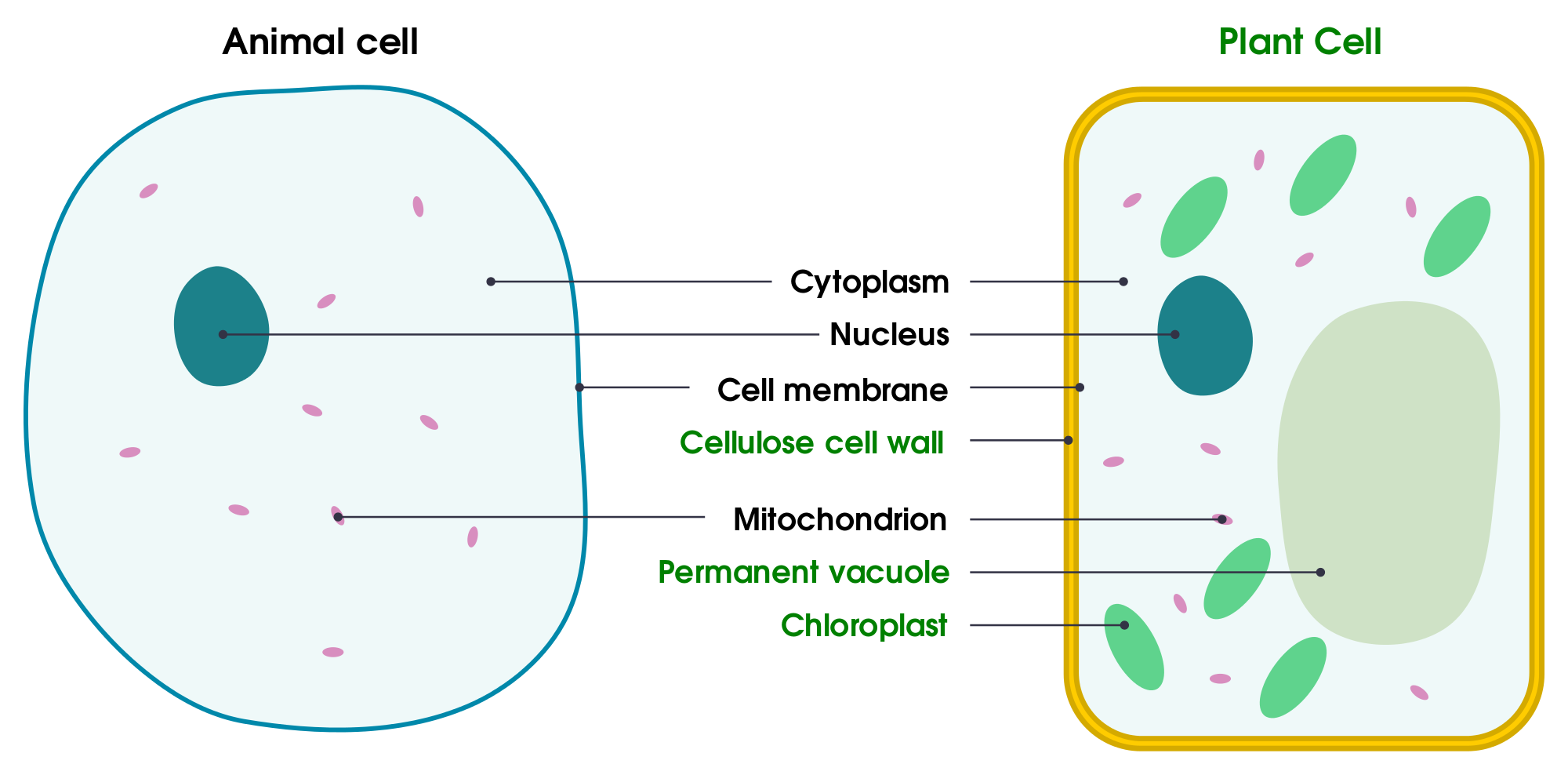
Animal and Plant Cells
- Most human cells, like most animal cells contain a nucleus, cytoplasm, cell membrane, mitochocondria and ribsomes.
- Plant and algal cells contain everything in an animal cell, plus many also contain chloroplasts and a permanent vacuole filled with sap.
- Plant cells are different because they have different functions
- KEYWORDS
- Nucleus
- Cytoplasam
- Cell Membrane
- Mitochondria
- Ribsomes
- The site of protein synthesis in a cell
- Protein
- Algal Cell
- The cell of algae, single celled or simple multicellular organisms, which can photosynthesis but it is not a plant
- Cell Wall
- A rigid structure which surrounds the cells of living organisms apart from animals
- Chlorophyll
- Vacuole
Specialised Cells
- Cells are specialised to carry out a particular function, e.g. fat cells, cone cells, root hair cells and sperm cells.
- If a cell has many ribsomes it is making a lot of protein, e.g. Gland Cells which produce enzymes.
- Receptor cells have special structures which enable them to detect stimuli, e.g. the cone cells in the eye are light sensetive
- Neutrons are specialised to carry impulses from receptors to the CNS
- CNS = Centeral Nervous System
- Plant cells with many chloroplasts will be photosynthesising, e.g. mesophyll cells of a leaf
- Root hair cells increase the surface area of the root so that it can absorb water and mineral ions efficiently.
Diffusion
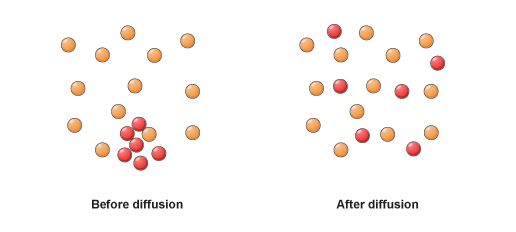
- Molecules in gases and liquids move around randomly because of the energy they have
- DIFFUSION is the spreading out of the particles of a gas, or of any substance in solution.
- The NET MOVEMENT into or out of cells depends on the concentration of the particles on each side of the cell membrane
- Because the particles move randomly, there will be a net (overall) movement from an area of high concentration to an area of lower concentration.
- The difference in concentration between two areas is called the concentration gradient
- The larger the difference in concentration, the faster the rate of diffusion
Tissues and Organs
- A tissue is a group of cells with similar structure and function
- During the development of multicellular organisms the cells differentiate
- Multicellular Organism
- An organism which is made up of many different cells which work together. Some of the cells are specialised for different functions in the organism
- Multicellular Organism
- Animal tissues include...
- Muscle tissue which can contract to bring about movement
- Glandular Tissue, to produce substances such as enzymes or homones
- Epithelial Tissue, which covers some parts of the body
Organisms in the Enviroment
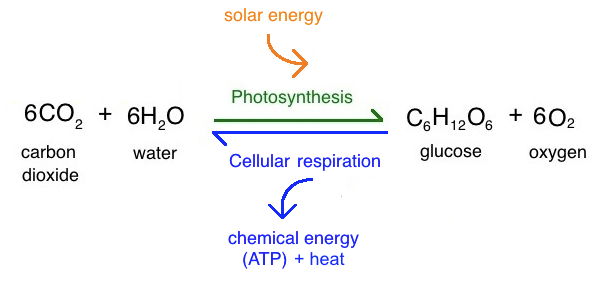
- Photosynthesis
- Photosynthesis can only be carried out by green plants and algae
- Chlorophyll in the chloroplasts absorbs the Sun's light energy.
- The Process
- 1. Carbon dioxide is taken in by the leaves, and water is taken up by the roots.
- 2. The chlorophyll traps the light energy needed for photosynthesis.
- 3. This energy is used to convert the carbon dioxide and water into glucose.
- Oxygen is released as a by-product of photosynthesis
- some of the glucose is converted into insoluble starch for storage.
- Keywords
- Light Energy
- Energy in the form of light.
- Glucose
- A simple sugar.
- Variegated
- Having diffrent colours, e.g a green and white leaf.
- Light Energy
- Making the most of photosynthesis
- Plant growers try to give their plants the best conditions for grwoth by controlling the enviroment
- Plant grwoers can atificially control the enviroment to improve plant growth
- It can be expensive to provide a suitable temperature, light and carbon dioxide. The grower has to compare the biomass of plants growth indoors and outdoors without these extra factors.
- Limiting Factors
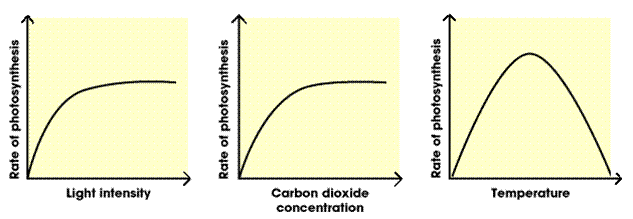
- Plants grow best when they have enough light, carbon dioxide and water, and are kept at a suitable temperature.
- If any of these conditions are not met, the rate of photosynthesis will be limited.
- A lack of light will slow down the rate of photosynthesis.
- If it is cold, then th enzymes will not work effectively and this slows down the rate of photosynthesis.
- Anything which puts a cap on the rate of photosynthesis is a limiting factor.
- Variables which need to be controlled are light, temperature and the type of plant being used.
- Keywords
- Limiting Factor
- Indepenent variable
- Dependent Variable
- Plants grow best when they have enough light, carbon dioxide and water, and are kept at a suitable temperature.
- How Plants Use Glucose
- Plants and algal cells produce glucose during photosynthesis
- Glucose produced in photosynthesis can be used in a variety of ways.
- Plants and algae need nitrate ions to make proteins.
- Uses of soluble glucose
- Converted into insoluble starch for storage
- Used for respiration
- Converted into fats and oils for storage.
- Used to produce cellulose which strengthens cell walls
- Measuring the Distribution of Organisms
- The distribution of living things in their natural enviroment can be measured.
- The data can be used to find the range, mean, median and mode of the measurements.
- Random sampling using a transect
- Sample size is important. In a large field, enough quadrats must be placed to be sure the sample is representive of the whole field.
- Photosynthesis
Enzymes
- Proteins, Catalysts and Enzymes
- Proteins are made up of long chains of amino acids.
- Enzymes are proteins which act as biological catalysts.
- Enzymes are large proteins and the shape of an enzyme is vital for its function.
- This shape has an area where other molecules can fit. This is called an active site.
- The substrate in a reaction can be held in the active site and can be either connected to another molecule or it can be broken down.
- What can an enzyme do?
- Build large molecules from many smaller ones
- Change one molecule into another one.
- Break down large molecules into smaller ones.
- Factors affecting enzyme action
- Factors which alter the shape of the active site prevent the enzyme from working.
- Enzyme activity is affected by temperature and pH.
- Reactions take place faster when it is warmer. At higher temperature, the molecules move around quicker and collide with each other more often and with more energy.
- If the temperature gets too hot the enzyme stops working because the active site changes shape. We say that the enzyme becomes denatured,
- Enzymes in Digestion
- Digestive enzymes are made by glands in the digestive system.
- Digestive enzymes work outside the body cells in the cavity of the digestive system.
- Specific enzymes digest each particular food type.
- Speeding up Digestion
- Enzymes work best in a narrow pH range.
- Protease enzymes in the stomach work best in acid conditions. Glands in the stomach wall produce hydochloric acid to create very acidic conditions.
- Amylase and Lipase work in the small intestine. They work best when the conditions are slightly alkaline.
- Bile is produced in the liver and stored in the gall bladder.
- Bile only neutralises acid, it does not contain enzymes.
- Proteins, Catalysts and Enzymes
Imagens e arquivos do mapa
Informações
- Descrição
- Mapa Mental sobre Cells, Tissues and Organs, criado por Jordann Dixon em 05-05-2017.
- Criado por
- Jordann Dixon
- Visualizações
- 141
- Tags
- Avaliação