
Mapa mental
Approaches to Profiling
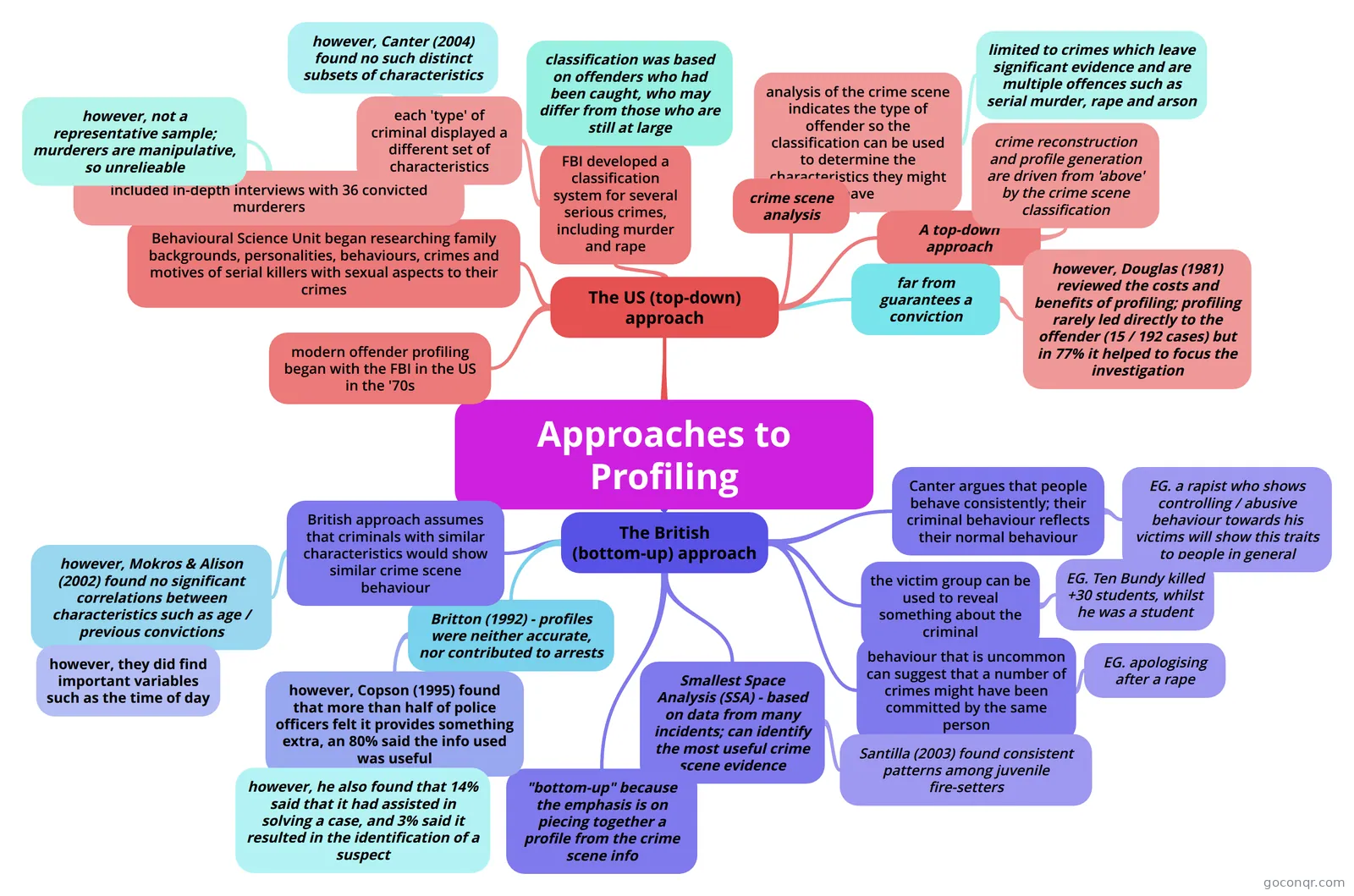
Mind map: approaches to profiling
Conteúdo do mapa
Approaches to Profiling
The US (top-down) approach
- modern offender profiling began with the FBI in the US in the '70s
- Behavioural Science Unit began researching family backgrounds, personalities, behaviours, crimes and motives of serial killers with sexual aspects to their crimes
- included in-depth interviews with 36 convicted murderers
- however, not a representative sample; murderers are manipulative, so unrelieable
- included in-depth interviews with 36 convicted murderers
- FBI developed a classification system for several serious crimes, including murder and rape
- each 'type' of criminal displayed a different set of characteristics
- however, Canter (2004) found no such distinct subsets of characteristics
- classification was based on offenders who had been caught, who may differ from those who are still at large
- each 'type' of criminal displayed a different set of characteristics
- crime scene analysis
- analysis of the crime scene indicates the type of offender so the classification can be used to determine the characteristics they might have
- limited to crimes which leave significant evidence and are multiple offences such as serial murder, rape and arson
- analysis of the crime scene indicates the type of offender so the classification can be used to determine the characteristics they might have
- A top-down approach
- crime reconstruction and profile generation are driven from 'above' by the crime scene classification
- far from guarantees a conviction
- however, Douglas (1981) reviewed the costs and benefits of profiling; profiling rarely led directly to the offender (15 / 192 cases) but in 77% it helped to focus the investigation
The British (bottom-up) approach
- Canter argues that people behave consistently; their criminal behaviour reflects their normal behaviour
- EG. a rapist who shows controlling / abusive behaviour towards his victims will show this traits to people in general
- the victim group can be used to reveal something about the criminal
- EG. Ten Bundy killed +30 students, whilst he was a student
- behaviour that is uncommon can suggest that a number of crimes might have been committed by the same person
- EG. apologising after a rape
- Smallest Space Analysis (SSA) - based on data from many incidents; can identify the most useful crime scene evidence
- Santilla (2003) found consistent patterns among juvenile fire-setters
- "bottom-up" because the emphasis is on piecing together a profile from the crime scene info
- Britton (1992) - profiles were neither accurate, nor contributed to arrests
- however, Copson (1995) found that more than half of police officers felt it provides something extra, an 80% said the info used was useful
- however, he also found that 14% said that it had assisted in solving a case, and 3% said it resulted in the identification of a suspect
- however, Copson (1995) found that more than half of police officers felt it provides something extra, an 80% said the info used was useful
- British approach assumes that criminals with similar characteristics would show similar crime scene behaviour
- however, Mokros & Alison (2002) found no significant correlations between characteristics such as age / previous convictions
- however, they did find important variables such as the time of day
- however, Mokros & Alison (2002) found no significant correlations between characteristics such as age / previous convictions
- Canter argues that people behave consistently; their criminal behaviour reflects their normal behaviour
Informações
- Descrição
- A-Levels PY4 (Forensic Psychology) Mapa Mental sobre Approaches to Profiling, criado por Hayd23 em 16-05-2013.
- Criado por
- Hayd23
- Visualizações
- 197
- Tags
- Avaliação