
Notas
Elements and Atoms
Conteúdo das notas (3)
Página 1
Elements
Different basic substances with different properties are called elements.
Examples: Carbon (C), Oxygen (O), Gold (Au), Lead (Pb)
The atom is the smallest particle which retains the same properties of the element. It is extremely small. A carbon atom, for example, is 70 pm, or 7 x 10^-11 meters, in length.
In context: A single strand of hair is millions of atoms wide.
Página 2
Structure of an Atom
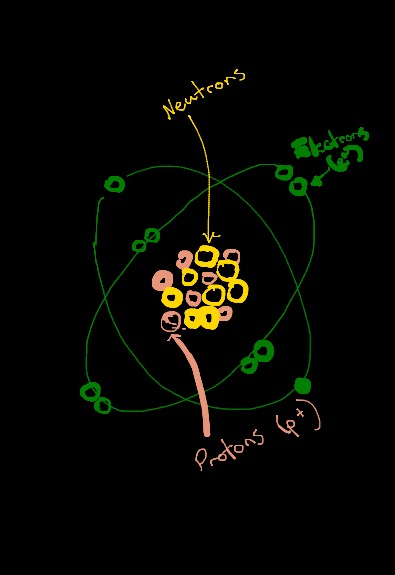
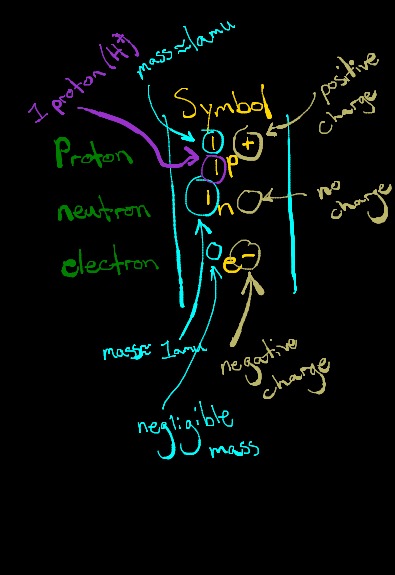
The proton is a positively charged subatomic particle which defines the element. The periodic table is listed in order of atomic number, or number of protons. Protons are located in the nucleus of an atom.
The neutron is also located in the nucleus of an atom. Neutrons carry no charge.
The electron is a negatively charged particle with a charge of equal magnitude to that of a proton. Electrons orbit the nucleus of an atom. The electron has a negligible mass.
Página 3
Notation
A <--------------------------Denotes the mass number, equal to Z + N (protons + neutrons)
X <-------------------------The Element's chemical symbol
Z <--------------------------Denotes the atomic number, or the number of protons
Example: Carbon-12 atom
6 neutrons (+ 6 p+)------> 12
Carbon atom----------------> C
6 protons--------------------> 6
Atoms of the same element with different amounts of neutrons are referred to as isotopes.
Below: Proton vs. Neutron vs. Electron
Informações
- Descrição
- How elements relate to atoms. The basics of how protons, electrons, and neutrons make up an atom. Notes from "Elements and atoms" on Khan Academy. Created by Sal Khan. https://www.khanacademy.org/science/ap-chemistry/atoms-compounds-ions-ap/introduction-to-the-atom-ap/v/elements-and-atoms
- Criado por
- Lucas Abounader
- Visualizações
- 18
- Avaliação