
Flashcards
Year 11 - Topic 4: Variation and evolution
Flashcards do conjunto (20)
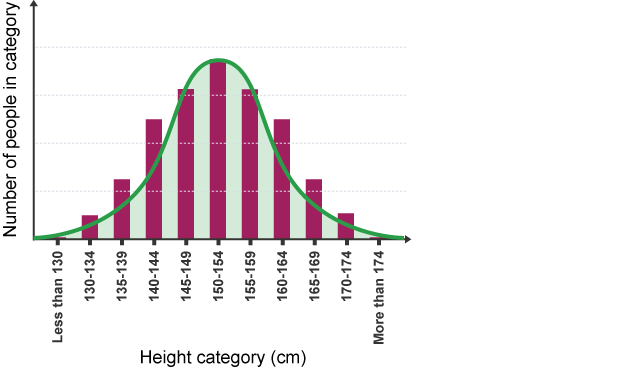
- 1What type of variation is shown in the graph?Continuous variation
- 2Describe the graph opposite [3]The graph shows continuous variation [1]
There is a bell shaped curve- normal distribution curve [1]
Any relevant data i.e. range of heights [1] - 3What type of variation is shown in the graph?Discontinuous variation
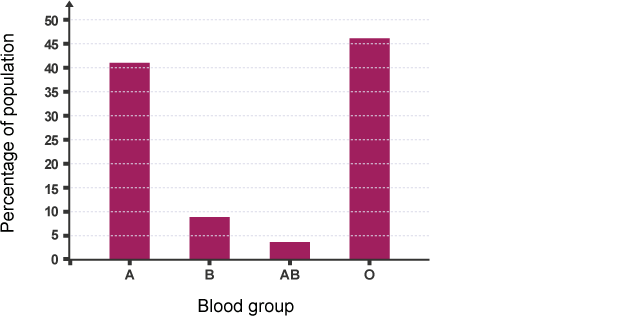
- 4What causes continuous variation?Genes and environment
- 5Name some examples of continuous variation.Height
Weight
Hand span - 6What causes discontinuous variation?Genes
- 7Name some example of discontinuous variationGender
Eye colour
Blood group - 8What is the difference between sexual and asexual reproduction?Sexual reproduction - leads to offspring being genetically different from parents. This gives rise to variation
Asexual reproduction - genetically identical offspring are produced i.e. clones - 9How are new genes produced?Mutations (changes in genes)
- 10Do mutations always have an effect?Not always - some mutations can be harmful, beneficial or have no effect at all
- 11How can you increase the chance of mutation?Mutation rates can be increased by ionising radiation
- 12What are the effects of cystic fibrosis?Cystic fibrosis is an inherited disease that causes the production of thick mucus that blocks the bronchioles
- 13How is cystic fibrosis inherited?The child must inherit a recessive allele from each of the parents as cystic fibrosis is a recessive disease
- 14How can gene therapy be used to treat cystic fibrosis?Gene therapy has potential to treat this condition, but is not straightforward as the introduction of genes must be able to work within the body.
There are also difficulties in targeting the appropriate cells and it is not a cure for the underlying condition.
The genes can be introduced into the lung tissue via an inhaler. - 15What is evolution?A gradual change over time
- 16What are the stages of natural selection?1. Over-production - all organisms produce more offspring than will survive
2. Variation - all organisms within a species will show variation (sometimes caused by mutation)
3. Competition - those organisms that are better adapted will survive
4. Reproduction - survivors will breed and pass on their advantageous genes to their offspring - 17Who proposed natural selection?Alfred Russell Wallace and Charles Darwin
- 18Why do some species become extinct?The process of natural selection is too slow for organisms to adapt to their new environment and so, become extinct
- 19Explain how bacteria are becoming resistant to antibiotics1. Variation – some strains of bacteria are resistant and some aren’t.
2. Competition – The non-resistant bacteria are killed by the penicillin.
3. Survival of the fittest – the resistant bacteria survive.
4. Passing on of genes – the resistant bacteria reproduce and pass on their adaptations to their offspring.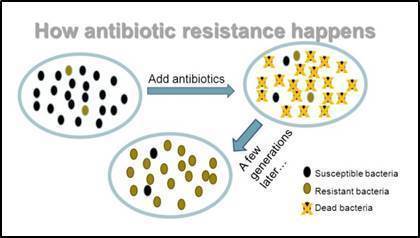
- 20Why is it important to increase our understanding of the human genome?It could be used to develop new ways to treat, cure or even prevent disease.
Informações
- Descrição
- GCSE Biology FlashCards sobre Year 11 - Topic 4: Variation and evolution, criado por Mrs Z Rourke em 26-03-2018.
- Criado por
- Mrs Z Rourke · mar 2018
- Atualizado
- 19 abr 2018
- Visualizações
- 975
- Avaliação