
Biology Test #2: Sexual and Asexual Reproduction, Mitosis, Meiosis
Slides do conjunto (9)
-
- Asexual reproduction requires only one organism (parent.) Some organisms that reproduce asexually are bacteria, yeast, and spider plants.
- Advantages: Only one parent, a large number of offsprings, extremely rapid, no risk of sexually transmitted diseases.
- Disadvantages: No genetic diversity, offspring susceptible to the same weaknesses (i.e. diseases, environmental factors, etc.)
- Budding: an offspring is formed as a small growth on the parent. - yeast
- Binary Fission: a cell divides evenly - bacteria, paramecia
- Vegetative Reproduction: only in plants, growing parts (runner) - spider plant, strawberries
- Regeneration: to reproduce part or the entire organism from a portion of the parent - starfish, lobsters
- Grafting: artificial reproduction in which plant parts are combined - roses, fruit trees
- Cloning: formation of a new individual from a single cell of a parent (derived from a genetic code) - agricultural plants
- Spore Formation: creates a reproductive cell from a single organism - mold
-
- Purpose: growth, repair, replacement. Cell Cycle: the process of growing and dividing.
- Interphase - cells carry out functions necessary for survival, prepare to divide (DNA replication, growth)
- Mitosis - cells divide their genetic contents into two parts
- Cytokinesis - contents of the cytoplasm are separated and the cell splits into two daughter cells
-
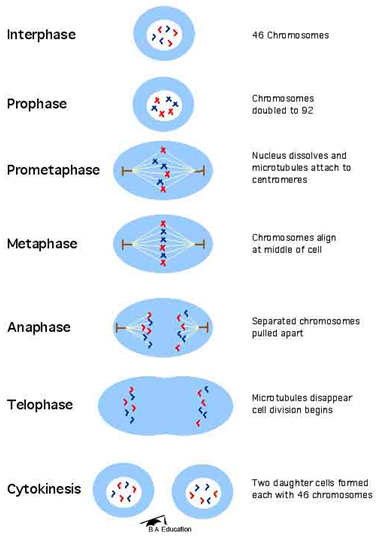
- Mitosis: the process in which a body cell reproduces asexually to create another genetically identical body cell (cell division), the final stage of the cell cycle. The nucleus contents split into two equal parts, and two daughter nuclei are formed. As the nucleus prepares to divide, replicated DNA from interphase joins together to form chromosomes, joined by a centromere.
- Purpose: growth, repair, replacement (GRR)
- Daughter cells are genetic duplicates of the parent cell
- Body cells are diploid with a double copy of chromosomes originating from the mother and the father
- All body cells except gametes reproduce this way
- Stages: IPMAT
-
- Interphase: chromosomes and centrioles replicate, nuclear membrane and nucleolus visible, chromosomes and DNA not
- Prophase: chromosomes condense (become more visible) chromatids pair up, nuclear membrane and nucleolus disappear, spindle apparatus forms
- Metaphase: chromosomes line up in the middle, two separate centrioles begin to pull them apart
- Anaphase: chromatids move away from each other towards opposite poles
- Telophase: nuclear membrane and nucleolus reform, the cell is separated into two, (Cytokinesis: cytoplasmic division of all other materials)
-
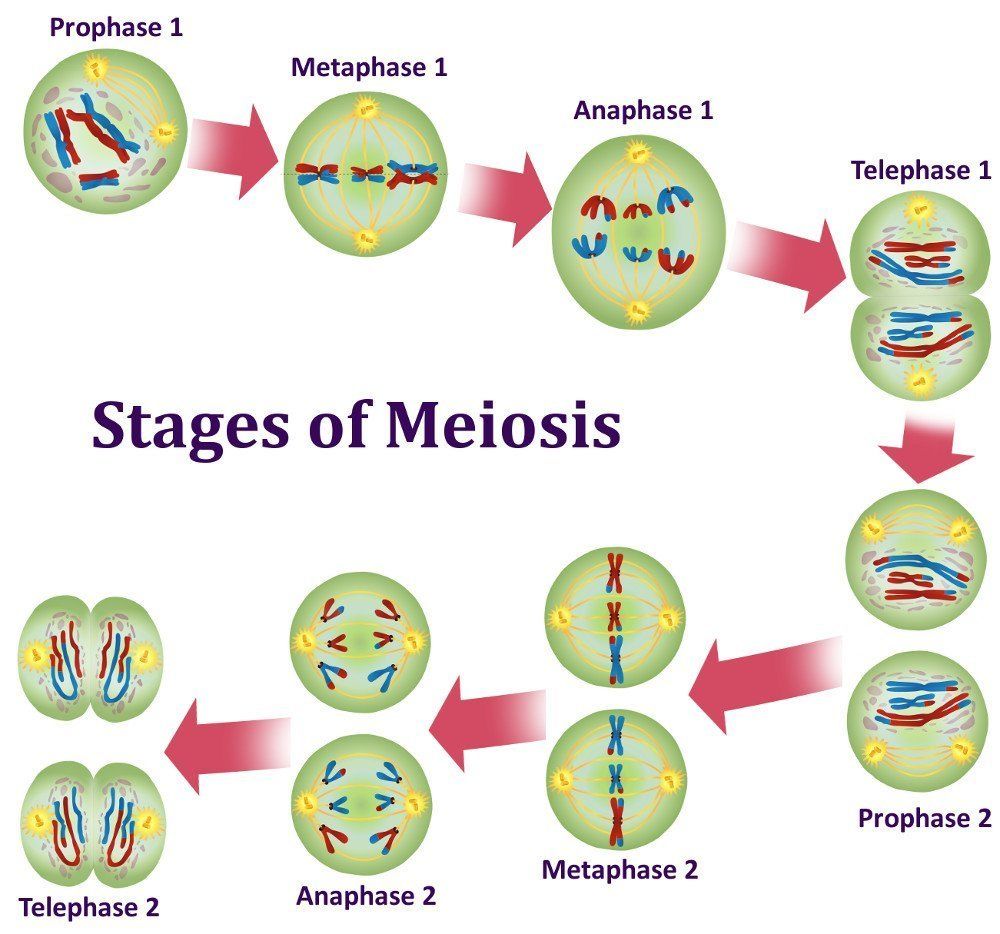
- Meiosis - the creation of sex cells with half (haploid) the number of chromosomes as the original parent.
- Division starts with diploid germ cell, finishes with 4 haploids
- 4 sperm are produced, or 1 egg/ova (during cytokinesis, the cytoplasm and the organelles are divided unevenly. Whichever ova receives the majority survives, while the other three are polar bodies)
- Sperm and egg cells are called gametes, used for sexual reproduction
- Stages: IPMATPMAT.
- Independent assortment (random distribution of chromosomes during division) and crossing over (tails of chromatids are exchanged) increase genetic diversity.
-
- MITOSIS
- Purpose: GRR (Growth/Repair/Replacement.) Make genetically identical cells.
- One round of division: PMAT.
- Creates two diploid daughter cells
- MEIOSIS
- Purpose: to create gametes (sperm and ovum)
- Two rounds of division: PMATPMAT
- Creates four haploid cells
- Variability due to independent assortment and crossing over
-
- Sexual reproduction requires 2 parents and produces offspring that are genetically different from each other, and either parent. Variation in the genetic information of a species is called genetic diversity and can increase chances of survival.
- Each parent donates a gamete/sex cell. Females - egg (ovum) Males - sperm. When the egg and sperm fuse, it forms a zygote and it is called fertilization. Sperms and eggs are haploid/have half the number of chromosomes of the parents.
-
External and Internal Fertilization
- EXTERNAL FERTILIZATION
- Sperm and egg cells unite outside the bodies of the parents.
- Common among aquatic organisms, mosses, and ferns
- Advantages: very little energy required, large numbers of offspring
- Disadvantages: many gametes do not survive to be fertilized, embryos and zygotes are unprotected
- INTERNAL FERTILIZATION
- Sperm cells are deposited into the female to meet an egg cell
- Common among land organisms
- Advantages: more offspring survive
- Disadvantages: require a lot of energy, fewer zygotes formed
- ***In plants, internal fertilization is called pollination - the transfer of male gametes in pollen.
-
- Egg + Sperm (gametes). Fertilization.
- Zygote (morula - blastula (hollow sphere of cells) - cells differentiate in gastrula (three layers of cells))
- Embryo. (2 weeks, 100+ cells)
- Fetus (8-10 weeks) with gills and tail.
- Baby (9 months)
Informações
- Descrição
- Grade 9 Science Slides sobre Biology Test #2: Sexual and Asexual Reproduction, Mitosis, Meiosis, criado por Jessica Ngo em 01-05-2019.
- Criado por
- Jessica Ngo · mai 2019
- Atualizado
- 1 mai 2019
- Visualizações
- 568
- Tags
- Avaliação