
Periodicity- unfinished
Slides do conjunto (21)
-
- Key Definitions:
- A period is a horizontal row of elements in the periodic table.
- A group is a vertical column in the periodic table. Elements in a group have similar chemical properties as their atoms have the same number of outer shell electrons.
- Periodicity is the repeating pattern across different periods.
- Each element in a group has the same number of electrons in the outer shell and the same type or orbital.
- This means elements in the same group react in a similar way due to their similar electron structures.
- For elements 2 and 3 you need to be able to explain the following trends across a period and down a group:
- Atomic Radii
- First ionisation energy
- Melting points
- Boiling points
-
- Key Definitions
- The first ionisation energy of an element is the energy required to remove one electron from each atom in one mole of gaseous atoms to form one mole of gaseous ions with a plus one charge.
- Across a period
- Both the nuclear charge and the number of protons increases
- The shielding by inertial electrons remains approximately constant
- The effective nuclear charge increases
- More energy is needed to overcome the attraction of the nucleus for outer electron- 1st IE increases
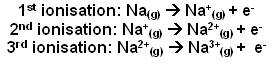
- Legenda: The equation for the 1st 2nd and 3rd IEs of Sodium.
-
- Down a group
- Both the nuclear charge and number of electrons increases.
- The shielding by inner shell electrons increases more so.
- The effective nuclear charge decreases.
- Less energy is needed to overcome the attraction of the nucleus for the outer electron- 1st IE decreases
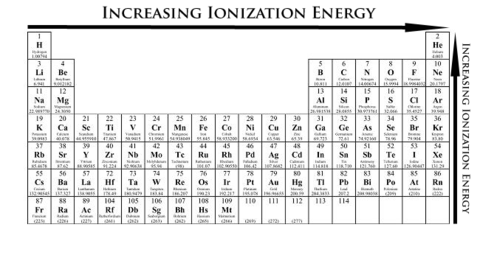
- Legenda: Trends in activation energy on the periodic table
-
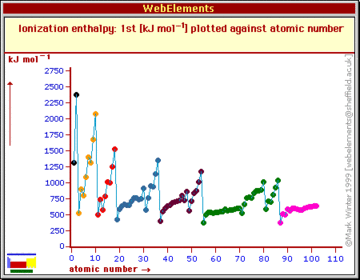
- The Graph t the left shows a graph of 1st ionisation energy against atomic number.
- The different colours represent different periods. We can see that the 1st IE increases across a period as the values across the period get larger.
- We can also see than they decrease down a group as the corresponding values of each group get smaller.
-
- Across a Period
- Both the nuclear charge and the number of protons increases.
- Shielding by inner shell electrons remains approximately the same.
- The effective nuclear charge increases.
- The force of attraction of the nucleus for the outer shell electrons is greater- Atoms decrease in size.
- Down a group
- Both the nuclear charge and number of protons increases.
- Shielding by outer shell electrons increases more so
- The effective nuclear charge decreases
- The force of attraction of the nucleus for the outer shell electrons is smaller- Atoms increase in size.
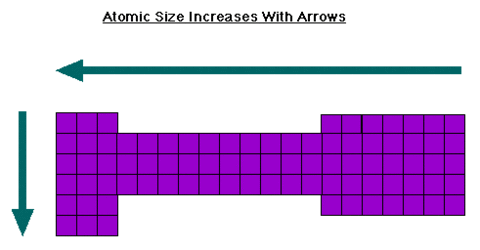
- Legenda: Trends in atomic size on the periodic table
-
- This is the energy required to remove each electron one after the other from an atom
- E.g. the 2nd ionisation energy is the energy required to remove one electron from one mole of gaseous ions with a plus 1 charge.
- Tip- The number of the successful ionisation energies is the same as the charge on the ion formed
- Why are the 2nd ionisation energies of an atom greater than their first?
- -Same number of protons attracting fewer electrons
- -Therefore outermost electrons experience a greater nuclear attraction
- -More energy is needed to overcome this attraction so ionisation energy is greater
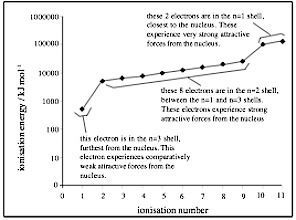
- Legenda: Successive ionisation energy for sodium.
-
Interpreting successive ionisation data
- Sometimes you will be given a bar chart, table or graph depicting the data of successive ionisation energies of an element and be asked to identify the element or where it is in the periodic table.
- To answer these questions you must,
- -Identify the large jump in ionisation energy
- -Count how many electrons are in the outer shell i.e. until the first large jump
- -Refer to the large increase and number of outer shell electrons in your answer.
- Example,
- There is a large increase between the 4th and 5th ionisation energies.
- Which shows that the 5th electron is being taken from a main shell closer to the nucleus.
- So there are 4 electrons in the outer shell. Which means that the element is in group 4.
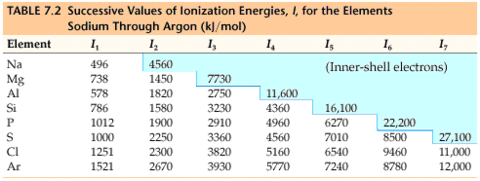
- Legenda: An example of a table you may be given.
-
Structure + bonding across periods 2 + 3
- Period 2
- 1 2 3 4 5 6 7 8
- Li Be / B C / N O F Ne
- / /
- Giant Metallic / Giant Covalent / Simple Molecular Structures
- / /
- Strong forces / strong / Weak London forces between
- between +ve / covalent bonds / molecules
- and -ve / between atoms /
- delocalised / /
- e- / /
- Period 3
- 1 2 3 4 5 6 7 8
- Na Mg Al / Si / P S Cl Ar
- / /
- Giant metallic / Giant / Simple Molecular Structures
- / Covalent /
- / /
- Strong forces of / strong / Weak London forces between
- attraction between / covalent / molecules
- +ve and -ve / bonds /
- delocalised e- / between /
- / atoms /
-
Properties of Diamond + Graphite
- Diamond
- Structure- Giant covalent molecule.
- -Millions of Carbon atoms bonded by millions of strong covalent bonds.
- -Tetrahedral shape .
- -Each carbon atom use 4 electrons to bond with 4 other carbon atoms.
- Electrical conductivity- Does NOT conduct .
- -No free electrons can move and carry the current.
- Hardness- Very hard as millions of strong covalent bonds keep its shape.
- -Very high melting point and boiling point as millions of strong covalent bonds need a lot of energy to overcome.
- Graphite
- Structure- Giant covalent molecule.
- -Millions of Carbon atoms bonded by millions of strong covalent bonds.
- -Layer of hexagonal nets.
- -3 out of 4 outer electrons are used to bond to 3 other carbon atoms .
- -1 electron per atom is delocalised. these delocalised electrons can carry a current.
- Electrical conductivity- The only non-metallic substance that CAN conduct.
- -Delocalised electrons move through the layers and carry the current.
- Hardness- Soft and greasy as weak London forces between layers allow layers to slide over each other.
- -Very high melting and boiling points as millions of strong covalent bonds need a lot of energy to overcome.
-
- - The thinnest and strongest material ever made.
- - Graphene is a single layer of Graphite.
- - Hexagonal shape within sheet, 1 carbon atom covalently bonded to 3 other carbon atoms, each carbon atom has 1 delocalised electron.
- - Has the same electric conductivity as copper (delocalised electrons carry current).
- - Very strong due to many strong covalent bonds
- - 100x stronger than steel
- Note:
- Allotropes are pure forms of the same substance e.g. diamond and graphene.
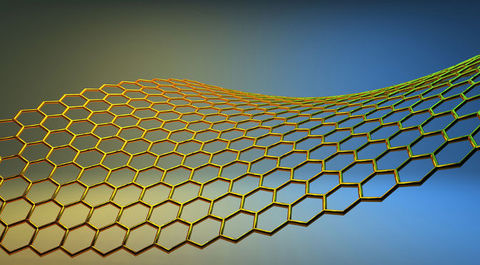
- Legenda: Graphene
-
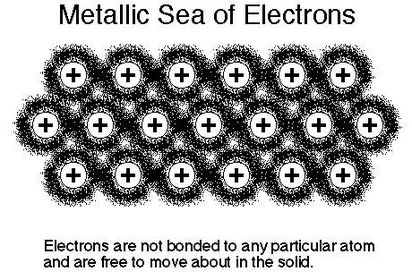
- Definition- A giant metallic lattice is a 3-d lattice of positive ions in 'a sea' of delocalised electrons and are bonded together by strong metallic bonds.
- -Metallic bonding is the electrostatic force of attraction between positive ions and delocalised electrons
-
- Properties of Metallic Lattice
- High melting and boiling points - Although the electrons are free to move throughout the structure the positive ions remain static.
- -A strong force of attraction exists between the positive ions and the delocalised electrons.
- -For the metal to melt these strong electrostatic forces have to be broken and this requires a large amount of energy.
- High electrical conductivity- The delocalised electrons are free to move within the lattice structure.
- -Even in the solid state electrons are able to move and carry the current.
- Malleability and ductility- Metals can be drawn out to make wires (ductile)
- -Metals can be hammered out into shapes- (malleable).
-
- You may be asked to explain why the boiling or melting point for one metal is larger/smaller than another. You should take into account the following;
- -Change in the number of delocalised electrons.
- -Change in positive ions (charge density).
- -Electrostatic force of attraction between the metal ions and these electrons
- E.g.
- Explain why the boiling point increases from sodium to aluminium.
- -Ionic size decreases. Al3+ has a greater number of protons than Mg2+ and Na+.
- -Ionic charge increases. Ion size is smaller for Al3+ than Mg2+ and Na+.
- -Number of outer-shell electrons increases. Al3+ has more outer shell electrons than Mg2+ and Na+.
- -Charge density increases. Al3+ has a greater charge density that Mg2+ and Na+.
- -Attraction between metal ions and electrons increases leading to an increased in boiling point. Delocalised electrons are more strongly attracted to Al3+ than Mg2+ and Na+ causing a stronger bond. This bond requires more energy to overcome.
-
- SO4 (2-)
- Test: Ba (2+) aqueous
- Observations: Insoluble white precipitate forms BaSO4
- Equation: Ba (2+) aq + SO4 (2+) aq --> BaSO4 (s)
- NH4 (+)
- Test: Heat/ NaOH aqueous
- Observation: NH3 g is given off, pass onto pink limbs paper, paper turns blue
- CO3 (2-)
- Test: H (+) aq
- Observations: CO2 g fizzing, Limewater turns milky.
- All group 7
- Cl (-)
- Test: AgNO3 aq
- Observations: White precipitate soluble in dilute NH3 aq
- Br (-)
- Test: AgNO3 aq
- Observations: Cream precipitate soluble in concentrated NH3 aq
- I (-)
- Test: AgNO3 aq
- Observations: Yellow precipitate insoluble in NH3 aq
-
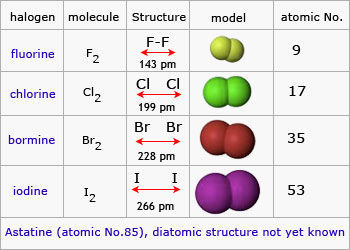
- Fluorine, F2 - Yellow gas at room temperature
- Chlorine, Cl2 - Green gas at room temperature
- Bromine, Br2 - Volatile red liquid at room temperature
- Iodine, I2 - Silver grey solid at room temperature
- Astatine At2 - Black solid at room temperature
- Note: As we go down the group it is important to note that the melting and boiling points increase as do the total number of electrons. (London forecaster stronger).
- However the size increases down the group as the effective nuclear charge decreases.
-
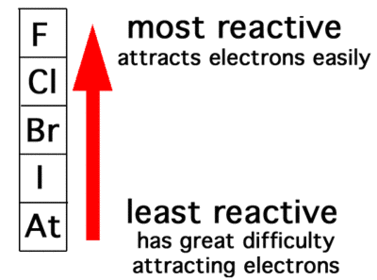
- Oxidising agents oxidise others, they are themselves reduced.
- Oxidation is the loss of electrons, Reduction is the gain of electrons.
- So the best oxidising agent is the one that can gain electrons more easily.
- Halogens are the most reactive of the none metals and are strong oxidising agents removing electrons from other species in these reactions.
- Fluorine is the most oxidising and Astatine is the least oxidising.
- This is because,
- It is the smallest atom in the group,
- Therefore its outer shell is nearest to the attraction of the nucleus,
- When an electron is gained the atom can hold it more strongly.
-
- Halogens in water Halogens in cyclohexane
- Cl2 is pale green Cl2 is green
- Br2 is yellow/orange Br2 is orange
- I2 is brown I2 is violet
- Halides in water likewise for cyclohexane
- Cl (-) is colourless
- Br (-) is colourless
- I (-) is colourless
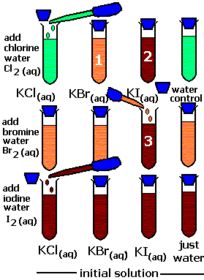
- The Test
- Each halogen is mixed with the different halides
- A more reactive halogen will oxidise the halide ion of a less reactive halogen by removing the electron forming a new halogen molecule. This is often called a displacement reaction.
- As halogens form solutions of different colours then any colour change in the reaction indicates whether a redox reaction has occurred.
- The mixture is often shaken with an inert solvent such as cyclohexane to help intensify the colour and distinguish between bromine and iodine.
-
- Reactions
- Cl2 (aq) + 2Br- (aq) --> 2Cl- (aq) + Br2 (aq) colour change: green --> yellow
- Cl2 (aq) + 2I- (aq) --> 2Cl- (aq) +I2 (aq) colour change: green --> brown
- Br2 (aq) + 2Cl- (aq) --> no reaction No colour change
- Br2 (aq) + 2I- (aq) --> 2Br- (aq) + I2 (aq) Colour change: orange --> brown
- I2 (aq) + 2Cl- (aq) --> No reaction No colour change
- I2 (aq) + 2Br- (aq) --> No reaction No colour change
-
- The test
- The unknown halide is first dissolved in water.
- An aqueous solution of AgNO3 (silver nitrate) is added.
- The silver ions from the silver nitrate reacts with the halide ions giving a silver halide precipitate.
- The silver halide precipitates are coloured with the colour intensity increasing from Cl- to I-. The colour tells you which halide ion is present.
- It can be difficult to decide on the actual colour of the precipitate, then add NH3 (ammonia solution), as the halide ions have different solubility in NH3, decreasing from Cl- to I-
- Note: The NH3 may be added before the AgNO3 to remove any carbonates ions which would also produce a precipitate.
- Observations
- Ion: Cl(-)
- Equation: Cl(-) aq + Ag(+) aq --> ClAg s
- Observation: White precipitate
- Solubility in NH3: soluble in dilute NH3
- Ion: Br (-)
- Equation: Br(-) aq + Ag(+) aq --> BrAg s
- Observations: Cream precipitate
- Solubility in NH3: soluble in concentrated NH3
- Ion: I (-)
- Equation: I(-) aq + Ag (+) aq --> IAg s
- Observations: Yellow precipitate
- Solubility in NH3: Insoluble in NH3
-
- Group 2 metals often form alkaline oxides and hydroxides.
- Properties- Relatively high melting and boiling points.
- -Light metals with low density.
- -They form white solid compounds or colourless solution.
- Reactivity increases down the group. Because,
- -Ionisation energy decreases.
- -There is an increase in shielding.
- -The outer shell electrons are further from the nucleus.
- -Decreased attraction to the nucleus.
- Reactions
- Group 2 elements are Reducing agents.
- They Reduce other species by giving 2 electrons, they are themselves oxidised.
- The metals react vigorously with oxygen in a redox reaction forming a solid white ionic oxide in each case.
- Group 2 metals react with water to form their hydroxides and hydrogen gas. Magnesium reacts rapidly with steam to produce magnesium oxide and hydrogen gas.
- Group 2 metals also react with acids to form their salt and hydrogen gas.
-
- Both group 2 oxides and hydroxides are bases so they neutralise acids yo from salt and water
Informações
- Descrição
- AS - Level Chemistry Slides sobre Periodicity- unfinished, criado por Alice Butterworth em 19-01-2016.
- Criado por
- Alice Butterworth · jan 2016
- Atualizado
- 20 jul 2016
- Visualizações
- 9
- Avaliação