
10. CLASSIFICATION AND EVOLUTION
Slides do conjunto (8)
-
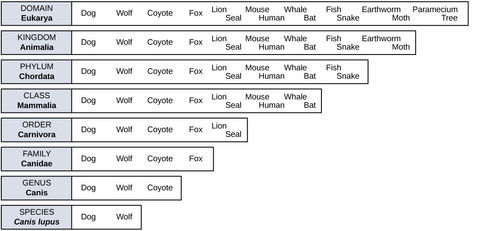
- Legenda: The taxonomic hierarchy of biological classification of species identifies species to easily identify, predict characteristics between species and find evolutionary links from a shared common ancestor. Scientists worldwide can share research.
- The binomial system ensures scientists all over the world are discussing the same organism (binomial nomenclature).
- All species are given a name consisting of two parts:
- First word - genus (shared by close relatives - generic)
- Second word - organism's species (specific)
-
- Prokaryotae (bacteria)
- unicellular
- no nucleus or other membrane bound organelles
- no visible feeding mechanism - absorbed through cell wall
- Protoctista (unicellular eukaryotes)
- mainly unicellular
- nucleus and other membrane bound organelles
- some have chloroplasts
- some are sessile, others move by cilia or flagella
- nutrients acquired by photosynthesis
- Fungi (e.g. yeasts, moulds, mushrooms)
- unicellular or multicellular
- nucleus and other membrane bound organelles and chitin cell wall
- no chloroplasts or chlorophyll or mechanisms for locomotion
- body of mycelium made of threads or hyphae
- nutrients acquired through absorption
- store food as glycogen
- Plantae
- multicellular
- nucleus, membrane bound organelles, chloroplasts, cellulose cell wall
- do not move
- nutrients acquired by photosynthesis
- store food as starch
- Animalia
- multicellular
- nucleus, membrane bound organelles, no cell walls
- no chloroplasts
- Now six kingdoms since Archaebacteria is chemically different from Eubacteria (have peptidoglycan) and there are three domains:
- Eukarya - 80s ribosomes, RNA polymerase has 12 proteins
- Archaea - 70s ribosomes, RNA polymerase has 8-10 proteins
- Bacteria - 70s ribosomes, RNA polymerase has 5 proteins
-
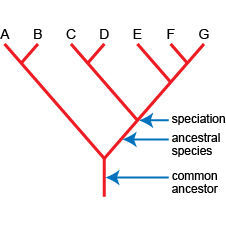
- Legenda: Phylogenetic trees. The closer the branches, the closer the evolutionary relationship. F and G are more closely related than G and E. The earliest species are found at the base of the tree and most recent at the tips. They are produced looking at similarities and differences in species' physical characteristics and genetic makeup. Most evidence is from fossils.
- Phylogeny is the evolutionary relationships between organisms. Classification can occur without any knowledge of phylogeny.
- Classification uses knowledge of phylogeny in order to confirm the classification groups are correct. E.g. dolphins has similar characteristics to a fish so can be classified as a fish, however knowledge from phylogeny confirms it as a mammal.
- Phylogeny produces a continuous tree whereas classification requires discrete taxonomical groups.
- The hierarchal nature of Linnaean classification can be misleading.
-
- Interspecific variation - differences between organisms of different species e.g. mouse has four legs, teeth, fur and a bird has two legs, two wings, feathers, beak
- Intraspecific variation - differences between organisms of the same species e.g. height, build, hair colour
- Genetic causes of variation
- Alleles (variants) - individuals in a species population may inherit different alleles of genes which produce different characteristics e.g. different blood groups
- Mutations - changed to DNA sequence and genes lead to changed in proteins coded which affects physical and metabollic characteristics for variation
- Meiosis - Independant assortment and crossing over of the genetic material in the two parent cells so gametes show variation
- Sexual reproduction - offspring inherits genes from both parents so differs from each of them
- Chance - many different (unique) gametes are produced and is a result of chance as to which two combine so differ from siblings
- Environmental causes of variation
- All organisms are affected by the environment in some way, plants more so than than animals.
- E.g. sun access will vary in different areas of a garden so one plant will grow larger than another in a shadier position, which cannot move.
- E.g. Scars will have occurred as a result of an environmental accident or disease (no genetic origin or inheritance)
- Environmental and Genetic causes
- The scenario in most cases, so is harder to investigate and draw conclusions about the cause of a variation (nature vs nurture)
- If you have very tall parents, you will most likely inherit the genes to also grow tall, but is influenced by what diet you lead.
- Skin colour is determined by the amount of pigment, melanin, contained and is determined by genetics. More melanin = darker skin. However more melanin is produced in sunlight to protect it from UV rays, turning it darker.
-
10.6 Representing Variation Graphically
- Discontinuous variation - a characteristic that can only result in certain values. No in-between values. Variation determined by genetic factors. E.g. Animal sex / shape of bacteria (rods, spherical, spiral) , human blood groups. Represented with a bar chart or pie chart.
- Continuous variation - a characteristic that can take any value within a range. There's a graduation of values from one extreme to the other in a characteristic (continuum). E.g. height / mass of plants and animals. Not controlled by single gene but a number of them (polygenes). Often influenced by environmental factors. Collected in a frequency table and plotted on histograms. Curve is drawn to show trend.
- Correlation coefficient - if two sets of data are related:
- no correlation - no relationship between data
- positive correlation - as one set of data increases in value, the other set also increases
- negative correlation - as one set of data increases in value, the other set also decreases
- Student's t test - used to compare the means of data values of two populations. Data must be normally distributed and enough to calculate reliable mean.
- Standard deviation - How spread out the data is along the mean. Greater standard deviation - greater spread of data. In variation, characteristic with high standard deviation has a large amount of variation. When calculating SD of data that displays a normal distribution:
- 68% of values are within 1 SD of mean
- 95% of values are within 2 SD of mean
- 99.7% of values are within 3 SD of mean
-
- Anatomical adaptations
- Body covering - fur, feathers, shells etc offer warmth, flight, protection. Thick waxy layers on plants prevent water loss
- Camouflage - blend into environment e.g. snowshoe hare
- Teeth - related to diet. Herbivores (sheep) - molars / Carnivores (tigers) - sharp large canines
- Mimicry - copying animals appearance / sound to fool predators it's dangerous e.g. hoverfly mimics wasp
- Behavioural adaptations
- Survival behaviours - opossum plays dead / rabbit freezes
- Courtship - attracting a mate e.g. scorpions dance - increasing chance reproducing
- Seasonal behaviours - cope with environmental changes -migration / hibernation
- Innate behaviours - inherited through genes e.g. spiders build webs to survive in habitat
- Learned behaviour - learnt from observation. e.g. tools in otters like stones as hammers for shells on rocks and crack open
- Physiological adaptations
- Poison production - reptiles produce venom / plants poisons
- Antibiotic production - bacteria produce antibiotics to kill other species of bacteria in area
- Water holding - water-holding frog stores water to survive in desert / cacti / desert plants store in tissues
- Analogous structures and convergent evolution
- Analogous structures - structures adapted to perform the same function but have different genetic origin e.g. fins of fish and whales
- Convergent evolution - unrelated species begin to share similar traits. These similarities evolve when the organism adapt to similar environments or selection pressures. E.g. mammals in America and marsupials in Australia.
-
10.8 Changing Population Characteristics
- Natural selection
- Organisms within a species show variation in characteristics caused by differences in alleles of a gene (new alleles arise by mutations)
- Organisms whose characteristics are best adapted to a selection pressure e.g. predation, competition or disease has an increased chance of surviving and successfully reproducing. Less well adapted organisms die or fail to reproduce
- Successful organisms pass the allele encoding the advantageous characteristic onto their offspring
- This is repeated for every generation so overtime the proportion of advantageous adapted individuals increases and therefore the frequency of allele that codes for the characteristic increases in population's gene pool
- Over a long period of time this process can lead to the evolution of a new species
- Modern examples of evolution
- Antibiotic-resistant bacteria - MRSA has developed resistance to many antibiotics when increasing rapidly and evolve in a short time from altered DNA. Natural selection made is possible for the bacteria to survive methicillin.
- Peppered moths
- Sheep blowflies
Informações
- Descrição
- Module 4 Chapter 10
- Criado por
- Abbie Vincent · abr 2016
- Atualizado
- 11 jan 2017
- Visualizações
- 59
- Tags
- Avaliação