
Key Facts - Molecular Genetics
Slides do conjunto (10)
-
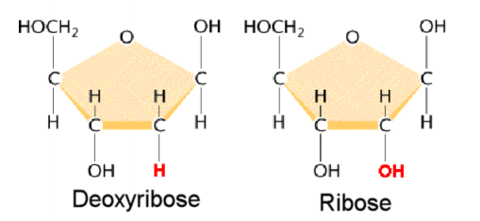
- Differences:
- DNA lacks one oxygen molecule
- DNA nitrogenous bases: ATGC
- RNA nitrogenous bases: AUGC
- DNA is double stranded
- RNA is single stranded
- Similarities:
- 5-carbon sugars
- made up of long chains of sub-units called nucleotides
- contain a combination of 4 nucleotides
- each nucleotide is made up of a 5-carbon sugar, a phosphate group and one of four nitrogenous bases
- - Chargaff's Rule
-
- "thread-like molecule that is composed of two strands of nucleotide bases strung together that wrap around each other"
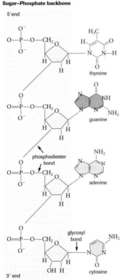
- unwound, it looks like a ladder with the sugar-phosphate backbone (the rails of the ladder), while the nitrogenous bases from both strands face each other and form the rungs of the ladder
- All of the phosphate groups for a strand have the same orientation so
- each DNA strand is said to have directionality with a 5′ end and a 3′ end
- The two
- strands are in opposing directions to each other or said to be antiparallel.
- By
- convention, a strand is “read” in a 5′ to 3′ direction.
- The phosphate
- bridges that link the sugars together are strong, maintaining the sugar-phosphate
- backbone
- The hydrogen bonding between the base pairs keeps the two strands together
- The hydrophilic and hydrophobic regions of the molecule keeps the sugar-phosphate backbone on the outside and the nitrogenous bases on the inside
- This structure allows the DNA molecule to be extremely stable which is a necessary factor for a molecule that carries the genetic blueprint of an organism
-
-
- Purines
- Adenine and Guanine
- Double-ring structure
- Pyramidines
- Cytosine and Thymine
- Single-ring structure
- A purine on one strand is always associated with a pyramidine on another strand; known as complementary base pairings
- These
- configurations allow for hydrogen bonding to occur between the complementary base
- pairs.
- A and T can form two hydrogen bonds between them while C and G can form
- three.
-
- DNA replication is semi-conservative
- Process:
- The enzyme DNA
- helicase is responsible for unwinding the helix by temporarily breaking the hydrogen
- bonds holding the two strands together
- Specialized single-stranded binding proteins
- (SSBs) then attach to the individual strands to prevent the hydrogen bonds from
- reforming
- Since only small areas of DNA are being unravelled at any one time, tension
- can form in the twist of the helix further up the line. If the tension were to become too
- great, the strands could break apart. To prevent this, DNA gyrase cuts the two DNA
- strands and allows them to swivel around each other until the increased tension has
- been released and then reseals the strands.
- 3. As soon as DNA helicase opens up the helix and the SSBs stabilize it, replication
- begins.
- 4.The junction where the two strands are yet to be unravelled is called the
- replication fork and replication proceeds in the direction of that fork
- 5.It is the enzyme
- DNA polymerase III that creates the new DNA strands but, certain conditions have to be
- met before it can begin
- The enzyme is only able to add new nucleotides to the 3′ end
- of the strand. This means that the enzyme can only work in a 5′ to 3′ direction. As well, the enzyme is incapable of attaching itself to the template strand and simply stringing
- the appropriate nucleotides together.
- 6.Instead, another enzyme, RNA primase, must first
- lay down a short string of temporary RNA nucleotides to provide an attachment site for
- DNA polymerase III. The polymerase can then start attaching the complementary DNA
- nucleotides to the temporary RNA nucleotides.
-
- leading strand: runs in 5' to 3' direction. DNA Polymerase III is able to do its job smoothly.
- lagging strand: runs in 3' to 5' direction. in order for DNA Polymerase III enzyme to work on this strand, it must move past one to two hundred
- nucleotides on the template strand in a 3′ to 5′ direction without synthesizing the new
- strand. It then stops, reattaches itself to a set of temporary RNA nucleotides set down
- by RNA primase and then works in its normal 5′ to 3′ direction away from the replication
- fork. Then, just as it does on the leading strand, it reads the order of nucleotides from the template strand and creates the complementary copy but this time, in Okazaki fragments. It continues
- this action for the entire length of the strand, moving ahead, stopping, reattaching,
- making a short segment, and so on.
- Once DNA polymerase III has commenced replication and moved forward, the
- temporary RNA nucleotides can be removed and replaced by the appropriate DNA
- nucleotides, this is performed by DNA Polymerase I.
- DNA ligase forms a phohphodiester bond
- between the outer nucleotides on each Okizaki fragment to form one continuous strand.
- As the replication fork continues
- forward and more of the DNA strands are synthesized, the two double-stranded DNA
- molecules automatically reform their helical twist and the hydrogen bonds holding the
- two strands together, form. DNA replication is now complete.
- Repair
- Errors can occur during the copying process. If this were to happen regularly, the DNA of
- each cell could mutate and stop functioning properly. Therefore, it
- is extremely important that DNA replication be as close to error free as
- possible. DNA polymerase I and III have proof-reading mechanisms for this reason. When
- an error is found, both polymerases have exonuclease abilities. This allows them to cut
- out an incorrect base, replace it with the correct base and then carry on with the rest of
- the strand.
-
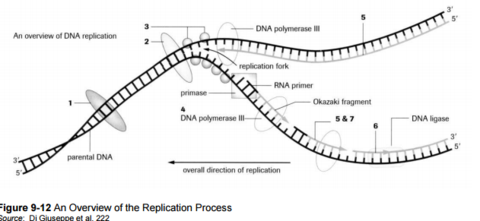
- Legenda: an overview of DNA replication
-
- RNA
- 3 major classes:
- mRNA - messenger RNA; responsible for creating a copy of the genetic
- information contained in the DNA and moving that information from the nucleus to the
- cytoplasm where protein synthesis occurs
- tRNA - transfer RNA; responsible for
- supplying the amino acids in the correct order as the polypeptide chain is being
- synthesized
- rRNA - ribosomal RNA; plays a structural role and helps
- form the ribosome which is the structure that synthesizes the polypeptide chain
- Genetic Code
- three nucleotides are required to code for each amino acid
- This set of three nucleotides is referred to as a codon
- The start codon tells the ribosome that this is the first codon for the amino acid chain
- There are three stop codons to let the ribosome know that this is the end of the chain and to stop adding amino acids
-
- Transcription
- first phase of protein synthesis & involves the formation of the
- mRNA molecule
- divided into 4 stages:
- Initiation
- RNA polymerase binds to double helical DNA at a promoter region. DNA strand is unwound and the double helix is disrupted, exposing the template strand.
- Elongation
- mRNA is synthesized by using one strand of DNA as a template. synthesized in the 5' to 3' direction. Uracil complements adenine. As elongation proceeds, RNA polymerase moves along DNA, synthesizing mRNA. DNA that has already been transcribed rewinds into double-helical form. RNA polymerase reaches termination sequence at end of gene.
- Termination
- RNA synthesis ceases; mRNA and RNA polymerase are released.
- Post-transcriptional Modification
-
- Translation
Informações
- Descrição
- Slides sobre Key Facts - Molecular Genetics, criado por Chahat Sharma em 20-05-2016.
- Criado por
- Chahat Sharma · mai 2016
- Atualizado
- 19 out 2016
- Visualizações
- 34
- Tags
- Avaliação