
Notas
Sem título
Conteúdo das notas (2)
Página 1
Atoms
O= Particle- any particle
Contains electrons, neutrons, protons
States of Matter- gas, liquid, solid
vapour, water, ice
Shape and volume of a container, random but straight
Liquid, definitive volume, particles near each other
Solids, fixed structure, only collide with near neighbours
It's about the distance away from the particles and their relationship.
Using valency to determine the chemical formula of ionic compounds
Ionic compounds are compounds made up of a metal + non-metal
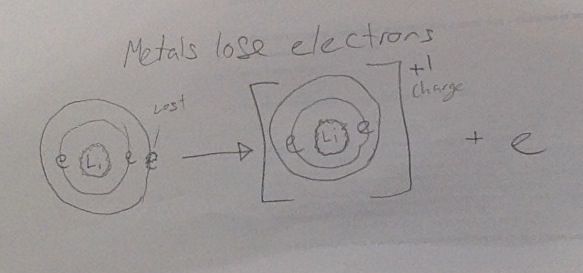
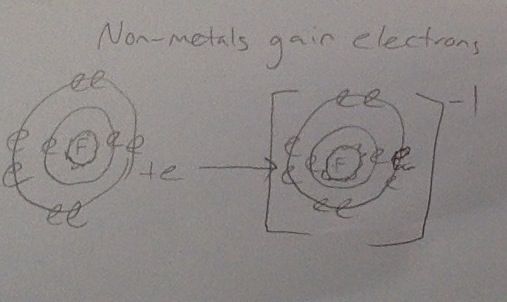
To fufill the OCTET RULE (where the outermost orbital shell is 'full') atoms will gain or lose electrons.
The general rule is Metals (Left of P.T) lose electrons, while the Non-metals (Right of P.T) gain the lost electrons
OCTET rule, the outmost orbital becomes full
Página 2
Using the Periodic Table, we see a pattern where the column the atom belongs to, also tells us the valency of it's ion formed (i.e how many electrons gained or lost
group 1- +1
group 2- +2
group 3- +3
group 4- +4
group 5- -3
group 6- -2
group 7- -1
group 8- 0
Valency is the charge left after the atom has lost or gained electrons, becoming an ion.
Atoms have no valency as they are neutral- e.g C, H, K
Ions have a charge = valency. E.g O^-2 K^+
Naming an Ionic Compound:
First-->Metal + Nonmetal <--atom loses end of name and '-ide' replaced
e.g Lithium Fluoride
e.g CuO= Copper (II) Oxide
Cu2O= Cooper (I) Oxide
Displacement reactions
When a very reactive metal displaces or replaces a metal already in a compound
Mg+CuNO3
Informações
- Descrição
- Year 11 Chemistry Notas sobre Sem título, criado por Nikki M em 26-10-2016.
- Criado por
- Nikki M · out 2016
- Atualizado
- 30 nov 2016
- Visualizações
- 0
- Avaliação