
Notas
Language Paper
Conteúdo das notas (1)
Página 1
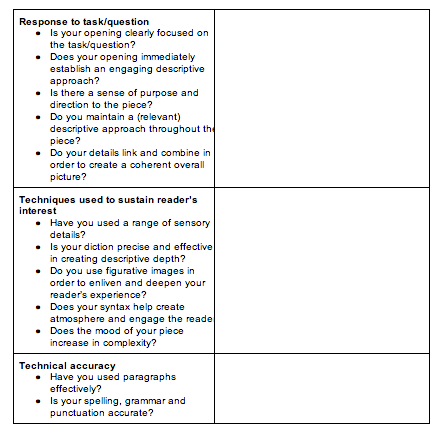
What are the conventions? Descriptive writing, primarily uses adjectives to create imagery. This is the simplest way to describe, although, there are other literary features to be included in descriptive writing.
Similes, Metaphors, Personification
Words relating to one's senses (sight/touch/hearing/smell)
Showing rather than telling - e.g. 'My heart was close to bursting' rather than 'I was scared'
These senses can be mixed up (called Synesthesia) in order to heighten sensation and really bring the scene to life e.g. tasting something that you can normally only see, such as 'the warm buttery taste of sunlight on a Summer's evening'
Very specific adjectives as opposed to general, commonly used ones and a sophisticated vocabulary
Varied sentence lengths - short sentences followed by long sentences. Short sentences work well at the start of a descriptive writing piece to grab attention or they can be used when you want to change tone, change pace of create a sudden shock
Varied sentence structures - again to help foreground the attention of the reader on the most important elements and demonstrate your control over structure to the examiner. Most English sentences are structured Actor, Verb Object - e.g. 'I (Actor) ate (verb) the apple (Object)' but a varied sentence structure might bring the verb to the front and may even put an adverb in front of that: 'Slowly (adverb) devouring (interesting verb) the apple (object) I rose from my chair and ...'
Repetition to emphasis key moments, elements or ideas
Order - descriptive writing usually has an element of organisation either chronologically or in order of importance. This can be disturbed if you want to and your description may be circular ending back to where it started which can be used to create an effect of inescapability, monotony or routine. An alternative structure is to start right in the middle of the action to grab the attention of the audience and then 'flash back' to an earlier point in time in order to explain the events leading up to the point where you started
Alliteration, sibilance, assonance, harsh consonants, hyperbole - descriptive writing is as close to poetry as you can get in narrative writing and so use all the tools that a poet has at their disposal to create effects
Hints and Tips
Do’s:
Do make up facts to your work more interesting - e.g. if asked to write about you first day at school then you don't have to write about your actual first day, which may have been quite boring and ordinary or perhaps you can't even remember it. Instead write about the first day in school from hell - complete with monstrous senior studies students stalking the corridors and slime oozing from the cockroach infested salad in the canteen
Do use every opportunity to display your knowledge of writing - exams are about showing off - so don't feel you have to stick to the truth if you feel you can write more interesting lies: however, your lies must be sane and believable - ridiculous descriptions will not gain you any marks
Do focus on small details- these give you more to write about and more opportunities to use a variety of descriptive techniques: don't feel like you have to describe everything, or to use the example above, your whole first day. A brilliant account of your fitst 5 minutes in the sandpit will probably score more marks than a routine plodding through of everything that happened on your first day in kindergarten
Do think like an examiner- include points that you would give marks for if you were an examiner
Don’ts:
Don’t forget to answer the question- if you focus too much on the fine detail you can lose sight of what you’re trying to answer
Don’t sacrifice detail for quantity
Don’t forget to use similes, metaphors and hyperbole
Example Questions 1. Describe your first vacation.
2. Describe your most memorable moment.
3. Describe the day when you went to the candy store.
4. Describe your day at the theme park with your friends.
5. Describe the room you’re in.
6. Describe your adventure to the exotic island.
7. Describe your life as a dog.
8. Describe your day as a bird.
Can u
Can use:
- alliteration
- metaphors
- similes
- personification
- hyperbole
- sibilance
- assonance
Sensory detail is important
Synesthesia = i could taste the cold winter as the snow pierced my skin and sent chills through my back, making my whole body shudder.
- change of mood i the piece
half describing one, second as it becomes more ominous or positive
Carefully shape your narratives.
Carefully plan your characters and plot line, especially the climax
Make use of settings that are familiar to you.
Use the setting to build tension.
Skilfully handle plot revelations.
Don’t forget to reveal plot details.
Don’t forget a climax
Don’t include too many events.
Don’t include unconnected and far-fetched details
Don’t use too much dialogue.
Use lively and varied vocabulary.
Use a variety of sentence structures to create effects.
Stay in the past tense.
Be carefully with punctuation Use capital letters correctly.
Avoid common spelling errors.
Adjectives
These are words that describe nouns e.g. ‘harsh’, ‘excruciating, ‘noble’. Writers use them to create a specific picture in the readers mind.
Why has the writer used these adjectives? What picture does it create?
Adverbs
These are words that describe verbs. e.g. ‘carefully’, ‘quietly’, ‘quickly’. These can be used to add more detail to an action so that the reader can picture what is going on and how.
Why has the writer added detail to this action? What picture does it create?
Alliteration
Repetition of a sound at the beginning of words, e.g. ‘Cruel Catherine…’ It is used to stress certain words or phrases or to make a point to the reader.
Why has the writer stressed these words? What point are they trying to make?
Colour
Using colour words like ‘red’ , ‘blue’ or ‘yellow’. Colour creates images in the readers mind and can affect atmosphere through connections the reader makes with that colour e.g. red associates with ‘danger’ ‘anger’ or ‘love.’
What image has been created with the use of colour? How has it affected the atmosphere?
Contrasts
Strong differences between two things. A writer might write a paragraph about a beautiful place and follow it with a paragraph describing a run-down place to show the differences between the ways in which two groups of people live.
Why has the writer chosen to show these two things? What difference is being highlighted and why?
Exclamations
Show anger, shock, horror, surprise and joy, e.g. ‘I won!’. They are used to portray emotion and show how a character reacts or is feeling.
Why has the writer chosen to put the exclamation there? What emotion or reaction are they portraying? Why?
Humour
Making a character or situation appear in a funny way can be used to mock the character or the place, or it could show that a character is humorous.
Why has the writer made this situation or character humorous? How does it affect the mood?
Imagery
(including similes, metaphors, colour and use of the 5 senses- sight, sound, touch, taste and smell)
The words allow the reader to create an image in their and involve the reader in the moment being described.
What image has been created? What is the effect of involving the reader in the moment?
Juxtaposition
The positioning of two words, phrases or ideas next to, or near, each other. This highlights a contrast between two words, phrases or ideas, e.g. ‘The two friends were known as clever Carole and stupid Steven.’
Why has the writer chosen to position these two things together? What contrast is being highlighted and why?
Metaphor
A image created by referring to something as something else, e.g. ‘storm of controversy.’ This shows meaning by directly comparing something to something else.
Why is the word being compared to something else? What element of the thing that it is being compared to is being highlighted in the word.
Negative diction
Words that are negative, e.g. ‘cruel’, ‘evil’, ‘dark’. This gives a negative tone and can portray negative feelings towards a character or situation.
Why has the writer created negative tone? What effect do these negative feelings have on the representation of the character or the atmosphere?
Onomatopoeia
Words that sound like what the describe, e.g. ‘The clash of the symbols startled John.’ The reader can almost hear the sound for themselves.
Why does the writer want the reader to hear the sound? What is the effect on the atmosphere?
Personification
Making an object/ animal sound like a person, giving it human characteristics, e.g. ‘the fingers of the tree grabbed at my hair as I passed.’
Why has the object/ animal been given human characteristics? How does it affect the mood?
Positive diction
Words that are positive, e.g. ‘happy’, ‘joyous’ They give a positive tone or portray positive feelings towards a character or situation.
Why has the writer created a positive tone? What effect do these positive feelings have on the representation of the character or the atmosphere?
Sentence Length.
Short sentences are just a few words long, without detail. ‘I wondered if he knew what he was doing to me. It hurt. A lot.’ Short sentences affect the speed the piece is read and grabs attention.
Why has the writer used a short sentence? How does it affect the speed and tension?
Simile
A comparison between two things that includes the words ‘as’ or ‘like’, e.g. ‘Her voice cut through him like a knife.’ This shows meaning by comparing something to something else
Why has the word been compared to something else? What element of the thing that it is being compared to has been highlighted in the word.
Verbs
Action words such as ‘scrambled’, ‘sprinted’, ‘leaped’. The writer uses these to add action to the writing.
Why has the writer used these verbs? What mood has been created?
Beautiful Words Amorphous: indefinite, shapeless
Beguile: deceive
Caprice: impulse
Cascade: steep waterfall
Cashmere: fine, delicate wool
Chrysalis: protective covering
Cinnamon: an aromatic spice; its soft brown color
Coalesce: unite, or fuse
Crepuscular: dim, or twilit
Crystalline: clear, or sparkling
Desultory: half-hearted, meandering
Diaphanous: gauzy
Dulcet: sweet
Ebullient: enthusiastic
Effervescent: bubbly
Elision: omission
Enchanted: charmed
Encompass: surround
Enrapture: delighted
Ephemeral: fleeting
Epiphany: revelation
Epitome: embodiment of the ideal
Ethereal: celestial, unworldly, immaterial
Etiquette: proper conduct
Evanescent: fleeting
Evocative: suggestive
Exuberant: abundant, unrestrained, outsize
Felicity: happiness, pleasantness
Filament: thread, strand
Halcyon: care-free
Idyllic: contentedly pleasing
Incorporeal: without form
Incandescent: glowing, radiant, brilliant, zealous
Ineffable: indescribable, unspeakable
Inexorable: relentless
Insouciance: nonchalance
Iridescent: luster
Languid: slow, listless
Lassitude: fatigue
Lilt: cheerful or buoyant song or movement
Lithe: flexible, graceful
Lullaby: soothing song
Luminescence: dim chemical or organic light
Mellifluous: smooth, sweet
Mist: cloudy moisture, or similar literal or virtual obstacle
Murmur: soothing sound
Myriad: great number
Nebulous: indistinct
Opulent: ostentatious
Penumbra: shade, shroud, fringe
Plethora: abundance
Quiescent: peaceful
Quintessential: most purely representative or typical
Radiant: glowing
Redolent: aromatic, evocative
Resonant: echoing, evocative
Resplendent: shining
Rhapsodic: intensely emotional
Sapphire: rich, deep bluish purple
Scintilla: trace
Serendipitous: chance
Serene: peaceful
Somnolent: drowsy, sleep inducing
Sonorous: loud, impressive, imposing
Spherical: ball-like, globular
Sublime: exalted, transcendent
Succulent: juicy, tasty, rich
Suffuse: flushed, full
Susurration: whispering
Symphony: harmonious assemblage
Talisman: charm, magical device
Tessellated: checkered in pattern
Tranquility: peacefulness
Vestige: trace
Zenith: highest point
Ugly Words Cacophony: confused noise
Cataclysm: flood, catastrophe, upheaval
Chafe: irritate, abrade
Coarse: common, crude, rough, harsh
Cynical: distrustful, self-interested
Decrepit: worn-out, run-down
Disgust: aversion, distaste
Grimace: expression of disgust or pain
Grotesque: distorted, bizarre
Harangue: rant
Hirsute: hairy
Hoarse: harsh, grating
Leech: parasite,
Maladroit: clumsy
Mediocre: ordinary, of low quality
Obstreperous: noisy, unruly
Rancid: offensive, smelly
Repugnant: distasteful
Repulsive: disgusting
Shriek: sharp, screeching sound
Shrill: high-pitched sound
Shun: avoid, ostracize
Slaughter: butcher, carnage
Unctuous: smug, ingratiating
Visceral: crude, anatomically graphic
Descriptive Writing
Narrative Writing
100 Beautiful and Ugly Words
Informações
- Descrição
- IGCSE English (Language) Notas sobre Language Paper, criado por ShreyaDas em 04-04-2014.
- Criado por
- ShreyaDas · abr 2014
- Atualizado
- 6 abr 2018
- Visualizações
- 347
- Tags
- Avaliação