
Notas
Blood Administration
Conteúdo das notas (2)
Página 1
Blood Administration
Blood products used and the conditions they treat:
Red Blood Cells
Symptomatic anemia
Hemoglobin level of 7–8 g/dL in stable, hospitalized patients
Hemoglobin ≤8 g/dL in the presence of clinical symptoms for patients with cardiovascular disease
Plasma
Replacement of clotting factors in patients with a demonstrated deficiency or for single-factor deficiency when concentrate not available
Correct coagulation deficiencies
Before an invasive procedure
Burn victims
Platelets
Acute thrombocytopenia:
Platelet count <10,000/μL
Stable patients with chronic thrombocytopenia: 5000/μL
Fever or recent hemorrhage (with bleeding controlled): 10,000/μL
Patients with coagulopathy, on heparin, or with anatomic lesion likely to bleed: 20,000/μL
Procedure for blood administration:
Confirm consent
Verify the order
assess for 18-20 gauge catheter of needle inserted into vein
assess baseline vital signs, oxygen saturation and lung sounds
assess blood type and check label prior to administration
perform double check of blood product/patient
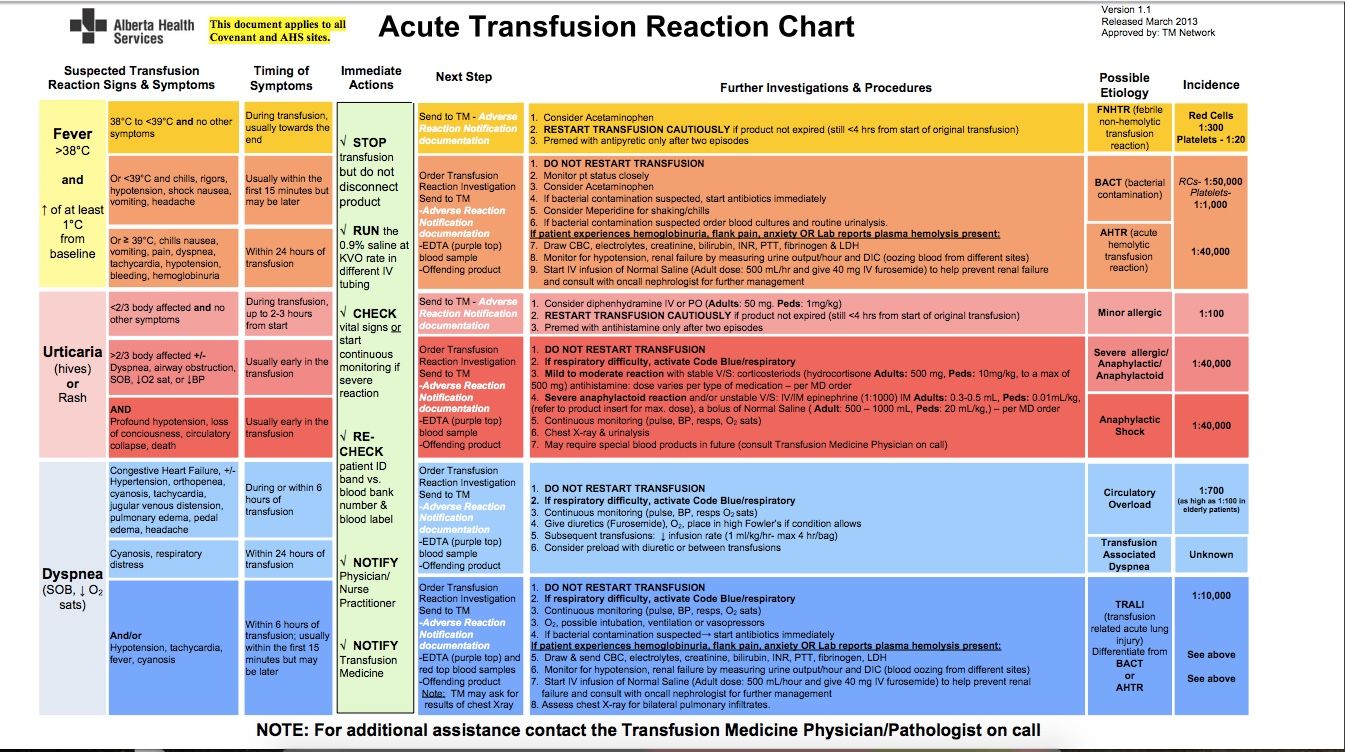
monitor transfusion of blood/components and monitor for complications
identify and use appropriate infusion tubing to deliver blood/components with.
170 to 260 micron filter; tubing is good for 8 hours and as many infusions as can be done in that time
sideline solution container of .9% normal saline. The use of dextrose in water or hypotonic solutions can cause RBC hemolysis as a result of cell swelling. Lactated Ringer’s solution is not recommended because it contains enough ionized calcium to overcome the anticoagulant effect of CPDA-1 and allows small clots to develop.
transfuse blood/blood components at appropriate rates
Vitals taken in first 15 minutes
1ml/min for the first 15 minutes, look for anaphykaxis, do not leave
Transfusion must be complete within 4 hours
dispose of blood bag and tubing properly. (biohazard)
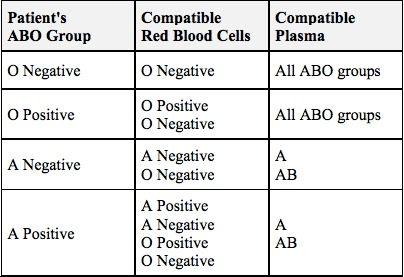
A note on cross-match: Lab comes to draw, need two people to identify patient. Cross match is good for 72 hours, but can be extended if there’s no transfusion in the first 72 hours. Cross match takes 30 minutes for someone who hasn’t gotten a transfusion before. 10 hours for Denane’s dad. The more transfusion a pt has, the longer it takes to cross match because they make more and more antibodies
Type O: no ABO Antigens on Red Cells; anti-A and anti-B Antibodies in Plasma
Type A: A antigens on red cells, anti-B antibodies in plasma
Type B: B antigens on red cells; anti-A antibodies in plasma
Type AB: A+B antigens on red cells; no antibodies in plasma
Página 2
Informações
- Descrição
- An overview of blood administration, procedure, and ABO compatibilities
- Criado por
- Sarah-Jean Edmonds · mar 2017
- Atualizado
- 6 abr 2018
- Visualizações
- 81
- Tags
- Avaliação