
Quiz
C2.1 Structure and Bonding
Crie uma conta grátis para terminar este quiz
Salve seu progresso e veja sua nota final.
Já tem uma conta? Inicie sessão
Perguntas do quiz (13)
1What is a compound?
- AWhen two elements react with each other.
- BA molecule made up of different elements.
- CA substance made of two or more elements that are chemically joined together.
2Which electrons in an atom are involved in bonding?
- AThe Inner electrons (closest to nucleus).
- BThe outer electrons (highest energy level of shells).
- CAll electrons.
3What happens to the electrons in atoms when ionic bonds are formed?
- AThey are lost in the reaction.
- BThey are shared with the other atom - so all atoms have full shells.
- CThey are transferred (metal lose electron, non-metal gains electron)
4What happens to electrons in atoms when covalent bonds are formed?
- AThey are shared (for each covalent bond, a pair of electrons is shared)
- BThey are transferred (metal atom loses electron, non-metal atom gains electron)
- COuter electrons are lost in reaction.
5Why do the elements in group 1 form ions with a single positive charge?
- AThey gain an electron, which means its charge becomes positive.
- BThey lose one outer electron (which has a negative charge, so charge becomes positive)
- CThey gain protons in it's nucleus so its charge becomes positive.
6Why do elements in group 7 form ions with a single negative charge?
- AThey lose their seven electrons which makes the atom charge negative.
- BThey lose one electron which makes the atom negative.
- CThey gain one electron to make a full outer shell (electron is negative).
7Which of the following substances are make of molecules? (all numbers are subscript)
- AKCl
- BH2O
- CC2H6
- DMgO
- ECO2
- FNaNO3
8Why can the structure of a metallic element like copper be represented by lots of spheres the same size packed closely together?
- AThe atoms in copper are all the same size (and are spherical) and are packed tightly together (as a solid, in a giant structure)
- BAtoms are always represented as small circles the same size, solids are made of closely packed atoms and copper is a solid (at room temp).
- CAtoms are all metallic so are the same size and are packed closely together (as they attract each other).
9Why do ionic compounds have giant structures?
- AIons always have a free bond so attract more and more ions.
- BThe forces between oppositely charged ions act in all directions, so ions are packed closely together in a regular arrangement.
- CIons are very small so a crystal contains many ions.
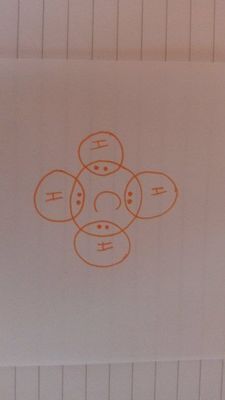
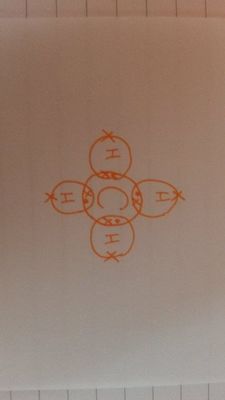
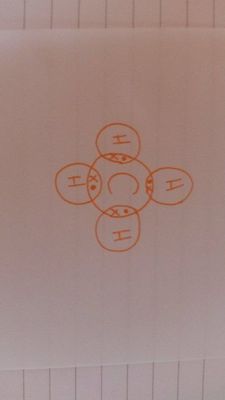
10Which is the correct dot and cross diagram for CH4? (4 is subscript)
- A
- B
- C
- A
11Which is the correct diagram showing covalent bonds for H2O and 02?
- AH-O-H, O=O
- BH-O-H, O-O
- CH-H-O, O=O
12Why does silicon (group 4) have a giant structure?
- AGroup for elements can react and join to multiple atoms, this happens here and a giant structure is formed.
- BSilicon atoms join to others in al directions, so giant structure is formed.
- CThey have four covalent bonds, so form to four other atoms, this continues until a giant structure is formed.
13How are the atoms in sodium (metal) held together?
- AAtoms share electrons with each so all atoms have a full outer shell, this holds the atoms in place together. (forces between atoms are strong)
- BOuter electrons delocalise, leaving a lattice of positive ions, the delocalised electrons attract positive ions and hold them in position. (Electrostatic forces are strong)
- CMetallic atoms attract each other and are held together by strong magnetic forces.
Informações
- Descrição
- Chemistry 2, Structure and Bonding (AQA)
- Autor
- elzzie
- Idioma
- English
- Visualizações
- 949
- Etiquetas
- Avaliação
- 4,7 de 5 · 6 avaliações Avalie este quiz