
Quiz
SD329 Block 1
Este quiz tem tipos de pergunta que abrem no player de sempre.
Perguntas do quiz (14)
1We obtain all our experience of the external world through our [blank_start]senses[blank_end]. The development of the brain from birth onwards, particularly in the [blank_start]first years of life[blank_end], depends crucially on the information received from the senses. Extended periods of [blank_start]sensory deprivation[blank_end] can lead to permanent [blank_start]damage[blank_end] of the brain
- Asenses
- Bsensory deprivation
- Cdamage
- Dfirst years of life
2Sensory processing comprises two overlapping stages: first, [blank_start]reception[blank_end] of the sensory stimulus, called ‘[blank_start]sensation[blank_end]’, and second, the [blank_start]construction[blank_end] of a mental [blank_start]representation[blank_end] of the sensory environment, called ‘[blank_start]perception[blank_end]’.
- Areception
- Bsensation
- Cconstruction
- Drepresentation
- Eperception
3The mental [blank_start]representation[blank_end] formed from sensory information is referred to as a [blank_start]percept[blank_end], and is the result of a range of processes including context, [blank_start]attention[blank_end] and past [blank_start]experiences[blank_end].
It is possible to investigate the process of [blank_start]perception[blank_end] using illusory figures, which are able to separate [blank_start]sensation[blank_end] from perception.- Arepresentation
- Bpercept
- Cattention
- Dexperiences
- Eperception
- Fsensation
4Our interpretation of the [blank_start]sensory environment[blank_end] requires more than the [blank_start]integration[blank_end] of individual sensory signals. Rather, we make a number of [blank_start]assumptions[blank_end] about our environment, such as what features should remain [blank_start]constant[blank_end], and use a number of different [blank_start]sensory cues[blank_end], for example interposition, to perceive a [blank_start]three-dimensional world[blank_end].
- Asensory environment
- Bintegration
- Cassumptions
- Dconstant
- Esensory cues
- Fthree-dimensional world
5The processes of [blank_start]sensation[blank_end], perception and motor [blank_start]action[blank_end] allow us to actively engage with our sensory [blank_start]environment[blank_end] and learn about it, so as to inform [blank_start]future[blank_end] actions.
- Asensation
- Baction
- Cenvironment
- Dfuture
6The [blank_start]bodily[blank_end] senses consist of a wide range of different types of [blank_start]receptors[blank_end] providing information about the external [blank_start]sensory[blank_end] world and about the [blank_start]body[blank_end] itself.
In the case of touch and [blank_start]pain[blank_end], the receptors are located [blank_start]all over[blank_end] the body. By contrast, receptors for [blank_start]proprioception[blank_end] are rather more limited in their locations, being found in joints, [blank_start]muscles[blank_end] and tendons.- Abodily
- Breceptors
- Csensory
- Dbody
- Epain
- Fall over
- Gproprioception
- Hmuscles
7The sense of hearing is a [blank_start]distal[blank_end] sense and involves sound waves stimulating [blank_start]mechanoreceptors[blank_end] found in the ear. The characteristics of the [blank_start]wave[blank_end] relate to the [blank_start]perceptual[blank_end] features of the [blank_start]sound[blank_end], such as the [blank_start]pitch[blank_end] of a musical note.
- Adistal
- Bproximal
- Cmechanoreceptors
- Dwave
- Eperceptual
- Fsound
- Gpitch
8The [blank_start]vestibular[blank_end] system detects [blank_start]proprioceptive[blank_end] information (important for balance) but is often considered separately because it relates entirely to the position of the [blank_start]head[blank_end].
- Avestibular
- Bproprioceptive
- Chead
9[blank_start]Vision[blank_end] is a [blank_start]distal[blank_end] sense and involves a [blank_start]light wave[blank_end] signal entering the eye and stimulating [blank_start]photoreceptors[blank_end] in the [blank_start]retina[blank_end]. As with hearing, the characteristics of the light wave affect the [blank_start]perceptual[blank_end] characteristics.
- AVision
- Bdistal
- Cproximal
- Dlight wave
- Ephotoreceptors
- Fretina
- Gperceptual
10Smell and taste are often referred to as the [blank_start]chemical[blank_end] senses because they require [blank_start]molecular[blank_end] interactions as a stimulus. They are intimately [blank_start]linked[blank_end] and, when combined, give rise to the perception of [blank_start]flavour[blank_end].
- Achemical
- Bmolecular
- Clinked
- Dflavour
11Fill in the table
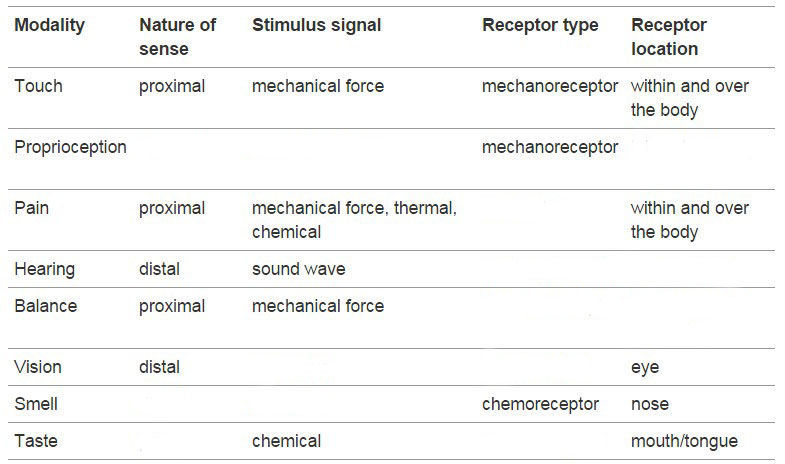
- Adistal
- Bproximal
- Cdistal
- Dproximal
- Edistal
- Fproximal
- Gmechanical force
- Hlight wave
- Isound wave
- Jchemical
- Kmechanical force
- Llight wave
- Msound wave
- Nchemical
- Omechanical force
- Plight wave
- Qsound wave
- Rchemical
- Smechanoreceptor
- Tnociceptor
- Uchemoreceptor
- Vphotoreceptor
- Wmechanoreceptor
- Xnociceptor
- Yphotoreceptor
- Zchemoreceptor
- AAmechanoreceptor
- ABnociceptor
- ACphotoreceptor
- ADchemoreceptor
- AEmechanoreceptor
- AFnociceptor
- AGphotoreceptor
- AHchemoreceptor
- AImechanoreceptor
- AJnociceptor
- AKphotoreceptor
- ALchemoreceptor
- AMwithin and over the body
- ANjoints, tendons and muscles
- AOear (vestibular system)
- APeye
- AQeye
- ARear (cochlea)
- ASear (vestibular system)
- ATjoints, tendons and muscles
- AUear (cochlea)
- AVear (vestibular system)
12People who have [blank_start]impairments[blank_end] involving their sense of [blank_start]touch or pain[blank_end] are very rare. Lack of the sense of [blank_start]pain[blank_end] can lead to [blank_start]permanent damage[blank_end] since, if pain is absent, there is no early [blank_start]warning[blank_end] signal that the body is at risk.
- Aimpairments
- Btouch or pain
- Cpain
- Dpermanent damage
- Ewarning
13Sensory [blank_start]impairments[blank_end] associated with vision and hearing are considerably more [blank_start]common[blank_end] than other sensory impairments, and clearly illustrate the different extents to which deficits may occur. For example, some individuals are unable to hear certain [blank_start]frequencies[blank_end] and others are totally [blank_start]deaf[blank_end]; visual impairments range from [blank_start]mild colour deficiency[blank_end] to total [blank_start]blindness[blank_end].
- Aimpairments
- Bcommon
- Cfrequencies
- Ddeaf
- Emild colour deficiency
- Fblindness
14Impairments of [blank_start]smell and taste[blank_end], although seemingly less problematic than disorders of the other senses, can have a substantial effect on a person’s [blank_start]quality[blank_end] of life. They can affect the [blank_start]diet[blank_end], as well as introduce dangers caused by the inability to detect gas, or smoke or spoiled food. The noticeable loss of the sense of smell or taste may be the first indication of an [blank_start]illness[blank_end], leading to earlier diagnosis and treatment than might otherwise be the case – for example, the early warning of the onset of [blank_start]Alzheimer’s[blank_end] disease.
- Asmell and taste
- Bquality
- Cdiet
- Dillness
- EAlzheimer’s
Informações
- Descrição
- Quiz based on the summaries of Block 1
- Autor
- Mikki M
- Idioma
- English
- Visualizações
- 45
- Etiquetas
- Avaliação
- Ainda sem avaliações Avalie este quiz