
Quiz
Midterm 2 Prep
Este quiz tem tipos de pergunta que abrem no player de sempre.
Perguntas do quiz (66)
1What is starch made from?
- Aglycogen
- Bcellulose
- Camylose
- Damylopectin
2What type of bonds do both glycogen and amylopectin share at their branch points?
- Aalpha- 1,3
- Balpha- 1,5
- Calpha - 1,6
- Dalpha- 1,4
3Glycogen has shorter branch points than amylopectin (one every 6-10 residues).
- AVerdadeiro
- BFalso
4[blank_start]Glycogen[blank_end] has more branching than [blank_start]amylopectin[blank_end] because animals require [blank_start]rapid[blank_end] release of energy for flight/fight response. More branching means that enzymes have more access for degradation.
- AGlycogen
- Bamylopectin
- Crapid
5[blank_start]Glycogen[blank_end] has more branching than [blank_start]amylopectin[blank_end] because animals require [blank_start]rapid release[blank_end] of energy for flight/fight response. More branching means that [blank_start]enzymes[blank_end] have more access for degradation.
- AGlycogen
- Bamylopectin
- Crapid release
- Dslow release
- Eenzymes
- Fproteins
- Gamino acids
6Cellulose form [blank_start]beta-1,4 linkages[blank_end]. It is a [blank_start]linear[blank_end] polymer that forms [blank_start]insoluable[blank_end] fibre in our gut. This is because humans don't have [blank_start]beta-glucosidase[blank_end]. Cellulose [blank_start]H-bonds[blank_end] with itself not water.
- Abeta-1,4 linkages
- Balpha - 1,4 linkages
- Cbeta-1,6 linkages
- Dlinear
- Ebranched
- Finsoluable
- Gsoluble
- Hbeta-glucosidase
- Ialpha-glucosidase
- JH-bonds
- Kvan der Waal bonds
- Lionic bonds
7Pectin forms [blank_start]soluble[blank_end] fibre in our gut because it h-bonds lots with [blank_start]water[blank_end]. It has [blank_start]alpha- 1,2[blank_end] glycosidic bonds and can also bind [blank_start]cholesterol[blank_end] and bile salts.
- Asoluble
- Binsoluble
- Cwater
- Ditself
- Eother molecules
- Falpha- 1,2
- Galpha - 1,4
- Halpha - 1,6
- Icholesterol
- Jamino acids
- Kproteins
8[blank_start]Starch[blank_end]: amylose + amylopectin
[blank_start]Amylose[blank_end]: linear polysaccharide made of glucose monomers
[blank_start]Amylopectin[blank_end]: branched (every 24-26 residues) polysaccharide made of glucose monomers
[blank_start]Glycogen[blank_end]: branched (every 6-10 residues) polysaccharide made of glucose monomers; found in animals
[blank_start]Cellulose[blank_end]: forms insoluble fibre in our gut, has beta-1,4 linkages
[blank_start]Pectin[blank_end]: soluble fibre in our gut has alpha 1,2 glycosidic bonds and [blank_start]CHARGED[blank_end] sugars- AStarch
- BAmylose
- CAmylopectin
- DGlycogen
- ECellulose
- FPectin
- GCHARGED
- HUNCHARGED
9This disaccharide is _______. It is composed of ________ and __________. It has _____________ bond.
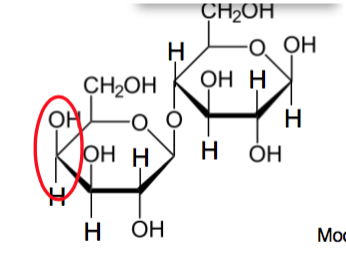
- Abeta-1,4 bond
- Balpha- 1,4 bond
- Cgalactose
- Dglucose
- Eglucose
- Fmaltose
- Glactose
- Hsucrose
- Imaltose
- Jisomaltose
10This disaccharide is _______. It is composed of ________ and __________. It has _____________ bond.
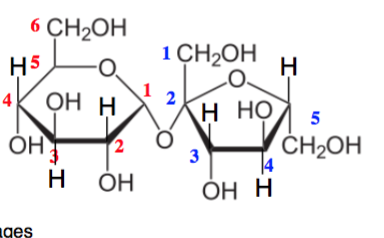
- Aglucose
- Bgalactose
- Cfructose
- Dmaltose
- Ealpha- 1,2 glycosidic bond
- Falpha -1,3 glycosidic bond
- Gsucrose
- Hlactose
- Iisomaltose
11This disaccharide is _______. It is composed of ________ and __________. It has _____________ bond.
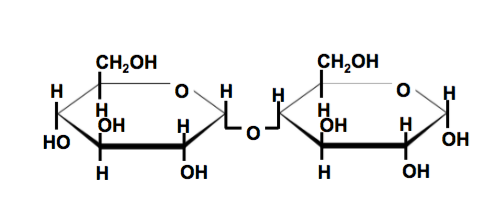
- Amaltose
- Blactose
- Csucrose
- Disomaltose
- Ealpha- 1,4 glycosidic bond
- Falpha - 1,2 glycosidic bond
- Gbeta- 1,4 glycosidic bond
- Hbeta- 1,2 glycosidic bond
- IGlucose
- JGalactose
- Kglucose
- Lfructose
12This disaccharide is _______. It is composed of ________ and __________. It has _____________ bond.
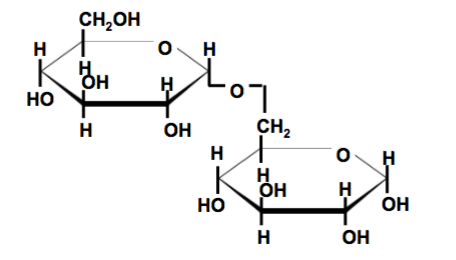
- Aalpha- 1,6 glycosidic bond
- Balpha- 1,4 glycosidic bond
- Cbeta- 1,6 glycosidic bond
- Dbeta- 1,4 glycosidic bond
- EGlucose
- FGalactose
- Gglucose
- Hfructose
- IIsomaltose
- JMaltose
- KLactose
- LSucrose
13Galactose is an epimer of glucose at carbon 4.
- AVerdadeiro
- BFalso
14Maltose and Isomaltose are:
- Adigestion products
- Bmade in glycolysis
- Cmade in plants
15[blank_start]Amylases[blank_end] hydrolyze alpha- 1,4 bonds in [blank_start]glycogen[blank_end], [blank_start]amylose[blank_end] and [blank_start]amylopectin[blank_end]. They are [blank_start]endoglycosidases[blank_end].
- AAmylases
- BProteases
- Cglycogen
- Dcellulose
- Eamylose
- Fstarch
- Gamylopectin
- Hendoglycosidases
- Iexoglycosidases
16Digestion (further) of maltose and isomaltose takes place in the:
- AMouth
- BStomach
- CVilli (intestine)
- DColon
17Name the enzyme that controls the following reactions:
[blank_start]Maltase/Isomaltase[blank_end]: Maltose/Isomaltose + H2O ---> 2 Glucose
[blank_start]Lactase[blank_end]: Lactose + H2O ---> [blank_start]Glucose[blank_end] + [blank_start]Galactose[blank_end]
[blank_start]Sucrase[blank_end]: Sucrose + H2O ---> Glucose + [blank_start]Fructose[blank_end]- ASucrase
- BGlucose
- CGalactose
- DFructose
- ELactase
- FMaltase/Isomaltase
18What type of sugars remain after digestion?
- APolysaccherides
- BDisaccharides
- CMonosaccharides
19How is the sodium gradient established for the transport of monosaccharides following digestion?
- ADiffusion
- BSecondary Active Transport
- CK+/Na+ ATPase
- DIonophore-mediated ion transport
20[blank_start]GLUT 1[blank_end]: Ubiquitous, all cells have this transporter
[blank_start]GLUT 4[blank_end]: Muscle, fat and heart --> [blank_start]Insulin Sensitive[blank_end]
[blank_start]GLUT 2[blank_end]: Liver, pancreas, islets and intestine
GLUT 5: transports [blank_start]fructose[blank_end]
GLUT 2: transports [blank_start]glucose[blank_end], [blank_start]galactose[blank_end] and fructose- AGLUT 1
- BGLUT 4
- CInsulin Sensitive
- DGlucagon Sensitive
- EGLUT 2
- Ffructose
- Gglucose
- Hgalactose
21[blank_start]SGLUT[blank_end] transporters transport glucose using [blank_start]Na+ secondary active transport[blank_end]. These transporters are called [blank_start]symporters[blank_end]. [blank_start]GLUT[blank_end] transporters transport glucose using [blank_start]passive diffusion[blank_end]. These transporters are [blank_start]uniporters[blank_end] and exist in [blank_start]two[blank_end] conformations.
- ASGLUT
- BNa+ secondary active transport
- Csymporters
- DGLUT
- Epassive diffusion
- Funiporters
- Gtwo
- Hthree
- Ifour
22Glucose has electrical potential
- AVerdadeiro
- BFalso
23Each GLUT transporter has its own glucose affinity (Km) and its own maximum rate of transport (Vmax).
- AVerdadeiro
- BFalso
24[blank_start]Insulin[blank_end] increases the number of [blank_start]GLUT 4[blank_end] transporters on the plasma membrane to [blank_start]increase[blank_end] the speed of transport.
- AInsulin
- BGlucagon
- CAdrenalin
- DGLUT 4
- EGLUT 2
- FGLUT 1
- Gincrease
- Hdecrease
25What do C1 and C2 represent?

- A[glucose] inside the cell
- B[glucose] outside the cell
26Why is transport "saturable" for GLUT transporters? Because it involves _______.
- AProteins
- BCoenzymes
- CCholesterol
- DAmino Acid Side Chains
27Label the transporters:
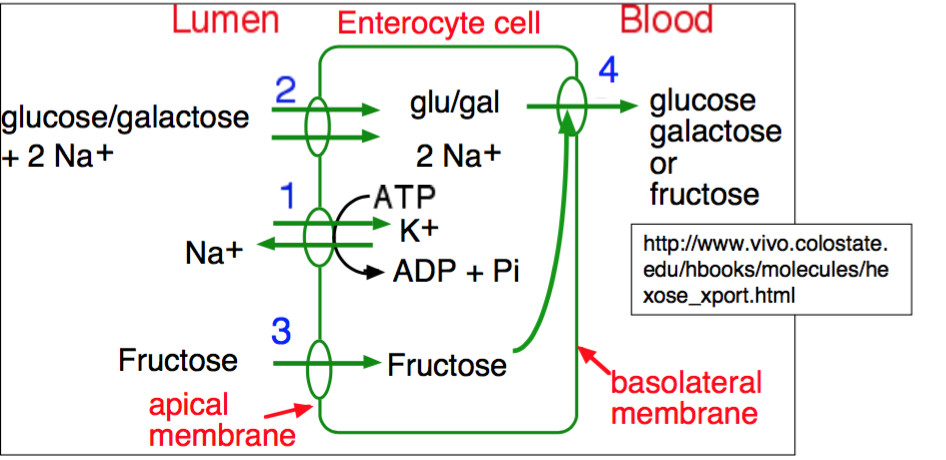
- ANa+/K+ Pump
- BBuilds up Na+ Gradient
- CSGLUT
- DGLUT 5
- EGLUT 2
- FActive Transport
- GPassive Diffusion
28What enzyme is not feedback inhibited by high levels of G6P ?
- AHexokinase IV (Glucokinase)
- BHexokinase I
- CHexokinase II
- DHexokinase III
29Label the diagram with the correct enzyme and tissue type
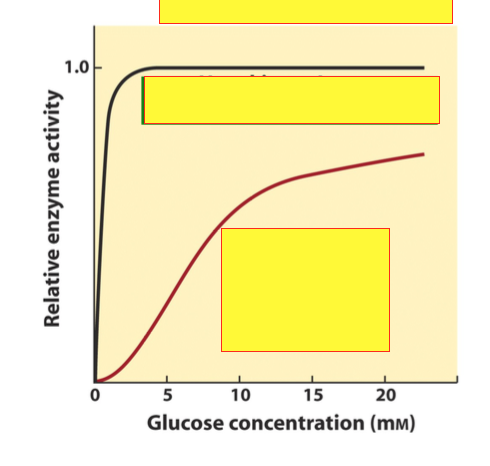
- AHexokinase (I,II and III)
- BMuscle, Brain, Adipose
- CHexokinase IV (Glucokinase)
- DLiver
30Is glycogen a reducing or non-reducing sugar?
- ANon-reducing
- BReducing
31Glycogen synthase has a standard free energy change of [blank_start]-13.4[blank_end] kJ/mol in the reaction of UDP-glucose + Glycogen (n) --> glycogen (n+1)
- A-13.4
32A [blank_start]phosphoanhydride[blank_end] bond holds glucose and UDP together when Glucose-1-Phosphate is converted to UDP-Glucose by [blank_start]UDP-glucose pyrophosphorylase[blank_end].
- Aphosphoanhydride
- BUDP-glucose pyrophosphorylase
33Step 3 in glycogen synthesis is completely [blank_start]reversible[blank_end] because the products:UDP-Glucose and [blank_start]PPi[blank_end] both have a [blank_start]phosphoanhydride[blank_end] bond. This means that the standard free energy change for this reaction is [blank_start]zero[blank_end], until PPi is cleaved in step [blank_start]5[blank_end].
- Areversible
- Birreversible
- CPPi
- DUMP
- Ephosphoanhydride
- Fphosphomonoester bond
- GCyclic phosphodiester bond
- Hzero
- I-13.4 kJ/mol
- J5
- K6
- L7
34What is the purpose of glycogen branching in animals?
- AThere is no branching in glycogen.
- BIncreases glucose packing density.
- CIncreases the rate of degradation
- DDecreases the rate of degradation
- EProtects the polymer from cellular damage.
35Where are glucagon receptors found in the body?
- ALiver
- BMuscle
- CIntracellularly
- DExtracellularly
36Where are Beta-Adrenergic Receptors found in the body?
- AIntracellularly
- BExtracellulary
- CLiver
- DMuscle
37How is signaling amplified in Epinephrine and Glucagon Signalling?
- Avia the alpha subunit
- BVia receptor upregulation
- CBecause for each GTP binding event 20 cyclic 3'5' AMP molecules are generated
38[blank_start]Insulin[blank_end] utilizes Protein phosphotase-1 (PP-1) to regulate other enzyme activity by hydrolyzing off phosphates attached to specific amino acid side chains. [blank_start]Epinephrine and Glucagon[blank_end] utilize [blank_start]protein kinase A[blank_end] (PKA) to [blank_start]phosphorylate[blank_end] many of the enzymes that PP-1 dephosphorylates. It is the [blank_start]catalytic[blank_end] domains of PKA that are involved in phosphorylation. Hence, PKA and PP-1 are [blank_start]antagonists[blank_end].
- AInsulin
- BEpinephrine and Glucagon
- Cprotein kinase A
- Dphosphorylate
- Edephosphorylate
- Fcatalytic
- Gregulatory
- Hantagonists
- Iagonists
39PKA is a:
- AMonomer
- BDimer
- CTrimer
- DTetramer
40How many cAMP must bind to each PKA molecule and how many cAMP bind per regulatory unit? (_,_)
- A4,2
- B4,1
- C8,1
- D3,2
41For a single binding event of glucagon or epinephrine, how many glucose molecules are released? What is this an example of?
- A1,000 and signal transduction
- B1,000 and amplification
- C10,000 and signal transduction
- D10,000 and amplification
42[blank_start]G-6-P[blank_end] is the final product of glycogen degradation in muscle, wheras [blank_start]glucose[blank_end] is the final product in liver.
- AG-6-P
- Bglucose
43What phosphorylase a?
- AMonomer
- BDimer
- CTrimer
- DTetramer
44How does phos a break off 10 G1P units from the non-reducing end of glycogen?
- AHydrolysis
- BTransfer
- CPhosphorlysis
- DCleavage
45Which two enzymes use PLP as a coenzyme?
- APhosphorylase A
- BTransaminases
- CSuccinate dehydrogenase
- DMalate-Aspartate Shuttle
46PLP is a precursor for which vitamin?
- AB12
- BB6
- CB7
- DB10
47Glucokinase is sequestered in the nucleus during [blank_start]glycogen degradation[blank_end] to prevent a [blank_start]futile cycle[blank_end] from occurring. [blank_start]High[blank_end] blood glucose concentration returns glucokinase back to the [blank_start]cytoplasm[blank_end]. This type of regulation is regulation by [blank_start]compartmentalization[blank_end].
- Aglycogen degradation
- Bfutile cycle
- Coverload
- Drespiration
- EHigh
- FLow
- Gcytoplasm
- HER
- Icompartmentalization
- Jsequestering
48Which enzyme covalently modifies glycogen synthase to inactivate it and through what mechanism does this take place?
- APKA, Phosphorylation
- BPhos B, Dephosphorylation
- CPhos A, Dephosphorylation
- DG-6-P, Cofactor
49Match the allosteric regulatory with the correct enzyme:
[blank_start]G6P (-)[blank_end]: Hexokinase in muscle
[blank_start]Ca2+ (+)[blank_end]: Phosphorylase b kinase (inactive)
[blank_start]AMP[blank_end]: Phosphorylase b (inactive)
[blank_start]ATP (-)[blank_end]: Phosphorylase a (active) IN MUSCLE
[blank_start]Glucose (-)[blank_end]: Phosphorylase a (active) IN LIVER
[blank_start]G6P (+)[blank_end]: Glycogen synthase b (inactive)
[blank_start]Ca2+ and AMP[blank_end]: Non-stress conditions signals glycogen break down- AG6P (-)
- BCa2+ (+)
- CAMP
- DATP (-)
- EGlucose (-)
- FG6P (+)
- GCa2+ and AMP
501. Label the image with the situation that corresponds to the pathway shown.
Note: (m) = Muscle (L) = Liver
2. Identify what enzyme activates/inactivate a certain pathway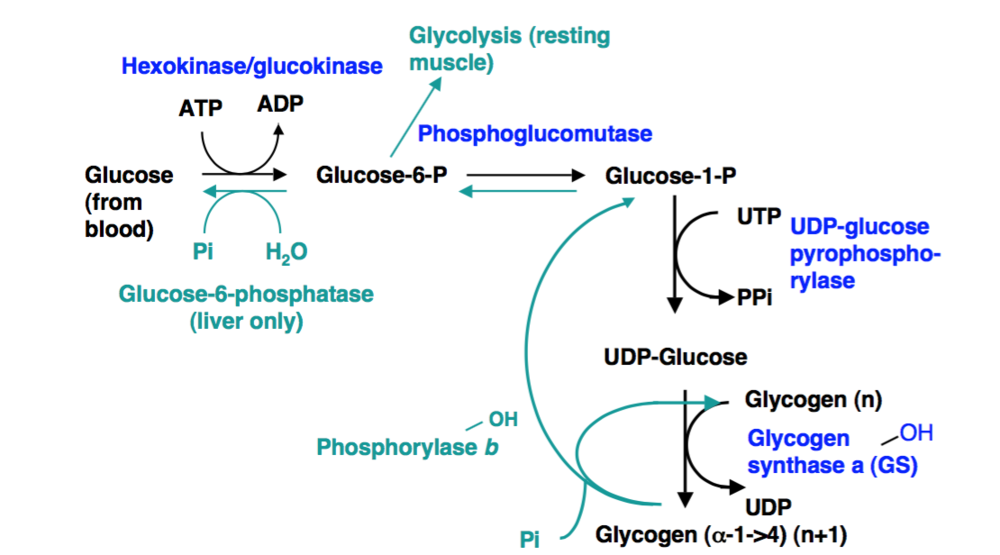
- AGlycogen Degradation - Fight/Flight (m)
- BGlycogen Synthesis - postmeal - (m+L)
- CGlycogen Degradation - Fear no run (m)
- DGlycogen Degradation - hormonal G/E (L)
- EGlycogen Degradation - Fear no run (L)
- FPhos a --> phos b via PKA
- GPhos a --> phos b via PP-1
- HGSb --> GSa via increased G-6-P
- IGSb --> GSa via phosphorylation
511. Label the image with the situation that corresponds to the pathway shown.
Note: (m) = Muscle (L) = Liver
2. Identify what enzyme activates/inactivate a certain pathway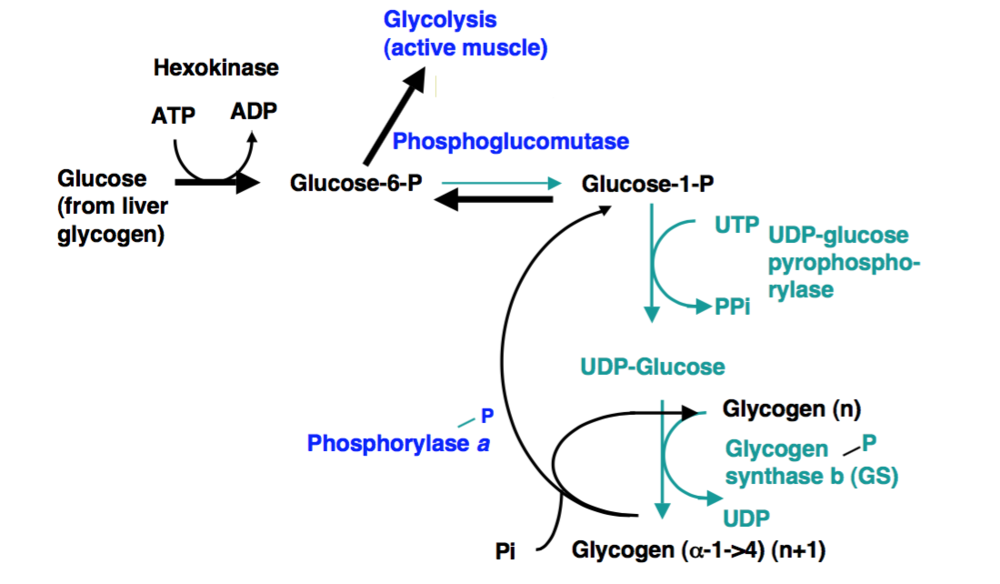
- AGlycogen Synthesis - post meal: (m+L)
- BGlycogen Degradation - Fight/Flight (m)
- CGlycogen Degradation - Fear, no run (m)
- DGlycogen Degradation - Fear, no run (L)
- EGlycogen Degradation - Hormonal G/E (m)
- FPhos b --> Phos a via PP-1
- GPhos b --> Phos a via Phos b kinase
- HPP-1 is inactivated by PKA
- IPP-1 is inactivated by GSa
521. Label the image with the situation that corresponds to the pathway shown.
Note: (m) = Muscle (L) = Liver
2. Identify what enzyme activates/inactivate a certain pathway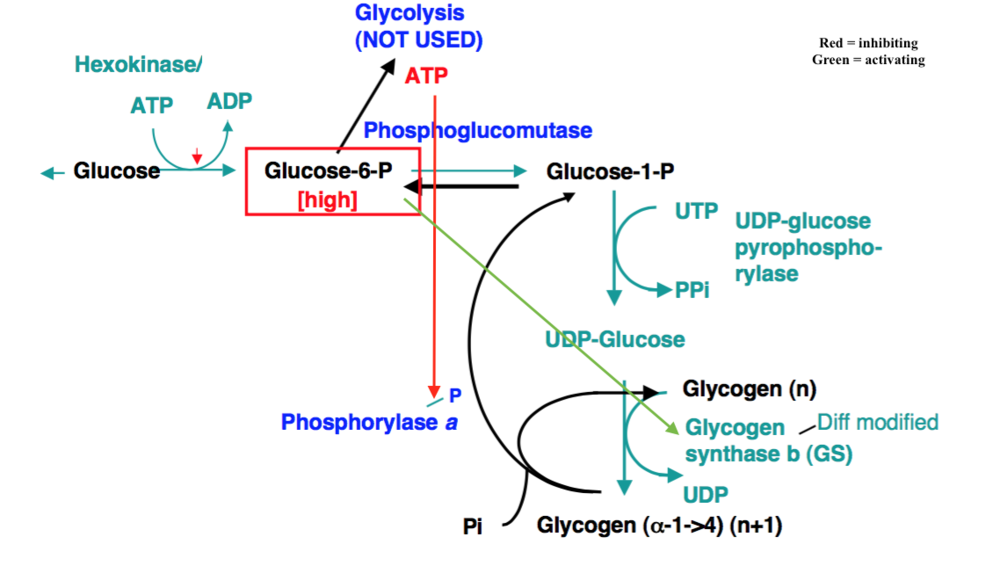
- AGlycogen Synthesis - Post Meal (m+L)
- BGlycogen Degradation - Fight/Flight (m)
- CGlycogen Degradation - Fear, no run (m)
- DGlycogen Degradation - Hormonal G/E (L)
- EGlycogen Degradation - Fear, no run (L)
- FATP inhibits Phos a (allosterically)
- GATP inhibits Phos a (covalently)
- HIncreased ATP due to less glycolysis
- IIncrease ATP due to inactive muscle
- JG6P overrides covalent mod of GSb
- KG6P inactivates GSb
- LHigh G6P feedback inhibits hexokinase
- MHigh G6P feedback inhibits glucokinase
531. Label the image with the situation that corresponds to the pathway shown.
Note: (m) = Muscle (L) = Liver
2. Identify what enzyme activates/inactivate a certain pathway
3. Which hormones cause this signalling (top left corner)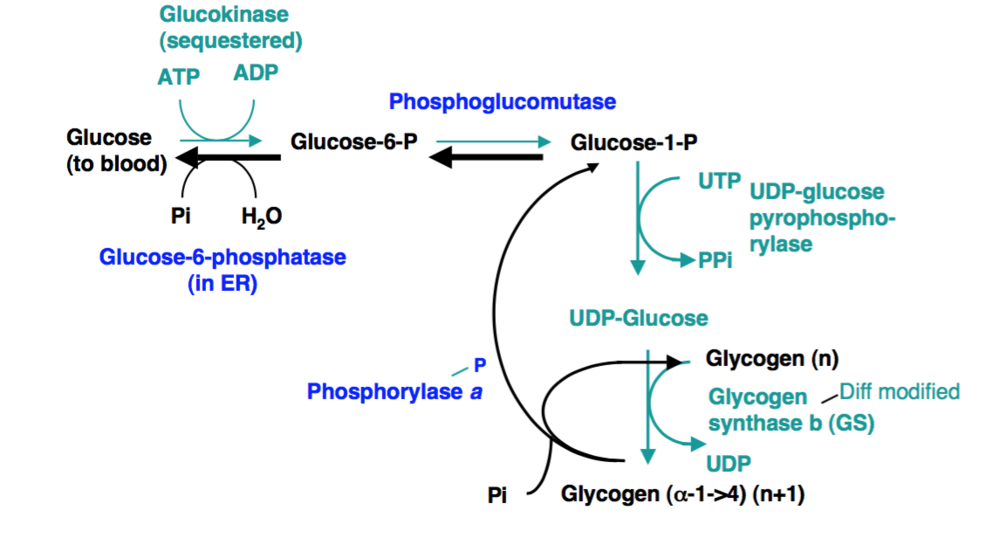
- AGlycogen Synthesis - Post Meal (m+L)
- BGlycogen Degradation - Fight/Flight (m)
- CGlycogen Degradation - Fear, no run (m)
- DGlycogen Degradation - Hormonal G/E (L)
- EGlycogen Degradation - Fear, no run (L)
- FPhos b --> phos a via phos b kinase
- GPhos b --> phos a via PP-1
- HPP-1 is inactivated by PKA
- IPKA is inactivated by PP-1
- JInsulin and Epinephrine
- KNorepinephrine and Glucagon
- LEpinephrine and Glucagon
541. Label the image with the situation that corresponds to the pathway shown.
Note: (m) = Muscle (L) = Liver
2. Identify what enzyme activates/inactivate a certain pathway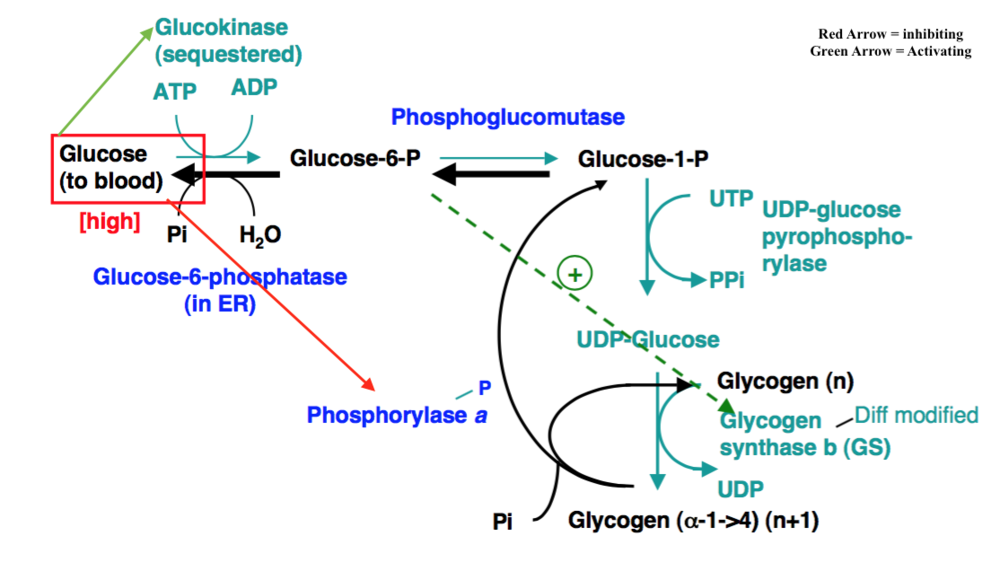
- AGlycogen Synthesis - Post Meal (m+L)
- BGlycogen Degradation - Fight/Flight (m)
- CGlycogen Degradation - Hormonal G/E (L)
- DGlycogen Degradation - Fear, no run (m)
- EGlycogen Degradation - Fear, no run (L)
- FAllosteric inactivation
- GCovalent inactivation
- Hsignals for return to cytoplasm
- Isignals for return to MT
- Jactivates GSb overrides covalent mod.
- Kactivates GSb overrides allosteric mod.
55Which product is responsible for driving reactions 6-9 of glycolysis forward?
- AG6P
- BG1P
- CF-1,6-BP
- DF6P
56What type of enzyme is pfk-2?
- AIsomerase
- BBi-functional
- CTransferase
- DTrimer
57What are the 2 domains of pfk-2 in MUSCLE?
- ARegulartory
- BCatalytic
- CKinase
- DPhosphotase
58How is muscle glycolysis controlled?
- AAllosterically
- BSupply and Demand
- CHormonally
- DCovalently
59Which pfk enzyme does F6P allosterically regulate?
- Apfk-1
- Bpfk-2
60Pfk-1 and Pfk-2 work ________________.
- AAntagonistically
- BSynergistically
61What are the domains of pfk-2 in LIVER?
- ARegulatory
- BKinase
- CPhosphorylase
- DIsomerase
62During [blank_start]Insulin[blank_end] signaling, PP-1 dephosphorylates pfk-2 in the [blank_start]liver.[blank_end] During glucagon/epinephrine signalling [blank_start]PKA[blank_end] phosphorylates pfk-2 in the [blank_start]liver[blank_end].
- AInsulin
- BGlucagon
- CPKA
- DPP-1
- Eliver.
- Fmuscle.
- Gliver
- Hmuscle
63In liver glycolysis, ATP no longer inhibits pfk-1 or PK when insulin is present.
- AVerdadeiro
- BFalso
64Why is there no hormonal control of muscle glycolysis?
- AMuscle pfk-2 is missing a Ser/Thr and therefore cannot be covalently modified
- BMuscles can't detect hormones
- COnly the liver needs to do glycolysis
65In liver glycolysis, ATP no longer inhibits pfk-1 or PK when glucagon or epinephrine are present.
- AVerdadeiro
- BFalso
66PKA phosphorylates two enzymes following glucagon/epinephrine signalling during glycolysis, what are these enzymes?
- APfk-2
- BPyruvate Kinase (PK)
- CPfk-1
- DGlucokinase
Informações
- Descrição
- Biochemistry (Midterm 2 Review) Quiz sobre Midterm 2 Prep, criado por Manisha BHARADIA em 27-10-2016.
- Autor
- Manisha BHARADIA
- Idioma
- English
- Visualizações
- 1
- Histórico
- Criado em 27 out 2016 · atualizado em 8 nov 2016
- Etiquetas
- Avaliação
- Ainda sem avaliações Avalie este quiz