
Quiz
Weeks 1 and 2
Este quiz tem tipos de pergunta que abrem no player de sempre.
Perguntas do quiz (72)
1Both Genus and species names are either ..
- Aunderlined and bold
- Bunderlined and italicized
2First letter of Genus is always
- Acapitalized
- Blower case
3Species designation is always
- Alowercase
- Buppercase
4Which name is never abbreviated
- AGenus
- BSpecies
5[blank_start]87%[blank_end] of Microorganisms are harmless
[blank_start]10%[blank_end] of Microorganisms are opportunistic
[blank_start]3%[blank_end] of Microorganisms are overtly pathogenic- A87%
- B10%
- C3%
6Total microbial load [blank_start]>10.13[blank_end] microbial cells in the body vs. [blank_start]10.13[blank_end] body cells
- A>10.13
- B>10.12
- C10.13
- D10.14
7Robert Hooke (1665) was the first person to
- Adescribe a cell
- Bdeveloping antisepsis for surgery
8Joseph Lister (1870) was the first person to...
- Adevelop antisepsis for surgery
- Bdescribe a cell
9Antoni Van Leeuwinhoek was the first person to...
- Adescribe a cell
- Bdescribe bacteria including their shapes
10Robert Hooke was the first person to [blank_start]describe a cell[blank_end]
Joseph Lister was the first person to [blank_start]develop antisepsis[blank_end]
Antoni van Leeuwenhoek was the first person to [blank_start]describe a bacterium[blank_end]- Adescribe a cell
- Bdevelop antisepsis
- Cdevelop antisepsis
- Ddescribe a bacterium
- Edescribe a bacterium
- Fdescribe a cell
11Ignaz Semmelweis was the first to...
- Ause handwashing in clinical practice
- Bdevelop antisepsis
12Select the two correct answers
- ALouis Pasteur was the first person to disprove abiogenesis
- BLouis Pasteur was the first person to discover pasteurisation
- CLouis Pasteur was the first person to apply hand washing in clinical practice
13Robert Koch was the first to study the following two diseases..
- AAnthrax
- BTubercolosis
- CChlamidia
14Robert Koch found the
- Agerm theory of disease
- Bdisproved the theory of abiogenesis
15Robert Koch contributed towards staining methods for microbes
- AVerdadeiro
- BFalso
16Kochs postulates (germ theory of disease)
1. Specific causative agent must [blank_start]be found in every case of disease[blank_end]
2. Disease organism must [blank_start]be isolated in pure culture[blank_end]
3. Innoculation of culture sample into healthy animal must [blank_start]produce same disease[blank_end]
4. Disease organism must [blank_start]be recovered from animal[blank_end]- Abe found in every case of disease
- Bbe isolated in pure culture
- Cproduce same disease
- Dbe recovered from animal
17Select the three domains of life
- AEubacteria
- BFungi
- CArchaea
- DAlgae
- EProtozoa
- FEucarya
18What are the two aspects of Eubacteria
- AGram stain positive and negative
- BAlgae and Fungi
19Select which is classified as Eucarya
- AAlgae, Fungi, Cyanobacteria, Plants, Animals
- BPlants, Animals, Thermophiles, Algae, Fungi
- CProtozoa, Algae, Fungi, Plants, Animals
20Archaea and Bacteria are
- AEukaryotes
- BProkaryotes
21Fungi, Protozoa and Fungi are
- AProkaryotes
- BEukaryotes
22Protozoa are
- Asingle celled Eukaryotes
- Bsingle celled Prokaryotes
23Fungi have a cell wall
- AVerdadeiro
- BFalso
24Moulds are
- AUnicellular
- BMulticellular
25Moulds reproduce
- ASexually and Asexually
- BBudding
26Yeasts are
- AUnicellular
- BMulticellular
27Yeasts reproduce by
- Abudding
- Bsexual reproduction
28Bacteria have a nuclei
- AVerdadeiro
- BFalso
29A virus which infects a bacteria is called a Bacteriophage
- AVerdadeiro
- BFalso
30Peptidoglycan is found in Prokaryotes cell wall (Bacteria/Eubacteria)
- AVerdadeiro
- BFalso
31Prokaryotes do not reproduce by binary fission
- AVerdadeiro
- BFalso
32Eukaryotes reproduce by meiosis/meitosis
- AVerdadeiro
- BFalso
33Endospores are not a survival mechanism by Prokaryotes
- AVerdadeiro
- BFalso
34Plasmids are small, enclosed, transferable pieces of DNA
- AVerdadeiro
- BFalso
35Bacteria contain plasmids
- AVerdadeiro
- BFalso
36Gram stain positive bacteria have a [blank_start]thick[blank_end] cell wall layer of peptidoglycan and teichoic acid and [blank_start]lipoteichoic[blank_end] acid
- Athick
- Bthin
- Clipoteichoic
- Dlipopolysaccharide
37Gram Negative bacteria have an outer membrane called [blank_start]lipopolysaccharide[blank_end]
- Alipopolysaccharide
- Blipoteichoic
38Select the two different types of Glycocalyx
- Aslime
- Bcapsules
- Ccapsid
- Dlipopolysaccharide
39Flagella are for [blank_start]motility[blank_end] only
Fimbriae are for [blank_start]adherence[blank_end] only
Pili is for [blank_start]conjugation[blank_end] and adherence- Amotility
- Badherence
- Cadherence
- Dmotility
- Econjugation
- Fmotility
40Describe this polar distribution of bacterial flagella

- AMonotrichous
- BIophotrichous
- CAmphitrichous
41Describe this polar distribution of bacterial flagella
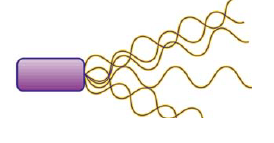
- AMonotrichous
- BIophotrichous
- CAmphitrichous
42Describe this polar distribution of bacterial flagella
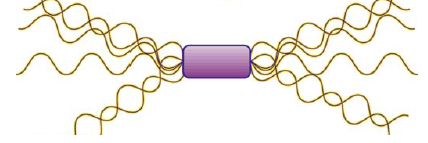
- AAmphitrichous
- BIophotrichous
- CMonotrichous
43What is the purpose of Bacterial Sporulation?
- Asurvival under unfavorable growth conditions
- Bsurvival under favorable growth conditions
44Bacteria reproduce by a process called
- ABinary Fission
- BBudding
45Binary Fission is a
- AAsexual process
- BSexual process
46Binary Fission is a process of when
- Asingle cell splits into two sister cells
- BTwo non-identical cells developed sexually
47The bacterial growth stages comprises of the [blank_start]lag[blank_end] phase to begin with, then the [blank_start]exponential[blank_end] phase, then the [blank_start]stationary[blank_end] phase, followed by the [blank_start]death/decline[blank_end] stage
- Alag
- Bexponential
- Cexponential
- Dstationary
- Estationary
- Fexponential
- Gdeath/decline
- Hstationary
48There are many different atmospheric conditions for Bacteria such as:
[blank_start]Obligate Aerobe[blank_end] - which oxygen is essential for growth
[blank_start]Microaerophiles[blank_end] - low levels of oxygen is required
[blank_start]Obligate Anaerobes[blank_end] - will only grow in complete absence of Oxygen
[blank_start]Facultative Anaerobes[blank_end] - able to grow with or without Oxygen
[blank_start]Carboxyphiles[blank_end] - grow best with increased presence of CO2- AObligate Aerobe
- BMicroaerophiles
- CMicroaerophiles
- DObligate Aerobe
- EObligate Anaerobes
- FFacultative Anaerobes
- GFacultative Anaerobes
- HCarboxyphiles
- ICarboxyphiles
- JObligate Aerobe
49Temperature preferences:
[blank_start]Psychrophiles[blank_end] - Growth temp. 0 - 20 degrees
[blank_start]Mesophiles[blank_end] - Growth temp. 10 - 45 degrees
[blank_start]Thermophiles[blank_end] - Growth temp. 45 - 85 degrees- APsychrophiles
- BMesophiles
- CThermophiles
50The breakdown and formation of ATP is mediated by the oxidation-redoxation(redox) reactions:
[blank_start]Oxidation[blank_end] - Electrons loss
[blank_start]Reductions[blank_end] - Electrons gain- AOxidation
- BReductions
51Fermentation produces low ATP
- AVerdadeiro
- BFalso
52Respiration produces lots of ATP
- AVerdadeiro
- BFalso
53Host microbes relationship:
[blank_start]Mutualism[blank_end] - where both members benefit
[blank_start]Commensalism[blank_end] - where one member benefits without harming the other
[blank_start]Parasitism[blank_end] - relationship where one member is harmed for the other members gain- AMutualism
- BCommensalism
- CParasitism
54Stages of Infectious disease:
[blank_start]Incubation period[blank_end] - No symptoms
[blank_start]Prodromal phase[blank_end] - Mild symptoms
[blank_start]Invasive phase[blank_end] - Identifiable disease with dramatic microbial increase
[blank_start]Decline phase[blank_end] - Reduction of microbes
[blank_start]Convalescence[blank_end] - Recovery- AIncubation period
- BProdromal phase
- CInvasive phase
- DDecline phase
- EConvalescence
55Endotoxin and Exotoxins are toxic substances secreted by bacteria and released outside the cell
- AVerdadeiro
- BFalso
56Exotoxins are a toxin primarily produced by
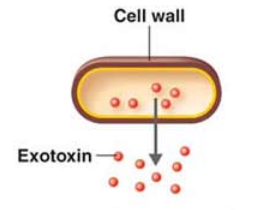
- AGram-positive bacteria
- BGram-negative bacteria
57Endotoxins are toxins that are primarily produced by
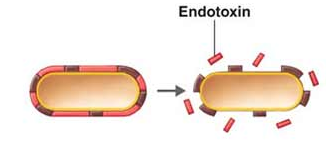
- AGram-negative bacteria
- BGram-positive bacteria
58Exotoxins are produced when the
- Agram-positive bacteria secreted by the living bacterial cell
- Bgram-positive bacteria dies by the bacterial cell
59Endotoxins are produced when the
- AGram-negative bacteria dies and wall breaks up
- BGram-negative bacteria is alive during secretion
60Haemolysins are lipids and proteins that cause lysis of red blood cells by destroying their cell membrane.
- AVerdadeiro
- BFalso
61Alpha is a type of Haemolysin which is non-haemolytic
- AVerdadeiro
- BFalso
62The three types of Haemolysins are:
[blank_start]Alpha[blank_end] - Partial lysis of RBC, grey/green colour
[blank_start]Beta[blank_end] - completely clear zone around colonies
[blank_start]Gamma[blank_end] - Non-haemolytic- AAlpha
- BBeta
- CGamma
63Haemolysin which causes partial lysis of RBC is called
- AAlpha
- BBeta
64Haemolysin which causes complete lysis of RBC is called
- AAlpha
- BBeta
65Non-Haemolysin of lysis to RBC is called
- AAlpha
- BGamma
66Microbial Biofilms consist of
- Amicrobes, cell debris and extra-cellular matrix
- Bmicrobes, capsules and extra-cellular matrix
67Iris diaphragm and condenser control light on a microscope
- AVerdadeiro
- BFalso
68Contrast can be increased by closing the condenser diaphragm on a microscope
- AVerdadeiro
- BFalso
69Select the Four principle shapes of Bacteria
- ARods/Bacillus
- BCoccus
- CSpirals
- DVibrio/Comma
- EChains
- FClusters
70[blank_start]Selective media[blank_end] only allow certain bacteria to grow while inhibiting others.
[blank_start]Differential media[blank_end] contain substances that will allow different bacteria to be distinguished from each other- ASelective media
- BDifferential media
71- [blank_start]Mannitol Salt Agar (MSA)[blank_end] is selective for Staphylococci - high salt concentration.
- [blank_start]MacConkey agar[blank_end] is a selective and differential culture medium for bacteria designed to selectively isolate Gram-negative and enteric bacilli and differentiate them based on lactose fermentation- AMannitol Salt Agar (MSA)
- BMacConkey agar
72Mannitol Salt Agar (MSA) is selective for Staphylococci - high salt concentration.
- AVerdadeiro
- BFalso
Informações
- Descrição
- Lecture feedback questions from wks 1 and 2
- Autor
- Jessica Bulley
- Idioma
- English
- Visualizações
- 27
- Etiquetas
- Avaliação
- Ainda sem avaliações Avalie este quiz