
Quiz
AQA (9-1) Chemistry Only Paper 2
Este quiz tem tipos de pergunta que abrem no player de sempre.
Perguntas do quiz (16)
1Alkenes have the general formula of CnH2n+2
- AVerdadeiro
- BFalso
2Because alkenes contain at least one double bond between carbon atoms, we describe them as [blank_start]unsaturated[blank_end] compounds.
- Aunsaturated
3The test for [blank_start]alkenes[blank_end] makes use of the addition reaction, and involves adding [blank_start]bromine[blank_end] water to a sample of hydrocarbon. If an [blank_start]alkane[blank_end] is present the solution stays orange-brown, but an [blank_start]alkene[blank_end] will turn the solution colourless. This is because the bromine is added across the carbon-carbon [blank_start]double[blank_end] bond.
- Aalkenes
- Balkanes
- Cbromine
- Dchlorine
- Eiodine
- Falkane
- Galkene
- Hdouble
- Isingle
4Alcohols have the functional group of [blank_start]-OH[blank_end] ([blank_start]hydroxyl[blank_end]), and gives rise to the ending of alcoh[blank_start]ol[blank_end]. It is responsible for the general reactions that all alcohols can do.
Carboxylic acids have the functional group of [blank_start]-COOH[blank_end] ([blank_start]carboxyl[blank_end]), and gives rise to the ending of carbox[blank_start]ylic acid[blank_end]. It is responsible for the general reactions that all carboxylic acids can do.- A-OH
- Bhydroxyl
- Col
- D-COOH
- Ecarboxyl
- Fylic acid
5Which of the following is not a reaction alcohols can do?
- Acan be oxidised to make a carboxylic acid in the presence of an oxidising agent
- Bburn in air to produce carbon dioxide and water
- Cdissolve in water to form neutral solutions
- Dreact with metals to form a salt and hydrogen
6What is the name of the polymer formed from monomers of propene?
[blank_start]poly(propene)[blank_end]- Apoly(propene)
7Proteins are an example of [blank_start]polymers[blank_end]. There are [blank_start]21[blank_end] different amino acids that can be arranged to make proteins we need to survive. Many proteins are [blank_start]enzymes[blank_end], and/or are essential to our biological functions.
Amino acids have two different functional groups in a molecule. Amino acids react by [blank_start]condensation[blank_end] polymerisation to produce [blank_start]polypeptides[blank_end].- Apolymers
- B21
- Cenzymes
- Dcondensation
- Epolypeptides
8Match the colours to the metal ions
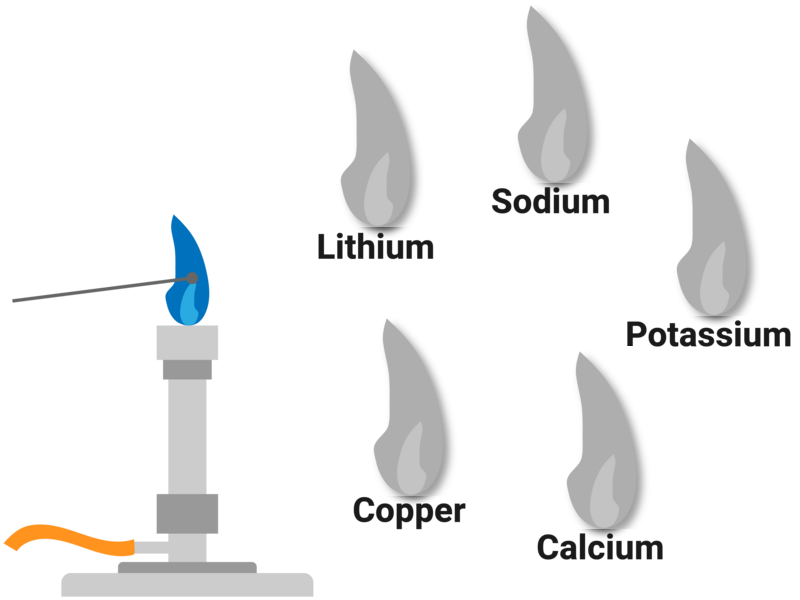
- Acrimson
- Bred
- Cgreen
- Dblue
- Eyellow
- Flilac
- Gpurple
- Horange-red
- Iorange
9Dilute sodium hydroxide solution (NaOH) is used to test for some metal ions and can also be used to identify ammonium ions. Write the colour of the precipitate formed next to each ion.
aluminium [blank_start]white[blank_end]
calcium [blank_start]white[blank_end]
copper [blank_start]blue[blank_end]
iron(II) [blank_start]green[blank_end]
iron(III) [blank_start]brown[blank_end]- Awhite
- Bwhite
- Cblue
- Dgreen
- Ebrown
10Match the chemical test to to the ions
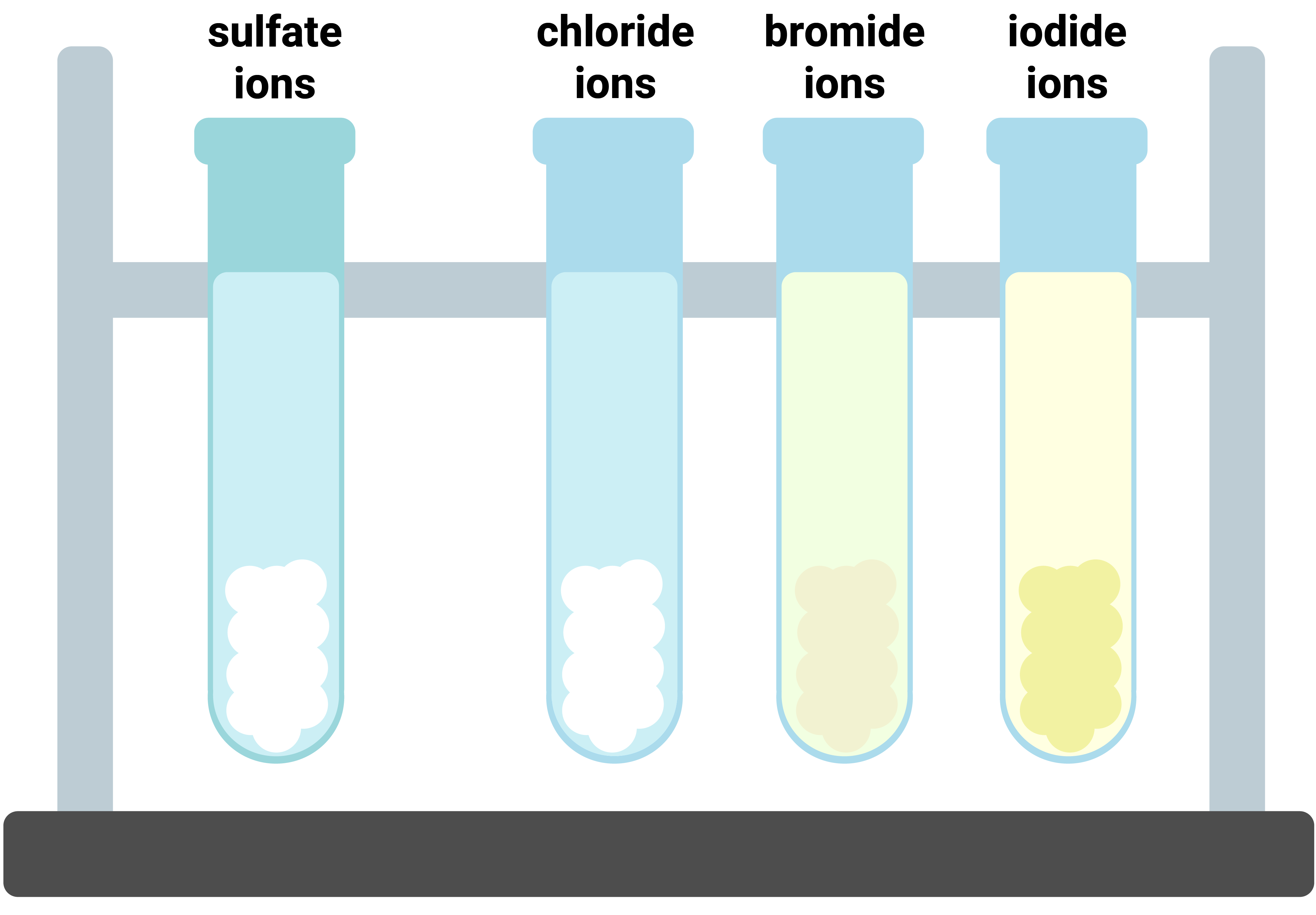
- Aadd acid, then barium chloride
- Badd dilute acid
- Cadd barium chloride
- Dadd nitric acid, then silver nitrate
- Eadd silver nitrate
- Fadd nitric acid
11New technology, developed over the last few decades, have considerably advanced analytical chemistry. These new instrumental methods have three main advantages, they are:
- Afaster, more accurate, more senstive
- Bcheaper, more rapid, more accurate
- Cmore sensitive, faster, more environmentally friendly
12Rusting is a specific example of [blank_start]corrosion[blank_end], and requires both air and water for [blank_start]iron[blank_end] to rust. There are three ways to prevent iron from rusting:
exclusion of [blank_start]oxygen[blank_end] (by either using an atmosphere of nitrogen or argon)
exclusion of [blank_start]water[blank_end] (by storing with a desiccant)
sacrificial [blank_start]protection[blank_end] (when a more reactive metal than iron is attached to the object to prevent iron from rusting)- Aoxygen
- Bwater
- Cprotection
- Dcorrosion
- Eiron
13Pure metals are generally too soft to use as they have a regular lattice structure.
- AVerdadeiro
- BFalso
14Thermosoftening plastics melt when heated, meaning that they can be recycled, as this involves melting them before making a new product.
- AVerdadeiro
- BFalso
15The conditions for the Haber Process are:
- Atemperature of 450 °C
- Btemperature of 350 °C
- Cpressure of 200 atmospheres (200 atm)
- Dpressure of 100 atmospheres (100 atm)
- Eiron catalyst
- Fnickel catalyst
16Phosphate rock is treated with nitric acid or sulfuric acid to produce soluble salts that can be used as fertilisers. Reacting phosphate rock with:
nitric acid to make [blank_start]phosphoric[blank_end] acid and calcium [blank_start]nitrate[blank_end]
sulfuric acid to make [blank_start]single[blank_end] superphosphate (this is a mixture of calcium phosphate and calcium sulfate)
phosphoric acid to make [blank_start]triple[blank_end] superphosphate (calcium phosphate)- Aphosphoric
- Bnitrate
- Csingle
- Dtriple
Informações
- Descrição
- GCSE Chemistry (AQA) Quiz sobre AQA (9-1) Chemistry Only Paper 2, criado por https:// revisechemistry.uk em 17-04-2019.
- Idioma
- English
- Visualizações
- 6.986
- Etiquetas
- Avaliação
- Ainda sem avaliações Avalie este quiz