
Quiz
Psychology GCSE Edexcel Topic A - How do we see the world? | Difficult
Este quiz tem tipos de pergunta que abrem no player de sempre.
Perguntas do quiz (14)
1Tick the boxes that correctly describe how the retina, optic nerve and optic chiasma work.
- AThe retina is a region that contains photoreceptors that convert light into electric impulses, which are sent into the optic nerve by using rods and cones.
- BThe retina is the red, internal region of the eye that converts light into electric impulses, in which rods and cones extract visual information and transfer it to the retina to maintain a continuous image.
- CThe optic nerve is a bundle of nerves that carry visual information from the eye, sending that information to the visual cortex, the back of the brain, in which the visual cortex makes sense of the visual information from the optic nerve.
- DThe optic nerve is a bundle of nerves that extracts information from the visual cortex, the back of the brain transferring that data into the eyes.
- EThe optic chiasma is the region where both optic nerves cross over. The optic nerves switch places, transferring information from one another, flipping images back right side up after the lens refracts and makes images upside down
- FThe optic chiasma is the region where both optic nerves cross over. The optic nerves are then bundled up into a helix, allowing information to be evenly distributed and shared. This ensures that upside down images are flipped right side up.
2Why is there a blind spot on our eye?
- AIt's because the blind spot is where the optic nerve leaves the eye.
- BIt's because the retina has created no photoreceptors within the blind spot.
3Drag and drop words to complete these sentences.
[blank_start]Vision[blank_end] is a biological process, which is about what [blank_start]we see from the eye[blank_end].
[blank_start]Perception[blank_end] is a psychological process, which is about how our brain makes sense of [blank_start]visual information[blank_end] coming from our eyes.
[blank_start]Depth cues[blank_end] are the way our eyes and the brain adapt to seeing visual information from clues in the environment, in which we learn to adapt ourselves through experience. There are two types of depth cues:
[blank_start]Monocular depth cues[blank_end], meaning one, where you can see in [blank_start]two dimensions[blank_end].
[blank_start]Binocular depth cues[blank_end], meaning two, where you can see in [blank_start]three dimensions[blank_end].- AVision
- Bwe see from the eye
- CPerception
- Dhow we percieve information from our eye
- Evisual information
- Fcognitive information
- Ginformation of images
- HDepth cues
- IMonocular depth cues
- JBinocular depth cues
- Ktwo dimensions
- Lthree dimensions
4"The dominant eye is a binocular depth cue." True or false? Choose a reason why.
- ATrue
- BFalse
- CUsing both eyes and making a hole with your hand, looking at the hole from the centre and closing one eye at a time indicates which eye is the dominant eye depending on how well each eye can see through the hole.
- DThe dominant eye only requires one eye. This is because even if you have two eyes, when you have one eye, your brain will automatically assign that one eye as the dominant eye.
5What can you see in Rubin's Vase? Label the bottom node by what type of illusion it is.
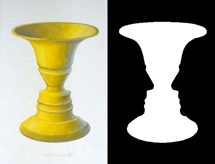
- AA vase
- BA trinket
- CTwo faces
- DThe mid-section of the trinket
- EAmbiguous figure
- FFiction
- GDistortion
- HThe mid-section of the vase
6Tick the boxes which are the correct Gestalt laws.
- AClosure
- BProximity
- CDistance
- DContinuity
- ESimilarity
- FFigure and ground
- GObject and background
- HSmoothness
- IDifference
7Gregory's theory is about how we see things through monocular depth cues. True or false?
- AVerdadeiro
- BFalso
8Tick the boxes which correctly describe what Palmer (1972) is about.
- AThere are 64 student participants which are a grouped sample.
- BThere are 64 student participants across 3 different schools, coming from Grammar, Secondary, and Technical schools, which are evenly distributed across to create a matched sample.
- CParticipants observe a photo of a kitchen for 2 seconds. After this, participants are then given a choice as to what they saw. They chose from: Bread, Mailbox, or Drum.
- DParticipants observe a photo of a kitchen for 2 seconds. After this, participants are then given a choice as to what they saw. They chose from: Toaster, Chopping board, and Drum.
- EThe conditions of the experiment were:
- Chose an object with an appropriate context and shape
- Chose an object with an innapropriate context, but has a similar shape
- Chose an object with an innapropriate context and different shape
- No interpretation given. - FThe conditions of the experiment were:
- Chose bread or toaster
- Chose mailbox or chopping board
- Chose drum
- No interpretation given. - GMany of the participants were able to choose the correct object, the toaster. This is because they were given the schema of a kitchen, so what they often chose was an object with an appropriate context and shape.
- HMany of the participants chose the bread. This is because they were given the schema of a kitchen, so what they often chose was an object with an appropriate context and shape.
9The independent variable is the value you measure. True or false?
- AVerdadeiro
- BFalso
10Which is a way to measure validity?
- ARepeat the experiment multiple times in order to get the same result.
- BMatching your aim/hypothesis and experiment design in order to get the most accurate way of measuring what the experiment is supposed to measure.
11Safety is an ethical guideline? True or false?
- AVerdadeiro
- BFalso
12Drag and drop the appropriate words in the gaps.
Monocular depth cues:
Parallel lines that appear to converge into the distance is an example of [blank_start]linear perspective[blank_end].
When objects appear to overlap one another by partially taking up their space, this is known as [blank_start]superimposition[blank_end].
The closer objects are to you, the bigger they are. The further away objects are to you, the smaller they are. This is known as [blank_start]relative size[blank_end].
When we look at patterns on the floor, they appear to look more blurry and less detailed the further away we look at them. This is called [blank_start]texture gradient[blank_end].
Objects usually appear further away the closer they are to the horizon. This is called [blank_start]height in the visual plane[blank_end].- Alinear perspective
- Bsuperimposition
- Crelative size
- Dtexture gradient
- Eheight in the visual plane
13What kind of experiment was Carmichael et al's? What's good about this type of experiment?
=== SELECT TWO ANSWERS ===- ALab experiment
- BQuasi experiment
- CThis type of experiment allows for high levels of control, so the experiment can be fairly measured and tested for reliability.
- DThis type of experiment used a natural experiment, which means that it very high amounts of realism.
14The Kanisza Triangle is a fiction illusion? True or False?
- AVerdadeiro
- BFalso
Informações
- Descrição
- GCSE Psychology GCSE Quiz sobre Psychology GCSE Edexcel Topic A - How do we see the world? | Difficult, criado por Azidic Arcturus em 30-11-2015.
- Autor
- Azidic Arcturus
- Idioma
- English
- Visualizações
- 95
- Etiquetas
- Avaliação
- 5,0 de 5 · 1 avaliação Avalie este quiz