
Flashcards
Atomic structure and the periodic table- basics
Flashcards do conjunto (8)
- 1Describe the structure of an atom:The nucleus contains the protons and neutrons. The electrons then move around the nucleus in electron shells.
- 2What charge does an atom have?They are neutral; they have no charge overall.
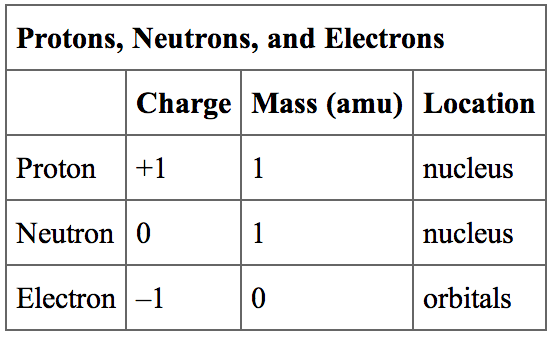
- 3Describe the properties of Subatomic particles:
- 4How are ions different to atoms?In an ion, the number of protons doesn't equal the number of electrons. This means it has an overall charge.
- 5What is an element?An element is a substance that is made of only one sort of atom. The substance has to also contain atoms with the same number of protons.
- 6What are isotopes?Isotopes are different forms of the same element, which have the same number of protons but a different number of neutrons. They have the same atomic number but different mass numbers.
- 7What is the relative atomic mass?An average mass, taking into account the different masses and abundances of all isotopes making elements.
- 8Give the equation for relative atomic mass:(% of isotope 1 × mass of isotope 1) + (% of isotope 2 × mass of isotope 2) ÷ 100
So in the case of chlorine:
(75 × 35) + (25 × 37)∕100
= 2625 + 925∕100
= 35.3
Informações
- Descrição
- GCSE Chemistry FlashCards sobre Atomic structure and the periodic table- basics, criado por Clare Noone em 01-06-2018.
- Criado por
- Clare Noone
- Visualizações
- 14
- Tags
- Avaliação