
Flashcards
Lecture 12 - Membrane Transport & Signal Transduction
Flashcards do conjunto (34)
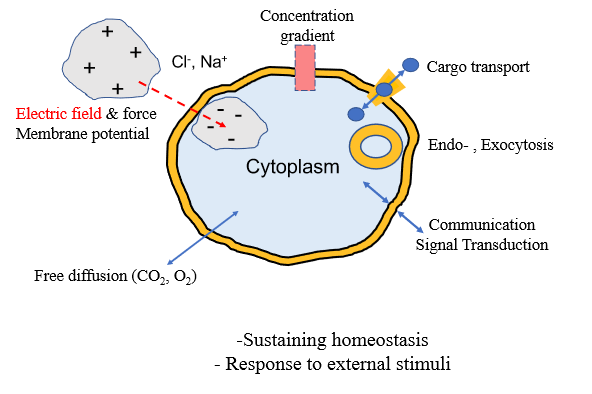
- 1Concepts to understand1) There is a constant flow of matter and information in/out cell
2) Concentration gradients
3) Cell membrane permeability
4) Membrane potential
5) Passive vs. active transport (primary vs. secondary)
6) Uniporters, Symporters, Antiporters
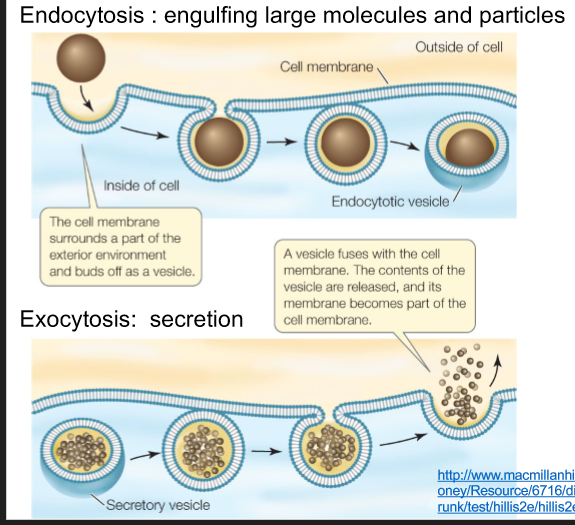
Endocytosis, Exocytosis
7) Signal transduction. G-proteins and receptors. Tyrosine Kinase
8) Examples of pathways - 2The flow of matter & information into and out of the cell
- 3The "concentration gradient" concept As in the case of a chemical reaction: 1.) _____ diffusion in the direction of ΔG < 0 (__ the gradient) 2) Equilibrium when ΔG = __ therfore [A in] = [A out ]0Spontaneous
along
0

- 4Living cells sustain gradients of ___ molecules and ions. Diffusion tends to ___ gradients. (Equilibrium at ΔG = 0) However, gradients are not ___ restored in cells. Lipid bilayer is a ___ barrier. ->Large ___ molecules and ions are BLOCKED from passing through.many
eliminate
readily
diffusion
polar - 5SIMPLE DIFFUSION favors ___, ___ molecules Simple diffusion is ___ (uses no energy, moves down the concentration gradient) What molecules tend to undergo simple diffusion?small, nonpolar
passive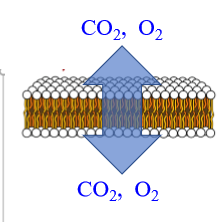
- 6Passive/Facilitated diffusion -Large molecules, including polar, and ions can pass through ____ proteins, such as pores (____) or channels (animals) and transporters (___ ____). Transmembrane proteins that transport a SINGLE solute type is a ____transmembrane
bacteria
carrier proteins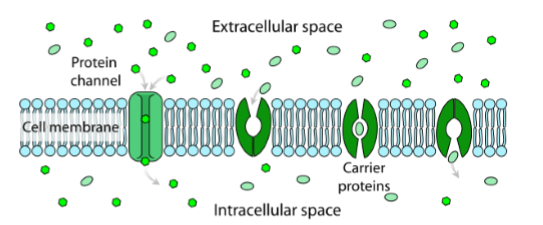
- 7Passive Facilitated Diffusion Carrier Proteins -Solute binds on one side; ____ change occurs; then lets go on other side -Often carry ONE type of molecule EX: passive ___ transporter (__) Channel Protein -Solute moves due to ___ -When ions are transported, these channels are called ___ channels. ->They are specific to __ & __conformational
glucose (GLUT)
diffusion
ion
size & charge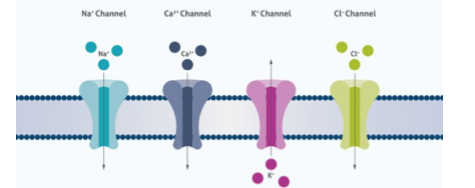
- 8Some channels are always open (___ channels), while others are regulated:Leak
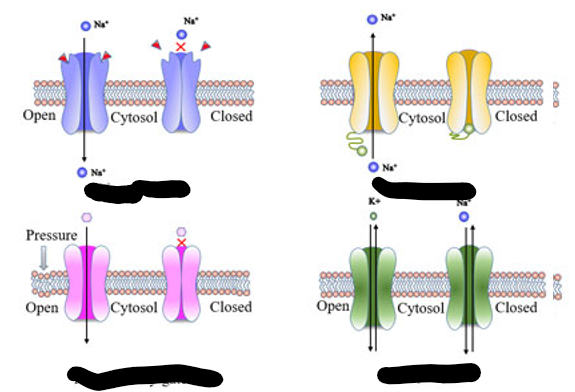
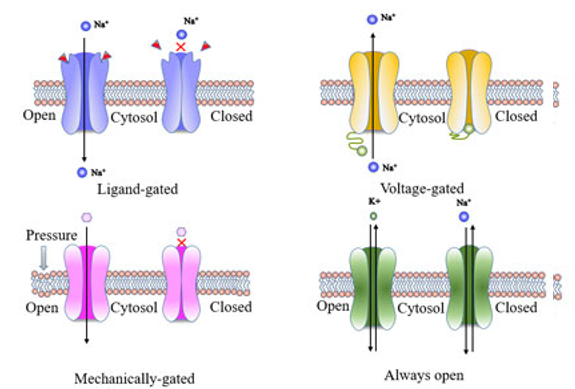
- 9Example of a voltage-gated channels = opening of ___ channels Neural signal ____ due to the opening of sodium channels.Na+
propagates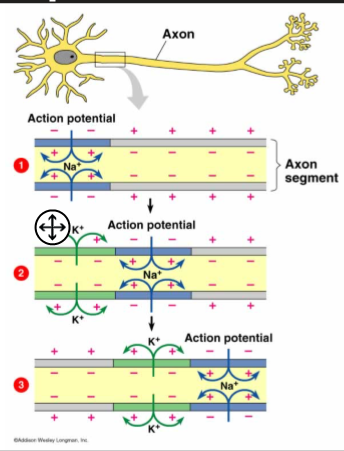
- 10SUMMARY So far ___ ___: no use of energy & moves along the gradient Simple diffusion: moves ___ through the cell membrane ____ diffusion: Transmembrane proteins ____ : Transmembrane protein that transports a single solute type Next Active transport: use of energy & moves ____ the gradientPassive diffusion
directly
Facilitated
Uniporter
Against - 11Membrane Potential (___ across the membrane) Cell is like an electric battery. Cell is __ inside & __ outside. Δψ : from -40 to -70 mV ΔG = zFΔψ z = charge F = Faraday's constant Δψ < 0 and F > 0 and ΔG < 0 when z __ 0voltage
negative 4
positive
> - 12Membrane Potential is sustained by ___ /__ pumps _ N+ out & _ K+ in with a +1 charge transfer per pump cycle Cell generates 3 ΔG sources: 1) 2) 3)sodium/potassium
3NA+ out & 2K+ in
Na+ gradient
K+ gradient
electric potential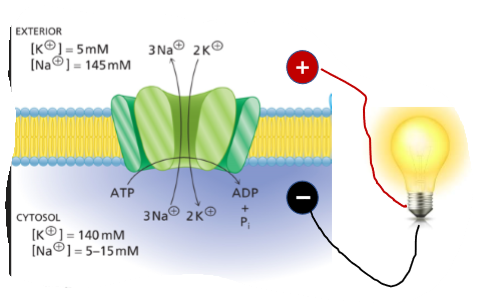
- 13Sodium/Potassium Pump is the example of ___ Transport It is active, because ions move ___ their gradient (ΔG initial __ 0) However, A LOT of ATP energy is used (ΔG ATP __ 0) so total (ΔG total __0)Active
against
>
<
< - 14Class Clicker Question How does membrane potential, V= -70 mV, change if a significant number of Na+ channels (transporting only sodium) synchronously open? A. will decrease, more negative B. will increase, more positiveAnswer = B. will increase, more positive
This is because NA+ is following its gradient via facilitated diffusion into the cell (from high to low concentration). - 15PRIMARY Active transport = when a ___ emergy source is used (__ or __)DIRECT
ATP or light - 16SECONDARY Active Transport = when the energy of ion ___ is used *Primary energy source (ATP) creates the secondary energy source (__ ___). ->This energy is used to move cargo across the membrane. Symport = two molecules move in ___ direction (move __)gradients
ion gradients
same
together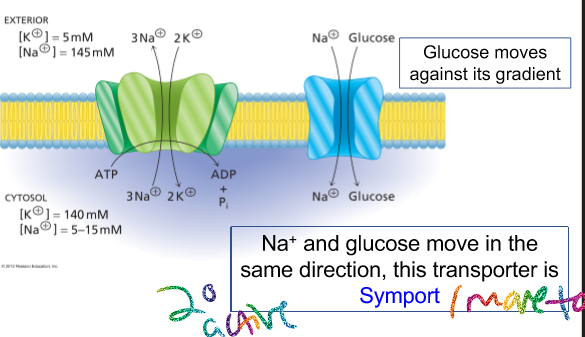
- 17Antiport = Sodium/Calcium transporter Two molecules move in ____ directions This is active transport because the energy of the Na+ ___ is used.opposite
gradient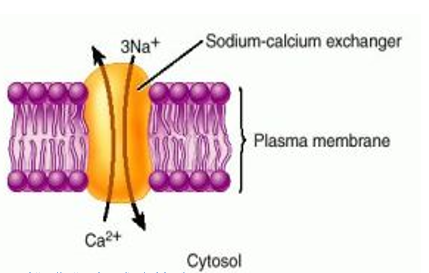
- 18—
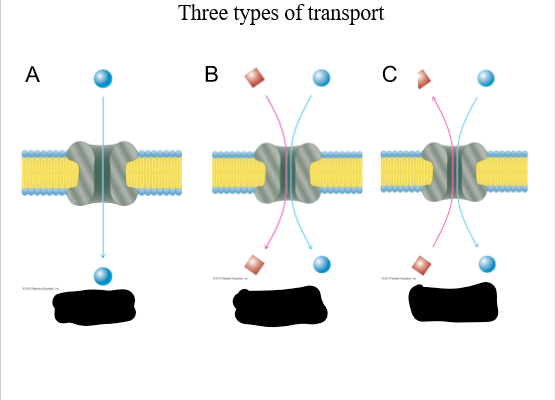
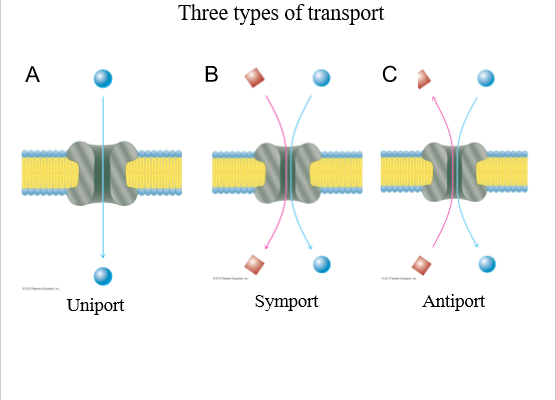
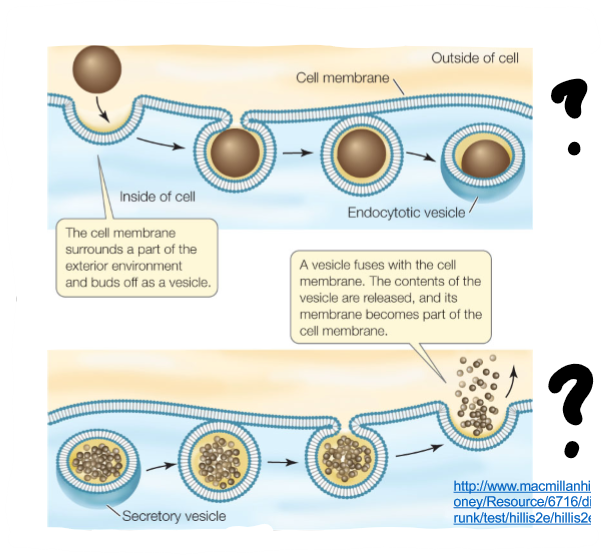
- 19Endocytosis = ___ large molecules and particles Exocytosis = ___engulfing
secretion - 20—
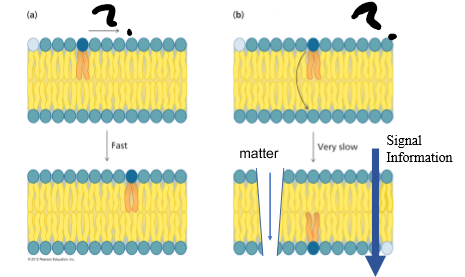
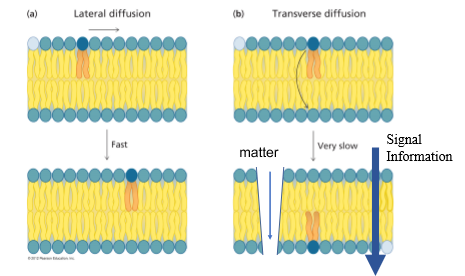
- 21Transduction of extracellular signals Transduction = ___ of signal or energy from one form to another Lateral diffusion = __ (communication) Transverse diffusion = ___transformation
fast
slow - 22—
- 23Signal Transduction ___ = primary messenger & binds to a receptor on the outer membrane surfaceLigand
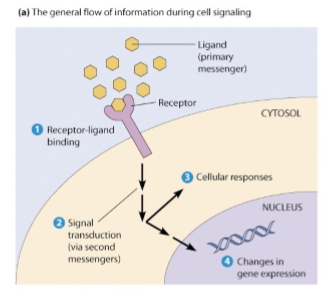
- 24____ = on outer membrane surface ->SPECIFIC to the ligand ->Undegoes a conformational change ->SIgnal transduction ->Second messenger ->Amplification Pathways = Often ___ cell response Complex interactionsReceptor
multistep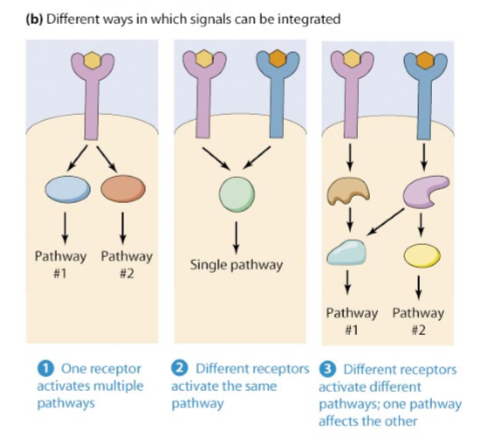
- 25G protein-coupled receptors (GPCR) -Large family of protein receptors -Ligand binds to receptor -> conformational change -> signal passed Structure of GPCR = transmembrane __-___ and are couple to __ - proteinsα - helices
G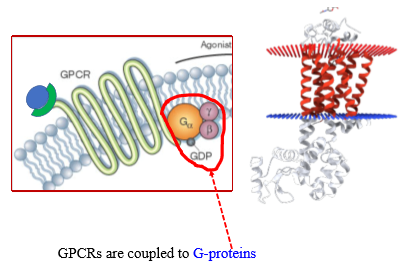
- 26G proteins (different types) are GTPases that ___ GTP GTP becomes ___hydrolyze
GDP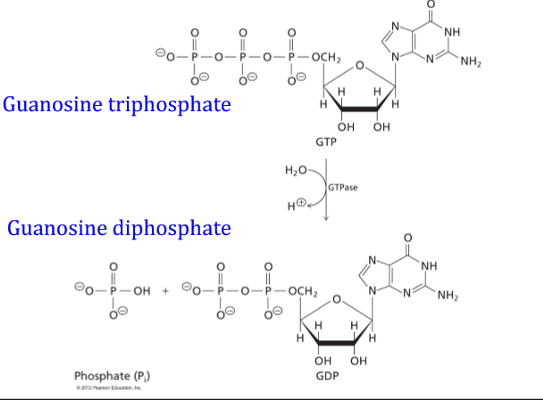
- 27Heterotrimeric G-protein: α, β, γ subunits α, and γ bound to the membrane What are the signal transduction steps shown on this image?Signal Transduction steps:
1) Signal activates receptor
2) Conformational change
3) Inactive G protein binds to receptor
4) GDP is replaced with GTP
5) GTP-α complex is activated
6) β and γ subunits leave
7) GTP- α relays signal further
8) GTP-α --> GDP-α
9) Inactive G protein is reassembled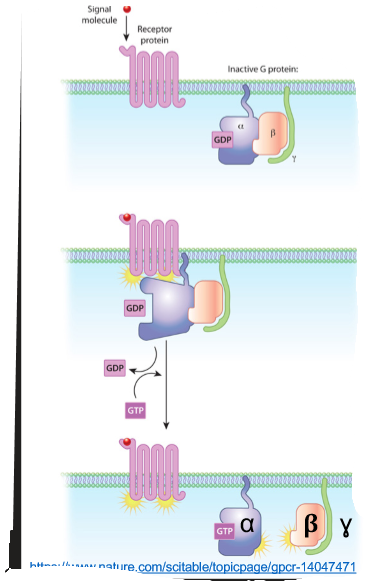
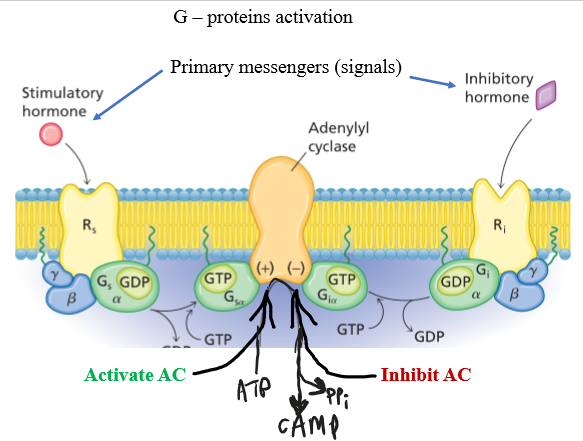
- 28Another example of a GPCR is the: Adenyl Cyclase signaling pathway Primary messengers (hormones) bind to GPCR and then G-proteins become activated and can either activate or inhibit adenyl cyclase (AC) Second messenger = cAMP (___ the signal)amplifies
- 29—
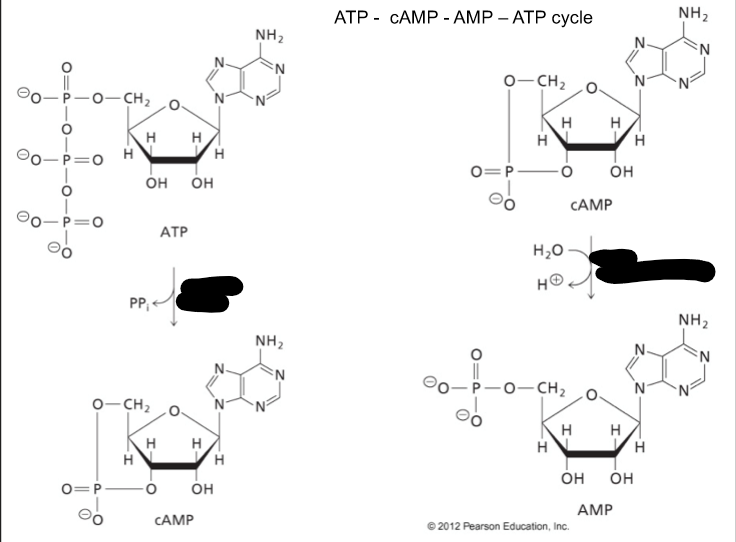
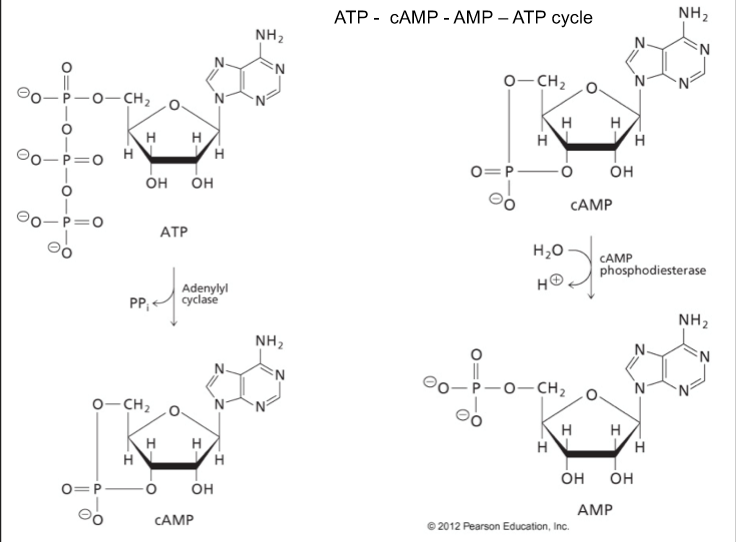
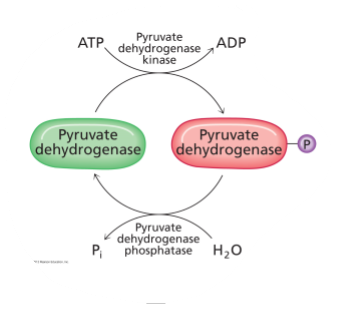
- 30Kinase ___ Phosphatase ___phosphorylates
dephosphorylates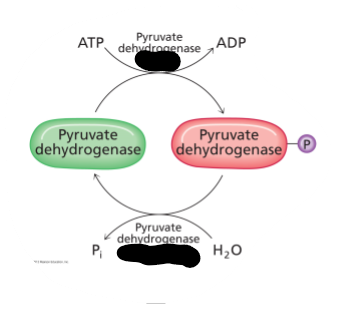
- 31The adenyl cyclase signaling pathway Phosphodiesterase = ___ cAMP (becomes AMP) *It is important to be capable of turning __ the signal. Caffeine __ the inhibitor and this results in __ signal action.inactivates
OFF
inhibits - 32cAMP _ cAMP molecules must bind to the regulatory sites on the inactive complex to activate the ___ subunits ->This activates protein __ __4
catalytic
kinase A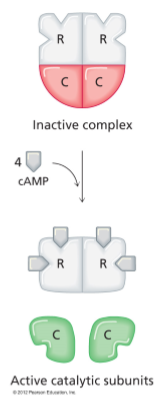
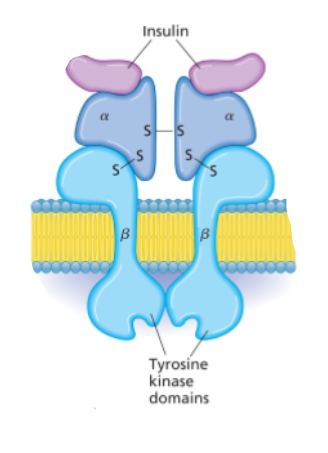
- 33Tyrosine Kinase Pathway -Ligand binding causes ___ -Each kinase ___ its partner (auto___) -Phosphorylated dimer becomes ___dimerization
phosphorylates
autophosphorylation
active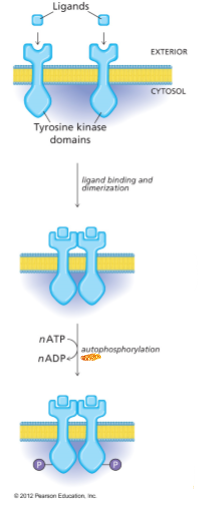
- 34Insulin receptor is an example of a tyrosine kinase receptor -Tyrosine kinase domains catalyze phosphorylation of proteins called insulin receptor substrate (IRS) to further produce secondary messengers (PIP3).
Informações
- Descrição
- Read chapter 9.9-9.11 Exam One
- Criado por
- Marissa Alvarez
- Visualizações
- 33
- Avaliação