
Flashcards
BIOL 473 Theory Test 1
Flashcards do conjunto (67)
- 1Five sensesAuditory, gustatory, olfactory, and tactile
- 2Adaptation definitionthe process by which a sensory system becomes insensitive to a continuing source of stimulation
- 3Proprioreceptiorstype of interoreceptor that innervate muslces, ligaments, joints, and tendons to advise brain of body's movement and position
- 4Mechanoreceptor that senses gentle pressureMeissner's corpuscles
- 5Receptive fieldThe area of skin that a tactile receptor can respond to
- 6Order from most localization to least: forearm, fingertip, wrist, palmFingertip, palm, wrist, forearm
- 7What determines tactile sensitivity for a given areaDensity of receptors
More receptor fields = more sensitive - 8Penny experiment: why is pressure sensation soon lost?The brain can choose what to focus on, so it can ignore constant stimuli
- 9What temperatures are thermoreceptors sensitive to?Cold: lower than 37ºC
Warm: 37ºC-45ºC
Above 45ºC: nociceptors (pain)
Receptors adapt in range of 20ºC-40ºC - 10Homeostatic thermoreceptorsNear hypothalamus, responsible for setting internal temp. to ~37ºC
- 11Do warm temp. receptors transmit absolute or relative information about temperaturesRelative
- 12Define reflexesRapid, autonomic responses to specific stimuli;
may rely on only sensory and motor neurons (monosynaptic) or involve interneurons between sensory and motor neurons (polysynaptic) - 13Steps of knee jerk reaction1. Extensor muscle stretched
2. Muscle spindle stimulated
3. Primary afferent neuron excited
4. Primary afferent neuron stimulates alpha motor neuron to extensor muscle
5. Alpha motor neuron stimulates extensor muscle to contract
6. Primary afferent neuron stimulates inhibitory interneuron
7. Interneuron inhibits alpha motor neuron to flexor muscle
8. Flexor muscle (antagonist) relaxes - 14Are muscle stretches mono- or polysynapticmonosynaptic
- 15Grey matterPrimarily cell bodies of neurons of spinal cord; un-myelinated
- 16Grey matter: Posterior hornaxon terminals of sensory neurons
- 17Grey matter: lateral horncell bodies of autonomic system neurons
- 18Grey matter: Anterior (ventral) horncell bodies of somatic motor neurons
- 19Roots: posterior (dorsal) rootNerve that travels to posterior horn
- 20Roots: dorsal root ganglioncell bodies of sensory neurons
- 21Roots: Anterior (ventral)Nerve that travels from lateral and ventral horns
- 22When the volunteer performed Jendrassik maneuver, how did the knee-jerk reflex change?Amplitude increased because inhibition decreased
- 23What does the effect of the Jendrassik maneuver indicate about neural pathways involved in simple reflexes?pathways close --> inhibition response decreases
- 24Why do you multiple the distance between patellar tendon and sacrum by twoSensory --> CNS
CNS --> targets W - 25Would you expect the conduction velocity to be the same or different with Jendrassik maneuver?Same because distance and time do not change
- 26Consider the two volunteers: Liam is 1.8m (5.9ft) tall and Jacqui is 1.4m (4.6ft) tall. Which volunteer will have a faster response timeJacqui bc she is shorter --> less distance to travel
- 27Why is it important that neurons in this reflex are myelinated?It decreases response time, which is important to keep the body safe in dangerous situations
- 28Guillain-Barre syndrome is a demyelinating disease caused by infection. People with this will have loss of knee-jerk reaction. Why is this true?Signals are lost because they are weaker; can't generate AP or reach CNS
- 29MyopiaNearsightedness; occurs when the eyeball is too long or focusing apparatus (cornea and lens) is too strong (or both); light is focused in front of retina; corrected with diverging lens
- 30HyperopiaFarsightedness; when eyeball is too short or focusing apparatus is too weak (or both); light is focused behind the retina; corrected with converging lens
- 31Presbyopiawhen lens of eye loses elasticity with age; corrected with convex (converging) lens
- 32AstigmatismCornea is football shaped; causes multiple focal points bc light is bent more in some places than in others
- 33Conduction deafnessAny problems with external or middle ear structures involved in conducting sound vibrations
- 34Sensorineural deafnessAny problems with structures inside cochlea
- 35Weber testTests for conductive deafness using tuning fork; whichever ear it sounds louder in is the "damaged" ear
- 36Rinne testTest for conductive deafness using tuning fork; if sound is not audible, there is conductive deafness in that ear, if the sound is audible, there is sensorineural deafness in the opposite ear
- 37Weber/Rinne example: Participant 1 lateralizes left for the Weber test. After the Rinne test, they report they can hear the tuning fork on the left side. This person has ______deafness in the ________earSensorineural deafness in the right ear
- 38What do the semicircular canals detectRotational movement
- 39What are the three doses of drugs that will be givenInitial dose: ketamine (dream-like state) and Xylazine (muscle relaxant)
Second dose: bupivacaine (painkiller) after incision mark but before actual incision
Third dose: Ketoprofen as additional painkiller post-op - 40What drugs can be given to reverse the effects of xylazine and bupivacaineatipamezole
- 41Preparation of the ratApply sterile opthalmic ointment to each of animal's eyes; shave hair; ear punch; instructor marks incision site; disinfect
- 42disinfection orderalcohol-iodine-alcohol
- 43Three layers of the abdominal wallExternal oblique
Internal oblique
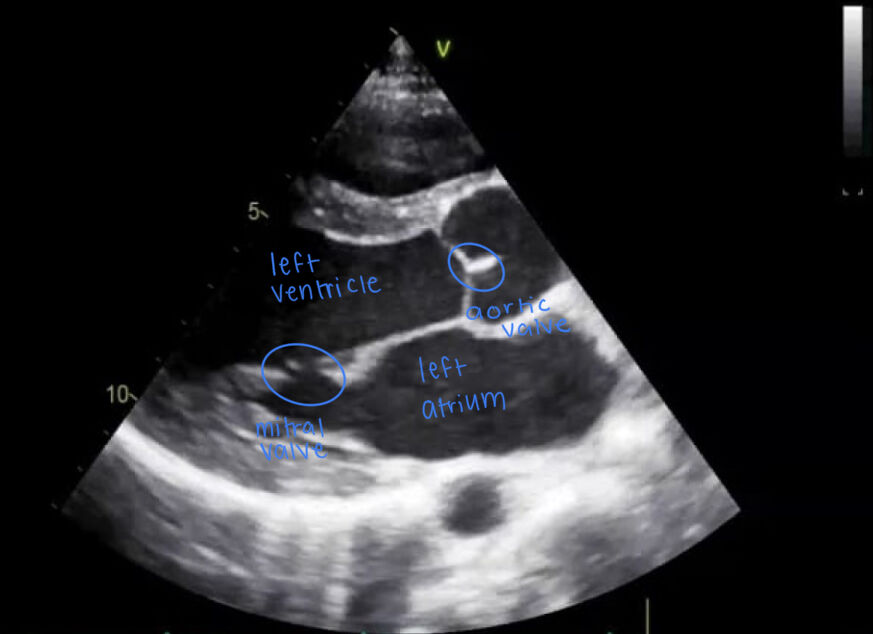
Transverse abdominis - 44Which side receives oxygenated bloodThe left ventricle by the left atrioventricular (bicupid/mitral) valve
- 45Where does blood go after left ventricleThrough aortic semilunar valve to aorta, where it is shunted to the rest of the body
- 46Which side of the heart receives deoxygenated bloodThe right atrium receives deoxygenated blood and is separated from right ventricle by the right atrioventricular valve (tricuspid)
- 47Where does the blood go after it is received in the right side of the heartTo the lungs to be oxygenated!
- 48Papillary musclesfinger like extensions from the wall of the ventricle; connected to right and left atrioventricular valves
- 49Chordae musclesConnect papillary muscles to atrioventricular valves
- 50Blood flow through the heartLeft atrium --> through bicuspid valve into left ventricle --> through aortic semilunar valve into aorta
- 51What is ultrasoundTechnology that uses high frequency sound waves to penetrate the body, creating an echo signal
- 52HyperechoicAppears white
ex) connective tissue - 53AnechoicAppears black
Fluid filled
ex) blood vessels - 54IsoechoicAppears light grey
ex) Liver - 55HypoechoicAppears dark grey
ex) Kidneys - 56List the following structures from closest to farthest from the probe: liver, gallbladder, abdominal musclesAbdominal muscles, liver, gallbladder
- 57True or false: Organs have homogenous ethnogenicitiesFalse
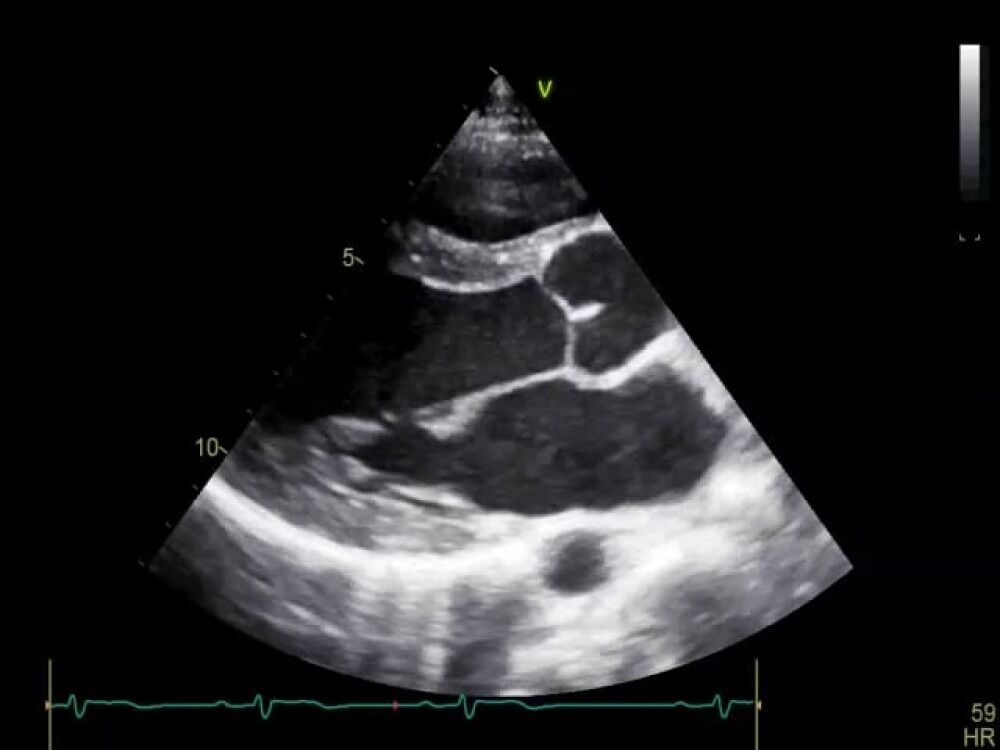
- 58What axis are we viewing the heart fromParasternal long axis
- 59—
- 60Which probes do you use for: heart, abdomen, and neckHeart: 3S
Abdomen: 4C
Neck 12L - 61What would happen to the blood pressure in the brain if the internal jugular vein did not change during the Valsalva maneuverIt would build up; this could result in inadequate blood/gas exchange
- 62—Liver
Can see portal vein and other blood vessels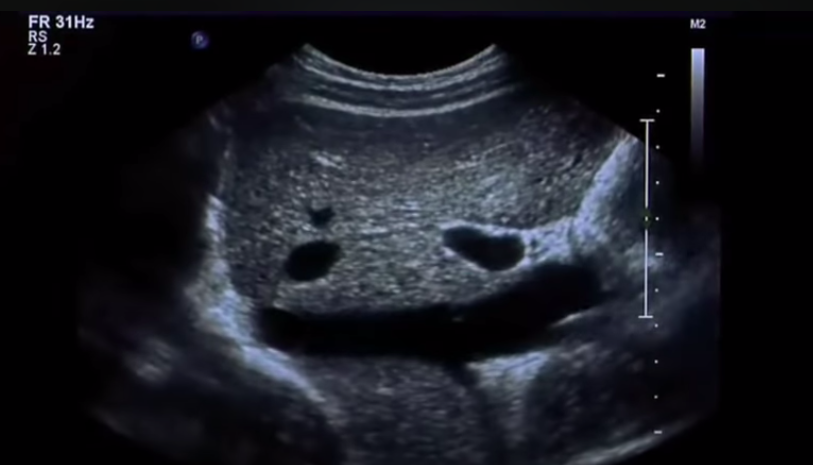
- 63—
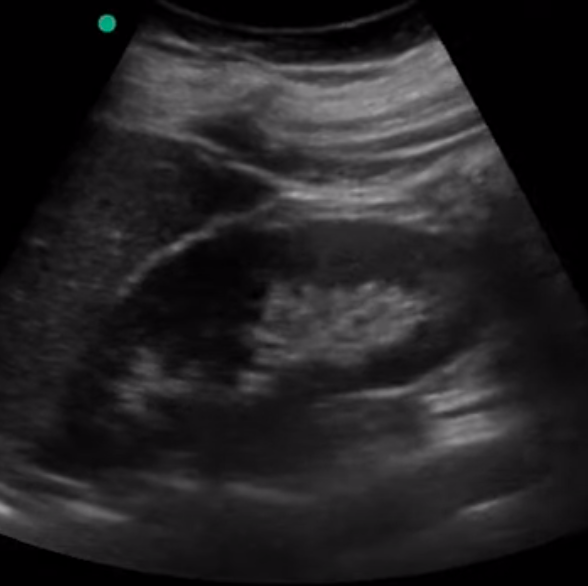
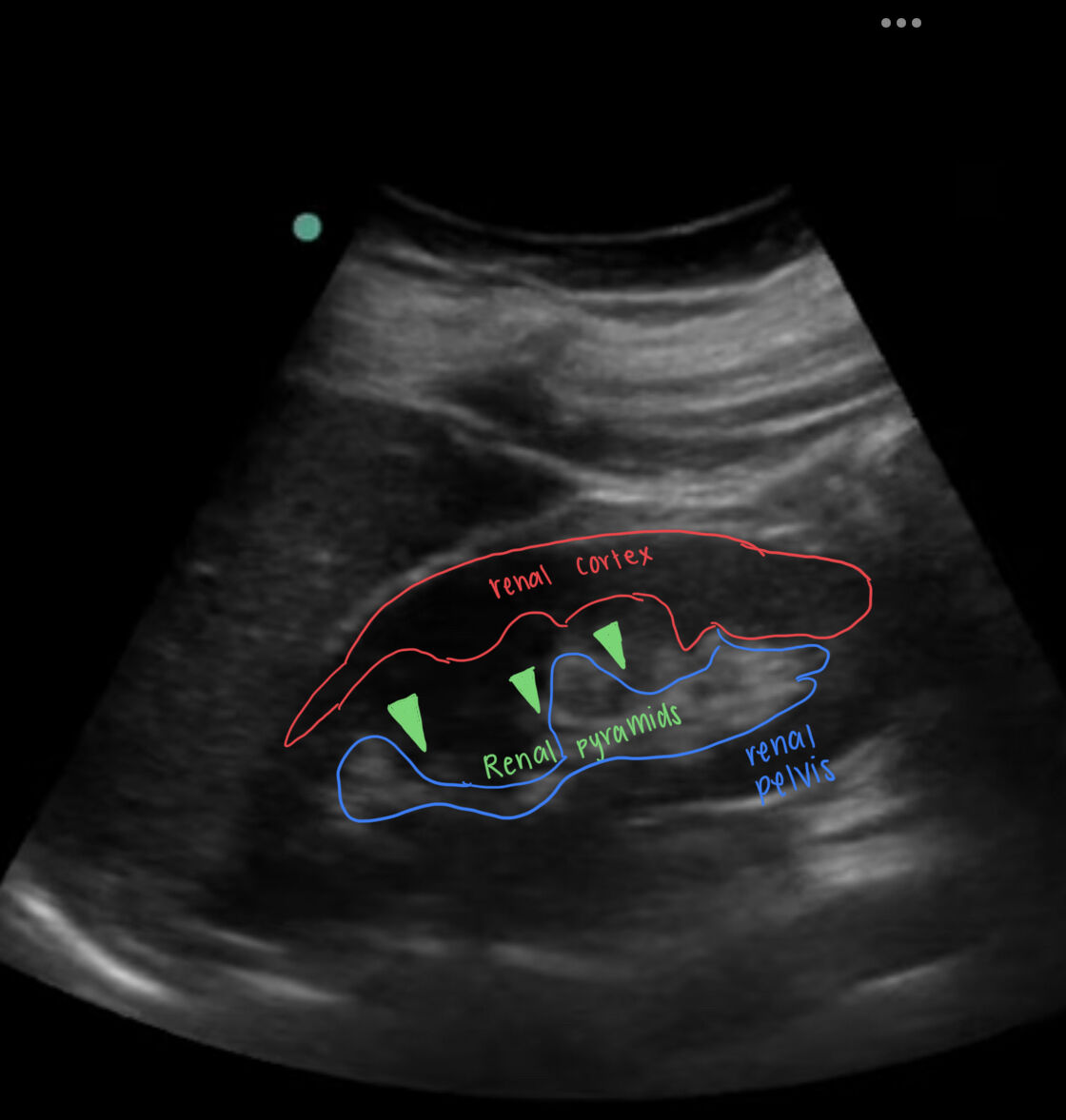
- 64What are the ethnogenicities of the kidneyAnechoic w/ isoechoic cortex, hypoechoic pyramids, & hyperechoic calluses
- 65When the left ventricle is contracting, which valve is openAortic semilunar
- 66When the left ventricle is relaxed, which valve is open?Bicuspid
- 67Do the ends of the leaflets of the valves ever touchYes, to prevent blood regurgitating back
Informações
- Descrição
- Theory test for physiology lab covering special senses, rat surgery, and ultrasound
- Criado por
- Maddie Allen
- Visualizações
- 70
- Tags
- Avaliação