
Flashcards
AS Level AQA Biology: Unit 4 (Genetic information, variation and relationships between organisms)
Flashcards do conjunto (96)
- 13.4 Genetic information, variation and relationships between organismsN/A
- 23.4.1 DNA, genes and chromosomesN/A
- 3What is DNA like in prokaryotic cells?- Short
- Circular
- Not associated with proteins - 4What is a plasmid?A short section of circular DNA in prokaryotic cells that is separate to the main strand.
- 5What is DNA like in eukaryotic cells?- long
- linear
- associated with proteins, called histones - 6What is a chromosome?The structure formed of DNA and histones.
- 7Where is DNA found in eukaryotic cells?- Nucleus
- Mitochondria
- Chloroplasts - 8What is DNA like in mitochondria & chloroplasts? (eukaryotic cells)- Short
- Circular
- Not associated with proteins - 9What do genes code for?- Amino acid sequences of polypeptides
- A functional RNA - 10Where are genes located?In a fixed position on DNA molecule (Locus)
- 11What is a section of three DNA base pairs called?- Triplet
- Codon - 12What do sections of three DNA base pairs do?Code for a specific amino acid
- 13What are the three traits of the genetic code?- Universal (same for all organisms)
- Non-overlapping (Each triplet of base pairs codes separately)
- Degenerate (Amino acids can be coded for by more than one codon) - 14What can be found between genes?Non-coding multiple repeats
of base sequences - 15What is the name for a codon that does not code for a polypeptide?Intron
- 16What is the name for a codon that codes for a polypeptide?Exon
- 173.4.2 DNA and protein synthesisN/A
- 18What is the genome?The complete set of DNA within a cell or organism.
- 19What is the proteome?The full range of proteins that a cell or organism is able to produce.
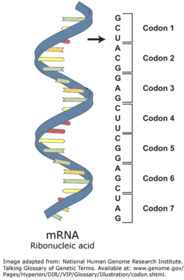
- 20What is the structure of messenger RNA (mRNA) like?- Short
- Single helix - 21Diagram of an mRNA molecule
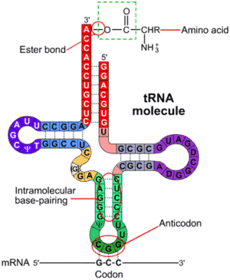
- 22What is the structure of transfer RNA (tRNA) like?- Very short
- Clover-like structure
- Amino acid attachment site on one end
- Anticodon loop opposite amino acid attachment site - 23Diagram of a tRNA molecule
- 24What is transcription?The process of pre-mRNA production from DNA (occurs in Nucleus)
- 25How does transcription differ in prokaryotic cells to eukaryotic cells?In prokaryotic cells, mRNA is produced directly from DNA
- 26What are the steps involved in transcription?- DNA 'unzipped' by DNA helicase which catalyses the breakdown of hydrogen bonds between base pairs
- Free nucleotides arrive from around base pairs and form hydrogen bonds with one of the DNA strands
- RNA polymerase catalyses the formation of strong chemical bonds between phosphate-sugar part of nucleotides, forming a long 'backbone'
- pre-RNA leaves nucleus through nuclear pores, splicing occurs at this point - 27What is splicing?The process of removing non-coding codons from the pre-mRNA molecule, forming mRNA
- occurs on the inside of nucleus, by the nuclear pores - 28What are the steps involved in splicing?- Pre-mRNA is attacked just before it leaves the nucelus through the nuclear pores by spliceosomes
- Spliceosomes catalyse the removal of introns from the structure, leaving only exons and thus forming mRNA - 29What is translation?The process during which mRNA is decoded to produce a specific polypeptide which can fold into a protein
- occurs in ribosomes - 30What are the three stages of translation?- Initiation
- Elongation
- Termination - 31What happens during the initiation phase of translation?- Small ribosomal subunit binds with mRNA
- Small subunit moves along mRNA until it reaches the start codon (AUG)
- Matching anti-codon of tRNA (with methianine) binds with start codon
- Large subunit moves on top and acts as stapler to start - 32What happens during the elongation phase of translation?- Additonal tRNA anticodons attach to mRNA codons
- Amino acids attached to the tRNA molecules attach to one another by means of peptide bonds
- tRNA releases amino acids to pick up further amino acids
- mRNA shifts along the large subunit by one codon, first tRNA molecule leaves, new tRNA molecule enters
- this repeats until termination - 33hen does the termination phase of translation occur?When a stop codon in the mRNA is bound to the ribosome
- 34What happens during the termination phase of translation?- Ribosome accepts a protein called a release factor
- Release factor causes the addition of a water molecule instead of an amino acid
- This reaction releases the protein and the translation assembly comes apart - 353.4.3 Genetic diversity can arise as a result of mutation or during meiosisN/A
- 36What is a mutation?Any change in the quantity of base sequences of DNA
- 37What is a gene mutation?A change to one or more bases or the sequence of bases in DNA
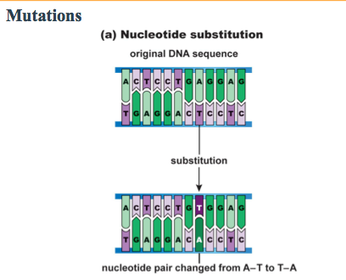
- 38What is substitution of bases?One or more of the bases in DNA is replaced by a nucleotide with a different base
- 39Diagram of base substitution
- 40What is a nonsense mutation?A substitution mutation in which a stop codon is prematurely coded, causing the polypeptide to be shortened
- 41What is a mis-sense mutation?A substitution mutation in which a codon is changed and thus a different amino acid is coded for, leading to a different polypeptide
- 42What is a silent mutation?A substitution mutation in which a codon is changed but the same amino acid is coded for due to the degeneracy of the genetic code, leading to no impact
- 43What is Thalassemia?- Caused by nonsense mutation?
- Autosomal recessive blood disease
- Results in reduced rate or no synthesis of one of globin chains that make up haemoglobin
- Results in anaemia (deficiency of red blood cells) - 44What is a sickle-cell anaemia?- Caused by mis-sense mutation
- Occurs due to a mutation in the haemoglobin gene
- Hydrophilic amino acid Glutamic acid is replaced by the hydrophobic acid Valine
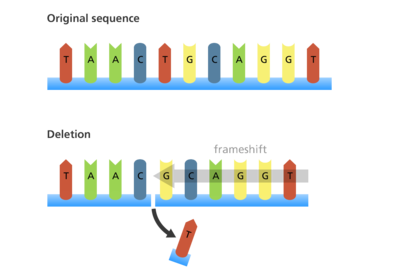
- This distorts the shape of the red blood cell and decreases its elasticity, resulting in a fixed sickle-like shape that clogs blood vessels slowing flow - 45What is base deletion?- Nucleotide lost from the normal DNA sequence
- Leads to frame shift as DNA is non-overlapping
- All subsequent triplets are changed as the code 'shifts to the left' (in reality it doesn't, the gap is simply skipped) - 46Base deletion diagram
- 47What is Tay-Sachs disease?- caused by deletion of bases
- autosomal recessive disorder
- causes relentless deterioration of mental and physical abilities that commences around 6 months of age and results in death by age of four
- caused by insufficient activity of the enzyme hexosaminidase, found in lysosomes and responsible for the breakdown of lipds (lysosomes are inactive due to frame-shift in coding enzyme)
- without this, lipids accumulate in the brain and interfere with biological processes - 48What is a chromosome mutation?A change in a chromosome or a whole set of chromosomes
- 49What is a change in a whole set of chromosomes?- when organism has three or more sets of chromosomes rather than two
- called polyploidy
- mainly occurs in plants (results in infertility, often found in wheat, tobacco, potato, banana, strawberry) - 50What is a change in the number of individual chromosomes?- caused by non-disjunction during meiosis (when homologous pairs fail to split)
- results in additional or fewer chromosomes - 51What is Down's syndrome?Chromosome 21 is the smallest chromosome (40 million nucleotide pairs, 1.5% of DNA)
- causes delayed growth and development
- additional chromosome could be from a completely different pair
- many codons affected so there are many different causes - 52What is a mutagenic agent?A chemical agent that increases the rate of genetic mutation
- 53What is meiosis?- cell division creating gametes
- Made up of two divisions: Miosis I & Miosis II - 54What happens during Meiosis I?Mitosis cell division:
- Interphase
- Prophase (including independent segregation and crossing over/recombination)
- Metaphase
- Anaphase
- Telophase - 55What is independent segregation?- During Meiosis I the homologous chromosomes line up alongside their partner after they have replicated
- There are two possible ways in which these pairs can line up, increasing the chance of variation in offspring - 56What is crossing over and recombination?- When the homologous chromosomes line up, they become entangled and twist many times, crossing over
- This can result in sections of chromosomes breaking off and re-joining to the opposite chromosome, recombining and increasing variation - 57What does Meiosis I look like?
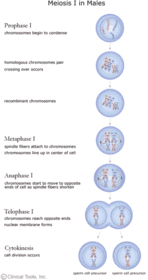
- 58What happens during Meiosis II?- Prophase
- Metaphase
- Anaphase
- Telophase - 59What does Meiosis II look like?
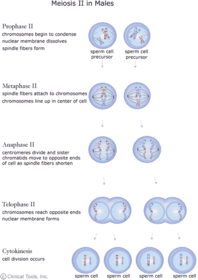
- 60How is the number of possible gamete variations in gametes calculated?2^number of homologous pairs
- 61How is the number of possible varieties in zygotes calculated?Number of variations in gametes of parents multiplied together
- 62How does random fertilisation increase variation in offspring?Greater chance of parents with different gametes, increasing the number of chromosome combinations in the zygote
- 633.4.4 Genetic diversity and adaptationN/A
- 64What is genetic diversity?The number of different alleles in a population
- 65How does genetic diversity affect natural selection?It allows it to occur
- 66What are the principles of natural selection in evolution?- Random mutation can result in new alleles
- Many mutations are harmful, but some can result in advantages leading to greater reproductive success
- Advantageous alleles that allow greater reproductive success are passed on to future generations
- Over generations the proportion of the population with the new allele increases until it becomes the norm - 67What is directional selection?Natural selection that favours organisms at the extremes e.g. antibiotic-resistant bacteria become the norm
- 68Directional selection diagram
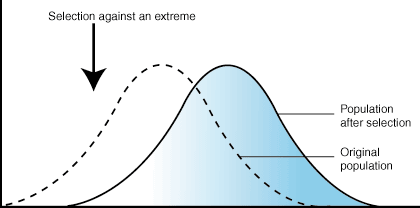
- 69What is stabilising selection?Natural selection that favours organisms with average characteristics e.g. birth weights of babies, with those close to the mean weight having a greater likelihood of survival
- 70Stabilising selection diagram
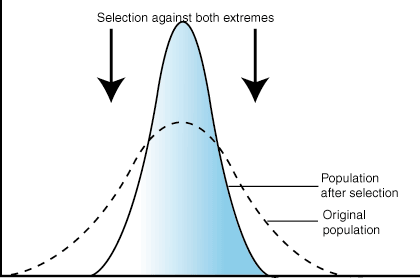
- 71What is the outcome of natural selection?Species that are better adapted to their environment/conditions
- 72What are the types of adaptation?- Anatomical
- Physiological
- Behavioural - 73What is an anatomical adaptation?Physical change to organism's anatomy that makes it better adapted to the environment
e.g. white fur of polar bear - 74What is a physiological adaptation?Change to an organism's internal reactions/chemical processes
e.g. venom production in some snakes - 75What is a behavioural adaptation?Change to an organism's behaviour that makes it better adapted to the environment/better able to survive
e.g. changing migration patterns of birds to warmer climates - 763.4.5 Species and taxonomyN/A
- 77What is a species?A group of organisms with similar characteristics capable of producing fertile offspring
- 78What is the role of courtship behaviour in ensuring successful mating?Ensure that fertile offspring are produced
- 79What are the steps of the courtship process?- Recognise members of own species
- Identify a mate of the opposite sex
- Synchronise mating and fertility
- Ensure sexual maturity
- Form a pair bond
- Mate - 80What is a phylogenetic classification system?- Arranges species into groups based on evolutionary origins and relationships
- Uses heirachical, non-overlapping system made up of groups called taxa - 81What is the binomial classification?Developed by Carl Linnaeus in 18th century
- Made up of seven hierachical groups
- Species are referred to double name made up Genus and species e.g.
Homo sapiens (italicized/underlined) - 82What does Linnaeus' classification look like?
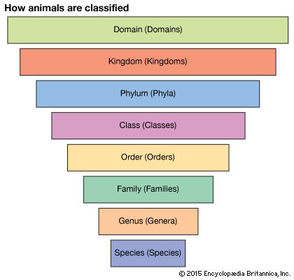
- 83How can species be classified?- Examining DNA
- Breeding experiments
- Fossil records
- Patterns of embryonic development - 843.4.6 Biodiversity within a communityN/A
- 85What is biodiversity?- Variety of life within a given area
Area can be of any size - 86What is an ecosystem?Self-contained, self-supporting combination of interacting biotic (living) and abiotic (components)
- Made up different populations (inter-breeding groups) of species
- Comprises many interacting communities within many habitats - 87What is species richness?Measure of the number of different species in a community
- 88What kinds of diversity are there?- Species diversity - variety of species within ecosystem
- Genetic diversity - variety of genes/alleles within ecosystem
- Ecosystem diversity - variety of different habitats within an ecosystem - 89How is species diversity measured?Considering number of different species, and number of each species present
D = diversity index
N = total number of species
n = number of each species present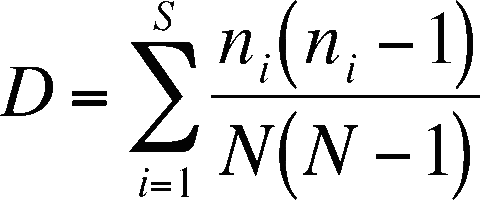
- 90How can humans affect the environment?- Habitat loss
- Introduced species
- Population growth of humans
- Pollution
- Over-consumption of resources - 91How can agriculture reduce biodiversity?- Destruction of habitats to clear land e.g. removal of hedges to enlarge fields
- Over-grazing of land destroying vegetation e.g. sheep grazing same area of grassland
- Creation of monocultures (single species ecosystem)
- Use of pesticides/insecticides can kill species - 92How can agricultural methods be improved to support biodiversity?- Use of hedges as natural partitions
- Leave wet corners of fields rather than draining
- Reduce of pesticides/insecticides
- Maintaining ponds and creating new ones
- Use crop rotation including nitrogen fixing plants (that trap nitrogen and release it into the soil when they break down) to naturally boost fertility - 933.4.7 Investigating diversityN/A
- 94How can genetic diversity within or between species be observed?- frequency of measurable/observable characteristics
- base sequence of DNA
- base sequence of mRNA
- amino acid sequence coded for by mRNA - 95How can quantitative data relating to variation within a species be gathered?- Gathering data from random sampling using transects and quadrats at regular intervals/quadrats placed at random positions over an area
- Mean and standard deviation of data calculated
- Data interpreted or extrapolated to estimate diversity over a wider area - 96How has gene technology changed methods of investigating diversity?- Change from unreliable methods of comparing anatomical features (flawed as characteristics coded for by more than one gene and affected by environment
- change to DNA and mRNA base sequence comparison - bases read and displayed by computers and given fluorescent dye A(green), T(red), C(blue), G(yellow)
Informações
- Descrição
- AS - Level Biology (Unit 4) FlashCards sobre AS Level AQA Biology: Unit 4 (Genetic information, variation and relationships between organisms), criado por Big Dave em 28-11-2016.
- Criado por
- Big Dave
- Visualizações
- 135
- Tags
- Avaliação