
Flashcards
Biology Topic 3.1

Flashcards do conjunto (13)
- 1What are the 10 main parts of a eukaryotic cell?Centrioles, Mitochondria, Nucleus, Nucleolus, Rough endoplasmic reticulum, Smooth endoplasmic reticulum, Ribosomes, Cell surface membrane,
Golgi apparatus, Lysosomes. - 2What seven things do prokaryotic cells have which eukaryotic cells do not?*Flagellum, *Pili, *Capsule, *Plasmid, Infolding of the cell surface membrane, Circular DNA, Cell wall.
*these features may not always be present. - 3Describe the process of protein synthesis. (six steps)1. The mRNA made during transcription leaves the nucleus though a pore.
2. The primary sequence of the protein is assembled in the ribosomes on the rER.
3. The protein then moves though the rER assuming its 3D structure on route.
4. A vesicle containing the protein is pinched off and fuses with the Golgi apparatus.
5. Proteins are modified within the Golgi and vesicles transport the protein thought the layers.
6. The final vesicle fuses with the cell surface membrane, releasing the protein. - 4Draw a labelled diagram of an egg cell.
- 5Draw a labelled diagram of a sperm cell.
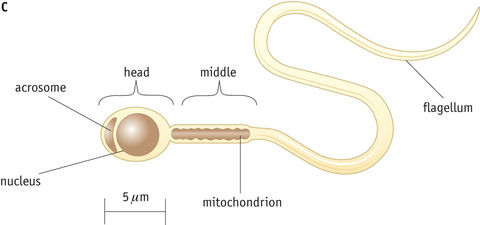
- 6Why does an egg cell need lipid droplets? Why does a sperm cell need a mitochondrion?To provide energy so if the egg is fertilised it can divide to form an embryo.
To release energy so the sperm can swim. - 7Describe the acrosome reaction.1. The sperm reaches the ovum and chemicals are released, triggering the reaction.
2. The acrosome swells, fusing with the cell surface membrane, releasing the enzymes.
3. The digestive enzymes break down the follicle cells and the zona pellucida.
4. The sperm surface membrane fuses with the ovum surface membrane and the nucleus enters the ovum.
5. The cortical reaction occurs.
6. The nuclei fuse. - 8Describe the cortical reaction.Once the nucleus from the sperm has entered the egg the lysosomes in the ovum release enzymes which thicken the zona pellucida, preventing any other sperm from entering.
- 9Describe the process of meiosis.1. The chromosomes replicate before division, forming chomatids.
2. The homologous pairs of chomatids pair up.
3. The cell separates twice, forming 4 gametes with haploid nuclei. - 10What is independent assortment?When the homologous pairs pair up during meiosis they can be in any order either way round (i.e. the chromosomes you get from your mum can be on the left or right). This order is completely random so independent assortment is a way of increasing genetic variation.
- 11What is crossing over?When the homologous pairs pair up during meiosis, the chromatids come into contact. This contact point is called a chiasma and the chromatids can swap genes. The chiasma will have the same locus on both chomatids. Crossing over is a source of genetic variation.
- 12When are two genes said to be linked?When they have a locus on the same chromosome because they're more likely to be inherited together.
Two genes are strongly linked if their loci are close on the same chromosome because the genes will only not be inherited together if crossing over occurred in exactly the right place. - 13When are genes said to be sex-linked.When they have a locus on the sex chromosome (number 23).
For example red-green colour blindness is more common in men than women because the gene in on the X chromosome.
Informações
- Descrição
- Edexcel new AS level Topic 3.1 In the begining
- Criado por
- Amy Tourle
- Visualizações
- 199
- Avaliação