
Flashcards
Circulation
Flashcards do conjunto (50)
- 1Oxygen goes from...Lungs to body cells.
- 2Nutrients go from...The small intestine to the liver, then to other cells.
- 3Carbon dioxide goes from...Body cells to lungs.
- 4Ammonia goes from...All cells to liver.
- 5Urea goes from...Liver to kidneys.
- 6Hormones go from...Endocrine glands to tissue/cells.
- 7Why do large animals need a circulation?In small animals, diffusion can move materials around, but diffusion would take too long in large animals.
- 8When is circulation unnecessary?When an organism is very small, has a thin shape (eg: flatworms), or very inactive.
- 9What are the three main parts of the circulatory system? What what do each of these parts do?Blood, heart, and blood vessels.
Blood: the fluid which helps carry materials around.
Heart: The pump to push the fluid around.
Blood vessels: Tubes to carry the blood. - 10What is the composition of blood?Plasma (55%)
White blood cells and platelets (<1%)
Red blood cells (45%) - 11A typical adult has about how many liters of blood?5 liters.
- 12What is plasma?A yellow liquid, mainly water, which contains many dissolved substances.
Substances include: nutrients (eg: glucose), wastes (eg: CO2), ions/minerals. - 13What are the scientific names for the three types of blood cells?Red blood cells = erythrocytes
White blood cells = leucocytes
Platelets = thrombocytes - 14Where are the blood cells made?Erythrocytes are made in the bone marrow.
Leucocytes are made in the bone marrow and lymph nodes.
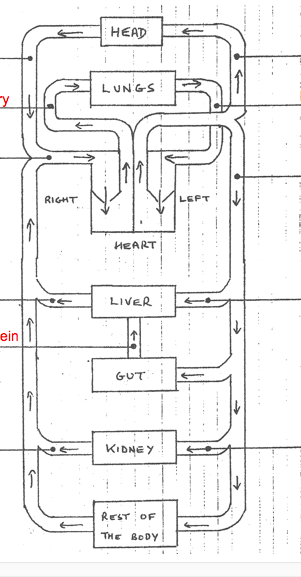
Thrombocytes are made in the bone marrow. - 15What is the structure and function of erythrocytes?Structure is a biconcave disc with no nucleus.
Function is to transport oxygen. - 16What is the structure and function of leucocytes?Structure is irregular and has a nucleus.
Function is to defend body against disease. In the leucocytes are phagocytes which engulf and break down pathogens, and lymphocytes which make and release antibodies. - 17What is the structure and function of thrombocytes?Structure is cell fragments with no nucleus.
Function is to clot blood. - 18What does oxygen bind to in erythrocytes?A protein which contains iron atoms, called hemoglobin (Hb).
- 19Hb + 4O2 --> ?Hb(O2)4
- 20Lack of iron is called?Anemia
- 21What are the structural adaptions of erythrocytes?1. Biconcave disc. This increases the surface area to volume ratio for gas exchange in lungs. It also makes erythrocytes more flexible which prevents it from getting stuck in a capillary
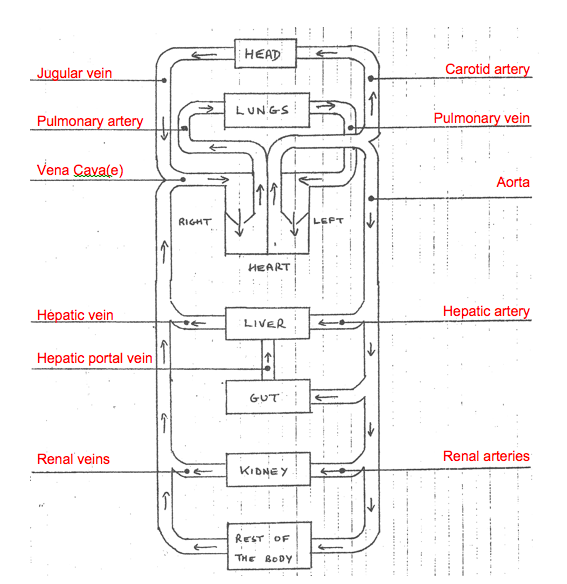
2. No nucleus. More hemoglobin will fit in - 22What is the process of single circulations (blood passes through heart once)?Blood goes from the HEART to the LUNGS to the REST OF THE BODY.
- 23What are the disadvantages of single circulations?1. It's slow. However, this is okay for fish because water holds much more oxygen than air.
2. The gases are not necessarily exchanged each circulation. For example, the oxygenated and deoxygenated blood mix. - 24What are the advantages of double circulations (blood passes through heart twice)?1. The oxygenated and deoxygenated blood are fully separated. This means that all blood receives oxygen and loses carbon dioxide every complete circuit.
2. The blood is pumped twice (once to blood and once to the body), and it is pumped fast. This allows activity with high energy requirements. - 25Define arteries?Arteries carry blood AWAY from the heart. Blood in the arteries is oxygenated.
The exceptions are the pulmonary artery and umbilical artery. - 26Define veins?Veins carry blood towards the heart. Blood in the veins is deoxygenated.
The exceptions are the pulmonary vein and umbilical vein. - 27—
- 28What is the function of capillaries?They connect arteries and veins to each other. They are 1 cell wall thick.
- 29—
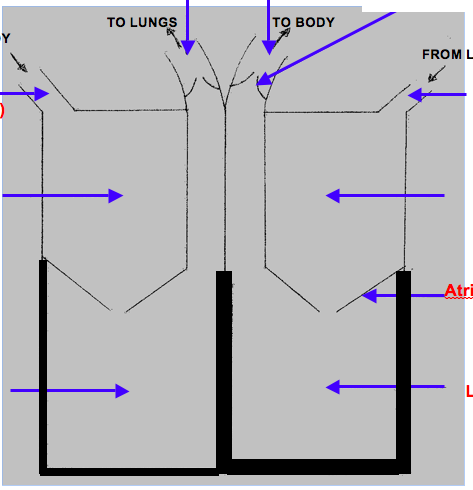
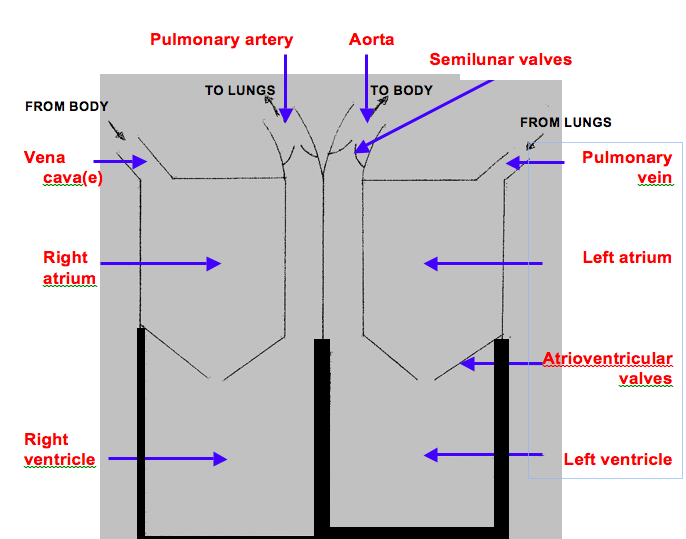
- 30Explain the cardiac cycle.First, the heart muscle is relaxed (diastole). This means that the blood flows from the veins into the atria and ventricles.
Next, the atria contract (atrial systole). Here the atrial muscles contract, pushing blood from the atria into the ventricles so that the ventricles become full of blood.
Finally, the ventricles contract. Here the powerful ventricle muscles contract forcing blood from the ventricles into the arteries. - 31Electrical signals are sent out from a small area of the right atrium called the...Pacemaker, or SA node.
- 32An irregular heartbeat is called...Arrhythmia.
- 33—
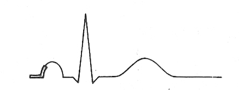
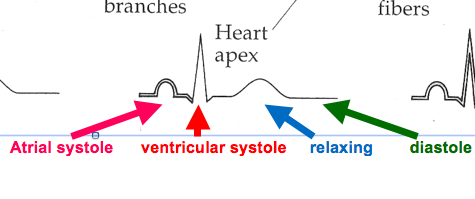
- 34What is an electrocardiogram?An electrical record of heart activity.
- 35During exercise, the 1.__ nerve becomes more active, and the 2.__ nerve becomes less active. 3. __ adrenaline is released.1. sympathetic
2. parasympathetic
3. more - 36Define blood pressure.Blood pressure is a measure of the force pushing blood through the blood vessels.
- 37—
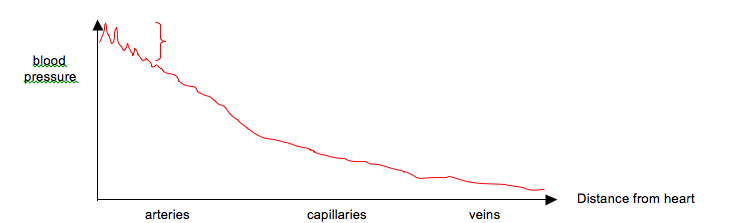
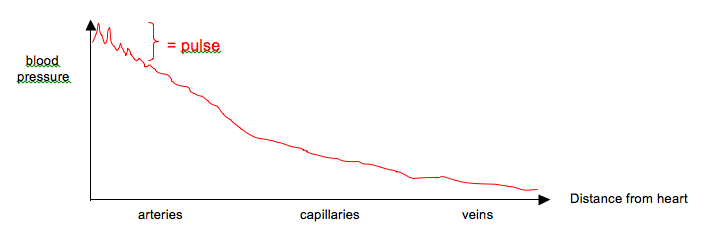
- 38How does someone measure blood pressure?They record the maximum pressure and minimum pressure using a sphygmomanometer.
1. The cuff is inflated so that it's high pressure blocks all the blood flow.
2. The pressure in the cuff is slowly released. When the maximum blood pressure is reached the blood can just squirt past the cuff (a stop start squirting sound is heard, and BP is recorded).
3. The cuff falls further, and a constant squirting sound is heard. The minimum BP is recorded. - 39What is the average BP?120/80
- 40A doctor can listen to a patients heart using a ...Stethoscope.
- 41What is the "lub-dub" sound?They are the sounds of the valves closing?
Lub = the atrioventricular valves
Dub = the semilunar valves - 42What is the structure of arteries?Elastic tissue, for heart beat. The arteries stretch as the blood goes through.
Circular tissue. This helps reduce blood flow to intestine when exercising. It also helps arteries shrink down and dilate. - 43What is the structure of veins?Veins have thinner walls than arteries because it has a lower blood pressure.
- 44How does the body prevent blood from traveling away from the heart?1. Veins contain valves
2. Limb and body movements and breathing squeeze the veins pushing blood towards the heart - 45What are lymph vessels?Tubes that collect excess tissue fluid from all around the body.
- 46What are the functions of the lymphatic system?1. Defends body against disease. The lymph nodes contain lymphocytes which detect and respond to bacteria or other foreign materials. When activated, these nodes swell up.
2. Fat absorption. Lacteals (tiny lymph vessels) in the villi of the small intestine absorb fats. - 47—Elephantiasis.
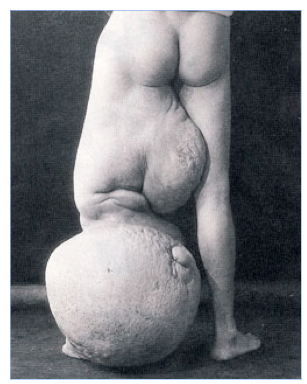
- 48Materials enter/leave cells by...Simple diffusion, facilitated diffusion, and active transport.
- 49Tissue fluid is similar to...plasma (but has fewer proteins).
- 50What are the symptoms of a heart attack?Pale face, pain in the back of left arm... symptoms for women are milder than that of men.
Informações
- Descrição
- Biology FlashCards sobre Circulation , criado por Nicole Engen em 29-04-2017.
- Criado por
- Nicole Engen
- Visualizações
- 26
- Tags
- Avaliação