
Flashcards
16. Reflexes and Escape Behaviour
Flashcards do conjunto (16)
- 1Define locomotionThe ability of an organism to move in space in purposeful ways by using efficient mechanisms that are suitable for the purposes of the movement
- 2What are the specific animal adaptations for locomotion?• Muscles (locomotion requires muscles)
• The nervous system (muscle contraction requires control) - 3What makes a good model system for studying the control of locomotion?• The behaviour needs to be, reliable, reproducible and simple
• The underlying control mechanisms need to be simple
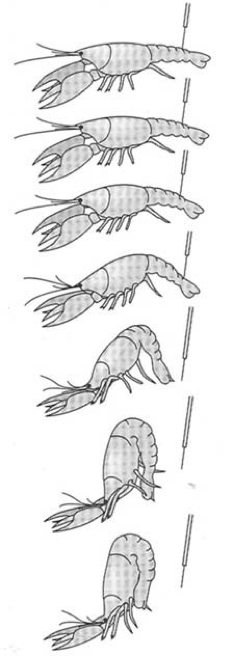
• The system needs to be accessible - 4Briefly describe crayfish escape behaviour in response to a tail touch. What causes the response?- Touching the tail with a probe triggers a downward tail flip that propels the animal up and away from the stimulus
• It's fast --> the time between the stimulus and the response is 10ms
• Contraction of the tail is caused by the rapid contraction of the flexor muscles - 5Describe the crayfish nervous system• The brain: a collection of ganglion fused in the head region
• Subesophageal ganglion complex
• 5 thoracic ganglia (correspond to the 5 thoracic ganglia)
• 6 abdominal ganglia (correspond to the 6 abdominal ganglia)
• Each ganglion is connected by axons - 6Where is the circuitry for the tail flip response located?In the abdominal ganglia
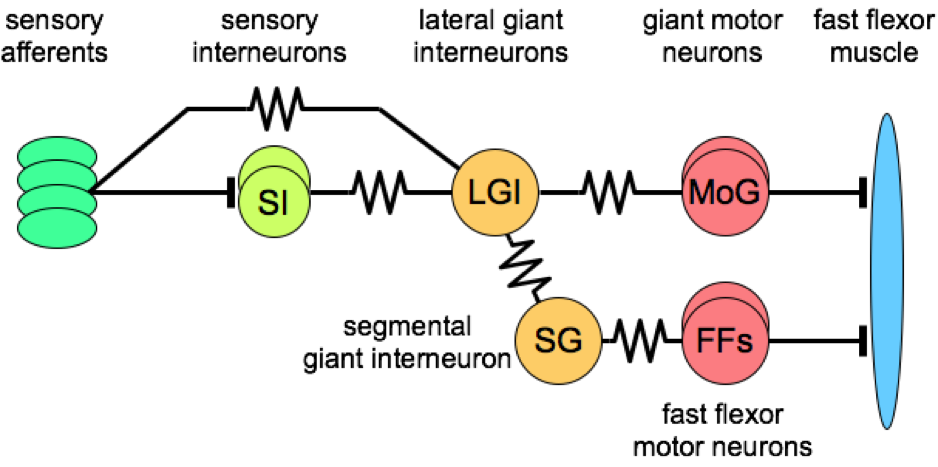
- 7Describe the pathway for the tail flip circuitry• Tail afferents (bipolar sensory cells)
-> Sensory interneurons
-> Lateral Giant Interneuron (LGI)
-> Giant Motor Neurons (MoG)
-> Fast flexor muscles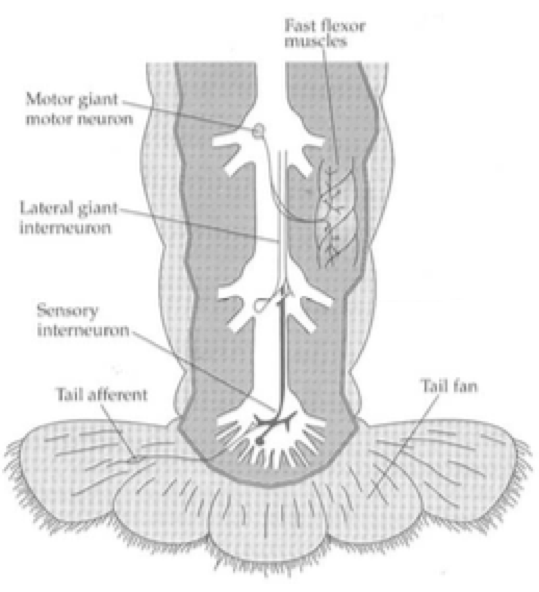
- 8[Diagram of tail flip circuitry]The zig-zag lines indicate electrical synapses
- 9Describe the anatomical organisation of the lateral giant interneurons• There is one LGI per abdominal ganglion
• They are coupled to each other via segmental electrical synapses
[The LGIs essentially operate as a single unit because of how strongly they are connected (ensures rapid spread of activity throughout the ganglia)]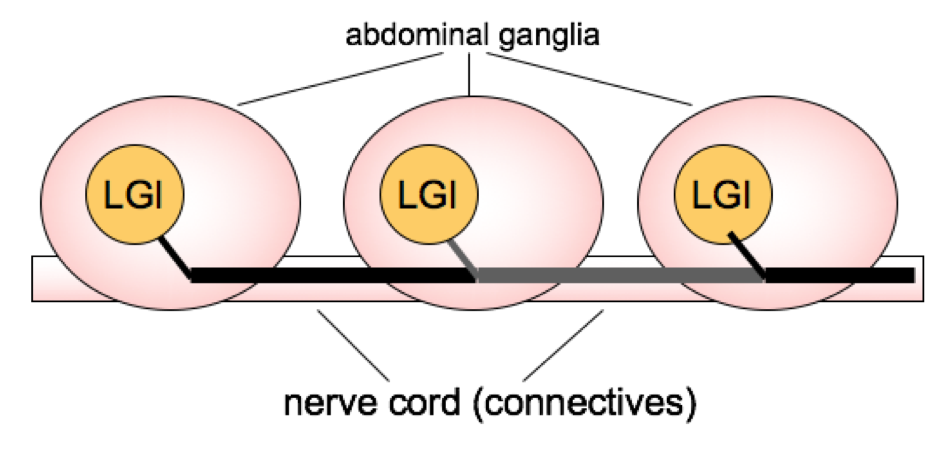
- 10—• This experiment proves that LGI activity is necessary for the tail flip response
• After electrically stimulating the sensory neuron (mimics tail touch) > depolarisation of LGI > APs in motor neuron
• Injecting negative current leads to hyperpolarisation > no AP in LGI > no AP in motor neuron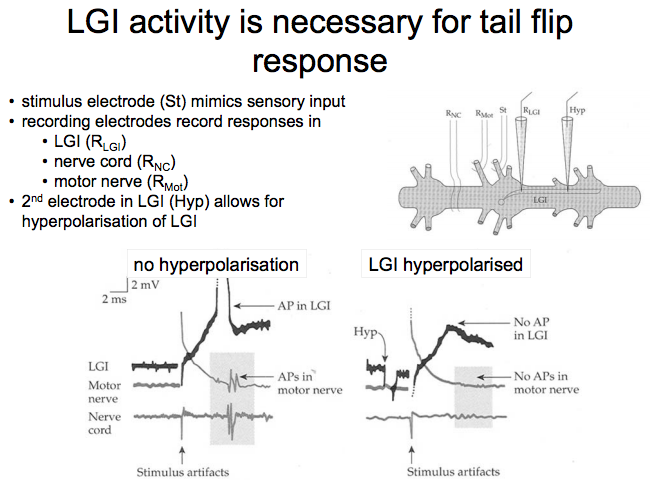
- 11Describe crayfish escape behaviour in response to a head touch. What interneuron is involved in this escape response?• Triggers a tail flip that propels the animal backwards
• The Medial Giant Interneuron (MGI) is involved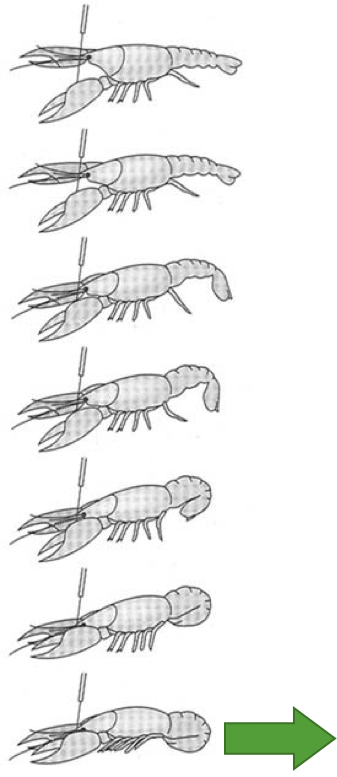
- 12What's the difference between the MGI and the LGI?• MGI is carries sensory information from the head
• LGI carries sensory information from the tail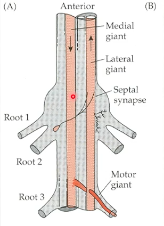
- 13What's the difference between how the MGI and the LGI cause the tail flip response?• LGI synapses with MoGs in abdominal segments 1 - 3 so only these muscles contract
• MGI synapses with all segments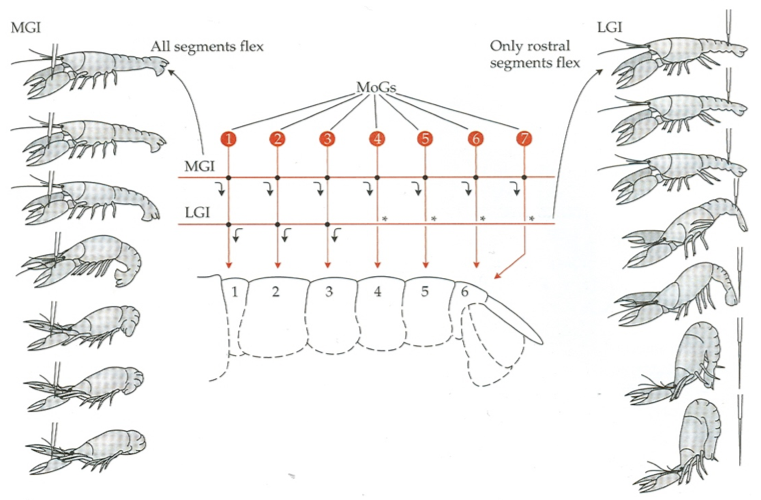
- 14How are escape networks specialised for fast responses?• Neurons have large axon diametres
• Networks have many electrical synapses - 15Describe the squid jet propulsion escape response.• It rapidly contracts body and expels water to propel itself away from the stimulus
• It is triggered by the activity of the Squid Giant Axon - 16Describe the Drosophila escape jump response.• The fly jumps upwards and backwards and flies away
• Giant Fibres carry sensory information from the eyes to the tergotrochanteral muscles which contract to make them jump
Informações
- Descrição
- BS2066 Lecture 16 by VS - Reflexes and Escape Behaviour
- Criado por
- Mimi E
- Visualizações
- 110
- Tags
- Avaliação