
Quiz
MEF-CLOUDCAMPUS_COMPLETO
Create a free account to finish this quiz
Save your progress and see your final score.
Already have an account? Sign in
Questions in this quiz (180)
1The interface between an Operator MEN (Operator CEN) and the subscriber is called
a (an):- Aa. ENNI
- Bb. OVC
- Cc. EVC
- Dd. UNI
- Ee. CE
2Service multiplexing allows:
- Aa. Multiple services on one EVC
- Bb. Bundling
- Cc. Multiple UNIs on one EVC
- Dd. Multiple CE‐ULAN IDs to be mapped to an EVC
- Ee. Multiple EVCs on one UNI
3What is the MEF definition of a UNI?
- Aa. All functions required to connect the CE to the MEN (CEN)
- Bb. The logical representation of a service connection between two or more EVCs
- Cc. The interface between two Operator MEN/CENs
- Dd. The physical demarcation point between the responsibility of the Service
Provider and the responsibility of the Subscriber
4Equipment on the subscriber side of the UNI that connects to the MEN (CEN) is
called the:- Aa. User network interface
- Bb. Customer edge
- Cc. Subscriber edge
- Dd. Carrier edge
- Ee. Network edge
- Ff. Consumer edge
5Which two Carrier Ethernet service combinations can be offered simultaneously at a
given UNI?- Aa. EVPL and EVP‐LAN
- Bb. EP‐LAN and EVPL
- Cc. EVP‐Tree and EPL
- Dd. EPL and EP‐Tree
6A UNI is configured to support all‐to‐one bundling. Which three statements are true?
(Choose three)- Aa. At this UNI, all CE‐VLAN IDs map to the same EV
- Bb. Service multiplexing is not supported at the UNI.
- Cc. Bundling is not supported at the UNI.
- Dd. Any number of EVCs can be bundled to this UNI.
7Which three service types are defined in MEF 6.1? (Choose three)
- Aa. Ethernet LAN (E‐LAN)
- Bb. Ethernet Virtual Connection (EVC)
- Cc. Ethernet Tree (E‐Tree)
- Dd. Ethernet Access (E‐Access)
- Ee. Ethernet Line (E‐Line)
- Ff. TDM Line (T‐Line)
8An enterprise needs to connect three branch offices with its two payroll processing
data centers. The two data centers require interconnectivity for data mirroring
(protection). The service must ensure that the branch offices cannot see each
other's sensitive payroll dat~ Which two of the following service arrangements
supports this application? (Choose two)- Aa. One EP‐LAN service connecting all five sites
- Bb. An EP‐Tree service with payroll data center UNIs designated as roots and branch office UNIs designated as leaves
- Cc. One EVPL service from each branch office to each payroll data center (six EVPLs in all), plus an EPL between the two payroll centers
- Dd. An EP‐Tree service with the payroll data center UNIs designated as leaves and the branch office NIs designated as roots
9A UNI is configured without bundling or all‐to‐one bundling and is also configured to
support service multiplexing. How many EVCs can terminate at this UNI?- Aa. Up to 4094
- Bb. 0
- Cc. Up to 64
- Dd. 0 or 1
10Which kind of UNI‐to‐UNI connectivity is used for the Ethernet Private Line (EPL)
service?- Aa. Point‐to‐point Ethernet Virtual Circuit
- Bb. Point‐to‐point Ethernet Virtual Connection
- Cc. Point‐to‐point Ethernet Private Connection
- Dd. Ethernet Private Circuit
11A customer with three locations requests a Carrier Ethernet service that provides
the most transparent connectivity for all PDU types between sites. Which service is
most suitable?- Aa. A single Ethernet Virtual Private LAN (EVP‐LAN)
- Bb. A single Ethernet Virtual Private Tree (EVP‐Tree)
- Cc. A single Ethernet Private LAN (EP‐LAN)
- Dd. A single Ethernet Private Tree (EP‐Tree)
12McBary's, a business enterprise with numerous independently‐owned restaurant
franchises, wants to connect each franchise to the corporate data center to obtain
daily sales information. Which of the following service arrangements is most
suitable?- Aa. A single Ethernet Virtual Private LAN (EVP‐LAN) service
- Bb. A single Ethernet Private Tree (EP‐Tree) service with the corporate data center UNI designated as the root and franchise UNIs designated as leaves
- Cc. One Ethernet Virtual Private Line (EVPL) service between each franchise and
the corporate data center - Dd. One Ethernet Private Line (EPL) service between each franchise and the corporate data center
13Which two statements about a VLAN‐based (virtual private) service are true?
(Choose two)- Aa. All UNIs may be configured to support bundling.
- Bb. All UNIs must be configured to support bundling.
- Cc. All UNIs must be configured to support service multiplexing.
- Dd. All UNIs may be configured to support all‐to‐one bundling.
- Ee. All UNIs must be configured to support all‐to‐one bundling.
- Ff. All UNIs may be configured to support service multiplexing.
14A UNI is configured without bundling or all‐to‐one bundling and is also configured to
support service multiplexing. What is the maximum number of CE‐VLAN IDs that can
be mapped to a given EVC at the UNI?- Aa. 1
- Bb. 0
- Cc. 4096
- Dd. 256
- Ee. 4094
15Which Carrier Ethernet services support bridging (frame forwarding based on MAC
address learning)? (Choose all answers that are correct)- Aa. EP‐Tree
- Bb. EVPL
- Cc. EP‐LAN
- Dd. EVP‐Tree
- Ee. EPL
- Ff. EVP‐LAN
16The MEF refers to an Ethernet frame transmitted across a UNI towards the
subscriber as a (an):- Aa. Subscriber frame
- Bb. L2CP frame
- Cc. UNI frame
- Dd. Service frame
17For an EVPL service, which two options are valid for Link OAM processing? (Choose
two)- Aa. Peer
- Bb. Tunnel
- Cc. Discard and Tunnel
- Dd. Discard and Peer
- Ee. Peer and Tunnel
18An EVC is provisioned with a maximum transmission unit (MTU) size of 1526 bytes. A
service frame containing 1530 bytes is transmitted to the UNI from the C~Which
statement is correct?- Aa. The frame should be marked yellow (drop‐eligible) and forwarded.
- Bb. The frame should be dropped.
- Cc. The frame should be truncated to 1526 bytes and forwarded.
- Dd. The service level specification (SLS) does not apply to the frame.
19A broadcast service frame is transmitted from the subscriber to a UNI that is
provisioned to support service multiplexing. Where will the service frame be
delivered, assuming that it is not discarded?- Aa. To all EVCs multiplexed at the UNI
- Bb. To all UNIs in the EVC, except the ingress UNI
- Cc. To all UNIs of each EVC multiplexed at the UNI
- Dd. To all UNIs in the EVC
- Ee. To all UNIs in the EVC, except the egress UNI
20Which two services are required to tunnel L2CP service frames containing Bridge
Protocol Data Units (BPDUs) to support Spanning Tree Protocol (STP)? (Choose two)- Aa. EVP‐Tree
- Bb. EPL
- Cc. EVP‐LAN
- Dd. EP‐Tree
21Which two of the following service attributes are EVC per UNI attributes? (Choose
two)- Aa. CE‐VLAN ID / EVC Map
- Bb. Maximum number of EVCs
- Cc. Ingress Bandwidth Profile per CoS Identifier
- Dd. Bundling
- Ee. CE VLAN ID Preservation
22For an EPL service, which option is valid for L2CP processing of bridge protocol data
units (BPDUs) used for spanning tree protocol (STP)?- Aa. Peer
- Bb. Discard
- Cc. Tunnel
- Dd. Peer and Tunnel
23A EVPL service has to support an application that uses IP packets of length up to 800
bytes. What is the smallest value of attribute EVC MTU Size that can be specified for
this service?- Aa. 1500 bytes
- Bb. 818 bytes
- Cc. 822 bytes
- Dd. 800 bytes
- Ee. 1518 bytes
- Ff. 1522 bytes
24Which is a requirement of bundling?
- Aa. The UNI must be configured to support service multiplexing.
- Bb. All CE‐VLAN IDs are mapped to a single EVC.
- Cc. The service must be an EVPL, EVP‐LAN, or EVP‐Tree service.
- Dd. More than one EVC must terminate at the UNI.
25A UNI is configured without bundling or all‐to‐one bundling and is also configured to
support service multiplexing. What is the maximum number of CE‐VLAN IDs that can
be mapped to a given EVC at the UNI?- Aa. 4094
- Bb. 1
- Cc. 4095
- Dd. 64
26A UNI supports service multiplexing. Which statement is not true?
- Aa. At the UNI, all‐to‐one bundling is permitted.
- Bb. Bundling is optional at the UNI.
- Cc. The UNI can support up to 4094 EVCs.
- Dd. At the UNI, at least one CE‐VLAN ID must be mapped to each EVC.
27Which statement is not true for a UNI configured with all‐to‐one bundling?
- Aa. The UNI can support up to 4094 EVCs.
- Bb. CE‐VLAN ID preservation is Yes.
- Cc. CoS Preservation is Yes.
- Dd. Service multiplexing is No.
- Ee. Bundling is No.
28An EPL service has to support jumbo frames with payload of up to 3000 bytes. What
is the smallest value of attribute EVC MTU Size that can be specified for this
service?- Aa. 3030 bytes
- Bb. 3018 bytes
- Cc. 3026 bytes
- Dd. 3000 bytes
- Ee. 3022 bytes
29The CE‐VLAN ID for Untagged and Priority Tagged Service Frames service attribute
applies to which three of the following services? (Choose three)- Aa. EVP‐LAN services
- Bb. EVP‐Tree services
- Cc. EPL services
- Dd. EVPL services
- Ee. EP‐Tree services
- Ff. EP‐LAN services
30Which statement about Layer 2 Control Protocol (L2CP) handling is not true?
- Aa. The EVC L2CP Processing attribute must specify Tunnel or Discard.
- Bb. For EVPL services, BPDUs for STP should be tunneled, or may be discarded.
- Cc. The UNI L2CP Processing attribute must specify Peer, Discard, Pass to EVC, or
Peer and Pass to EVC. - Dd. For EVPL services, Link OAM L2CP frames must be peered or discarded.
31The smallest value allowed for the EVC MTU Size attribute is:
- Aa. 1526 bytes
- Bb. 4094 bytes
- Cc. 4096 bytes
- Dd. 1522 bytes
32At UNIs, which three of the following are MEF‐permissible CoS identifiers? (Choose
three)- Aa. Ethernet CFI bit
- Bb. Differentiated services code point (DSCP) in the IP header
- Cc. Ethernet DEI bit
- Dd. PCP bits in IEEE 802.10 customer VLAN tag (CE‐VLAN tag)
- Ee. EVC identifier
33Which one of the following statements is false?
- Aa. The SLS contains technical details in engineering terms.
- Bb. The SLA includes all business agreements related to the service
- Cc. The SLS is considered part of the SLA
- Dd. The SLA is considered part of the SLS.
34A Carrier Ethernet service for a bank needs to deliver critical data that cannot be
dropped. Bandwidth profiles should be set with:- Aa. CIR>0, CBS>0, EIR=0, EBS=0
- Bb. CIR=0, CBS>0, EIR=0, EBS=0
- Cc. CIR=0, CBS=0, EIR>0, EBS>0
- Dd. CIR>0, CBS>0, EIR>0, EBS>0
- Ee. CIR>0, CBS=0, EIR=0, EBS=0
35A Service Level Agreement (SLA) is which one of the following?
- Aa. A contract between the subscriber and service provider specifying a business agreement
- Bb. An agreement stating service‐level commitments in engineering terms
- Cc. A specification of service levels offered by the service provider
- Dd. A technical specification for the service
- Ee. An agreement about service performance attributes, including frame delay,
frame delay variation, frame loss ratio, and availability
36Given a continuous stream of service frames with rate greater than EIR + CIR bits per
second, approximately how many bytes of service frames will the bandwidth profile
algorithm declare to be Yellow over a time interval of T seconds.- Aa. EIR *T bytes
- Bb. (EIR‐CIR)/8 *T bytes
- Cc. (CIR+EIR) *T bytes
- Dd. EIR/8 *T bytes
- Ee. CIR/8 *T bytes
37A Subscriber requires an EVC that supports three Classes of Service: Silver, Gold, and
Diamond. Which one of the following schemes is acceptable for identifying CoS at
UNIs using PCP bit values (0‐7)?- Aa. Silver (7, 6); Gold (5, 4); Diamond (3, 2, 1, 0)
- Bb. Silver (6); Gold (4); Diamond (2)
- Cc. Silver (4); Gold (5); Diamond (4)
- Dd. Silver (5); Gold (6); Diamond (7)
- Ee. Silver (0,1, 2); Gold (5); Diamond (6)
38Which set of parameter settings ensures that the bandwidth profile algorithm will
never declare a service frame green?- Aa. EBS=0, CBS>0
- Bb. EBS>0, CBS>0
- Cc. CIR>0, EIR=0
- Dd. EIR>0, EBS>0
- Ee. CBS=0, EBS>0
39Four EVCs are service multiplexed to a UNI that is configured with the following per‐
UNI ingress bandwidth profile:
CIR (Committed Information Rate) = 200 Mb/s CBS (Committed Burst Size) =
20,000 bytes
EIR (Excess Information Rate) = 800 Mb/s
EBS (Excess Burst S:ze) = 25,000 bytes CF (Coupling Flag) = N
CM (Color Mode) = Color‐Blind
Which statement is accurate?- Aa. The rate of green frames for each EVC is limited to 50 Mb/s.
- Bb. The size of green frames is limited to 25,000 bytes.
- Cc. The rate of yellow frames for each EVC is limited to 200 Mb/s.
- Dd. The size of yellow frames is limited to 20,000 bytes.
- Ee. The total rate of green frames for all EVCs is limited to 200 Mb/s.
40What happens to an Ethernet service frame that is marked Green by the
bandwidth profile algorithm?- Aa. It is buffered
- Bb. It becomes drop‐eligible
- Cc. It is placed in a higher class of service
- Dd. It is forwarded
- Ee. It is discardee
41If a service frame is marked Yellow at MEN (CEN) ingress, which one of the following
statements is true?- Aa. The subscriber is exceeding CIR/CBS, but not EIR/EBS.
- Bb. The subscriber is not exceeding EIR/EBS or CIR/CBS.
- Cc. The subscriber is exceeding CIR/CBS and EIR/EBS.
- Dd. The subscriber is exceeding EIR/EBS, but not CIR/CBS.
42Which four services allow specification of per‐CoS Egress Bandwidth Profiles at UNIs?
(Choose four)- Aa. EVP‐Tree
- Bb. EVPL
- Cc. EP‐Tree
- Dd. EPL
- Ee. EP‐LAN
- Ff. EVP‐LAN
43Performance monitoring estimates frame delivery performance for:
- Aa. All service frames admitted to the EVC
- Bb. Green and Yellow service frames
- Cc. Yellow service frames
- Dd. Green service frames, per CoS
- Ee. All service frames, except L2CP service frames
44Which three performance objectives are defined using a sliding window? (Choose
three)- Aa. Availability
- Bb. Consecutive High Loss Intervals (CHLI)
- Cc. Inter‐Frame Delay Variation (IFDV)
- Dd. Frame Delay (FD)
- Ee. Mean Frame Delay (MFD)
- Ff. High Loss Intervals (HLI)
45What is the maximum number of ordered UNI pairs in an EP‐Tree service that has
four leaf UNIs and two root UNIs?- Aa. 6
- Bb. 8
- Cc. 18
- Dd. 10
- Ee. 9
46The MFD performance objective for an EP‐LAN service is specified as 80 ms. Which statement best describes the meaning of this performance objective?
- Aa. For each ordered UNI pair in the pre‐agreed subset of UNI pairs, the average
time a green service frame spends in transit between CEs should not exceed 80
ms. - Bb. During an agreed time period, green service frames on average should spend
no more than 80 ms in transit between CEs. - Cc. No green service frame should spend more than 80 ms in transit between CEs.
- Dd. No service frame should spend more than 80 ms in transit between CEs.
- Ee. For each ordered UNI pair in the set of all ordered UNI pairs, the average time
a green service frame spends in transit between CEs should not exceed 80 ms.
- Aa. For each ordered UNI pair in the pre‐agreed subset of UNI pairs, the average
47FLR (Frame Loss Ratio) performance is determined by:
- Aa. [1 ‐ (green service frames delivered)/(green service frames sent)] /100
- Bb. [1 ‐ (total service frames delivered)/(total service frames sent)] X 100
- Cc. [1 + (total service frames delivered)/(total service frames sent)] X 100
- Dd. [1 ‐ (green service frames delivered)/(green service frames sent)] X 100
- Ee. [1 + (green service frames delivered)/(green service frames sent)] X 100
48Which one of the following statements is not true?
- Aa. A performance attribute can include more than one performance objective
- Bb. Performance is judged by comparing the measured value of the performance metric to the performance objective
- Cc. A performance attribute can include more than one performance metric
- Dd. A performance metric is defined by a set of performance objectives (possibly null) and one performance parameter.
49When a performance attribute is measured over an agreed subset of UNI pairs (more
than one UNI pair), how is the final value of the performance attribute calculated?- Aa. By taking the best case (highest performing) UNI pair measurement
- Bb. By averaging the UNI pair measurements
- Cc. By determining the median value within the set of UNI pair measurements
- Dd. By taking the worst‐case (lowest performing) UNI pair measurement
50Availability for a particular one‐way service between two UNIs is defined with a
sliding window of n=13 small time intervals Δt. Which condition ensures that the
first Δt in the sliding window is declared to be available? (No Δt is part of a
maintenance interval)- Aa. The frame loss Ratio (flr) for all Δt's in the sliding window is greater than threshold C.
- Bb. The frame loss Ratio (flr) for at least 7 Δt's in the sliding window is greater than threshold C.
- Cc. The frame loss Ratio (flr) for all Δt's in the sliding window is less than threshold C.
- Dd. The frame loss Ratio (flr) for at least 7 Δt's in the sliding window is less than threshold C.
51Which two performance metrics are defined as a percentage?
- Aa. Inter‐Frame Delay Variation (IFDV) and Mean Frame Delay (MFD)
- Bb. Frame Delay (FD) and Mean Frame Delay (MFD)
- Cc. High Loss interval (HLI) and Consecutive High Loss Interval (CHLI)
- Dd. Availability and Frame Loss Ratio (FLR)
52What is the maximum number of ordered UNI pairs in a EP‐LAN service that includes
four UNIs?- Aa. 6
- Bb. 8
- Cc. 4
- Dd. 16
- Ee. 12
53A MEF Type 2.2 UNI is required to support which type of protection?
- Aa. G.8031 Ethernet Linear Protection Switching
- Bb. Link aggregation per clause 43 of IEEE 802.3
- Cc. Layer 2 Control Protocol (L2CP)
- Dd. G.8032 Ethernet Ring Protection Switching
- Ee. Link OAM per clause 57 of IEEE 802.3
54Which of the following provides port protection?
- Aa. Type 1 UNI
- Bb. Link OAM
- Cc. E‐LMI
- Dd. L2CP
- Ee. Link aggregation
55Which two of the following statements about the Ethernet Local Management
Interface (E‐LMI) are true? (Choose two)- Aa. E‐LMI is required for Type 2.1 UNIs.
- Bb. E‐LMI allows the subscriber and the service provider to monitor and diagnose link‐level connectivity issues between UNI‐C and UNI‐N.
- Cc. E‐LMI protects against port failure using link aggregation.
- Dd. E‐LMI notifies the UNI‐C of changes to EVC status.
- Ee. E‐LMI allows UNI‐C to acquire configuRation information from UNI‐N so that it can automatically configure itself.
56Which three of the following requirements are mandatory for Type 2.2 UNIs, but
optional for Type 2.1 UNIs? (Choose three)- Aa. Link aggregation support
- Bb. Link OAM support
- Cc. Service OAM support
- Dd. Support of multiplexed UNI for services such as EVPL
- Ee. E‐LMI support
- Ff. Backward compatibility with UNI Type 1
57Which one of the following statements about Type 2 UNIs is not true?
- Aa. Type 2 UNIs support L2CP handling as defined in MEF 6.1 and MEF 10.2.
- Bb. Type 2 UNI requirements apply only to the UNI‐N (they are not applicable to the UNI‐C).
- Cc. MEF 20 describes two types of Type 2 UNIs.
- Dd. Type 2 UNIs support Service OAM.
- Ee. Type 2 UNIs are backward compatible with Type 1 UNIs.
58UNI Type 2.2 required protection mechanisms protect against which three types of
failure? (Choose three)- Aa. E‐LMI denial of service (DOS) attack
- Bb. Disconnection or failure of a cable connecting the CE and MEN (CEN)
- Cc. Loss of "green" service frames due to bandwidth oversubscription
- Dd. Port failure on UNI‐N
- Ee. Loss of timing
- Ff. Port failure on UNI‐C
59Which entity delivers Ethernet frames between ENNIs and UNIs/ENNIs?
- Aa. Operator Virtual Connection
- Bb. Operator Virtual Circuit
- Cc. Intermediate Virtual Connection
- Dd. Ethernet Virtual Circuit
- Ee. Ethernet Virtual Connection
60Per MEF 26.1, which three values are recognized for the Protection Mechanism ENNI
service attribute? (Choose three)- Aa. Other
- Bb. E‐LMI
- Cc. LACP
- Dd. LinkAggregation
- Ee. None
61The OVC End Points of an operator virtual connection (OVC) must associate to:
- Aa. Exactly one ENNI and any number of UN's
- Bb. Exactly two UNIs and any number of ENNIs
- Cc. At least one ENNI
- Dd. UNIs only
- Ee. Only ENNIs
62Two or more operators can:
- Aa. connect through an ENNI
- Bb. be involved in an EVC
- Cc. be responsible for an EVC
- Dd. be involved in an OVC
- Ee. be responsible for an OVC
63Which three frame formats are permitted at an ENNI? (Choose three)
- Aa. Stacked S‐Tags
- Bb. C‐Tag
- Cc. S‐Tag and no C‐Tag
- Dd. S‐Tag and C‐Tag
- Ee. Untagged
64How many EPL services can an ENNI support?
- Aa. Unlimited
- Bb. One
- Cc. Up to 4094
- Dd. Two
- Ee. About 16 million
65Which statement about the External Network‐to‐Network Interface (ENNI) is true?
- Aa. Service provider is responsible for the service from the UNI to the ENNI, and then the organization in charge of the Operator MEN/CEN is responsible.
- Bb. It is a physical demarcation point between two Operator MEN/CENs.
- Cc. The subscriber and service provider agree on its exact physical location so that responsibilities are clearly defined.
- Dd. It can only support one EPL service.
66An OVC requires which one of the following?
- Aa. Two or more UNIs
- Bb. An ENNI
- Cc. Two or more EVCs
- Dd. Two or more ENNIs
- Ee. A UNI
67An OVC End Point Map has bundling. Which statement is true about the associated
OVC?- Aa. CE‐VLAN ID Preservation can be Yes or No.
- Bb. CE‐VLAN Co5 Preservation can be Yes or No.
- Cc. S‐VLAN ID CoS Preservation can be Yes or No.
- Dd. S‐VLAN ID Preservation can be Yes or No.
68In which category of operator service attributes is Broadcast Service Frame Delivery?
- Aa. OVC Service Attributes
- Bb. OVC per UNI Service Attributes
- Cc. PVC End Point per ENNI Service Attributes
- Dd. ENNI Service Attributes
- Ee. UNI Service Attributes
69An OVC End Point Map has bundling. Which statement is not true about the
associated OVC?- Aa. All end points of the OVC have bundling.
- Bb. The OVC is point‐to‐point.
- Cc. The OVC cannot support hairpin switching.
- Dd. S‐VLAN ID Preservation is set to Yes.
- Ee. At least one end point of the OVC terminates at a UNI.
70Two Operator CENs connect through an ENNI. What is the advantage of using an
ENNI with Link OAM?- Aa. It allows the ENNI to support hairpin switching.
- Bb. It allows class of service (CoS) propagation through IEEE 802.1 ad Ethernet Frames
- Cc. It allows both operators to monitor and diagnose ENNI connectivity issues
- Dd. It provides link protection using two physical links, one active and one standby
- Ee. It allows two different types of physical layers to be connected at the ENNI
71Which OVC service attribute is incompatible with hairpin switching?
- Aa. S‐VLAN ID Preservation = Yes
- Bb. CE‐VLAN CoS Preservation = Yes
- Cc. S‐VLAN CoS Preservation = Yes
- Dd. CE‐VLAN ID Preservation = Yes
72Which statement is not true about the service provider in the MEF 26.1 service
model?- Aa. The service provider is responsible for the service to the subscriber.
- Bb. The service provider is responsible for coordinating operators.
- Cc. Two or more operators can collaboratively function as the service provider.
- Dd. The service provider may or may not be an operator.
73The smallest maximum transmission unit (MTU) size allowed for an operator virtual
connection (OVC) is:- Aa. 1526 bytes
- Bb. 4096 bytes
- Cc. None of the above
- Dd. 4094 bytes
- Ee. 1522 bytes
74How many EVCs can be supported by one OVC?
- Aa. Exactly one
- Bb. Up to 4094 if the OVC is point‐to‐point between two ENNIs
- Cc. Exactly one if the UNI is configured with All to One Bundling = Yes
- Dd. Up to 4094 if UNI is configured with Service Multiplexing = Yes
75Which three of the following statements are true? (Choose three)
- Aa. At ENNIs, drop‐eligibility can be encoded in the S‐Tag DEI bit or in the S‐Tag PCP value.
- Bb. At ENNIs, all frames require C‐Tags.
- Cc. At an ENNI, both Operators are responsible for setting S‐Tag values appropriately before transmitting frames across the ENNI.
- Dd. At ENNIs, CoS may be encoded in the C‐Tag or in the S‐Tag.
- Ee. Ingress ENNI frames are mapped to OVC end points based on S‐VLAN ID value.
76Which of the following is not an ENNI requirement?
- Aa. ENNIs are required to support Link OAM.
- Bb. ENNIs must support MTU sizes at least as large as 1526 bytes.
- Cc. At ENNIs, all bandwidth profiles must be color‐aware.
- Dd. If an ENNI includes two physical links, it must be capable of implementing link aggregation.
- Ee. ENNIs are required to support E‐LMI.
77Which of the following is an ENNI service attribute?
- Aa. All‐to‐one bundling
- Bb. Service Multiplexing
- Cc. Bundling
- Dd. End Point Map
78The End Point Map attribute:
- Aa. is an OVC End Point per ENNI service attribute
- Bb. lists the CE‐VLAN IDs that map to the EVC
- Cc. specifies how ingress ENNI frames are assigned to OVC end points based on SVLAN ID
- Dd. is inactive if the ENNI is provisioned with all‐to‐one bundling
79A rooted‐multipoint OVC has 5 OVC end points: 2 are designated Root, 2 are designated Leaf, and 1 is designated Trunk. A broadcast frame ingresses at a Leaf OVC end point. How many frames does the OVC deliver if OVC attribute Broadcast
Service Frame Delivery is configured to Deliver Unconditionally?- Aa. 5
- Bb. 1
- Cc. 2
- Dd. 3
- Ee. 4
80Why is the minimum MTU size requirement at ENNIs (1526 bytes) four bytes larger than the minimum MTU size requirement at UNIs (1522 bytes)?
- Aa. To account for the S‐Tag.
- Bb. Because ENNIs do not support all‐to‐one bundling.
- Cc. Because color‐aware bandwidth profiles are required at ENNIs.
- Dd. To allow hairpin switching.
81An EVPL service is implemented across three Operator CENs. How many UNIs, ENNIs, EVCs, and OVCs are involved?
- Aa. 2 UNIs, 3 ENNIs, 1 EVC, and 3 OVCs
- Bb. 2 UNIs, 2 ENNIs, 1 EVC, and 3 OVCs
- Cc. 2 UNIs, 3 ENNIs, 1 EVC, and 2 OVCs
- Dd. 2 UNIs, 2 ENNIs, 3 EVCs, and 1 OVC
82An EPL service spans three Operator MENs and each OVC is configured with S‐VLAN ID Preservation = Yes. Which of the following statements is true?
- Aa. The S‐Tag VLAN identifier will match at both UNIs and both ENNIs.
- Bb. The S‐Tag VLAN identifier will match at both UNIs.
- Cc. The S‐Tag VLAN identifier will match at both ENNIs.
- Dd. The S‐Tag VLAN identifier is preserved within each OVC, but can be translated at the ENNIs.
83An EP‐LAN service spans two Operator CENs that connect through one ENNI. At all UNIs, ingress bandwidth profiles are configured with CIR=0, CBS=0, EIR=20 Mb/s, and EBS= 2,000 bytes. How should the service be configured to ensure that yellow frames are not "promoted" to green?
- Aa. For both OVCs, configure Color Forwarding = Yes
- Bb. At all OVC end points, configure ingress and egress bandwidth profiles with Color Mode = Color Aware
- Cc. At those OVC end points that connect to the ENNI (not those connecting to UNIs), configure ingress and egress bandwidth profiles with Color Mode = Color Aware.
- Dd. At those OVC end points that connect to UNIs (not those connecting to the ENNI), configure ingress bandwidth profiles with Color Mode = Color Aware. Also, do not configure any bandwidth profiles at the OVC end points that connect to the ENNI.
84Which statement about CoS identification at ENNIs is not true?
- Aa. At a given OVC end point, two different S‐Tag PCP bit values can map to the same CoS.
- Bb. For each OVC end point, a CoS must be associated with each S‐Tag PCP value.
- Cc. CoS is determined by S‐Tag PCP bit values.
- Dd. The S‐Tag supports up to eight classes of service.
- Ee. At a given OVC end point, an S‐Tag PCP bit value can map to more than one CoS.
85How many classes of service does MEF 23.1 define for Performance Tier 2?
- Aa. 2 classes of service
- Bb. 3 classes of service
- Cc. 4 classes of service
- Dd. 6 classes of service
- Ee. 12 classes of service
86An Ingress Bandwidth Profile Per ENNI Class of Service Identifier is required at an OVC end point to police ingress ENNI frames marked with CoS Label M. Which one of the following ingress bandwidth profiles satisfies all MEF requirements?
- Aa. CIR=0, CBS=O bytes, EIR=200 Mb/s, EBS=2000 bytes, CF=Y, CM=Y
- Bb. CIR=200 Mb/s, CBS=2000 bytes, EIR=200 Mb/s, EBS=2000 bytes, CF=N, CM=Y
- Cc. CIR=200 Mb/s, CBS=2000 bytes, EIR=200 Mb/s, EBS=2000 bytes, CF=N, CM=N
- Dd. CIR=0, CBS=O bytes, EIR=200 Mb/s, EBS=2000 bytes, CF=Y, CM=N
87A point‐to‐point service uses CoS Label H. Which CP0(s) must be specified in the SLS?
- Aa. High Loss Intervals (HLI)
- Bb. Both Frame Delay (FD) and Frame Delay Range (FDR)
- Cc. Frame Loss Ratio (FLR)
- Dd. Consecutive High Loss Intervals (CHLI)
- Ee. Both Mean Frame Delay (MFD) and Inter Frame Delay Variation (IFDV)
88According to MEF 23.1, if CoS Label and Color are encoded in S‐Tag PCP bits, PCP bit
value 3 indicates...- Aa. M, Yellow
- Bb. M, Green
- Cc. H, Green
- Dd. Nothing
89Which two statements about Class of Service Performance Objectives (CPOs) are correct? (Choose two)
- Aa. CPOs for CoS Label M are more demanding than CPOs for CoS Label L.
- Bb. CPOs for CoS Label L are more demanding than CPOs for CoS Label H.
- Cc. CPOs for Performance Tier 1 are more demanding than CPOs for Performance Tier 3.
- Dd. CPOs for Performance Tier4 are more demanding than CPOs for Performance Tier 3.
90How many performance tiers does MEF 23.1 define for CoS Label H?
- Aa. 3 performance tiers
- Bb. 12 performance tiers
- Cc. 6 performance tiers
- Dd. 4 performance tiers
91For each of the following services, all service frames map to CoS Label L. Which service is subject to CPO values defined in MEF 23.1?
- Aa. Performance Tier 1 EPL service with ingress bandwidth profile CIR = 0.
- Bb. Performance Tier 4 EVP‐LAN service with ingress bandwidth profile CIR = 0.
- Cc. Performance Tier 1 EP‐LAN service with ingress bandwidth profile CIR > 0.
- Dd. Performance Tier 4 EVPL service with ingress bandwidth profile CIR > 0.
92According to MEF 23.1, if CoS Label and Color is encoded in S‐Tag PCP bits, PCP bit value 4 indicates...
- Aa. H, Green
- Bb. M, Green
- Cc. M, Yellow
- Dd. Nothing
93Both the Access EVPL and the Access EPL... (Choose two)
- Aa. Associate each service instance to one S‐VLAN ID value at the ENNI
- Bb. Allow CE‐VLAN ID translation
- Cc. Connect one ENNI and one UNI
- Dd. Are point‐to‐point OVCs
94Two access providers establish an ENNI connection between their networks. What types of EVC‐based services can they offer subscribers using only Access EPL and Access EVPL services? Assume that one of the access providers takes the role of service provider.
- Aa. E‐Line only
- Bb. E‐Line and E‐LAN only
- Cc. E‐Line, E‐LAN, and E‐Tree
- Dd. E‐Line and E‐Tree only
95An E‐Access service must support CM/=color‐blind for which bandwidth profile?
- Aa. Ingress bandwidth profile per OVC end point at ENNI
- Bb. Egress bandwidth profile per OVC end point at ENNI
- Cc. Egress bandwidth profile per OVC end point at UNI
- Dd. Ingress bandwidth profile per OVC end point at UNI
96Access EVPL differs from EVPL in that...
- Aa. Access EVPL is VLAN‐based, while EVPL is port‐based.
- Bb. Access EVPL supports CE‐VLAN ID Preservation, while EVPL does not.
- Cc. Access EVPL supports multiple CoS, while EVPL supports only one CoS.
- Dd. Access EVPL is OVC‐based, while EVPL is EVC‐based.
97An Ethernet access provider offers Access EPL service with a 1 Gb/s UNI. The value of CIR in service attribute ingress Bandwidth Profile Per OVC End Point at the UNI must be configurable to...
- Aa. 500 Mb/s and 1 Gb/s
- Bb. 250 Mb/s and 500 Mb/s
- Cc. 400 Mb/s and 800 Mb/s
- Dd. 20 Mb/s and 300 Mb/s
98Which service supports CE‐VLAN ID translation?
- Aa. Access EPL
- Bb. Access EVPL
- Cc. EVPL
- Dd. EPL
99E‐Access services and E‐Line services both include at least one...
- Aa. UNI
- Bb. ENNI
- Cc. EVC
- Dd. OVC
100A service provider has been using four Access EPLs to support an EP‐LAN for a subscriber. The subscriber now wants to convert the EP‐LAN service to an EP‐Tree service. How are the Access EPLs impacted by this change?
- Aa. They can no longer be used.
- Bb. The must be converted to Access EVPLs.
- Cc. They must now filter traffic.
- Dd. They are not impacted.
101Both Access EVPL and Access EPL...
- Aa. Are EVC‐based services
- Bb. Support hairpin switching
- Cc. Can connect a customer site to an Internet service provider
- Dd. Support multiple CoS
102If an E‐Access service is applied to reach an off‐net customer site in an EVC‐based service application, the EVC‐based service...
- Aa. Must involve at least one ENNI
- Bb. Must be point‐to‐point
- Cc. Cannot support CE‐VLAN ID translation
- Dd. Can support only one class of service
103As a service provider you have agreed to provide an EPL service supporting IP packets up to 2000 bytes in length. However, one customer site is off‐net, so you need to purchase an Access EPL service to reach that customer site. The access provider only offers Access EPLs with ingress bandwidth profiles at the ENNI and only supports the following values of CBS. Which value do you choose if you want to minimize CBS?
- Aa. CBS = 2030 bytes
- Bb. CBS = 2020 bytes
- Cc. CBS = 2000 bytes
- Dd. CBS = 2010 bytes
- Ee. CBS = 2040 bytes
104Which of the following statements is false?
- Aa. An ENNI can support up to 4094 Access EPLs.
- Bb. A UNI can support up to 4094 Access EPLs.
- Cc. A UNI can support up to 4094 Access EVPLs.
- Dd. An ENNI can support up to 4094 Access EVPLs.
105Which two services are used to reach off‐net customer sites? (Choose two)
- Aa. Access EPL
- Bb. Access EVPL
- Cc. EVPL
- Dd. EPL
106Access EPL is similar to EPL in that... (Choose two)
- Aa. Both support untagged frames and C‐Tagged frames at the UNI.
- Bb. Both are OVC‐based services.
- Cc. Both support multiple classes of service.
- Dd. Both support CE‐VLAN CoS ID preservation.
- Ee. Both support CE‐VLAN ID translation.
107An E‐Access service must support CM/=color‐aware for which bandwidth profile?
- Aa. Ingress bandwidth profile per OVC end point at ENNI
- Bb. Egress bandwidth profile per OVC end point at ENNI
- Cc. Ingress bandwidth profile per OVC end point at UNI
- Dd. Egress bandwidth profile per OVC end point at UNI
108Which one of the following statements describes how frame loss ratio (FLR) is measured for an EPL service?
- Aa. For each EVC CoS, count all green frames sent and received over an agreed time interval.
- Bb. For each EVC CoS, count all green and yellow frames sent and received over an agreed time interval.
- Cc. For an EVC, count all green and yellow frames sent and received over an agreed time interval.
- Dd. For an EVC, count all frames sent and received (regardless of CoS) over an agreed time interval.
109NE A and NE B are connected by an Ethernet link. Brian, an operator, has access only to NE B (NE B is in Brian's domain of operations, but NE A is not). Which two options below can be available (with correct provisioning) to Brian? (Choose two)
- Aa. Use RDI to initiate LOAM link discovery.
- Bb. Use SOAM loopback to verify link connectivity.
- Cc. Use LOAM loopback to redirect all traffic at NE B back toward NE A.
- Dd. Use LOAM loopback to redirect all traffic at NE A back toward NE B.
- Ee. Use SOAM loopback to redirect all traffic at NE A back toward NE B.
110Which of the following is not an SOAM frame?
- Aa. Alarm Indication Signal (AIS)
- Bb. Remote defect indication (RDI)
- Cc. Loss Measurement Message (LMM)
- Dd. Connectivity Check Message (CCM)
111Which two of the following statements are correct ? (Choose two)
- Aa. An ME can include any number of MIPs.
- Bb. SOAM domains can overlap.
- Cc. An ME can include more than two MEPs.
- Dd. LOAM support is required for Type 2.1 UNIs and at ENNIs.
- Ee. SOAM CCMs can support 50 ms protection switching.
112If a MEP sends a Loss Measurement Message (LMM), where does it go?
- Aa. To all MEPs in the MEG
- Bb. To peer MIPs in the same ME
- Cc. To all MIPs in every ME
- Dd. To the peer MEP in the same ME
- Ee. To all MEPs in every ME
113Per MEF 30.1, to whom does the EVC MEG belong?
- Aa. Subscriber and Operator
- Bb. Operator
- Cc. Operator and Service Provider
- Dd. Subscriber
- Ee. Service Provider
114MEP clock synchronization is required to measure which two of the following? (Choose two)
- Aa. One‐way delay with the Dual‐Ended Delay function
- Bb. One‐way delay with the Single‐Ended Delay function
- Cc. Two‐way delay with the Single‐Ended Delay function
- Dd. Two‐way delay with the Dual‐Ended Delay function
115To isolate a fault within a point‐to‐point OVC, an operator can:
- Aa. Send a frame loss measurement message (LMM) to the appropriate peer MEP.
- Bb. Initiate SOAM Loopback over the appropriate ME.
- Cc. Process the most recent remote defect indicator (RDI) per IEEE 802.1Q.
- Dd. Inspect all continuity check messages (CCMs) for the appropriate ME.
- Ee. Initiate SOAM Link Trace over the appropriate ME.
116Which Maintenance Entity (ME) should the service provider use to monitor the performance of an Ethernet service that spans two Operator MENs?
- Aa. Operator ME
- Bb. UNI ME
- Cc. EVC ME
- Dd. ENNI ME
- Ee. Subscriber ME
117Which two SOAM frames are used for performance monitoring? (Choose two)
- Aa. LBM (Loopback Message)
- Bb. LTM (Link Trace Message)
- Cc. CCM (Continuity Check Message)
- Dd. DMM (Delay Measurement Message)
- Ee. LMM (Loss Measurement Message)
118One‐way frame delay for a service frame in an EVC‐based service... (Choose two)
- Aa. Includes the time of transmission between the UNI‐C and the UNI‐N at both UNIs.
- Bb. Includes the time that the service frame waits in queue at the CE to be scheduled for transmission.
- Cc. Depends on the length of the service frame.
- Dd. Measures time of travel, CE‐to‐CE, for the first bit in the service frame.
119Which four of the following items are connectivity fault management (CFM) functions? (Choose four)
- Aa. Loopback
- Bb. Frame Delay Measurement
- Cc. Alarm Indication Signal (AIS)
- Dd. Frame Loss Measurement
- Ee. Link Trace
- Ff. Remote defect indication (RDI)
120How many ordered UNI pairs are in an EVC containing three UNIs?
- Aa. Nine
- Bb. Six
- Cc. Two
- Dd. Three
121Which two statements about SOAM frames are true? (Choose two)
- Aa. AIS frames are sent away from the direction of failure.
- Bb. CCM frames containing RDI are sent away from the direction of failure.
- Cc. AIS frames are sent toward the direction of failure.
- Dd. CCM frames containing RDI are sent toward the direction of failure.
122What are three advantages offered by Ethernet over Bonded Copper? (Choose three)
- Aa. Supports rates up to 1 Gb/s through bonding of additional copper pairs
- Bb. Widely available copper infrastructure
- Cc. No distance limitation
- Dd. Low cost
- Ee. Easy to deploy in rugged terrain
- Ff. Resiliency through bonding copper pairs
123An office, located 3 miles (4.8 km) from the service provider network, requires 2 Mb/s of symmetric connectivity to an EVP‐LAN service. A single copper pair is available. Which of the following access technologies is most appropriate?
- Aa. 10PASS‐TS
- Bb. Ethernet over DOCSIS
- Cc. Ethernet over PDH
- Dd. G.SHDSL
124What is the advantage of having Ethernet service over WiMAX?
- Aa. No cabling
- Bb. No reach limitation
- Cc. Bandwidth split among multiple users
- Dd. Resilience
125Which access technology can support Ethernet services in parallel with TV services as commonly deployed by MSO/Cable TV operators?
- Aa. Ethernet over HFC
- Bb. Ethernet over PDH
- Cc. Ethernet over Bonded Copper
- Dd. Ethernet over Terrestrial Microwave
- Ee. Ethernet over GPON
126A mobile backhaul operator needs to reach a cell tower located in an undeveloped rural area. Which two of the following technologies could be most quickly deployed? (Choose two)
- Aa. Ethernet over PDH
- Bb. Ethernet over bonded copper pairs
- Cc. Ethernet over SONET/SDH
- Dd. Ethernet over Fiber
- Ee. Ethernet over Free Space Optics
- Ff. Ethernet over Terrestrial Microwave
127What are two advantages of Ethernet over SONET/SDH? (Choose two)
- Aa. Supports circuit emulation
- Bb. Highly reliable
- Cc. Provides dedicated bandwidth that is not impacted by other user traffic
- Dd. Supports multiple classes of service
- Ee. Supports multipoint services (EP‐LAN, EP‐Tree)
128An incumbent provider (ILEC/PTT) wants to provide an Ethernet service at 6 Mb/s over its existing copper network infrastructure. The UNI will be 20 km (12.4 miles) away from the nearest switching office. Which technology do you recommend for this application?
- Aa. Ethernet over bonded T3/E3 PDH circuits
- Bb. Ethernet over bonded T1/El PDH circuits
- Cc. Ethernet over bonded copper pairs (2BASE‐TL)
- Dd. Ethernet over HFC/DOCSIS
129What is an advantage of Ethernet over PDH compared to Ethernet over Copper?
- Aa. Supports eight classes of service
- Bb. Supports resiliency through bonding
- Cc. No distance limitation
- Dd. Easy, low‐cost, and rapid to deploy
- Ee. Uses widely deployed infrastructure
130Which two of the following access technologies support rates over 1 Gb/s? (Choose two)
- Aa. Ethernet over HFC/DOCSIS
- Bb. Ethernet over Active Fiber
- Cc. Ethernet over PDH
- Dd. Ethernet over SONET/SDH
131Which wireless access technology uses licensed frequency spectrum in high‐power applications?
- Aa. Ethernet over DOCSIS
- Bb. Ethernet over terrestrial microwave
- Cc. Ethernet over free space optical
- Dd. Ethernet over WiFi
132Which of the following access technologies has the shortest reach?
- Aa. Ethernet over PDH
- Bb. Ethernet over Bonded Copper
- Cc. Ethernet over Terrestrial Microwave
- Dd. Ethernet over Active Fiber
- Ee. Ethernet over HFC/DOCSIS
133Which of the following is a disadvantage of Ethernet over Active Fiber?
- Aa. Dated technology
- Bb. Lack of widespread availability for fiber infrastructure
- Cc. Poor bandwidth granularity
- Dd. Distance limited to under 40 km
- Ee. Speed limited to 100 Mb/s
134What are two advantages of using Ethernet over GPON versus Ethernet over copper? (Choose two)
- Aa. Resiliency through bonding
- Bb. Supports efficient multicasting
- Cc. The physical media is widely deployed.
- Dd. Higher bandwidth
135How many service instances can Multi‐Protocol Label Switching (MPLS) support in one network?
- Aa. 4094
- Bb. 16,777,216
- Cc. Unlimited
- Dd. 16 million
136Which two technologies forward traffic over an explicitly provisioned traffic engineered path (similar to Layer 1) without bridging or a control plane? (Choose two)
- Aa. Ethernet over PBB
- Bb. Ethernet over MPLS VPLS
- Cc. Ethernet over MPLS VPWS
- Dd. Ethernet over PBB‐TE
- Ee. Ethernet over MPLS‐TP
137Which one of the following associations is incorrect?
- Aa. Ethernet Linear Protection Switching — ITU‐T G.8031
- Bb. Provider Backbone Bridging — IEEE 802.1ah
- Cc. Bridging — IEEE 802.1Q‐2005
- Dd. Ethernet Ring Protection Switching — ITU‐T G.8032
- Ee. PBB‐TE— IEEE 802.1Qay
- Ff. Provider Bridging — IEEE 802.1ag
138Which two of the following statements describe an advantage of Provider Bridging compared to Bridging? (Choose two)
- Aa. It can support multipoint‐to‐multipoint services and MAC learning.
- Bb. It can coexist in the same network with PBB‐TE.
- Cc. It allows customer VLAN Identifiers to be separated from service provider VLAN Identifiers.
- Dd. It has unlimited scalability.
- Ee. It supports ENNIs.
139Which three of the following technologies can support an EVPL service? (Choose three)
- Aa. PB
- Bb. OTN
- Cc. WDM
- Dd. MPLS VPLS
- Ee. SONET/SDH
- Ff. PBB‐TE
140Which two of the following protection mechanisms use CCMs? (Choose two)
- Aa. RSTP (Rapid Spanning Tree Protocol)
- Bb. ITU‐T G.8031, Ethernet linear protection switching
- Cc. ITU‐T G.8032, Ethernet ring protection switching
- Dd. SONET UPSR protection
- Ee. FRR (MPLS Fast Reroute)
- Ff. 1:1 link aggregation, per clause 43 of IEEE 802.3
141What is the advantage of MPLS‐TP compared to MPLS VPWS?
- Aa. It supports both EPL and EVPL services.
- Bb. It provides unlimited scalability.
- Cc. It supports multipoint‐to‐multipoint services, such as EVP‐LAN and EVP‐Tree.
- Dd. It supports traffic engineered paths, resulting in a highly predictable, connection‐oriented service.
142Which three of the following terms are related to a network's ability to detect and recover from faults without impacting subscribers? (Choose three)
- Aa. VLAN awareness
- Bb. Resiliency
- Cc. Bandwidth
- Dd. Protection
- Ee. Scalability
- Ff. G.8031
143Which three of the following technologies can support an Access EPL service? (Choose three)
- Aa. PBB
- Bb. OTN
- Cc. Bridging
- Dd. PBB‐TE
- Ee. PB
- Ff. SONET/SDH
144Which two of the following technologies support MAC address learning? (Choose two)
- Aa. MPLS VPLS
- Bb. OTN
- Cc. PBB‐TE
- Dd. PBB
- Ee. MPLS VPWS
145Which technology is also known at MAC‐in‐MAC?
- Aa. WDM
- Bb. Provider Backbone Bridging
- Cc. Provider Bridging
- Dd. PBB‐TE
- Ee. MPLS VPLS
146Which transport technology supports the highest bandwidth per optical fiber?
- Aa. OTN
- Bb. SONET
- Cc. SDH
- Dd. WDM
147Which two of the following technologies can support multipoint‐to‐multipoint Ethernet services? (Choose two)
- Aa. PBB‐TE
- Bb. SONET/SDH
- Cc. MPLS‐TP
- Dd. MPLS VPWS
- Ee. MPLS VPLS
- Ff. PBB
148Which technology is also referred to as Q‐in‐Q?
- Aa. MPLS VPLS
- Bb. Provider Backbone Bridging
- Cc. OTN
- Dd. Provider Bridging
- Ee. PBB‐TE
149Which two of the following technologies support EP‐LAN services? (Choose two)
- Aa. MPLS VPLS
- Bb. MPLS‐TP
- Cc. PBB‐TE
- Dd. SONET/SDH
- Ee. Provider Bridging
150Provider Backbone Bridging allows a single Carrier Ethernet network to accommodate a total of how many subscribers?
- Aa. 4094
- Bb. Unlimited
- Cc. 16 million
- Dd. 16,777,216
151Which two of the following technologies support multicasting? (Choose two)
- Aa. Provider Bridging
- Bb. SONET/SDH
- Cc. MPLS‐TP
- Dd. OTN over WDM
- Ee. MPLS VPLS
152Which two of the following technologies can support EP‐LAN services? (Choose two)
- Aa. PBB‐TE
- Bb. PB
- Cc. MPLS VPWS
- Dd. MPLS‐TP
- Ee. MPLS VPLS
153Which one of the following technologies cannot support an Access EVPL service?
- Aa. Bridging
- Bb. PBB‐TE
- Cc. MPLS‐TP
- Dd. MPLS VPWS
154Why is CESoETH sometimes used in Carrier Ethernet mobile backhaul networks?
- Aa. To support CoS
- Bb. To multiplex traffic from multiple RAN base stations to the RAN network controller
- Cc. To support voice traffic and/or to distribute timing
- Dd. For performance monitoring
155A mobile operator approaches a MEN (CEN) Service Provider to provide mobile backhaul service using a hub‐and‐spoke topology with a single Ethernet UNI at the hub site where the RAN Network Controller is located. Which of the following is
most appropriate?- Aa. Use one EVP‐LAN service interconnecting all RAN Base Stations.
- Bb. Use one EVPL service between each RAN Base Station and the RAN Network Controller.
- Cc. Use one EPL service between each RAN Base Station and the RAN Network Controller.
- Dd. Use one EVP‐Tree service with the RAN base station designated as root and the RAN network controllers designated as leaves.
156A customer wants to replace a T1 private line with a Carrier Ethernet service. Which of the following bandwidth profiles is most appropriate?
- Aa. CIR=1.5 Mb/s, CBS=0 bytes, EIR=O, EBS=O
- Bb. CIR=2 Mb/s, CBS=10,000 bytes, EIR=O, EBS=O
- Cc. CIR=0, CBS=O bytes, EIR=2 Mb/s, EBS=10,000
- Dd. CIR=2 Mb/s, CBS=10,000 bytes, EIR=2 Mb/s, EBS=10,000
157Which two of the following functions are required to support CESoETH? (Choose two)
- Aa. Link OAM (LOAM)
- Bb. ITU‐T G.8031 Ethernet linear protection switching
- Cc. Packetization and de‐packetization
- Dd. Synchronization
- Ee. Internet access
158Which two of the following services can be used, in conjunction with CESoETH, in the replacement of a TDM private line service? (Choose two)
- Aa. EVPL
- Bb. EP‐Tree
- Cc. EP‐LAN
- Dd. EVP‐LAN
- Ee. EPL
159LANs at three sites are to be interconnected. Which two of the following service scenarios can be configured to tunnel bridge protocol data units (BPDUs) so that spanning tree protocol (STP) works across the aggregation of connected LANs? (Choose two)
- Aa. Each site has two UNIs. Each pair of sites is interconnected by an EVPL service.
- Bb. Each site has one UNI. All three sites are interconnected by an EP‐LAN service.
- Cc. Each site has one UNI. Each pair of sites is interconnected by an EVPL service.
- Dd. Each site has two UNIs. Each pair of sites is interconnected by an EPL service.
- Ee. Each site has one UNI. All three sites are interconnected by an EVP‐LAN service.
160Which two of the following clock synchronization methods transmit timing packets across the Carrier Ethernet network? (Choose two)
- Aa. External timing
- Bb. IEEE 1588v2 PTP (Precision Time Protocol)
- Cc. Free run timing
- Dd. TDM line timing
- Ee. SyncE (Synchronous Ethernet)
- Ff. IETF RFC 1305 NTP (Network Time Protocol)
161A service provider wants to offer very transparent LAN connectivity, while limiting broadcast traffic. Which service solution is best?
- Aa. EP‐LAN service with EVC attribute Broadcast Service Frame Delivery set to Deliver Conditionally
- Bb. EP‐LAN service with EVC attribute Broadcast Service Frame Delivery set to Deliver Unconditionally
- Cc. EVP‐LAN service with EVC attribute Broadcast Service Frame Delivery set to Deliver Conditionally
- Dd. EVP‐LAN service with EVC
162A hospital has three clinics that need to connect to it. The three clinics are independent companies that must not be allowed to share information with each other. Which of the following service solutions is most suitable to connect the hospital to the three clinics if security is the primary concern?
- Aa. An EVP‐LAN service
- Bb. EP‐LAN service
- Cc. An EVPL service from each clinic to a service multiplexed UNI at the hospital
- Dd. EP‐Tree service
163Which EVC‐based Ethernet services can be used for mobile backhaul? (Choose the one best answer)
- Aa. EVPL or EVP‐Tree
- Bb. Any
- Cc. EP‐LAN or EP‐Tree
- Dd. EVP‐Tree , EVP‐LAN, or EVPL
164A sporting goods retailer has two data centers and numerous stores throughout the country. Each store needs to regularly exchange inventory, sales, and payroll information with both data centers. Stores should not exchange data with each
other. Which of the following service solutions is best? (Choose the one best answer)- Aa. A single EP‐Tree service with root UNIs at the data centers and leaf UNIs at the stores
- Bb. A full mesh of EVPL services interconnecting all sites
- Cc. A single EP‐LAN service interconnecting all sites
- Dd. A single EVP‐LAN service interconnecting all sites
- Ee. One EPL service connecting the two data centers
165An IP service provider wants to connect up to 100 customers through a single 1 Gb/s UNI with each customer allowed up to 10 Mb/s of bandwidth. None of the customers can be allowed to see traffic from any other customer. Which two the following
service solutions are viable? (Choose two)- Aa. One EVP‐Tree service connecting all UNIs with the IP service provider UNI designated as a Root and all other UNIs designated as leaves
- Bb. One EP‐LAN service between each customer and the IP service provider
- Cc. One EVPL service between each customer and the IP service provider
- Dd. One EVP‐LAN service connecting all UNIs
166MEF 22.1 defines four use cases for transporting mobile backhaul traffic over Carrier Ethernet services. When is CESoE (Circuit Emulation Services over Ethernet) required?
- Aa. When timing is distributed over the Ethernet physical layer using synchronous Ethernet (SyncE)
- Bb. When the RAN CE cannot connect to the Ethernet UNI and there is no legacy network operating in parallel to deliver timing
- Cc. When the operator needs to support voice traffic via an existing legacy network and offload data to a Carrier Ethernet network
- Dd. When RAN CE can connect to the Ethernet UNI through an Ethernet interface, eliminating the need for a Generic Inter‐Working Function (GIWF)
167A customer wants to replace a T1 private line service between two PBXs (private branch exchanges) with a Carrier Ethernet service. Which technology is required to carry the customer's traffic over a Carrier Ethernet Network (CEN)?
- Aa. Frame Relay
- Bb. ATM
- Cc. SON ET/SDH
- Dd. CESoE
168An enterprise has a headquarters (HQ) and four branch offices. Each branch office requires access to the Internet through a firewall at HQ, but no access to each other. In addition, HQ requires connection to the Internet service provider (ISP).
Which two of the following service arrangements supports these requirements using only one physical connection at each site? (Choose two)- Aa. One EVP‐LAN service interconnecting the branch offices and HO, plus one EVPL service between HQ and ISP
- Bb. Four EVPL services connecting branch offices to HQ, plus one EVPL service connecting HQ with ISP
- Cc. One EVPL service between HQ and ISP, plus one EVP‐Tree service with HQ designated as the root and branch offices designated as leaves
- Dd. One EP‐Tree service with HQ and ISP designated as roots and branch offices designated as leaves
169The E‐LAN service type supports which two of the following? (Choose two)
- Aa. Leaf UNIs
- Bb. G.8031 protection
- Cc. Multipoint‐to‐multipoint EVC
- Dd. MAC address learning
- Ee. CESoETH
170A subscriber needs a single EVP‐LAN service to connect numerous sites to three applications. All three applications use a different VLAN. All other VLANs should be blocked. Which two attribute settings are required? (Choose two)
- Aa. Bundling = No
- Bb. Service Multiplexing = No
- Cc. CE VLAN ID Preservation = Yes
- Dd. Service Multiplexing = Yes
- Ee. Bundling = Yes
171A subscriber requires an EP‐LAN service between 6 sites: 3 in Los Angeles and 3 in Miami. The LA sites are on‐net reachable by the Service Provider's network). The Miami sites are off‐net and only reachable through an Ethernet Access Provider that has no connectivity to the Service Provider. To deliver this service, the Service Provider purchases three Access EPLs from the Miami Ethernet Access Provider and one point‐to‐point OVC from an Interstate Operator. The Interstate Operator shares one ENNI with the LA Service Provider and one ENNI with the Miami Ethernet Access
Provider. Which of the following statements is not consistent with this service scenario?- Aa. Three OVC end points in the Service Provider network interconnect (through the ENNI) to a single OVC endpoint in the Interstate Operator network.
- Bb. The OVC in the Interstate Operator network provides hairpin switching.
- Cc. The OVC in the Service Provider network is multipoint‐to‐multipoint.
- Dd. The OVC in the Interstate Operator network uses end point map bundling.
- Ee. Three OVC end points in the Ethernet Access Provider network interconnect (through the ENNI) to a single OVC endpoint in the Interstate Operator network.
172An Ethernet Mobile Backhaul Service provides:
- Aa. Connectivity between two or more mobile phone users
- Bb. Temporary Ethernet services through a mobile WiMAX network
- Cc. Connectivity between RAN base stations and RAN network controllers
- Dd. Radio access between cell phone users and cell tower base stations
- Ee. A gateway between the public mobile phone network and the Internet
173What does MEF 18 contain?
- Aa. Tests cases for compliance of CESoETH functionality
- Bb. Test cases for compliance to functionality of Ethernet services at the UNI
- Cc. Test cases for compliance of UNI Type 2 functionality
- Dd. Test cases for compliance to functionality of Ethernet service traffic management
174A service provider uses Carrier Ethernet as the access network technology to deliver an IP service. What functionality does Ethernet access provide for the service provider?
- Aa. A Layer 3 (IP) VPN
- Bb. A virtual private gateway to the Internet
- Cc. Connection to the Internet through a Layer 2 (Ethernet) firewall
- Dd. Layer 2 emulation of a Layer 3 (IP) access service
- Ee. Layer 2 connectivity to a Layer 3 service or an Internet Service Provider (ISP)
175A company wants to connect two remote campuses to its corporate headquarters, extending all corporate VLANs across all three locations. Which two properties make the EP‐LAN service a good choice for this application? (Choose two)
- Aa. The company does not have to coordinate CE‐VLAN IDs with the service provider.
- Bb. The service can perform CE‐VLAN ID translation if desired.
- Cc. The service provider can forward frames without MAC address learning.
- Dd. The company can run STP across all locations if desired.
- Ee. The UNIs can support service multiplexing if desired.
176Which two statements concerning Carrier Ethernet mobile backhaul are true? (Choose two)
- Aa. A mobile operator using SOAM, uses the Subscriber MEG level.
- Bb. If LTE technology is used, the mobile backhaul service topology must be "hub and spoke".
- Cc. A mobile backhaul service must support at least 2 classes of service.
- Dd. CoS Label H must be used for packet‐based synchronization traffic.
177A mobile operator requests mobile backhaul services for a 4G LTE network that includes base stations (called eNodeBs) with Ethernet interfaces. Which of the following options would you recommend for interconnecting the eNodeBs to the Carrier Ethernet mobile backhaul service?
- Aa. GIWF in combination with CESoE
- Bb. Circuit Emulation Services over Ethernet (CESoE)
- Cc. Generic Inter‐Working Function (GIWF)
- Dd. None of the above
178An enterprise needs Carrier Ethernet services that give two branch offices access to critical business applications located at corporate headquarters, but not to each other. The critical business applications use VLAN IDs 10 and 20. CE devices do not support translation of CE VLAN IDs. All other VLANs should be blocked. Both branch offices need access to both critical business applications. Which service arrangement will support this application?
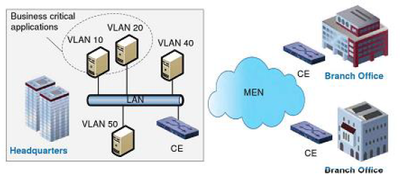
- Aa. One Ethernet Virtual Private Line (EVPL) service between each branch office and the headquarters. At the headquarters CE, the EVPLs terminate on different UNIs, which are both configured to support bundling
- Bb. One Ethernet Virtual Private Line (EVPL) service between each branch and the headquarters. At the headquarters CE, both EVCs terminate on one UNI that is configured for service multiplexing.
- Cc. One Ethernet Private Tree (EP‐Tree) service with the headquarters UNI designated as the root and branch offices designated as leaves and with the root UNI configured to support bundling.
- Dd. One Ethernet Private Line (EPL) service between each branch and the headquarters.
179Which of the following is not required for a Carrier Ethernet service that carries CESoETH?
- Aa. The EVC must tunnel BPDUs.
- Bb. Bandwidth profiles include only CIR and CBS components (no EIR or EBS components).
- Cc. All service frame delivery attributes should be set to "Deliver Unconditionally."
- Dd. The EVC is point‐to‐point.
180A subscriber has 10 sites with one UNI at each site. The 10 sites are interconnected by an EVP‐LAN service that supports multiple VLANs between the sites. Each UNI also supports one EVPL service that connects the site to an Internet service
provider (ISP). Which one of the following configuration options is not required?- Aa. Configure all UNIs with Service Multiplexing set to Yes.
- Bb. Configure CE‐VLAN ID preservation for each EVPL service to Yes.
- Cc. Con figure CE‐VLAN ID preservation for the EVP‐LAN service to Yes.
- Dd. Configure all UNIs with Bundling set to Yes.
Information
- Description
- Todos as disciplinas Geral (MEF) Quiz on MEF-CLOUDCAMPUS_COMPLETO, created by fdsqwertyfds qwerty on 12/05/2016.
- Author
- fdsqwertyfds qwerty
- Language
- Português
- Views
- 3
- Tags
- Rating
- No ratings yet Rate this quiz