
11648701
Description

Quiz by 1718 S3C 20 LUK CASEY YAN PING, updated more than 1 year ago

|
Created by 1718 S3C 20 LUK CASEY YAN PING
about 8 years ago
|
|
Question 1
Question
Name the countries covered
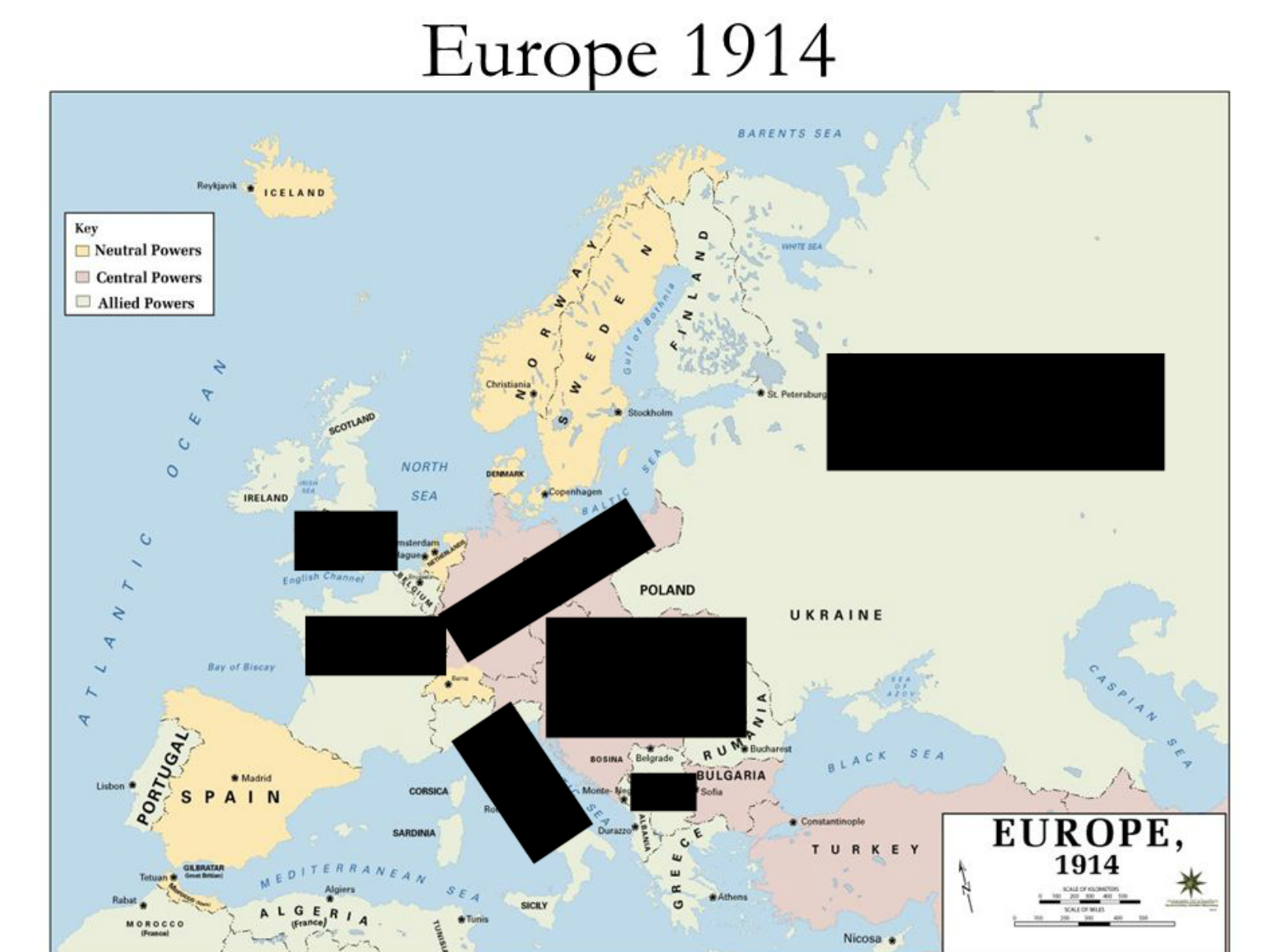
Answer
-
Britain
-
Serbia
-
Austria-Hungary
-
France
-
Germany
-
Italy
-
Russia
-
Spain
Question 2
Question
Which of the following countries shown on the ma is part of the triple alliance ?
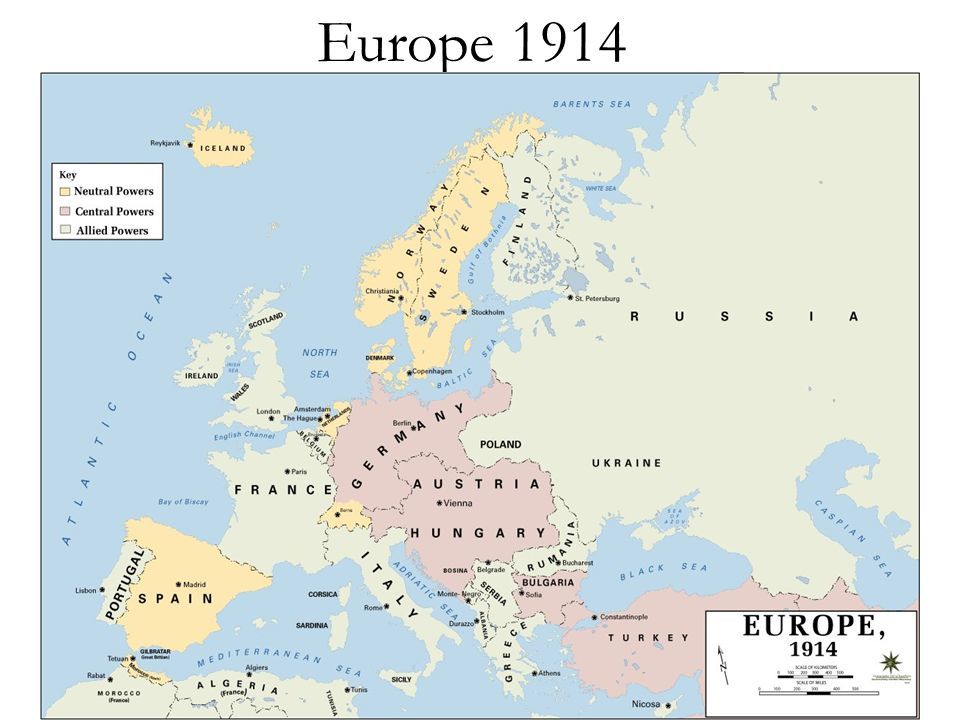
Answer
-
Germany
-
Turkey
-
Austria-Hungary
-
Italy
-
France
Question 3
Question
Which of the following countries shown on the map is part of the triple entente
Answer
-
Greece
-
Bulgaria
-
France
-
Britain
-
Spain
-
Russia
Question 4
Question
The alliance system threatened [blank_start]European peace[blank_end] in the following ways
1) European powers made the [blank_start]alliances in secret[blank_end] , this caused [blank_start]distrust[blank_end] and [blank_start]suspicion[blank_end] among them.
2)The powers thought they were [blank_start]supported by their allies[blank_end] . They [blank_start]would not give away easily[blank_end] when they had [blank_start]quarrels with other countries .[blank_end]
3)A small quarrel between [blank_start]two powers might involve more powers[blank_end] because each has as might lead to [blank_start]major conflict[blank_end] and even a [blank_start]general war in Europe[blank_end]
Answer
-
distrust
-
suspicion
-
alliances in secret
-
European peace
-
supported by their allies
-
would not give away easily
-
quarrels with other countries .
-
two powers might involve more powers
-
major conflict
-
general war in Europe
Question 5
Question
Three forms of [blank_start]arms race[blank_end]
1)[blank_start]Arms race[blank_end]
2)[blank_start]Army race[blank_end]
3)[blank_start]Naval race[blank_end]
Answer
-
Arms race
-
Army race
-
Naval race
-
arms race
Question 6
Question
Causes of the war
1)[blank_start]Alliance system[blank_end]
2)[blank_start]Armaments race[blank_end]
3)[blank_start]Colonial rivalries[blank_end]
4)[blank_start]Extreme nationalism[blank_end]
Answer
-
Alliance system
-
Armaments race
-
Colonial rivalries
-
Extreme nationalism
Question 7
Question
Reasons for colonial competitions
1)Political reasons : [blank_start]Symbol of national power[blank_end]
2) Economic reasons : [blank_start]To obtain resources[blank_end], [blank_start]cheap labor[blank_end] and [blank_start]overseas market[blank_end]
Answer
-
Symbol of national power
-
To obtain resources
-
cheap labor
-
overseas market
Question 8
Question
Effects of colonial expansion
1) [blank_start]Relations worsened among powers[blank_end]
2) Formed [blank_start]alliance[blank_end] to [blank_start]strengthen their positions[blank_end]
3)[blank_start]Arms race[blank_end] was intensified as they didn’t want to [blank_start]lose in these rivalries .[blank_end]
Answer
-
Relations worsened among powers
-
alliance
-
strengthen their positions
-
Arms race
-
lose in these rivalries .
Question 9
Question
Nationalism is the desire of [blank_start]people of the same race and culture[blank_end] to govern themselves . it became extreme in [blank_start]1900s[blank_end] people supported [blank_start]territorial expansion[blank_end] and use [blank_start]force[blank_end] to [blank_start]solve conflicts.[blank_end]
Answer
-
people of the same race and culture
-
1900s
-
territorial expansion
-
force
-
solve conflicts.
Question 10
Question
Extreme nationalism in France
After the defeat in [blank_start]Franco-Prussia[blank_end] War, France wanted to take revenge on [blank_start]Germany[blank_end] to get back [blank_start]Alsace-Lorraine[blank_end]
Answer
-
Franco-Prussia
-
Germany
-
Alsace-Lorraine
Question 11
Question
extreme nationalism in Germany
[blank_start]Pan-Germanism[blank_end]
Answer
-
Pan-Germanism
Question 12
Question
Extreme nationalism in Russia and Serbia
[blank_start]Pan-Slavism[blank_end]
[blank_start]Russia[blank_end] : wanted to lead all slavs
[blank_start]Serbia[blank_end] : wanted to expand in the [blank_start]Balkans[blank_end]
Answer
-
Russia
-
Serbia
-
Balkans
-
Pan-Slavism
Question 13
Question
Extreme Nationalism in Austria-Hungary
To restore [blank_start]glory[blank_end] by expanding to the [blank_start]Balkans[blank_end]
Answer
-
glory
-
Balkans
Question 14
Question
Causes of the war
1) The Moroccan Crises
-The [blank_start]First Moroccan crisis[blank_end]
-The [blank_start]Second moroccan Crisis[blank_end]
2)The Balkan Problems
-The [blank_start]Bosnia Crisis[blank_end]
3) The Balkan Wars
- The [blank_start]First Balkan War[blank_end]
-The [blank_start]Second Balkan War[blank_end]
4) Situation after the Balkan Wars
-After the [blank_start]first Balkan War[blank_end], [blank_start]Austria-Hungary[blank_end] instead on forming a new country , [blank_start]Albania[blank_end] . This stopped [blank_start]Serbia[blank_end] from [blank_start]getting an outlet[blank_end] to the [blank_start]Adriatic Sea[blank_end] , [blank_start]Austro-Serbian relations[blank_end] were worsened.
Answer
-
First Moroccan crisis
-
Third Moroccan Crisis
-
Second moroccan Crisis
-
Bosnia Crisis
-
First Balkan War
-
Second Balkan War
-
first Balkan War
-
Austria-Hungary
-
Albania
-
Serbia
-
getting an outlet
-
Adriatic Sea
-
Austro-Serbian relations
Question 15
Question
Pre-war crises dates
The First Moroccan Crisis ( [blank_start]1905-1906[blank_end])
The Second Moroccan Crisis ( [blank_start]1911[blank_end])
The Bosnia Crisis ( [blank_start]1908[blank_end])
The First Balkan War ([blank_start]1912[blank_end])
The Second Balkan War ( [blank_start]1913[blank_end])
Answer
-
1905-1906
-
1911
-
1908
-
1912
-
1913
Question 16
Question
The outbreak of WWI ([blank_start]1914-1918[blank_end])
Answer
-
1914-1918
Question 17
Question
Trigger of WWI
Answer
-
Bosnia Crisis
-
Moroccan Crisis
-
Sarajevo Assasination
Question 18
Question
Sarajevo Assasination
-Date : [blank_start]June 28th 1914[blank_end]
the [blank_start]heir[blank_end] of the [blank_start]Austrian[blank_end] Empire,[blank_start]Franz Ferdinand[blank_end] was visiting Sarajevo , [blank_start]the capital of Bosnia[blank_end] .[blank_start]Princip[blank_end] shot him and his wife
( [blank_start]Sophie[blank_end] ) dead
Answer
-
June 28th 1914
-
heir
-
Austrian
-
Franz Ferdinand
-
the capital of Bosnia
-
Princip
-
Sophie
Question 19
Question
[blank_start]Gavrilo Princip[blank_end]
A [blank_start]Bosnian Serb[blank_end] member of Young Bosnia , a [blank_start]Yugoslavist[blank_end] organisation( The Black Hand) seeking an end to [blank_start]Austro-Hungarian rule[blank_end] in [blank_start]Bosnia and Herzegovina[blank_end]
Answer
-
Gavrilo Princip
-
Bosnian Serb
-
Yugoslavist
-
Austro-Hungarian rule
-
Bosnia and Herzegovina
Question 20
Question
Austro-Hungarian ultimatum to Serbia
-Date : [blank_start]23rd July 1914[blank_end]
But [blank_start]Serbia[blank_end] rejected one of the demands in the ultimatum , because he was [blank_start]sure of Russian support[blank_end] ( his ally)
Answer
-
23rd July 1914
-
Serbia
-
sure of Russian support
Question 21
Question
Austro-Hungarian declaration of war on [blank_start]Serbia[blank_end]
-Date;[blank_start]28th July 1914[blank_end]
Answer
-
28th July 1914
-
Serbia
Question 22
Question
Russian Mobilization
-Date : [blank_start]30th of July 1914[blank_end]
In support of [blank_start]Serbia[blank_end] , Russia announced [blank_start]military mobilisation[blank_end]
Answer
-
Serbia
-
30th of July 1914
-
military mobilisation
Question 23
Question
German ultimatum to Russia
-Date: [blank_start]31st of July 1914[blank_end]
Russia’s [blank_start]military mobilisation[blank_end] alarmed Germany , which then sent an ultimatum demanding the [blank_start]demobilisation of Russian troops[blank_end] . Russia [blank_start]refused[blank_end]
Answer
-
31st of July 1914
-
military mobilisation
-
demobilisation of Russian troops
-
refused
Question 24
Question
German declaration of war on Russia
-Date : [blank_start]1 August 1914[blank_end]
Germany declared war on Russia. [blank_start]France[blank_end] immediately ordered [blank_start]mobilisation of her own army[blank_end] to support Russia
Answer
-
1 August 1914
-
France
-
mobilisation of her own army
Question 25
Question
German declaration of war on France
-Date:[blank_start]3rd of August[blank_end]
Germany declared war on France.the next day , [blank_start]German troops[blank_end] invaded France through [blank_start]Belgium[blank_end]
Answer
-
3rd of August
-
German troops
-
Belgium
Question 26
Question
Britain joined the war
-Date : [blank_start]4 August 1914[blank_end]
The German invasion was a [blank_start]violation of Belgian neutrality[blank_end] and Britain found it as a [blank_start]threat[blank_end] to her [blank_start]national security[blank_end] --> Britain declared war on Germany .
Answer
-
4 August 1914
-
violation of Belgian neutrality
-
national security
-
threat
Question 27
Question
Date : April 1915
[blank_start]Italy[blank_end] entered the war but on the [blank_start]Allied Power[blank_end]’s side
1) [blank_start]internal disagreement on war[blank_end]
2)[blank_start]the Allied Powers promised her land[blank_end]
Answer
-
Italy
-
Allied Power
-
internal disagreement on war
-
the Allied Powers promised her land
Question 28
Question
date: April 1917
[blank_start]US[blank_end] joined
Answer
-
US
Question 29
Question
Date : 1918
The [blank_start]Russian[blank_end] withdrew
[blank_start]German[blank_end] surrendered --> [blank_start]The end of WWI[blank_end]
Answer
-
Russian
-
German
-
The end of WWI
Question 30
Question
Paris Peace Conference ( [blank_start]1919[blank_end])
- Duration : [blank_start]January - June[blank_end]
Specialty : for [blank_start]victorious nations[blank_end] only
June 28
-Germany was summoned to sign the [blank_start]Treaty of Versailles[blank_end]
Answer
-
Treaty of Versailles
-
victorious nations
-
January - June
-
1919
Question 31
Question
What was it like to fight in WWI ?
-[blank_start]Machine guns and Trench warfare[blank_end]
Answer
-
Machine guns and Trench warfare
Question 32
Question
Unconventional weapons in WWI
Answer
-
Poison Gas
-
Flamethrower
-
Tanks
-
U-boat
-
Machine Guns
-
Fighter planes
-
Zeppelin
Question 33
Question
Aims of Paris Peace Conference
Answer
-
deal with defeated countries
-
maintain peace in Paris
-
set up new international peace organization
-
re-establish international order
Question 34
Question
The “ [blank_start]Big Three[blank_end] “
-[blank_start]Woodrow Wilson[blank_end] ( USA )
* US president
*Relative attitude towards Germany : [blank_start]Lenient[blank_end]
-[blank_start]David Lloyd George[blank_end] ( UK)
*British Prime Minister
*Relative attitude towards Germany : [blank_start]Moderate[blank_end]
-[blank_start]Georges Clemenceau[blank_end] ( FR)
*French Prime Minister
*Relative attitude towards Germany : [blank_start]Harsh[blank_end]
Answer
-
Woodrow Wilson
-
Lenient
-
David Lloyd George
-
Moderate
-
Georges Clemenceau
-
Harsh
-
Big Three
Question 35
Question
Treaty of Versailles , Revenge on Germany
-[blank_start]territorial losses[blank_end] , [blank_start]war guilt[blank_end] , [blank_start]lost of colonies[blank_end] , [blank_start]disarmament[blank_end] , [blank_start]huge reparations[blank_end]
-was designed to cripple Germany [blank_start]militarily[blank_end] , [blank_start]territorially[blank_end] and [blank_start]economically[blank_end]
Answer
-
territorial losses
-
war guilt
-
lost of colonies
-
disarmament
-
huge reparations
-
militarily
-
territorially
-
economically
Want to create your own Quizzes for free with GoConqr? Learn more.