
Quiz
Micro Midterm with Figures
Create a free account to finish this quiz
Save your progress and see your final score.
Already have an account? Sign in
Questions in this quiz (104)
1 How do all viruses differ from bacteria?
- AViruses are filterable.
- BViruses are obligate intracellular parasites.
- CViruses do not have any nucleic acid
- DViruses are not composed of cells.
- EViruses do not reproduce.
2Which of the following statements provides the most significant support for the idea that viruses are nonliving chemicals
- AThey are not composed of cells.
- BThey are filterable
- CThey cannot reproduce themselves outside a host.
- DThey cause diseases similar to those caused by chemicals.
- EThey are chemically simple.
3 Which of the following is NOT utilized to culture viruses?
- Alaboratory animals
- Bculture media
- Cembryonated eggs
- Danimal cell cultures
- Ebacterial cultures
4The definition of lysogeny is
- Aphage DNA is incorporated into host cell DNA.
- Blysis of the host cell due to a phage.
- Cthe period during replication when virions are not present
- Dwhen the burst time takes an unusually long time
- Eattachment of a phage to a cell.
5A viroid is a(n)
- Acomplete, infectious virus particle.
- Binfectious piece of RNA without a capsid.
- Ccapsid without nucleic acid.
- Dprovirus
- Einfectious protein.
6Which structure is a complex virus?
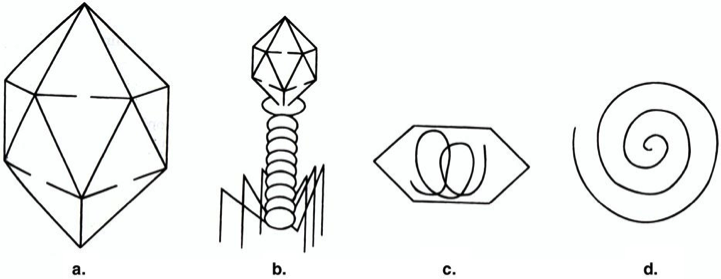
- Aa
- Bb
- Cc
- Dd
- EAll of the structures are complex viruses.
7Continuous cell lines differ from primary cell lines in that
- Aviruses can be grown in continuous cell lines
- Bcontinuous cell lines always have to be re-isolated from animal tissues.
- Ccontinuous cell lines are derived from primary cell lines
- Dcontinuous cell lines can be maintained through an indefinite number of generations.
- Econtinuous cell lines are from human embryos.
8Which of the following is necessary for replication of a prion?
- ADNA
- BDNA polymerase
- Clysozyme
- DPrPSc
- ERNA
9A persistent infection is one in which
- Athe virus remains in equilibrium with the host without causing a disease
- Bviral replication is unusually slow.
- Cthe disease process occurs gradually over a long period.
- Dhost cells are gradually lysed.
- Ehost cells are transformed.
10An infectious protein is a
- Abacteriophage.
- Bprion
- Cretrovirus.
- Dviroid.
- Epapovavirus.
11An example of a latent viral infection is
- Asubacute sclerosing panencephalitis
- Bcold sores.
- Cinfluenza
- Dsmallpox
- Emumps.
12A virus's ability to infect an animal cell depends primarily upon the
- Ahost cell's ability to phagocytize viral particles.
- Bpresence of receptor sites on the cell membrane.
- Ctype of viral nucleic acid.
- Denzymatic activity of a host cell.
- Epresence of pili on the host cell wall.
13Which of the following statements regarding fungi is FALSE?
- AMost fungi are pathogenic for humans.
- BFungi are eukaryotic heterotrophs
- CFungi reproduce by forming asexual or sexual spores.
- DMost fungi grow well in acidic culture condition.
- EFungi tolerate low moisture conditions.
14Which of the following statements about helminths is FALSE?
- AThey are heterotrophic.
- BThey are multicellular animals.
- CThey have eukaryotic cells.
- DAll are parasites.
- Eome have male and female reproductive organs in one animal.
15Seventeen patients in ten hospitals had cutaneous infections caused by Rhizopus. In all seventeen patients, Elastoplast bandages were placed over sterile gauze pads to cover wounds. Fourteen of the patients had surgical wounds, two had venous line insertion sites, and one had a bite wound. Lesions present when the bandages were removed ranged from vesiculopustular eruptions to ulcerations and skin necrosis requiring debridement. Fungi are more likely than bacteria to contaminate bandages because they
- Aare aerobic.
- Bcan tolerate low-moisture conditions
- Cprefer a neutral environment (pH 7)
- Dhave a fermentative metabolism.
- Ecannot tolerate high osmotic pressure.
16Which of the following statements regarding protozoa is FALSE?
- AProtozoa are unicellular eukaryotes.
- BNearly all protozoa cause disease
- CMost protozoa reproduce asexually.
- DProtozoa are common in water and soil.
- ESome protozoan pathogens are transmitted by arthropod vectors.
17Helminthic diseases are usually transmitted to humans by
- Arespiratory route.
- Bgenitourinary route
- Cgastrointestinal route
- Dvectors
- Eaerosols.
18 In the malaria parasite life cycle, humans are the ________ host, while mosquitoes are the ________ host as well as the vector.
- Adefinitive; intermediate
- Bintermediate; intermediate
- Ctemporary; final
- Dvector; intermediate
- Eintermediate; definitive
19Which of the following arthropods does NOT transmit diseases by sucking blood from a human host?
- Alice
- Bfleas
- Chouseflies
- Dmosquitos
- Ekissing bugs
20What do tapeworms eat?
- Aintestinal bacteria
- Bhost tissues
- Cred blood cells
- Dintestinal contents
- Eplant matter
21Ringworm is caused by a(n)
- Afungus
- Bcestode
- Cnematode
- Dprotozoan
- Etrematode
22 Which of the following are found primarily in the intestines of humans?
- Agram-negative aerobic rods and cocci
- Baerobic, helical bacteria
- Cfacultatively anaerobic gram-negative rods
- Dgram-positive cocci
- Eendospore-forming rods
23Which of the following genera is an anaerobic gram-negative rod?
- AEscherichia
- BStaphylococcus
- CBacteroides
- DTreponema
- ENeisseria
24Which of the following is NOT an enteric?
- ASalmonella
- BShigella
- CEscherichia
- DEnterobacter
- ECampylobacter
25You have isolated a bacterium that grows in a medium containing an organic substrate and nitrate in the absence of oxygen. The nitrate is reduced to nitrogen gas. You can be sure that this bacterium is
- Agram-positive.
- Busing anaerobic respiration.
- Ca chemoautotroph.
- Dphotoautotroph.
- Ea photoheterotroph.
26Rickettsias differ from chlamydias in that rickettsias
- Aare gram-negative.
- Bare intracellular parasites.
- Crequire an arthropod for transmission
- Dform elementary bodies.
- Eare enterics.
27Which of the following bacteria is gram-positive?
- APseudomonas
- BSalmonella
- CStreptococcus
- DBacteroides
- ERickettsia
28 Which one of the following bacteria does NOT belong with the others?
- ABacillus
- BEscherichia
- CLactobacillus
- DStaphylococcus
- EStreptococcus
29A primary difference between cyanobacteria and purple and green phototrophic bacteria is
- Aenergy source
- Bcell wall type.
- Celectron donor for CO2 reduction
- Dcell type.
- Ecolor.
30You have isolated a prokaryotic cell. The first step in identification is a(n)
- AGram stain.
- Blactose fermentation test.
- Cendospore stain.
- Dflagella stain.
- EDNA fingerprint.
31Mycoplasmas differ from other bacteria in that they
- Agrow inside host cells
- Black a cell wall
- Care acid-fast.
- Dare motile.
- Eare gram-negative.
32Which of the following statements about archaea is FALSE?
- AThey are prokaryotes
- BThey lack peptidoglycan in their cell walls.
- CSome are thermoacidophiles; others are extreme halophiles.
- DThey evolved before bacteria.
- ESome produce methane from carbon dioxide and hydrogen.
33If two organisms have similar rRNA sequences, you can conclude that they
- Alive in the same place.
- Bevolved from a common ancestor.
- Cwill have different G-C ratios.
- Dwill both ferment lactose.
- Emated with each other.
34 What is the outstanding characteristic of the Kingdom Fungi?
- AAll members are photosynthetic.
- BMembers absorb dissolved organic matter.
- CMembers absorb dissolved inorganic matter.
- DAll members are microscopic.
- EAll members are macroscopic.
35A bacterial species differs from a species of eukaryotic organisms in that a bacterial species
- Adoes not breed with other species.
- Bhas a limited geographical distribution.
- Ccan be distinguished from other bacterial species.
- Dis a population of cells with similar characteristics
- Ebreeds with its own species.
36 Which of the following is the best evidence for a three-domain system?
- ANucleotide sequences in ribosomal RNA vary between all three domains.
- BThere are three distinctly different sets of metabolic reactions.
- Chere are three distinctly different Gram reactions.
- DSome bacteria live in extreme environments.
- EThere are three distinctly different types of nuclei.
37Serological testing is based on the fact that
- Aall bacteria have the same antigens.
- Bntibodies react specifically with an antigen.
- Cthe human body makes antibodies against bacteria
- Dantibodies cause the formation of antigens.
- Ebacteria clump together when mixed with any antibodies.
38A clone is
- Agenetically identical cells derived from a single cell.
- Ba genetically engineered cell.
- Ca taxon composed of species.
- Da mound of cells on an agar medium
- ENone of the answers is correct.
39The enzyme in step 1 is
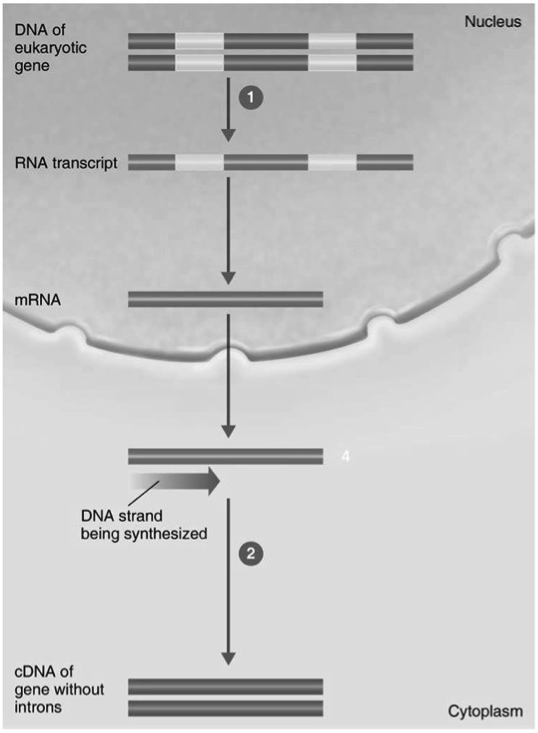
- ADNA polymerase.
- BDNA ligase.
- CRNA polymerase.
- Dreverse transcriptase
- Espliceosome.
40The enzyme in step 2 is
- ADNA polymerase.
- BDNA ligase
- CRNA polymerase.
- Dreverse transcriptase
- Espliceosome.
41 Which of the following is an advantage of using E. coli to make a human gene product?
- AEndotoxin may be in the product.
- BIt does not secrete most proteins
- CIts genes are well known
- DIt cannot process introns
- EEndotoxin may be in the product and it does not secrete most proteins.
42None
- Ablank
- Bnone
43Which of the following is NOT an agricultural product made by DNA techniques?
- Arost retardant
- BBacillus thuringiensis insecticide
- Cnitrogenase (nitrogen fixation
- Dglyphosate-resistant crops
- Epectinase
44Biotechnology involves the
- Ause of microorganisms to make desired products
- Buse of animal cells to make vaccines.
- Cdevelopment of disease-resistant crop plants
- Duse of microorganisms to make desired products and the use of animal cells to make vaccines
- Euse of microorganisms to make desired products, the use of animal cells to make vaccines, and the development of disease-resistant crop plants.
45In the figure above, the bacteria transformed with the recombinant plasmid and plated on media containing ampicillin and X-gal will
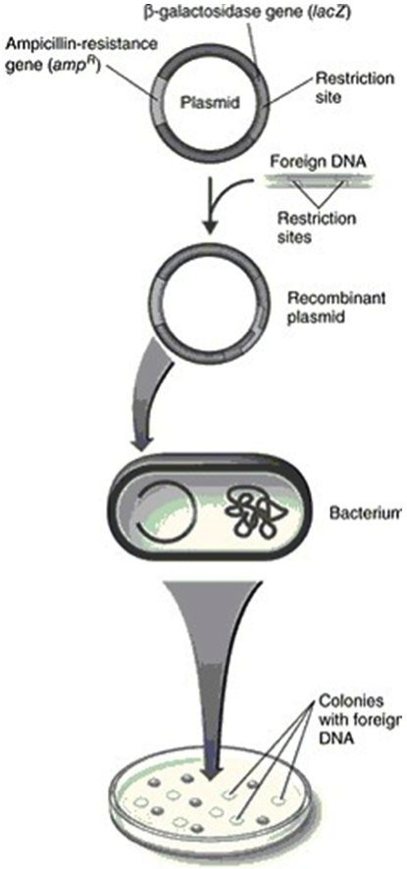
- Aform blue, ampicillin-resistant colonies.
- Bform blue, ampicillin-sensitive colonies
- Cform white, ampicillin-resistant colonies.
- Dform white, ampicillin-sensitive colonies.
- Enot grow.
46 Pieces of DNA stored in yeast cells are called a
- Alibrary
- Bclone
- Cvector
- DSouthern blot
- EPCR
47A population of cells carrying a desired plasmid is called a
- Alibrary
- Bclone
- Cvector
- DSouthern blot
- EPCR
48 Self-replicating DNA used to transmit a gene from one organism to another is a
- Alibrary
- Bclone
- Cvector
- DSouthern blot
- EPCR
49The Human Genome Project, which was completed in 2003, was focused on
- Aidentifying all of the genes in the human genome
- Bdetermining the nucleotide sequence of the entire human genome.
- Cdetermining all of the proteins encoded by the human genome.
- Dfinding a cure for all human genetic disorders.
- Ecloning all of the genes of the human genome.
50Which of the following techniques is NOT used to introduce recombinant DNA into plants?
- Agene guns
- Bprotoplast fusion
- CTi plasmids and Agrobacterium
- Dmicroinjection
- Eelectroporation
51Which of the following are used by the Centers for Disease Control and Prevention to track outbreaks of foodborne disease?
- ADNA fingerprints
- Brestriction fragment length polymorphisms
- Creverse-transcriptase PCR (rtPCR)
- DDNA fingerprints and restriction fragment length polymorphisms
- EDNA fingerprints, restriction fragment length polymorphisms, and reverse-transcriptase PCR(rtPCR
52The study of genetic material taken directly from the environment is
- Abioinformatics
- Bproteomics
- Creverse genetics
- Dforensic microbiology
- Emetagenomics
53A gene is best defined as
- Aany random segment of DNA
- Bthree nucleotides that code for an amino acid.
- Ca sequence of nucleotides in DNA that codes for a functional product.
- Da sequence of nucleotides in RNA that codes for a functional product.
- Ethe RNA product of a transcribed section of DNA
54An enzyme produced in response to the presence of a substrate is called a(n)
- Ainducible enzyme
- Brepressible enzyme
- Crestriction enzyme
- Doperator
- Epromoter
55Genetic change in bacteria can be brought about by
- Amutation
- Bconjugation
- Ctransduction
- Dtransformation
- EAll of the answers are correct.
56If you knew the sequence of nucleotides within a gene, which one of the following could you determine with the most accuracy?
- Athe primary structure of the protein
- Bthe secondary structure of the protein
- Cthe tertiary structure of the protein
- Dthe quaternary structure of the protein
- EThe answer cannot be determined based on the information provided.
57An enzyme that copies DNA to make a molecule of RNA is
- ARNA polymerase.
- BDNA ligase.
- CDNA helicase.
- Dtransposase
- EDNA polymerase.
58Which of the following best describes the pattern of microbial death?
- AThe cells in a population die at a constant rate.
- BAll the cells in a culture die at once.
- CNot all of the cells in a culture are killed
- DThe pattern varies depending on the antimicrobial agent.
- EThe pattern varies depending on the species.
59Which of the following chemical agents is used for sterilization?
- Aalcohol
- Bphenolics
- Cethylene oxide
- Dchlorine
- Esoap
60Which of the following substances is used for surgical hand scrubs
- Aphenol
- Bchlorine bleach
- Cchlorhexidine
- Dsoap
- Eglutaraldehyde
61 Which of the following does NOT achieve sterilization?
- Adry heat
- Bpasteurization
- Cautoclave
- Dsupercritical fluids
- Eethylene oxide
62 Which of the following is a limitation of the autoclave?
- AIt requires an excessively long time to achieve sterilization.
- BIt cannot inactivate viruses
- CIt cannot kill endospores.
- Dit cannot be used with heat-labile materials.
- EIt cannot be used with glassware.
63An agent used to reduce the number of bacteria on a toilet would most accurately be called a(n)
- Adisinfectant
- Bantiseptic
- Caseptic
- Dfungicide
- Evirucide
64Application of heat to living cells can result in all of the following EXCEPT
- Abreaking of hydrogen bonds
- Balteration of membrane permeability.
- Cdenaturation of enzymes.
- Ddecreased thermal death time.
- Edamage to nucleic acids.
65Which of the following disinfectants acts by disrupting the plasma membrane?
- Asoaps
- Baldehydes
- Cbisphenols
- Dhalogens
- Eheavy metals
66 Which of the following methods is used to preserve food by slowing the metabolic processes of foodborne microbes?
- Alyophilization
- Bnonionizing radiation
- Cfreezing
- Dionizing radiation
- Epasteurization
67Which concentration of ethanol is the most effective bactericide?
- A100 percent
- B70 percent
- C50 percent
- D40 percent
- E30 percent
68All of the following factors contribute to hospital-acquired infections EXCEPT
- Asome bacteria metabolize disinfectants.
- Bgram-negative bacteria are often resistant to disinfectants
- Cinvasive procedures can provide a portal of entry for bacteria.
- Dbacteria may be present in commercial products such as mouthwash.
- ENone of the answers is correct; all of these factors may contribute to hospital-acquired infection
69Which of the following treatments is the most effective for controlling microbial growth?
- A63°C for 30 minutes
- B72°C for 15 seconds
- C140°C for 4 seconds
- DThey are equivalent treatments
- ENone of the answers is correct.
70Which of the following regarding antimicrobial control agents is FALSE?
- AContaminating organic debris such as blood or sputum will decrease effectiveness.
- BSome agents kill by denaturing microbial cell proteins.
- CSome agents affect microbial cell membranes by dissolving lipids.
- DSome agents are utilized as both an antiseptic and a disinfectant.
- EA true antimicrobial control agent is equally effective against both bacteria and viruses.
71Which of the following could be used to sterilize plastic Petri plates in a plastic wrapper?
- Aautoclave
- Bgamma radiation
- Cmicrowaves
- Dsunlight
- Eultraviolet radiation
72All of the following substances are used to preserve foods EXCEPT
- Abiguanides.
- Bnisin.
- Cpotassium sorbate
- Dsodium nitrite.
- Ecalcium propionate.
73All of the following are effective for destroying prions EXCEPT
- Aboiling
- Bincineration.
- CNaOH + autoclaving at 134°C.
- Dproteases.
- ENone of the answers are correct; each of these will destroy prions.
74Which one of the following is most resistant to chemical biocides?
- Agram-negative bacteria
- Bgram-positive bacteria
- Cmycobacteria
- Dprotozoan cysts
- Eviruses with lipid envelopes
75All of the following are methods of food preservation EXCEPT
- Adesiccation
- Bhigh pressure
- Cionizing radiation.
- Dmicrowaves.
- Eosmotic pressure.
76The preservation of beef jerky from microbial growth relies on which method of microbial control?
- Afiltration
- Blyophilization
- Cdesiccation
- Donizing radiation
- Esupercritical CO2
77Salts and sugars work to preserve foods by creating a
- Adepletion of nutrients
- Bhypotonic environment
- Clower osmotic pressure
- Dhypertonic environment
- Elower pH.
78The term aerotolerant anaerobe refers to an organism that
- Adoes not use oxygen but tolerates it
- Bis killed by oxygen.
- Ctolerates normal atmospheric nitrogen gas levels
- Drequires less oxygen than is present in air.
- Erequires more oxygen than is present in air.
79Most bacteria reproduce by
- Aaerial hyphae
- Bfragmentation.
- Cmitosis.
- Dbinary fission.
- Ebudding.
80 Which of the following is NOT a direct method to measure microbial growth?
- Adirect microscopic count
- Bandard plate count
- Cfiltration on a support membrane followed by incubation on medium
- Dmetabolic activity
- Emost probable number (MPN)
81The source of nutrients in nutrient agar is
- Aagar.
- Bgelatin
- Cpeptone and beef extract
- Dpeptone and NaCl.
- Eagar and NaCl
82 Patients with indwelling catheters (long-term tubes inserted into body orifices for drainage, such as through the urethra and into the urinary bladder) are susceptible to infections because
- Ainjected solutions are contaminated
- Btheir immune systems are weakened
- Cinfections can be transmitted from other people.
- Dbiofilms develop on catheters
- Ebacteria cause infections.
83 In green and purple bacteria, electrons to reduce CO2 can come from
- ACO2
- BH2O
- CC6H12O6
- DH2S
- Echlorophyll.
84Which of the following statements is INCORRECT regarding prokaryotic cells?
- ATheir DNA is not enclosed within a membrane
- BThey lack membrane-enclosed organelles
- CThey typically have a circular chromosome.
- DThey reproduce by binary fission
- EThey lack a plasma membrane.
85 Each of the following statements concerning the gram-positive cell wall is true EXCEPT
- Ait maintains the shape of the cell.
- Bit is sensitive to lysozyme
- Cit protects the cell in a hypertonic environment
- Dit contains teichoic acids
- Eit is sensitive to penicillin
86Which of the following organelles most closely resembles a prokaryotic cell?
- Anucleus
- Bmitochondrion
- CGolgi complex
- Dvacuole
- Ecell wall
87Bacteria are a commonly used organism for studies of genetic material in the research laboratory. The nucleic acids must first be isolated from the cells for these studies. Which of the following would most likely be used to lyse gram-positive bacterial cells for nucleic acid isolation?
- Alysozyme
- Bpolymyxins
- Calcohol
- Dwater
- Emycolic acid
88Which of the following terms best describes the cell in Figure 4.2?

- Aperitrichous flagella
- Bamphitrichous flagella
- Clophotrichous flagella
- Dmonotrichous flagellum
- Eaxial filament
89Oxygen crosses a plasma membrane
- Aby osmosis
- Bthrough simple diffusion
- Cwith the help of a nonspecific transporter
- Dthrough facilitated diffusion
- Ethrough porins
90 The DNA found in most bacterial cells
- Ais surrounded by a nuclear membrane
- Butilizes histones for chromosomal packaging.
- Cis circular in structure.
- Dis linear in structure
- Eis found in multiple copies
91 The purpose of a mordant in the Gram stain is to
- Aremove the simple stain
- Bmake the bacterial cells larger.
- Cmake the flagella visible.
- Dprevent the crystal violet from leaving the cells.
- Emake gram-negative cells visible.
92 Which microscope achieves the highest magnification and greatest resolution?
- Acompound light microscope
- Bphase-contrast microscope
- Cdarkfield microscope
- Dfluorescence microscope
- Eelectron microscope
93 In the figure above, line "c" points to the microscope's
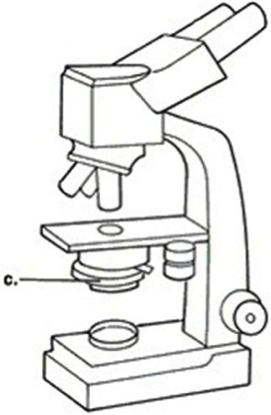
- Ailluminator
- Bcondenser
- Cocular lens
- Dobjective lens.
94 Which molecule is composed of a chain of amino acids?
- Acarbohydrate
- Blipid
- Cprotein
- Dnucleic acid
95 Which are the primary molecules making up plasma membranes in cells?
- Acarbohydrates
- Blipids
- Cproteins
- Dnucleic acids
96The term used to describe a disease-causing microorganism is
- Amicrobe
- Bbacterium
- Cvirus
- Dpathogen
- Einfection
97The formal system for classifying and naming organisms was developed by
- ARobert Koch
- BIgnaz Semmelweis.
- CAristotle.
- DCarolus Linnaeus.
- ELouis Pasteur.
98The bacterial shape of the cells in the scanning electron micrograph shown in Figure 1.1 would best be described as
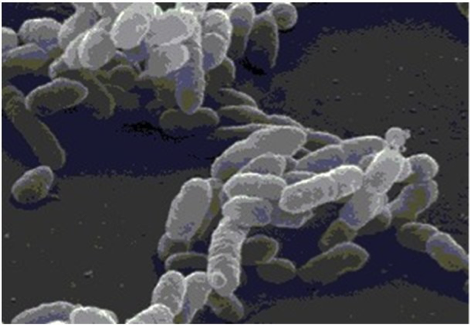
- Abacillus
- Bspiral
- Ccoccus
- Dovoid.
- Ecolumnar
99The infectious agent that causes AIDS is a
- Avirus
- Bbacterium
- Cyeast.
- Dprotozoan
- Emold.
100 Which of the following is NOT a domain in the three-domain system?
- Aanimalia
- Barchaea
- Cbacteria
- Deukarya
101 Who is credited with first observing cells?
- ARobert Hooke
- BAnton van Leeuwenhoek
- CRobert Koch
- DLouis Pasteur
- ECarolus Linnaeus
102Who is credited with first observing microorganisms?
- ARobert Hooke
- BAnton van Leeuwenhoek
- CRobert Koch
- DLouis Pasteu
- ECarolus Linnaeus
103Biogenesis refers to the
- Aspontaneous generation of organisms from nonliving matter
- Bdevelopment of life forms from preexisting life forms
- Cdevelopment of aseptic technique
- Dgerm theory of disease.
104Which physician is first associated with vaccination?
- AEhrlich
- BJenner
- CLister
- DKoch
- EEscherich
Information
- Description
- A&P II Quiz on Micro Midterm with Figures, created by Julie Joyce on 01/03/2018.
- Author
- Julie Joyce
- Language
- English
- Views
- 9
- Tags
- Rating
- No ratings yet Rate this quiz