
Quiz
Management of Pain and Anxiety
Create a free account to finish this quiz
Save your progress and see your final score.
Already have an account? Sign in
Questions in this quiz (48)
1The potency of an anesthetic agent is primarily a result of its
- Awater solubility.
- Bprotein solubility.
- Clipid solubility.
- Dcarbohydrate solubility.
2. The nerve that travels the mental foramen is a branch of the
- Ainferior alveolar nerve.
- Bmiddle superior alveolar.
- Clingual nerve.
- Dposterior superior alveolar nerve.
3Sodium bisulfite is added to a cartridge of anesthetic to increase the stability of the
- Adistilled water
- Bvasoconstrictor.
- Chydrochloride salt.
- Dplasma cholinesterase.
4Which of the following explains why the administration of a local anesthetic into an area of inflammation has a decreased effect?
- AInflamed tissue has a high pH.
- BThe local anesthetic remains in the salt form (ionized).
- CVascularity is decreased in the area of the inflammation.
- DThe local anesthetic is converted to the free base (unionized).
5All the following statements are TRUE about lidocaine EXCEPT
- Ait is an amide-linked compound.
- Bit is used in 2% concentrations.
- Cit forms a salt with a strong acid that is water soluble.
- Dits lipophilic portion is ester-linked to the amino group.
6 Which of the following gauge numbers indicates the needle with the smallest lumen?
- A30
- B27
- C25
- D23
7The maxillary division of the trigeminal nerve is;
- ASensory only
- Bmotor only.
- Csensory and motor simultaneously.
- Dmostly sensory and minimally motor.
8The type and size of a nerve plays an important part in the development of adequate anesthesia. All the following are TRUE about nerves and anesthesia EXCEPT
- Amyelinated nerves require a greater concentration to be blocked.
- Bmyelinated nerves require less time to be blocked.
- Csmaller nerve fibers are the last to regain sensation.
- Dmaller nerve fibers are blocked before the larger
9Anesthetics decrease or limit the sensation of pain by
- Adecreasing the firing threshold.
- Bpreventing depolarization.
- Crepolarizing the nerve membrane.
- Dcausing hyperpolarization.
10 Saltatory conduction refers to
- Arapid transmission of nerve impulses along a myelinated nerve fiber.
- Bdiffusion of sodium into the nerve cell during impulse conduction.
- Cconduction of an impulse along a nonmyelinated nerve fiber at the nodes of Ranvier.
- DNone of the above
11The sensory receptors responsible for the initiation of pain perception are
- AMeissner's corpuscles.
- BRuffine's end organs.
- Cfree nerve endings.
- DPacini's corpuscles
12When does depolarization of a nerve fiber occur?
- ADuring the resting state of the fiber
- BBecause of the sodium pump
- CDuring the relative refractory period
- DBetween the polarization stage and reverse polarity
13An environmental change capable of initiating a nerve impulse is termed
- Aminimal threshold stimulus.
- Binitiation stimulus.
- Cfiring mechanism
- Dthe "all or none" law.
14 The anesthetic solutions injected into the tissues are
- Aacidic salts.
- Bstrong acids
- Cweak bases
- Dalkaloids.
15The lipophilic portion of an anesthetic molecule allows the anesthetic solution to
- Adiffuse through the nerve tissue.
- Bdiffuse through osseous tissue.
- Cdiffuse through the interstitial tissues.
- Dbe absorbed by the blood supply
16Which acid is most often combined with a local anesthetic drug?
- ASodium bisulfite
- BSodium chloride
- CAcetic acid
- DHydrochloric acid
17The patient's medical history indicates past liver damage. Why is the amount of amide-based anesthetic solution a relative contraindication?
- AAmides increase the risk of an allergic reaction
- BAmides undergo biotransformation in the liver.
- CWithout action by the liver, amides will be reabsorbed.
- DAmides are absorbed much slower at the injection site.
18All the following ingredients are contained within an anesthetic solution EXCEPT
- Asodium chloride.
- Bsodium bisulfate.
- Cwater
- Dvasoconstrictor
19Vasoconstrictors are added to local anesthetic agents to increase duration and
- Areduce toxicity by increasing the efficiency of the heart.
- Breduce toxicity by slowing absorption.
- Cextend the overall shelf life.
- Dhelp speed up the detoxification process.
20Where are vasoconstrictors metabolized?
- ALiver
- BPlasma
- CBloodstream
- DKidneys
21For what purpose is epinephrine added to either prilocaine or lidocaine local anesthetic agent?
- AProlongation of anesthesia
- BReduction of hemorrhage in field of operation
- CConstriction of blood vessels in area of injection
- DPrevention of toxic effects from too rapid absorption
- EAll of the above
22Which of the following vasoconstrictor agents is used with mepivacaine (Carbocaine) 3%?
- ANeo-Cobefrin
- BEpinephrine
- CLevophed
- DBenzocaine
- ENone of the above
23After starting the root-planing procedure, you encounter considerable bleeding from the client's sulcular tissues. After consulting with the dentist, it is decided to administer a local anesthetic for hemostasis. Which component of the local anesthetic will help to achieve hemostasis?
- AAnesthetic salt
- BVasoconstrictor
- CSodium bisulfite
- DDistilled water
24What is the pressure in a FULL tank of oxygen (O2)?
- A700 to 800 psi
- B900 to 1100 psi
- C1400 to 1600 psi
- D. 1800 to 2100 psi
25What is the pressure in a FULL tank of nitrous oxide (N2O)?
- A650 to 900 psi
- B900 to 1100 psi
- C1400 to 1600 psi
- D1800 to 2100 psi
26What is the pressure of a HALF-full tank of O2?
- A700 to 800 psi
- B900 to 1100 psi
- C1400 to 1600 psi
- D1800 to 2100 psi
27What is the pressure in a HALF full tank of N2O?
- A650 to 900 psi
- B900 to 1100 psi
- C1400 to 1600 psi
- D1800 to 2100 psi
28Which of the following is TRUE concerning N2O?
- AA full tank would read approximately 2100 psi.
- BIt exists as a gas in the tank and is delivered as a gas.
- CIt can be administered and monitored by dental hygienists in all states.
- DIt may induce nerve damage if used chronically.
29The use of a scavenging system with N2O sedation equipment is desirable because it
- Aremoves the odor of nitrous from the room.
- B. assists the patient's respiration.
- C. removes any potentially toxic waste gas from the environment.
- D. allows the patient to inhale room air through the nosepiece.
30Which of the following patients would NOT be a good candidate for the use of N2O?
- A"Gagger"
- BPediatric client
- CPatient with heart disease or a heart attack
- Dpatient with a chronic obstructive pulmonary disease
31 In monitoring the use of N2O, the patient should be in which stage of general anesthesia?
- Astage I
- BStage II
- CStage III
- DStage IV
32. The ideal concentration range of N2O is
- A10% to 25%.
- B30% to 50%
- C50% to 60%.
- D60% to 70%.
33The dental hygienist administered 2.4 cartridges of 3% mepivacaine. How many milligrams were administered?
- A129.6 mg
- B137.5 mg
- C138.4 mg
- D125.2 mg
34How many cartridges of lidocaine 2% 1:100,000 epinephrine anesthetic agent can be safely administered to a 120-lb patient taking tricyclic antidepressants?
- A1.1 cartridges
- B2.2 cartridges
- C3.3 cartridges
- D4.4 cartridges
35How many cartridges of prilocaine 4% anesthetic agent can a healthy 130-lb patient receive?
- A6.8 cartridges
- B7.2 cartridges
- C7.8 cartridges
- D8.3 cartridges
36What is the target area for the inferior alveolar nerve block?
- AMandibular foramen
- BLateral surface of mandibular ramus
- CAnteromedial border of neck of mandibular condyle
- DRetromolar pad or triangle
37What is the injection site for the posterior superior alveolar nerve block?
- ARetromolar pad or triangle
- BMaxillary tuberosity
- CPterygopalatine fossa
- DSuperior to maxillary canines
38How can you determine a positive aspiration with the computer-controlled local anesthetic delivery date?
- ABlood will be noticed in the glass cartridge.
- B. Blood will be noticed in the plastic tubing only.
- CBlood will be noticed at the needle hub
- DThe unit will beep rapidly if aspiration is positive.
39Case A:
Which nerve is involved when anesthetizing the palatal gingiva of the maxillary lateral incisor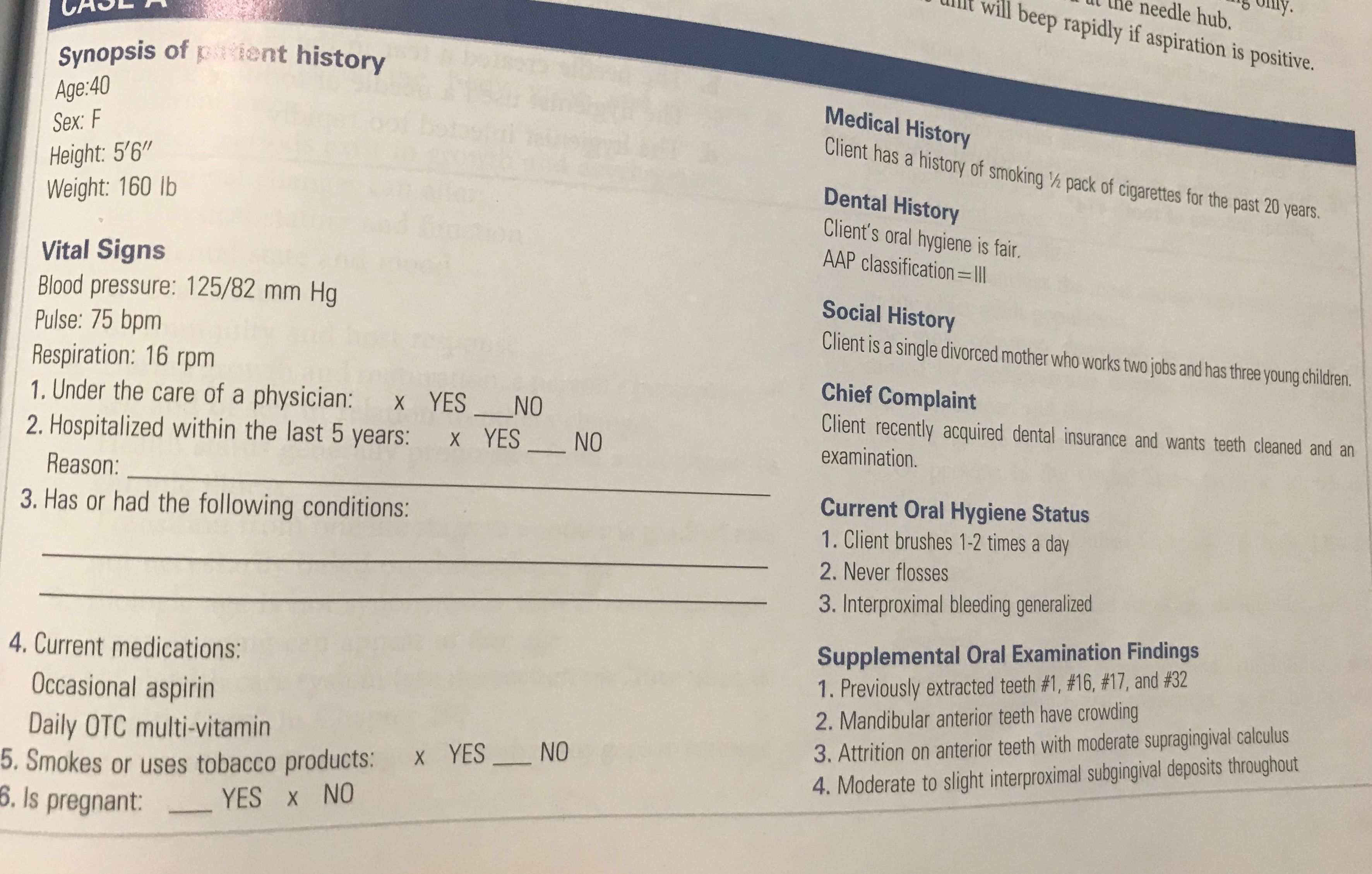
- AMiddle superior alveolar nerve
- BNasopalatine nerve
- CInfraorbital nerve
- DAnterior superior alveolar nerve
- EInferior alveolar nerve
40After administering a posterior superior alveolar nerve block, the maxillary first molar remains sensitive, but the maxillary second and third molars are anesthetized. Which of the following would be the BEST explanation?
- AAnesthetic agent was deposited too high.
- BNot enough anesthetic agent was deposited.
- CMesiobuccal root is normally not anesthetized by posterior superior alveolar nerve block.
- DAnesthetic agent was deposited too low.
41Which nerve is involved when anesthetizing the facial gingiva of the maxillary canine?
- AMiddle superior alveolar nerve
- BNasopalatine nerve
- C. Infraorbital nerve
- DAnterior superior alveolar nerve
- EInferior alveolar nerve
42When lingual nerve is anesthetized, which of the following tissue will NOT be affected?
- AAnterior two-thirds of the tongue
- BFloor of the mouth
- C. Lingual gingiva
- DPalatal periodontium
- ELower lip
43The soft tissue of alveolar process of the mandible is innervated by
- Abuccal and lingual nerves only.
- Bbuccal and mental nerves only.
- C. buccal, lingual, and mental nerves.
- Dbuccal and inferior alveolar nerves only.
44Which injection anesthetizes the palatal gingiva and palatal mucosa of tooth #14
- AMiddle superior alveolar nerve block
- B. Posterior superior alveolar nerve block
- CAnterior middle superior alveolar nerve block (palatal approach)
- DGreater palatine nerve block
45Which nerve is involved when anesthetizing the mandibular first premolar?
- AMiddle superior alveolar nerve
- BNasopalatine nerve
- C. Infraorbital nerve
- DAnterior superior alveolar nerve
- EInferior alveolar nerve
46. To prepare the maxillary right premolars for nonsurgical periodontal therapy, which of the following nerves need to be anesthetized?
- ARight buccal nerve only
- BRight MSA and greater palatine nerves
- CRight ASA only
- DRight PSA only
47When anesthetizing the mental nerve, which of the following tissues will be affected?
- ABuccal gingiva of mandibular molars
- BFloor of the mouth as well as lower lip
- CLingual gingiva of mandibular teeth
- DBuccal gingiva of mandibular anterior teeth and mandibular first premolar
- ESkin of upper cheek as well as lower chin
48After the administration of local anesthesia to anesthetize teeth #1 to #3, you notice a faint bluish discoloration on her cheek. You check intraorally and find the same discoloration near the injection site along with swelling. What is the most probable cause of this mark?
- AThe anesthetic cartridge was contaminated with alcohol.
- BThe needle created a tear in the blood vessel.
- CThe hygienist used a needle of too fine a gauge.
- DThe hygienist injected too rapidly.
Information
- Description
- Public Health Quiz on Management of Pain and Anxiety, created by Dee-Anna L'Heureux on 22/04/2018.
- Author
- Dee-Anna L'Heureux
- Language
- English
- Views
- 5
- Tags
- Rating
- No ratings yet Rate this quiz