
Quiz
Exam 2 Chapters 6-9
Create a free account to finish this quiz
Save your progress and see your final score.
Already have an account? Sign in
Questions in this quiz (80)
1Which structure is not part of the endomembrane system?
- AER
- Bchloroplast
- Cplasma membrane
- Dnuclear envelope
- EGolgi apparatus
2Which structure is common to plant and animal cells?
- Awall made of cellulose
- Bchloroplast
- Cmitochondrion
- Dcentriole
3Which of the following is present in a prokaryotic cell?
- Anuclear envelope
- Bribosome
- Cmitochondrion
- Dchloroplast
- EER
4Cyanide binds to at least one molecule involved in producing ATP. If a cell is exposed to cyanide, most of the cyanide will be found within the
- Aribosomes.
- Bperoxisomes.
- Cendoplasmic reticulum.
- Dmitochondria.
- Elysosomes.
5Which cell would be best for studying lysosomes?
- Amuscle cell
- Bnerve cell
- Cphagocytic white blood cell
- Dbacterial cell
6A newly discovered unicellular organism isolated from acidic mine drainage is found to contain a cell wall, a plasma membrane, two flagella, and peroxisomes. Based just on this information, the organism is most likely ________.
- Aa nonmotile eukaryote
- Ba motile eukaryote
- Ca motile archaea
- Da motile bacterium
- Ea nonmotile prokaryote
7Which of the following is a major difference between prokaryotic cells and eukaryotic cells?
- AEukaryotic cells have membrane-bound organelles, while prokaryotic cells do not.
- BEukaryotic cells have flagella, while prokaryotic cells do not.
- CProkaryotic cells have cell walls, while eukaryotic cells do not.
- DProkaryotic cells are generally larger than eukaryotic cells.
8Which domains of life are classified as prokaryotes?
- ABacteria and Eukarya
- BBacteria and Protista
- CArchaea and Fungi
- DBacteria and Archaea
9Which of the following are found in plant, animal, and bacterial cells?
- Achloroplasts
- Bribosomes
- Cmitochondria
- Dendoplasmic reticulum
10Examination of a cell by transmission electron microscopy reveals a high density of ribosomes in the cytoplasm. This observation suggests that this cell is actively producing large amounts of which of the following molecules?
- Anucleic acids
- Bpolysaccharides
- Cproteins
- Dlipids
11A cell with a predominance of smooth endoplasmic reticulum is likely specialized to ________.
- Astore large quantities of water
- Bimport and export large quantities of protein
- Csynthesize large quantities of lipids
- Dactively secrete large quantities of protein
12Which structure below is independent of the endomembrane system?
- Anuclear envelope
- BGolgi apparatus
- Cplasma membrane
- Dchloroplast
13Tay-Sachs disease is a human genetic abnormality that results in cells accumulating and becoming clogged with very large, complex, undigested lipids. Which cellular organelle is most likely defective in this condition?
- Athe rough endoplasmic reticulum
- Bthe lysosome
- Cthe Golgi apparatus
- Dthe smooth endoplasmic reticulum
14The liver is involved in detoxification of many poisons and drugs. Which of the following structures is primarily involved in this process and, therefore, abundant in liver cells?
- Arough endoplasmic reticulum
- BGolgi apparatus
- Cnuclear envelope
- Dsmooth endoplasmic reticulum
15Which of the following organelles produces and modifies polysaccharides that will be secreted?
- Amitochondrion
- Blysosome
- CGolgi apparatus
- Dperoxisome
16The evolution of eukaryotic cells most likely involved ________.
- Aendosymbiosis of an oxygen-using bacterium in a larger bacterial host cell-the endosymbiont evolved into chloroplasts
- Bevolution of an endomembrane system and subsequent evolution of mitochondria from a portion of the smooth endoplasmic reticulum
- Cendosymbiosis of a photosynthetic archaeal cell in a larger bacterial host cell to escape toxic oxygenthe anaerobic archaea evolved into chloroplasts
- Dendosymbiosis of an oxygen-using bacterium in a larger bacterial host cell-the endosymbiont evolved into mitochondria
17Suppose a cell has the following molecules and structures: enzymes, DNA, ribosomes, plasma membrane, and mitochondria. It could be a cell from ________.
- Anearly any eukaryotic organism
- Ba bacterium, but not a eukaryote
- Can animal, but not a plant
- Da plant, but not an animal
18Suppose a young boy is always tired and fatigued, suffering from a metabolic disease. Which of the following organelles is most likely malfunctioning in this disease?
- Alysosomes
- Bmitochondria
- CGolgi apparatus
- Dsmooth endoplasmic reticulum
19Motor proteins provide for molecular motion in cells by interacting with what types of cellular structures?
- Amembrane proteins of the inner nuclear envelope
- Bcomponents of the cytoskeleton
- Cfree ribosomes and ribosomes attached to the ER
- Dcellulose fibers in the cell wall
20Which of the following functions is NOT associated with the cytoskeleton in eukaryotic cells?
- Athe contraction of muscle cells in animals
- Bthe beating of cilia or flagella
- Cdetermining the shape of animal cells
- Dmaintaining the position of the nucleus in the cell
- EMovement of RNA molecules from the nucleus to the cytoplasm
21Which factors affect the rate of osmotic movement of water?
- AThe rate of osmosis increases with increasing differences in solute concentrations between two solutions separated by a selectively permeable membrane.
- BHydrostatic pressure applied to a hypertonic solution separated from a hypotonic solution by a selectively permeable membrane increases osmotic movement across the membrane.
- CNo factors have an effect; the rate of osmosis is constant.
22What happens when two solutions separated by a selectively permeable membrane reach osmotic equilibrium?
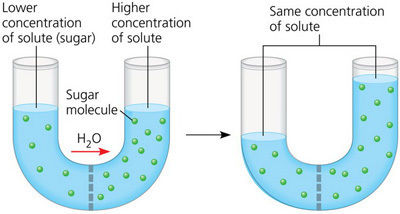
- AWater molecules no longer move between the solutions.
- BWater molecules move between the two solutions, but there is no net movement of water across the membrane.
- CWater molecules continue to move from the hypotonic solution to the hypertonic solution.
23Which of the following molecular movements is due to diffusion or osmosis?
- AWhen a plant cell is placed in concentrated salt water, water moves out of the cell.
- BThe sodium-potassium pump pumps three sodium ions out of a neuron for every two potassium ions it pumps in.
- CCells of the pancreas secrete insulin into the bloodstream.
24For a protein to be an integral membrane protein, it would have to be _____.
- Ahydrophilic
- Bexposed on only one surface of the membrane
- Chydrophobic
- Damphipathic, with at least one hydrophobic region
25According to the fluid mosaic model, a membrane ________.
- Ais composed of a mosaic of fluid polysaccharides and amphipathic proteins
- Bis composed of a fluid bilayer of phospholipids between two layers of hydrophilic proteins
- Cis composed of a fluid bilayer of phospholipids with embedded amphipathic proteins
- Dis composed of a single layer of fluid phospholipids between two layers of hydrophilic proteins
26An animal cell lacking carbohydrates on the external surface of its plasma membrane would likely be impaired in which function?
- Aestablishing a diffusion barrier to charged molecules
- Btransporting ions against an electrochemical gradient
- Ccell-cell recognition
- Dattaching the plasma membrane to the cytoskeleton
27Which of the following types of molecules are hydrophilic and therefore excluded from the hydrophobic portion of the phospholipid bilayer?
- Aperipheral membrane proteins
- Btransmembrane proteins
- Cintegral membrane proteins
- Dcholesterol
28For the following question, match the labeled component of the cell membrane in the figure with its description.
Which component in the accompanying figure is cholesterol?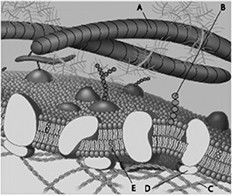
- AB
- BD
- CE
- DC
29What kinds of molecules pass through a cell membrane most easily?
- Asmall and hydrophobic
- Bsmall and ionic
- Clarge and hydrophobic
- Dlarge polar
30Which of the following statements describes a characteristic feature of a carrier protein in a plasma membrane?
- AIt requires the expenditure of cellular energy to function.
- BIt works against diffusion.
- CIt exhibits specificity for a particular type of molecule.
- DIt has no hydrophobic regions.
31A research team is working on the design of a new drug for the treatment of lung cancer. To be most effective, this drug must specifically enter the cytoplasm of lung cells while not entering the cells of other tissues. Which of the following characteristics would likely enhance the specificity of this drug?
- Asimilarity of the drug molecule to other molecules normally transported lung cells
- Bspecificity of the drug molecule for binding to the extracellular matrix of lung cells
- Cphospholipid composition of lung cell plasma membranes
- Dthe relative hydrophobicity of the drug molecule
32Five dialysis bags, constructed of a type of membrane that is permeable to water and impermeable to sucrose, were filled with various concentrations of sucrose and then placed in separate beakers containing an initial concentration of 0.6 M sucrose solution. At 10-minute intervals, the bags were massed (weighed), and the percent change in mass of each bag was graphed.
Which line in the graph represents the bag that contained a solution isotonic to the 0.6 M solution at the beginning of the experiment?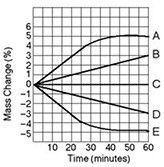
- AA
- BB
- CC
- DD
33Celery stalks that are immersed in fresh water for several hours become stiff. Similar stalks left in a 0.15 M salt solution become limp. From this we can deduce that the fresh water_____.
- Ais hypotonic and the salt solution is hypertonic to the cells of the celery stalks
- Bis isotonic and the salt solution is hypertonic to the cells of the celery stalks
- Cis hypertonic and the salt solution is hypotonic to the cells of the celery stalks
- Dand the salt solution are both hypertonic to the cells of the celery stalks
34What will happen to a red blood cell (RBC), which has an internal ion content of about 0.9%, if it is placed into a beaker of pure water?
- AThe cell would swell because the water in the beaker is hypotonic relative to the cytoplasm of the RBC.
- BThe cell would shrink because the water in the beaker is hypertonic relative to the cytoplasm of the RBC.
- CThe cell will remain the same size because the solution outside the cell is isotonic.
- DThe cell would shrink because the water in the beaker is hypotonic relative to the cytoplasm of the RBC.
35Which of the following statements correctly describes the normal tonicity conditions for typical plant and animal cells? The animal cell is in _____.
- Aan isotonic solution, and the plant cell is in a hypertonic solution
- Ba hypotonic solution, and the plant cell is in an isotonic solution
- Ca hypertonic solution, and the plant cell is in an isotonic solution
- Dan isotonic solution, and the plant cell is in a hypotonic solution
36Which of the following statements correctly describes osmosis?
- AOsmosis only takes place in red blood cells.
- BIn osmosis, water moves across a membrane from areas of lower solute concentration to areas of higher solute concentration.
- COsmosis is an energy-demanding or "active" process.
- DIn osmosis, solutes move across a membrane from areas of lower water concentration to areas of higher water concentration.
37Active and passive transport of solutes across a membrane typically differ in which of the following ways?
- AActive transport is always faster than passive transport.
- BActive transport uses protein carriers, whereas passive transport uses carbohydrate carriers.
- CActive transport is usually down the concentration gradient of the solute, whereas passive transport is always against the concentration gradient of the solute.
- DActive transport always involves the utilization of cellular energy, whereas passive transport does not require cellular energy.
- EActive transport is used for ions, passive transport is used for uncharged solutes.
38The voltage across a membrane is called the _____.
- Amembrane potential
- Bchemical gradient
- Cosmotic potential
- Delectrochemical gradient
39n some cells, there are many ion electrochemical gradients across the plasma membrane even though there are usually only one or two proton pumps present in the membrane. The gradients of the other ions are most likely accounted for by _____.
- Aion channels
- Bpores in the plasma membrane
- Cpassive diffusion across the plasma membrane
- Dcotransport proteins
40The force driving simple diffusion is ________, while the energy source for active transport is ________.
- Atransmembrane pumps; an electrochemical gradient
- Ba concentration gradient; ATP hydrolysis
- Cphosphorylated carrier proteins; ATP
- Da concentration gradient; ADP
41Choose the pair of terms that correctly completes this sentence: Catabolism is to anabolism as _______ is to _______.
- Aexergonic; endergonic
- Bentropy; enthalpy
- Cwork; energy
- Dexergonic; spontaneous
- Efree energy; entropy
42Which of the following metabolic processes can occur without a net influx of energy from some other process?
- Aglucose + fructose →sucrose
- B6 CO2+ 6 H2O→C6H12O6+ 6 O2
- CADP + P i →ATP + H2O
- Damino acids →protein
- EC6H12O6+ 6 O2→6 CO2+ 6 H2O
43If an enzyme in solution is saturated with substrate, the most effective way to obtain a faster yield of products is to
- Aadd an allosteric inhibitor.
- Badd a noncompetitive inhibitor.
- Cadd more substrate.
- Dadd more of the enzyme.
- Eheat the solution to 90°C
44Select the correct statement about chemical energy, a term used by biologists to refer to potential energy available for release in a chemical reaction.
- AA photosynthetic cell within a plant leaf produces chemical energy, stored within glucose molecules.
- BWhen a glucose molecule is catabolized to CO2 and H2O, chemical energy is lost.
- CLight energy is converted to chemical energy during photosynthesis.
45How does an enzyme increase the rate of the chemical reaction it catalyzes?
- AAn enzyme reduces the free energy of activation (EA) of the reaction it catalyzes.
- BAn enzyme’s active site binds only the reactants, and not the products of a reaction, pushing the equilibrium for the reaction far to the right.
- CAn enzyme reduces the free-energy change (ΔG) of the reaction it catalyzes.
46Which of the following statements is true of metabolism in its entirety in all organisms?
- AMetabolism consists of all the energy transformation reactions in an organism.
- BMetabolism uses all of an organism's resources.
- CMetabolism manages the increase of entropy in an organism.
- DMetabolism depends on a constant supply of energy from food.
47Which of the following terms most precisely describes the cellular process of breaking down large molecules into smaller ones?
- Aanabolism (anabolic pathways)
- Bcatabolism (catabolic pathways)
- Cmetabolism
- Ddehydration
48Which of the following statements is an important consequence of the first law of thermodynamics for a living organism?
- AOrganisms grow by converting energy into organic matter.
- BThe energy content of an organism is constant.
- CAn organism ultimately must obtain all of the necessary energy for life from its environment.
- DThe entropy of an organism decreases with time as the organism grows in complexity
49Chemical equilibrium is relatively rare in living cells because metabolic pathways are interconnected. Which of the following statements describes an example of a reaction that may be at chemical equilibrium in a cell?
- Aan exergonic reaction in which the free energy at equilibrium is higher than the energy content of the reaction at any point away from equilibrium
- Ban exergonic reaction in which the entropy change in the cell is precisely balanced by an opposite entropy change in the cell's surroundings
- Ca chemical reaction in which neither the reactants nor the products are being produced or consumed in any metabolic pathway at that time in the cell
- Dan endergonic reaction in an active metabolic pathway where the energy for that reaction is supplied only by heat from the environment
50Which of the following statements describes a central role that ATP plays in cellular metabolism?
- AHydrolysis of the terminal phosphate group stores free energy that is used for cellular work.
- BIts terminal phosphate bond is stronger than most covalent bonds in other biological macromolecules.
- CATP provides energy coupling between exergonic and endergonic reactions.
- DHydrolysis of ATP provides an input of free energy for exergonic reactions.
51When chemical, transport, or mechanical work is done by an organism, what happens to the heat generated?
- AIt is lost to the environment
- BIt is captured to store energy as more ATP.
- CIt is used to power yet more cellular work.
- DIt is used to generate ADP from nucleotide precursors.
52Which of the following is the most correct interpretation of the figure?
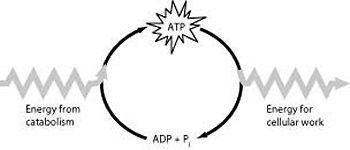
- AADP + Pi are a set of molecules that store energy for catabolism.
- BPi acts as a shuttle molecule to move energy from ATP to ADP.
- CEnergy from catabolism can be used directly for performing cellular work.
- DATP is a molecule that acts as an intermediary to store energy for cellular work.
53Which of the following statements describes a key component of the induced fit hypothesis of enzyme catalysis?
- ABinding of substrate to the active site changes the shape of the active site of an enzyme.
- BSubstrate binds to an allosteric site rather than to the active site of an enzyme.
- CThe conformation of the active site is determined by the tertiary or quaternary structure of the enzyme.
- DBinding of an activator molecule changes the shape of the active site of an enzyme.
54Zinc, an essential trace element for most organisms, is present in the active site of the enzyme carboxypeptidase. The zinc most likely functions as _____.
- Aa cofactor necessary for enzyme activity
- Ban allosteric activator of the enzyme
- Ca noncompetitive inhibitor of the enzyme
- Da coenzyme derived from a vitamin
55How does a noncompetitive inhibitor decrease the rate of an enzyme-catalyzed reaction?
- Aby binding to the active site of the enzyme, thus preventing binding of the normal substrate
- Bby decreasing the free-energy change of the reaction catalyzed by the enzyme
- Cby binding to an allosteric site, thus changing the shape of the active site of the enzyme
- Dby binding to the substrate, thus changing its shape so that it no longer binds to the active site of the enzyme
56How might a change of one amino acid at a site, distant from the active site of an enzyme, alter the substrate specificity of an enzyme?
- Aby changing the three-dimensional conformation of the enzyme
- Bby changing the binding site for a noncompetitive inhibitor
- Cby changing the stability of the enzyme
- Dby changing the optimum pH for the enzyme
57Use the following information to answer the question below. Activity of various enzymes at various temperatures (a) and at various pH (b)
Which curves on the graphs may represent the temperature and pH profiles of an enzyme taken from a bacterium that lives in a mildly alkaline hot springs at temperatures of 70°C or higher?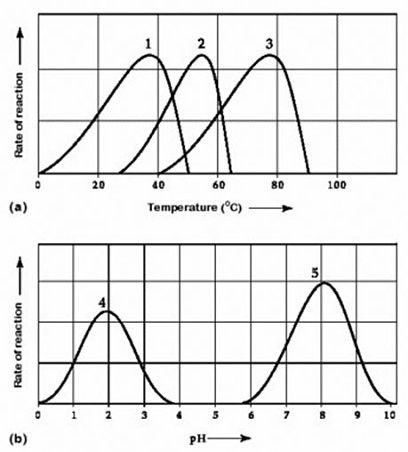
- Acurves 1 and 5
- Bcurves 2 and 5
- Ccurves 3 and 4
- Dcurves 3 and 5
58In a metabolic pathway, succinate dehydrogenase catalyzes the conversion of succinate to fumarate. The reaction is inhibited by malonic acid, a substance that resembles succinate but cannot be acted upon by succinate dehydrogenase. Increasing the amount of succinate molecules to those of malonic acid reduces the inhibitory effect of malonic acid. Which of the following statements correctly describes the role played by molecules described in the reaction?
- AFumarate is the product, and malonic acid is a noncompetitive inhibitor in the reaction.
- BSuccinate is the substrate, and fumarate is the product in the reaction.
- CSuccinate dehydrogenase is the enzyme, and malonic acid is the substrate in the reaction.
- DSuccinate dehydrogenase is the enzyme, and fumarate is the substrate in the reaction.
59HIV is the virus that causes AIDS. In the mid-1990s, researchers discovered an enzyme in HIV called protease. Once the enzyme's structure was known, researchers began looking for drugs that would fit into the active site and block it. If this strategy for stopping HIV infections were successful, it would be an example of what phenomenon?
- Anoncompetitive inhibition
- Bcompetitive inhibition
- Cdenaturation
- Dallosteric regulation
60________ is a regulatory mechanism in which the end product of a metabolic pathway inhibits an enzyme that catalyzes an early step in the pathway.
- AMetabolic inhibition
- BAllosteric inhibition
- CCooperative inhibition
- DFeedback inhibition
61The immediate energy source that drives ATP synthesis by ATP synthase during oxidative phosphorylation is the
- Aaffinity of oxygen for electrons.
- Boxidation of glucose and other organic compounds.
- Cflow of electrons down the electron transport chain.
- Dtransfer of phosphate to ADP.
- EH+ concentration across the membrane holding ATP synthase.
62Which metabolic pathway is common to both fermentation and cellular respiration of a glucose molecule?
- Athe citric acid cycle
- Bthe electron transport chain
- Cglycolysis
- Dreduction of pyruvate to lactate
- Esynthesis of acetyl CoA from pyruvate
63In mitochondria, exergonic redox reactions
- Areduce carbon atoms to carbon dioxide.
- Bare directly coupled to substrate-level phosphorylation.
- Care coupled via phosphorylated intermediates to endergonic processes.
- Dare the source of energy driving prokaryotic ATP synthesis.
- Eprovide the energy that establishes the proton gradient.
64When electrons flow along the electron transport chains of mitochondria, which of the following changes occurs?
- AATP synthase pumps protons by active transport.
- BThe electrons gain free energy.
- CThe pH of the matrix increases.
- DNAD+ is oxidized.
- EThe cytochromes phosphorylate ADP to form ATP.
65Which of the following statements accurately describes the function of a metabolic pathway involved in cellular respiration?
- AThe function of the citric acid cycle is the transfer of electrons from pyruvate to NADH to O2.
- BThe function of the bonding of acetic acid to the carrier molecule CoA to form acetyl CoA is the reduction of glucose to acetyl CoA.
- CThe function of glycolysis is to begin catabolism by breaking glucose into two molecules of pyruvate, with a net yield of two ATP.
66How will a healthy individual’s ATP production change during an eight-hour fast?
- AThe individual’s ATP production will decrease significantly.
- BThe individual’s ATP production will not change significantly.
- CThe individual’s ATP production will increase significantly.
67Identify all correct statements about the basic function of fermentation.
- AThe basic function of fermentation is the production of additional ATP by further oxidation of the products of glycolysis.
- BThe basic function of fermentation is the regeneration of NAD+, which allows continued ATP production by glycolysis.
- CThe basic function of fermentation is the production of ethyl alcohol or lactic acid.
68Select the correct statement about cellular respiration.
- APlants carry out cellular respiration only in organs such as roots that cannot carry out photosynthesis.
- BAnimals carry out cellular respiration whereas plants carry out photosynthesis.
- CCellular respiration and breathing differ in that cellular respiration is at the cellular level, whereas breathing is at the organismal level.
69Which of the following best describes the main purpose of the combined processes of glycolysis and cellular respiration?
- Acatabolism of sugars and related compounds
- Bproducing complex molecules from chemical building blocks
- Cbreaking down ATP, so that ADP and P can be reused
- Dthe breakdown of glucose to carbon dioxide and water
- Etransforming the energy in glucose and related molecules in a chemical form that cells can use for work
70Which of the following statements describes what happens to a molecule that functions as the reducing agent (electron donor) in a redox or oxidation-reduction reaction?
- AIt loses electrons and gains potential energy.
- BIt gains electrons and gains potential energy.
- CIt loses electrons and loses potential energy.
- DIt gains electrons and loses potential energy.
71The oxygen consumed during cellular respiration is directly involved in which of the following processes or events?
- Athe oxidation of pyruvate to acetyl CoA
- Bthe citric acid cycle
- Cglycolysis
- Daccepting electrons at the end of the electron transport chain
72A cell has enough available ATP to meet its needs for about 30 seconds. What is likely to happen when an athlete exhausts his or her ATP supply?
- AHe or she has to sit down and rest.
- BCatabolic processes are activated that generate more ATP.
- COther cells take over, and the muscle cells that have used up their ATP cease to function.
- DATP is transported into the cell from the circulatory system.
73Which of the following describes the process of glycolysis?
- AIt represents the first stage in the chemical oxidation of glucose by a cell.
- BGlycolysis occurs in the mitochondria.
- CIt requires ATP and NADH.
- DIt converts one glucose molecule to two molecules of pyruvate and carbon dioxide.
- EGlycolysis produces 30 ATP from each molecule of glucose.
74Which statement about the citric acid cycle is correct?
- AThe citric acid cycle oxidizes glucose to carbon dioxide.
- BThe oxidation of compounds by the citric acid cycle requires molecular oxygen.
- CThe citric acid cycle depends on the availability of NAD+, which is a product of glycolysis.
- DThe last reaction in the citric acid cycle produces a product that is a substrate for the first reaction of the citric acid cycle.
- EThe citric acid cycle produces most of the ATP that is subsequently used by the electron transport chain.
75A glucose molecule is completely broken down to carbon dioxide and water in glycolysis and the citric acid cycle, but together these two processes yield only a few molecules of ATP. What happened to most of the energy that the cell obtains from the oxidation of glucose?
- AIt is stored in NADH and FADH2
- BIt is stored in the carbon dioxide and water molecules released by these processes
- CIt is stored in the ATP that was formed by glycolysis and the citric acid cycle.
- DIt was lost as heat.
- EIt is stored in pyruvate.
76The electrons stripped from glucose in cellular respiration end up in which compound?
- Awater
- BATP
- Coxygen
- DNADH
- Ecarbon dioxide
77Which one of the following statements about the redox reactions of the electron transport chain is correct?
- ANADH gains electrons in the initial reaction of the electron transport chain.
- BThe redox reactions of the electron transport chain are directly coupled to the movement of protons across a membrane.
- CThe oxidation of NADH is directly coupled to the reduction of oxygen to water.
- DThe redox reactions of the electron transport chain are directly coupled with the synthesis of ATP.
- EThe electron transport chain takes electrons from water and gives them to oxygen.
78Which of the following metabolic processes take place in the cytosol of a eukaryotic cell?
- Afermentation and chemiosmosis
- Boxidation of pyruvate to acetyl CoA
- Cglycolysis and fermentation
- Dcitric acid cycle
79Yeast cells that have defective mitochondria incapable of respiration will be able to grow by catabolizing which of the following carbon sources for energy?
- Afatty acids
- Bamino acids
- Ccholesterol
- Dglucose
80Even though plants cells carry out photosynthesis, they still use their mitochondria for oxidation of pyruvate. Under what conditions will plant cell mitochondria be active in this process?
- Aonly in cells that store glucose in the form of starch and only in the dark
- Bin all cells, with or without light
- Conly in photosynthetic cells in the light, while photosynthesis occurs concurrently
- Din photosynthesizing cells in the light, and in other cells in the dark
Information
- Description
- Biology Quiz on Exam 2 Chapters 6-9, created by Cassidy T on 08/12/2018.
- Author
- Cassidy T
- Language
- English
- Views
- 10
- Tags
- Rating
- No ratings yet Rate this quiz