
Quiz
Economic_Final
Create a free account to finish this quiz
Save your progress and see your final score.
Already have an account? Sign in
Questions in this quiz (198)
1Government policies designed to promote efficiency:
- Ausually do so at the expense of equity
- Btend to cause the economy to grow more slowly.
- Calways fail.
- Drequire very high taxes.
2All of the following can be considered a student's costs of going to college, EXCEPT:
- Atextbooks.
- Btuition and fees.
- Croom and board (that costs her about the same as she was paying before entering college).
- Dthe student's time, which can no longer be devoted to earning a salary.
3An airline's plane from Los Angeles to New York is about to take off, but it still has a few seats empty. If the average cost per seat is $500, what price should the airline charge passengers in standby to fill in those remaining seats? (Consider that quantitative decisions are made at the margin)
- AAt least $500.
- BExactly $500.
- CAny price above zero that will entice standby passengers to take the flight.
- DSlightly less than $500.
4The Federal government enacted regulation in the 1960s requiring people to wear seatbelts in their cars. All of the following resulted from this regulation, EXCEPT:
- Aoverall deaths due to car accidents changed very little in the United States.
- Bfewer deaths occurred per accident.
- Cfewer pedestrians were killed in car accidents.
- Dthe frequency of accidents increased.
5When two persons trade goods:
- Aone person always gains at the expense of the other.
- Bboth persons usually gain from the exchange.
- Cone person usually gains at the expense of the other.
- Dthe overall well being of the two persons remains unchanged.
6In a market economy, the decisions of what and how much to produce are made by:
- Avoters in elections.
- Ball producers and consumers.
- Cthe government only.
- Dnon governmental agencies.
7Even though markets do a great job in organizing economic activity, governments are needed to do all of the following EXCEPT:
- Aestablish and enforce property rights.
- Bintervene when markets fail due to externalities.
- Cintervene when markets fail due to market power.
- Ddecide what and how much should be produced.
8Living standards in the United States have risen tremendously over the years, mainly due to:
- Arelentless increases in the productivity of labor over the years.
- Bthe forceful efforts of labor unions.
- Csuccessive increases in the minimum wage.
- Dtrade protection from competition from countries with low wages, such as China.
9Rapid and persistent inflation occurs mainly due to:
- Ahigh wage increases demanded by labor unions.
- Bgreedy firms that abuse consumers with higher-than-necessary prices.
- Crapid increases in the quantity of money in the economy.
- Dtrade with other countries.
10A government that implements a policy designed to reduce inflation can expect unemployment to:
- Aincrease in the short-run.
- Bdecrease in the short-run.
- Cincrease in the long-run.
- Ddecrease in the long-run.
11Which of the following is FALSE, regarding economics as a science?
- AEconomic knowledge is obtained through the scientific method, just as in any other science.
- BIt is difficult to conduct experiments in economic matters.
- CEconomists pay close attention to natural experiments resulting from historical events.
- DEconomic theories represent irrefutable facts.
12Economists use assumptions in order to:
- Arecreate real situations accurately, with all their complexity.
- Bavoid dealing with issues they would rather not talk about.
- Csimplify economic theories, so as to make it possible to answer economic questions.
- Dmake their theories more realistic.
13Economic models are:
- Asimplified versions of economic theories.
- Bcreated by making assumptions.
- Cusually composed of diagrams and equations.
- Dall of the other options are true.
14All of the following are characteristics of the Circular Flow Model of the economy, EXCEPT:
- Athe model has two markets: one for goods and services and one for factors of production.
- Bthe model includes two sectors: the Firms sector and the Households sector.
- Cthe model describes two circular flows: one for inputs and one for resources.
- Dthe two flows described by the model move in opposite directions.
15The circular flow model of the economy demonstrates that:
- Athe economy actually has only two sectors: firms and households.
- Bdollars in the economy are used over and over in an endless cycle.
- Cfirms produce and provide factors of production.
- Dgovernment is the source of revenue for households to purchase goods and services from firms.
16Which of the following is true regarding the Production Possibilities Frontier Model of the economy?
- AAny point along the PPF represents an efficient level of production.
- BAny point in the area below the PPF represents a combination of production that is not feasible.
- CThe opportunity cost of producing one more unit of one of the goods represented in the PPF remains the same at any point along the PPF.
- DIncreases in the resources available for production will cause the PPF to shift towards the origin.
17Economic growth in the economy can be portrayed in the Production Possibilities Frontier model as a:
- Amovement up and to the left along the PPF.
- Bshift of the PPF away from the origin.
- Cmovement down and to the right along the PPF.
- Dshift of the PPF towards the origin.
18Microeconomics is the study of:
- Ahow governments can get the economy out of a recession.
- Beconomy-wide phenomena, including inflation, unemployment, and economic growth.
- Chow households and firms make decisions and how they interact in markets.
- Dhow governments can reduce inflation.
19Which of the following is an example of a normative statement?
- AHigher interest rates will cause people to borrow and invest less.
- BThe government should increase spending during recessions, so that the economy recovers quickly.
- CWhen the price of a good increases, consumers respond by reducing the quantity that they want to purchase of the good.
- DOver the past 50 years, the number of women that participate in the labor force has increased dramatically.
20Economists tend to disagree with each because:
- Adifferent economists espouse different theories, so they believe different things are going on in the economy.
- Bdifferent economists make different assumptions, leading them to different conclusions in economic matters.
- Cdifferent economists have different values and priorities in economic matters.
- Dall the other options are true.
21The production possibilities frontiers used to explain trade in the text are straight lines because:
- Athe author assumes the farmers can switch at a constant rate from producing meat to producing potatoes.
- Bthat's how it turns out to be when the same person produces the two goods.
- Cone farmer is better than the other in producing both goods.
- Dthe gains of trade will benefit both farmers.
22The principle of Absolute Advantage refers to the situation in which one producer:
- Acan produce a good in greater quantities than other producers.
- Bcan produce a good using fewer resources than other producers.
- Cis able to produce exactly the same quantity of a good as other producers.
- Dhas access to more resources than other producers.
23The principle of Comparative Advantage refers to the situation in which one producer:
- Ahas a lower opportunity cost than other producers in the production of a good.
- Bcan produce a good in greater quantities than other producers.
- Chas access to more resources than other producers.
- Dcan produce a good using fewer resources than other producers.
24Which of the following is true regarding the principle of Absolute Advantage?
- ANations should specialize in producing those goods for which they have a lower opportunity cost.
- BNations should export goods for which they do not have an Absolute Advantage.
- CNations should specialize in producing those goods for which they have an Absolute Advantage.
- DNations should export goods for which they have a higher opportunity cost.
25Which of the following is true regarding the principle of Comparative Advantage?
- ANations should specialize in producing those goods for which they use the least amounts of resources.
- BNations should specialize in producing those goods for which they have the lowest opportunity cost.
- CA nation has nothing to gain from trade if it uses fewer resources than other nations to make any good.
- DA nation has nothing to gain from trade if it uses more resources than other nations to make any good.
26The boy next door has offered to mow Tiger Woods' lawn. It will take this boy twice as long as Tiger Woods to mow the lawn. Would Tiger Woods let the boy mow his lawn, instead of doing it himself?
- AYes, as long as the boy's opportunity cost is less than half of Tiger Woods' opportunity cost.
- BYes, because the boy next door needs the money and Tiger Woods can help him out that way.
- CNo, because it will be more efficient if Tiger Woods mows his own lawn, since he can do it faster.
- DNo, because Tiger Woods has better things to do with his money than pay the boy to mow the lawn.
27Suppose that engaging in free trade means we have to stop making cars, which will cause bankruptcies and will make people lose their jobs. Is it still worth having free trade?
- AYes, because in spite of the lost jobs, we still want to get along with other nations.
- BYes, because the gains outweigh the losses: new businesses and new jobs will flourish in other industries.
- CNo, because we need to protect our jobs.
- DNo, because our wages would have to fall drastically to make us remain competitive with low wage countries.
28Suppose that Jill can type 10 pages per hour in the computer, while Jim can only type 8. Further suppose that Jill can review 5 articles per hour while Jim can only review 2. If they are working on a final project together, who should specialize in what task in order to be as productive as possible?
- AJill should specialize in typing and Jim in reviewing articles.
- BJill should specialize in reviewing articles and Jim in typing.
- CJill should perform both tasks, since she is better at both than Jim.
- DJim should perform both tasks, since he is better at both than Jill.
29Suppose that Jill can type 10 pages per hour in the computer, while Jim can only type 8. Further suppose that Jill can review 5 articles per hour while Jim can only review 2. Based on this, we can say that:
- AJim has a comparative advantage over Jill in reviewing articles.
- BJill has an absolute advantage over Jim in reviewing articles.
- CJim has an absolute advantage over Jill in typing.
- DJill has a comparative advantage over Jim in typing.
30The principle of Comparative Advantage argues all of the following, EXCEPT:
- Aspecialization allows producers to produce goods for which they have a lower opportunity cost.
- Bfree trade tends to cause bankruptcies and high unemployment in the long run.
- Cfree trade allows producers to specialize.
- Das producers specialize, overall production increases, making everybody better off.
31Which of the following is NOT a characteristic of a perfectly competitive market?
- AThe goods being offered for sale are all the same.
- BBuyers and sellers are very numerous.
- CBuyers and sellers are price takers.
- DIt is difficult for new firms to enter the market.
32A market with only one firm is known as a:
- Acomplementary market.
- Bmonopoly.
- Cperfectly competitive market.
- Dnormal market.
33An increase in demand means that:
- Awhen the price drops consumers are willing to purchase greater quantities of the good.
- Bconsumers are willing to purchase greater quantities of the good at any given price.
- Cwhen the price rises, consumers are willing to purchase greater quantities of the good.
- Dconsumers make the price drop by buying greater quantities of the good.
34If good B is a substitute for good A, and the price of good B increases:
- Athe quantity demanded of good A will decrease.
- Bthe demand for good A will increase.
- Cthe price of good A will tend to decrease.
- Dthe quantity demanded of good B will increase.
35When the price of a good increases:
- Athe quantity supplied of the good will increase.
- Bthe quantity supplied of the good will decrease.
- Cthe supply curve of the good will shift to the right.
- Dthe supply curve of the good will shift to the left.
36A new technology that helps firms reduce production costs will cause a:
- Amovement down and to the left along the supply curve.
- Bmovement up and to the right along the supply curve.
- Cshift to the right of the supply curve.
- Dshift to the left of the supply curve.
37If the price in a market happens to be below equilibrium, there will be a ________ in the market, and the price will tend to ________.(ответ из интернета)
- Asurplus, drop
- Bsurplus, rise
- Cshortage, drop
- Dshortage, rise
38If the price in a market happens to be above equilibrium, there will be a ________ in the market, and the price will tend to ________.
- Asurplus, drop
- Bsurplus, rise
- Cshortage, drop
- Dshortage, rise
39Suppose that a scientific study just published demonstrates that eating apples makes people much healthier. How will this affect the equilibrium price and quantity in the market?
- AThe equilibrium price will increase and the equilibrium quantity will decrease.
- BThe equilibrium price will decrease and the equilibrium quantity will increase.
- CBoth the equilibrium quantity and price will increase.
- DBoth the equilibrium quantity and price will decrease.
40Suppose the price of corn syrup increases. Given that corn syrup is a major ingredient in the production of soft drinks, how will this affect the equilibrium price and quantity in the soda market?
- AThe equilibrium price will increase and the equilibrium quantity will decrease.
- BThe equilibrium price will decrease and the equilibrium quantity will increase.
- CBoth the equilibrium quantity and price will increase.
- DBoth the equilibrium quantity and price will decrease.
41A good will tend to have an inelastic demand if:
- Athe good has many close substitutes.
- Bthe good is a luxury.
- Cthe market is defined very broadly.
- Dthe time horizon is long.
42A perfectly elastic demand is represented graphically by a:
- Arelatively steep demand curve.
- Brelatively flat demand curve.
- Cvertical demand curve.
- Dhorizontal demand curve.
43What effect will an increase in the price have on Total Revenue, if demand is elastic?
- ATotal Revenue will increase.
- BTotal Revenue will decrease.
- CTotal Revenue will first decrease and then increase.
- DTotal Revenue will remain unchanged.
44The price elasticity of demand tends to be more elastic:
- Aat points further up and to the left along the demand curve.
- Bat points further down and to the right along the demand curve.
- Cwhen the demand curve becomes steeper.
- Dwhen the demand curve is vertical.
45Suppose that General Cars increases the price of its Cadiclap model from $13,500 to $16,500. As a result of this, the quantity demanded of the Cadiclap model decreases from 600,000 to 400,000 per year. Find the price elasticity of demand of the Cadiclap using the Mid-Point method.
- A-3.0
- B-0.5
- C-2.0
- D-0.3
46If a firm needs to increase its Total Revenue, the firm should ________ the price, if the demand for its product is ________.
- Adrop, inelastic
- Braise, elastic
- Cdrop, elastic
- Ddrop, unit elastic
47Suppose that consumers' incomes rise by 3%, and that this causes the quantity demanded for a good to increase by 4.5%. What is the income elasticity of demand?
- A1.50
- B0.67
- C-1.50
- D-0.67
48Suppose that a good has an income elasticity of demand of -2.0. This means that the good is:
- Anormal.
- Binferior.
- Ca substitute.
- Da complement.
49If two goods have a cross-price elasticity of demand of -0.8. This means that these goods are:
- Anormal.
- Binferior.
- Csubstitutes.
- Dcomplements.
50The price of good A increases from $4.50 to $5.50. This causes the quantity demanded of good B to increase from 900 to 1100 units per month. Find the cross price elasticity of demand using the Mid-Point method.
- A-1.0
- B+2.0
- C+1.0
- D-2.0
51Suppose that a regulation is in place that does not allow the price of a good to exceed $5. If this price is above the equilibrium price in the market, this would be an example of a:
- Abinding price ceiling.
- Bnot binding price ceiling.
- Cbinding price floor.
- Dnot binding price floor.
52Suppose that a regulation is in place that does not allow the price of a good to fall below $10. If this price is above the equilibrium price in the market, this would be an example of a:
- Abinding price ceiling.
- Bnot binding price ceiling.
- Cbinding price floor.
- Dnot binding price floor.
53Suppose that a regulation is in place that does not allow the price of a good to exceed $5. If this price is below the equilibrium price in the market, this would be an example of a:
- Abinding price ceiling.
- Bnot binding price ceiling.
- Cbinding price floor.
- Dnot binding price floor.
54If a price floor is in place and it is binding, the market will:
- Aremain in equilibrium, unaffected by the price floor.
- Bexperience a shortage.
- Cexperience a surplus.
- Dadjust its equilibrium point toward the price floor.
55If a price ceiling is in place and it is binding, the market will:
- Aremain in equilibrium, unaffected by the price floor.
- Bexperience a shortage.
- Cexperience a surplus.
- Dadjust its equilibrium point toward the price floor.
56If a price floor is in place and it is not binding, the market will:
- Aremain in equilibrium, unaffected by the price floor.
- Bexperience a shortage.
- Cexperience a surplus.
- Dadjust its equilibrium point toward the price floor.
57If a tax is imposed on buyers of a good, the ________ curve of the good will shift ________ by the amount of the tax.
- Ademand, upward
- Bdemand, downward
- Csupply, upward
- Dsupply, downward
58If a tax is imposed on sellers of a good, the ________ curve of the good will shift ________ by the amount of the tax.
- Ademand, upward
- Bdemand, downward
- Csupply, upward
- Dsupply, downward
59If a tax is imposed on a good and the incidence of the tax ends up falling more heavily on the sellers than on the buyers, this will be because:
- Ademand is more elastic than supply for that good.
- Bdemand is less elastic than supply for that good.
- Cthe tax was imposed on the buyers of the good.
- Dthe tax was imposed on the sellers of the good.
60If a tax is imposed on a good and the incidence of the tax ends up falling more heavily on the buyers than on the sellers, this will be because:
- Ademand is more elastic than supply for that good.
- Bdemand is less elastic than supply for that good.
- Cthe tax was imposed on the buyers of the good.
- Dthe tax was imposed on the sellers of the good.
61Which of the following would be a good example of an implicit cost incurred by Superior Airways?
- AThe salaries paid to the pilots.
- BThe jet fuel bills.
- CThe purchases of parts needed for maintenance of the aircraft.
- DThe rent that could be earned on an aircraft that is owned and used by Superior.
62Everything that needs to be given up whenever a choice is made is called:
- Aan implicit cost.
- Ban explicit cost.
- Can opportunity cost.
- Dvariable cost.
63Accounting profit is ________ compared to economic profit, because accountants ________ implicit costs in their calculations.
- Abigger, consider
- Bbigger, do not consider
- Csmaller, consider
- Dsmaller, do not consider
64The property of diminishing marginal product of labor states that:
- Aevery additional worker hired contributes to diminish the quantity produced by the firm.
- Bevery additional worker hired contributes to diminish the total costs of the firm.
- Cevery additional worker hired contributes a smaller increase in production than previously hired workers.
- Devery additional worker hired contributes a smaller increase in total costs than previously hired workers.
65The cost of raw materials will fall under the category of:
- Afixed costs.
- Bvariable costs.
- Clong-run costs.
- Daverage fixed costs.
66The lease payments made by a firm fall under the category of:
- Afixed costs.
- Bvariable costs.
- Cshort-run costs.
- Daverage fixed costs.
67Based on the table, if the Fixed Cost is $500, what is the Marginal Cost of the 10th unit?
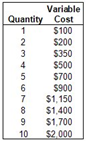
- A$250
- B$200
- C$50
- D$300
68Based on the table, if the Fixed Cost is $500, what is the Average Total Cost of the 5th unit?
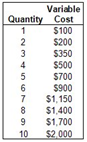
- A$250
- B$140
- C$240
- D$100
69Based on the table, if the Fixed Cost is $500, what is the Average Variable Cost of the 4th unit?
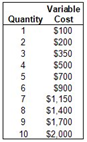
- A$250
- B$125
- C$240
- D$100
70Economies of scale occur when the ________ as the quantity of output increases.
- Ashort-run Average Total Cost falls
- Bshort-run Average Total Cost rises
- Clong-run Average Total Cost falls
- Dlong-run Average Total Cost rises
71Which of the following is NOT a characteristic of monopolistic competition?
- AThere are many sellers.
- BThere are many buyers.
- CEverybody is perfectly informed.
- DThe goods are identical.
72The diagram depicting monopolistic competition in the short run:
- Ais very similar to the short run monopoly diagram.
- Bis very similar to the short run perfect competition diagram.
- Cis very similar to the short run oligopoly diagram.
- Dis completely different to the diagrams of all the other types of markets.
73If the Average Total Cost curve of a firm in monopolistic competition happens to be above the demand curve, it means:
- Athe firm will have to sell a lot in order to make a profit.
- Bthe firm will have to sell at a very high price in order to make a profit.
- Cother firms are performing better in the market than the firm depicted in the diagram.
- Dthat firms in that industry will be incurring losses in the short run.
74In the long run, firms in monopolistic competition will see their price:
- Abecome equal to their Average Variable Cost.
- Bbecome equal to their Average Total Cost.
- Cremain well above their Average total Cost.
- Dbecome equal to their Marginal Cost.
75If firms in monopolistic competition are enjoying positive economic profits, in the long run:
- Athey will continue enjoying such profits, since new firms will be unable to enter the industry.
- Bconsumers will cease wanting to buy such expensive goods and will switch to cheaper alternatives.
- Cthis will attract new firms into the industry, causing prices to drop and profits to disappear.
- Dthe government will have to step in and regulate the price.
76Firms in monopolistic competition in long run equilibrium ________ than firms in perfect competition.
- Aproduce less
- Bcharge a lower price
- Chave bigger profits
- Dhave lower costs
77In monopolistic competition in long run equilibrium, the price will be equal to:
- Athe marginal cost.
- Bmarginal revenue.
- Caverage variable cost.
- Daverage total cost.
78A major critique of advertising is that:
- Ait provides information to consumers that they would be better off without.
- Bit manipulates people's tastes, leading people to make bad choices.
- Cit promotes excessive competition among firms in the industry.
- Dit is usually linked to promotions, which undermine the market's price.
79A major argument in favor of advertising is that:
- Ait provides information to consumers that allows them to make better choices.
- Bit helps people reaffirm their tastes and preferences.
- Cit reduces competition among firms in the industry, leading to lower prices.
- Dit is usually linked to promotions, which help lower the market's price.
80Branding can be good for society because:
- Ait allows people to show off the branded goods they use or wear.
- Bit keeps generic goods from taking over the market.
- Cit provides useful information to consumers about the quality of branded goods.
- Dit helps firms enjoy higher prices and profits.
81Factors of production are:
- Athe coefficients in a production function.
- Bthe characteristics of a market that determine how much is produced.
- Cthe inputs used to produce goods and services.
- Dthe outputs from a production function.
82The property of diminishing marginal product applies:
- Aonly to workers in the short run.
- Bapplies to workers and any other variable inputs in the short run.
- Conly to workers in the long run.
- Dapplies to workers and any other variable inputs in the long run.
83Which of the following statements is FALSE?
- AThe value of the marginal product of labor represents the benefit to the firm from hiring an additional worker.
- BThe value of the marginal product of labor curve represents the firm's demand for labor curve.
- CThe value of the marginal product of labor diminishes as more workers are hired.
- DThe value of the marginal product of labor is the same thing as the marginal product of labor.
84All of the following will cause the value of the marginal product of labor to increase, EXCEPT:
- Aan increase in the price of the good sold by the firm.
- Ba new production technology is developed and implemented by the firm.
- Can increase in the quantity of other factors of production used by the firm.
- Dan increase in the number of workers employed by the firm.
85If the supply curve for labor is backward bending, and if the wage of a worker increases, she might choose to work:
- Afewer hours per week, since she can earn the same income working fewer hours.
- Bmore hours per week, since she can earn the same income working fewer hours.
- Cfewer hours per week, since every hour of leisure is cheaper than before.
- Dmore hours per week, since she needs to work more hours to earn the same income.
86All of the following are things that can make the labor supply curve shift, EXCEPT:
- Achanges in the number of customers buying a good.
- Bchanges in tastes of workers.
- Cchanges in alternative job opportunities.
- Dchanges in immigration laws.
87If many students choose to study to become pharmacists, when all of these students eventually graduate, we can expect pharmacist's wages to ________, and the equilibrium number of pharmacists will ________.
- Arise, increase
- Bdrop, increase
- Crise, decrease
- Ddrop, decrease
88If there is a permanent increase in the demand for cars, car manufacturers will want to hire ________ workers, which will cause wages in the industry to ________.
- Amore, rise
- Bmore, drop
- Cless, rise
- Dless, drop
89As firms gradually acquire ever more technology, machinery and equipment, workers' productivity gradually ________, and workers wages gradually ________.
- Arises, decrease
- Bdiminishes, decrease
- Cdiminishes, increase
- Drises, increase
90The price paid for any factor of production tends to be equal to:
- Athe wage rate.
- Bthe value of the marginal product of that input.
- Cthe price of the product sold by the firm that inputs.
- Dthe price of the product sold by the firm that buys the inputs.
91Gross Domestic Product measures:
- Athe total income in the economy, but not the total expenditure on the economy's output.
- Bthe total expenditure on the economy's output, but not the total income in the economy.
- Cboth the total income in the economy and the total expenditure on the economy's output.
- Dneither the total income in the economy nor the total expenditure on the economy's output.
92Assume households purchase all greeting cards. In calculating GDP, the government will include the value:
- Aof all the paper as well as all the greeting cards produced in the economy.
- Bof all the greeting cards but of none of the paper.
- Cof all of the greeting cards and any paper that is added to inventory.
- Dof some of the greeting cards and all of the paper.
93The Gross Domestic Product measures the value of:
- Afinal goods, but not services.
- Bfinal services, but not goods.
- Cfinal goods and services.
- Dneither goods nor services.
94Which of the following are expenditures included in the calculation of the Gross Domestic Product?i. Investment.
ii. Government Purchases.
iii. Net Exports.
iv. Consumption.- Aonly ii, iii, and iv
- Bonly i, ii, and iii
- Conly i, iii, and iv
- Dall four
95For the purposes of national accounting, 'Investment' can be defined as:
- Adepositing money in Certificates of Deposits (CDs) or Money Market accounts.
- Bpurchases of stocks and bonds.
- Cspending on capital equipment, inventories, and structures.
- Dputting money away in a 401K pensions fund system.
96For the purpose of national accounting, 'Consumption' refers to the:
- Aspending done by households on everything except house purchases.
- Bwear and tear through the normal use of machinery and equipment.
- Cway Tuberculosis used to be called in the 19th century, at the time when economists were figuring out national accounting standards.
- Dwear and tear of highways and infrastructure through normal use.
97'Net Exports' are the nation's:
- Aexports minus imports of goods only.
- Bexports minus imports of goods and services.
- Cimports minus exports of goods only.
- Dimports minus exports of goods and services.
98The 'Government Purchases' category of GDP includes all government spending on goods and services:
- Aincluding transfer payments.
- Bexcept transfer payments.
- Cexcluding local government spending.
- Dexcluding state government spending.
99If Nominal GDP increased from $1.0 trillion in 2000 to $1.2 in 2005, we:
- Acan say that output increased by 20% in the economy through that period.
- Bcan say that prices increased by 20% in the economy through that period.
- Cdon't have enough information from this to determine how much output actually increased in the economy.
- Dcan say that output increased by 20% in the economy compared to the base year.
100If the Nominal GDP is $1.6 trillion, and the Real GDP is $1.0 trillion, the GDP deflator is:
- A160
- B62.5
- C60
- D37.5
101Over the last 100 years, which of the following countries has grown the fastest?
- AUnited States
- BUnited Kingdom
- CGermany
- DJapan
102Small changes in its growth rate make ________ changes in the GDP per person in the long term.
- Avery big
- Bsmall
- Cinsignificant
- Dinverse
103The key to increasing real average incomes in a nation lies in:
- Aactivist labor unions, that force businesses to increase wages throughout the nation.
- Braising significantly the minimum wage.
- Cincreasing productivity.
- Dlimiting imports, to protect our jobs and wages.
104Accumulating ever more physical capital, human capital, natural resources, and technological knowledge are strategies designed to increase our:
- Anet exports.
- Bpopulation.
- Ctaxes.
- Dproductivity.
105An economy that 'accumulates human capital' is:
- Ahiring ever more workers.
- Bincreasing its population.
- Cincreasing the skills of its workers.
- Dincreasing the labor force participation rate.
106In order to accumulate more technological knowledge, a nation must:
- Ateach more technological knowledge to its college students.
- Bspend more on training programs for displaced workers.
- Cfocus more on training newly hired workers on the technology they will be using.
- Dspend more money on research and development.
107In order for an economy to increase investment:
- Asociety must save more.
- Bbusinesses must spend less.
- Cthe government must raise taxes.
- Dexports must increase.
108The concept of diminishing returns to investment refers to the fact that:
- Afirms in rich countries invest less than firms in poorer countries.
- Bany given increase in investment yields less econonmic growth in a rich country than in a poor country.
- Cfirms in poor countries invest less than firms in rich countries.
- Dany given increase in investment yields less economic growth in a poor country than in a rich country.
109One key factor promoting investment is:
- Awillingness of households to spend their money.
- Ba substantial increase in government spending.
- Chigh taxes.
- Dclear and well enforced property rights.
110All of the following promote outward oriented growth policies, EXCEPT:
- Aavoiding tariffs and other trade restrictions.
- Breducing as much as possible the paperwork needed to export and import parts and finished goods.
- Callowing foreign money to be invested in our country with the least amount of restrictions.
- Drequiring foreign companies to produce their goods in our country, if they want to sell here.
111The Bureau of Labor Statistics measures unemployment by:
- Asurveying firms and asking them how many workers they have hired and fired each month.
- Breviewing claims for unemployment benefits.
- Csurveying households.
- Dreviewing statistics of homeless people.
112The Bureau of Labor Statistics surveys households to determine whether the interviewees are:
- Aearning high or low wages.
- Bemployed, unemployed or not in the labor force.
- Cworking legally or not.
- Dforeign or U.S. citizens.
113The labor force is the:
- Asum of the employed and the unemployed.
- Bpercentage of the labor force that is employed.
- Cworkers employed.
- Dpercentage of workers employed out of the total population.
114The unemployment rate is the:
- Anumber of people unemployed in the nation.
- Bpercentage of the labor force that is unemployed.
- Cpercentage of the population that is unemployed.
- Dnumber of people unemployed in a given state.
115The normal rate of unemployment around which the unemployment rate fluctuates is called the ________ rate of unemployment.
- Acyclical
- Bnatural
- Cfrictional
- Dstructural
116The unemployment that results because it takes time for workers to search for the jobs that best suit their tastes and skills is called ________ unemployment.
- Acyclical
- Bnatural
- Cfrictional
- Dstructural
117The unemployment that results because the number of jobs available in some labor markets is insufficient to provide a job for everyone who wants one is called ________ unemployment.
- Acyclical
- Bnatural
- Cfrictional
- Dstructural
118Which of the following statements is true?
- AIt is possible for an economy to completely and permanently eliminate unemployment.
- BIt is possible for an economy to eliminate unemployment completely, but only temporarily.
- CIt is impossible for an economy to eliminate unemployment completely.
- DIt is possible for an economy to completely and permanently eliminate unemployment, but only if the government finds a way to avoid recessions altogether.
119Which of the following policies would be most effective in reducing the unemployment rate?
- APass laws that make it difficult for employers to fire workers.
- BReduce the benefits to the unemployed (unemployment insurance).
- CPass laws that force businesses to hire more workers.
- DRaise taxes on imports (tariffs), to protect American producers and workers.
120All of the following make it difficult for wages to go down when necessary, EXCEPT:
- Aunions and collective bargaining.
- Bminimum wage laws.
- Cefficiency wages.
- Djob search time.
121The set of assets in an economy that people regularly use to buy goods and services form other people is most commonly called:
- Afinancial assets.
- Bliquid assets.
- Cexchange assets.
- Dmoney.
122All of the following are functions of money, EXCEPT:
- Amedium of exchange.
- Bliquidity.
- Cunit of account.
- Dstore of value.
123Which of the following is NOT a characteristic of commodity money?
- AIt must have an intrinsic value.
- BIt must be easily divisible, in order to make small payments.
- CIt must be durable.
- DIt must be set by decree.
124Fiat money, such as the dollar bills we use now-a-days:
- Ais backed by gold.
- Bhas no intrinsic value at all.
- Cis based on the amount of precious metals held by the government.
- Dis printed and introduced into the economy by the Treasury of the United States.
125Which of the following is NOT included in the M1 measure of the stock of money?
- Achecking account deposits
- Bcoins in circulation
- Cdollar bills in circulation
- Dsavings account deposits
126Which of the following is included in M2, but is not included in M1?
- Atraveler's checks
- Bcheckable deposits
- Cmoney market mutual funds
- Ddemand deposits
127Which of the following is true about the Federal Reserve System?
- AThe system is based on 10 regional reserve banks.
- BThere are 12 board members.
- CBoard members are appointed by the Chair of the Open Market Committee.
- DBoard members are appointed by the President of the United States for a term of 14 years.
128Which of the following actions by the Fed will cause the supply of money to grow?
- AThe Fed sells U.S. Treasury bonds.
- BThe Fed increases the required reserve ratio.
- CThe Fed reduces the discount rate.
- DThe Fed audits banks more strictly.
129All of the following occur when the Fed lowers the Discount rate, EXCEPT:
- Abanks borrow more than otherwise from the Fed.
- Bbanks' reserves increase.
- Cbanks start lending more.
- Dbanks borrow more than otherwise from other banks.
130Which of the following occurs when the Fed reduces the reserve requirement?
- AThe money multiplier gets bigger.
- BBanks become more reluctant to lend.
- CThe amount of money in the economy is reduced.
- DInterest rates tend to rise in the economy.
131When there is inflation:
- Aprices decrease in the economy.
- Bthe value of money decreases in the economy.
- Cthe value of the dollar rises on foreign exchange markets.
- Dbasic necessities become cheaper.
132'Money Demand' is the:
- Aamounts of money people are willing to buy at different price levels.
- Bamount of dollars foreigners are willing to buy with their foreign currency.
- Camounts of money people are willing to hold at different price levels.
- Damount of dollars U.S. citizens are willing to buy with their holdings of foreign currency.
133When the Fed adds more money to the economy, the Money Supply curve shifts to the ________, causing the equilibrium price level to ________.
- Aright, decrease
- Bright, increase
- Cleft, decrease
- Dleft, increase
134According to the Classical Dichotomy:
- Anominal variables do not affect real variables.
- Breal variables do not affect nominal variables.
- Cnominal variables are not adjusted for inflation and real units are adjusted for inflation.
- Dnominal variables are expressed in monetary units and real variables are expressed in physical units.
135According to the principle of monetary neutrality:
- Achanges in the money supply do not affect real variables.
- Breal variables do not affect nominal variables.
- Cnominal variables are not adjusted for inflation and real units are adjusted for inflation.
- Dnominal variables are expressed in monetary units and real variables are expressed in physical units.
136The velocity of money is:
- Athe speed at which the money multiplier works.
- Bthe rate at which money changes hands.
- Cthe speed at which prices rise in the economy.
- Dthe time it takes for checks to be cleared by the Fed.
137If the Fed increased the supply of money, and velocity remains unchanged, according to the quantity equation:
- AP x Y must decrease.
- BY must decrease.
- CP x Y must increase.
- DY must increase.
138The one-for-one adjustment of the nominal interest rate to the inflation rate is called the ________ effect.
- AFisher
- Binflation tax
- Cshoeleather
- Dinterest rate
139The resources wasted when inflation encourages people to reduce their money holdings is called:
- Amenu costs.
- Bshoeleather costs.
- Cmisallocation of resources.
- Drelative price variability.
140When inflation turns out to be higher than expected, borrowers will be ________ off, and lenders will be ________ off.
- Abetter, worse
- Bbetter, better
- Cworse, worse
- Dworse, better
141Another name given to Net Exports is:
- Atrade value.
- Btrade deficit.
- Ctrade balance.
- Dbalanced trade.
142Net Exports are affected by which of the following?
i. Tastes of consumers.
ii. Prices of goods at home and abroad.
iii. The incomes of consumers at home and abroad.
iv. Government policies toward international trade.- Aonly i, ii, and iii
- Bonly ii, iii, and iv
- Conly i, ii, and iv
- Dall four
143Other things remaining equal, when domestic incomes rise, Net Exports:
- Awill decrease.
- Bwill increase.
- Cwill remain unaffected.
- Dmight increase or decrease.
144When Net Capital Outflow is positive, it means:
- Aimports are bigger than exports.
- Bdomestic residents are spending more on foreign assets than foreigners are spending on domestic assets.
- Cforeigners are spending more on domestic assets than domestic residents are spending on foreign assets.
- Dnone of the above.
145Other things remaining equal, if real interest rates increase abroad, our:
- Anet exports will decrease.
- Bnet capital outflow will increase.
- Cnet capital outflow will decrease.
- Dnone of the above.
146Other things remaining equal, if there is political or economic turmoil in the U.S., we can expect our:
- Anet exports will decrease.
- Bnet capital outflow will increase.
- Cnet capital outflow will decrease.
- Dnone of the above.
147If the U.S. has a trade deficit, it means that:
- Asaving in the U.S. is less than investment.
- Bsaving in the U.S. is grater than investment.
- Cforeign incomes are greater than U.S. incomes.
- Dforeign incomes are less than U.S. incomes.
148If purchasing-power parity holds, and if prices in country A are the same as prices in country B, it means that the ________ exchange rate between these countries is equal to ________.
- Areal, zero
- Breal, one
- Cnominal, zero
- Dnominal, one
149According to the Purchasing Power Parity Theory, if a dollar will buy more in the U.S. than abroad, traders will ________, which will cause the dollar to ________.
- Abuy abroad and sell in the U.S., depreciate
- Bbuy abroad and sell in the U.S., appreciate
- Cbuy in the U.S. and sell abroad, appreciate
- Dbuy in the U.S. and sell abroad, depreciate
150According to the Purchasing Power Parity Theory, the ________ exchange rate tends to become equal to ________.
- Anominal, zero
- Bnominal, one
- Creal, zero
- Dreal, one
151Business cycle is fluctuations in economic activity, such as employment and production.
- ATrue
- BFalse
152Economics is the study of how society manages its scarce resources.
- ATrue
- BFalse
153Efficiency is the property of society getting the most it can from its scarce resources.
- ATrue
- BFalse
154Equality is the property of distributing economic prosperity fairly among the members of society.
- ATrue
- BFalse
155Externality is the impact of one person’s actions on the well-being of a bystander.
- ATrue
- BFalse
156Incentive is something that induces a person to act.
- ATrue
- BFalse
157Inflation is an increase in some prices in the economy.
- ATrue
- BFalse
158Marginal changes is large incremental adjustments to a plan of action.
- ATrue
- BFalse
159Market economy is an economy that allocates resources through the decentralized decisions of many firms and households as they interact in markets for goods and services.
- ATrue
- BFalse
160Market failure is a situation in which a market left on its own fails to allocate resources inefficiently.
- ATrue
- BFalse
161Market power is the ability of a single economic actor (or small group of actors) to have a substantial influence on market prices.
- ATrue
- BFalse
162Opportunity cost is whatever must be given up to obtain some item.
- ATrue
- BFalse
163Productivity is the quantity of goods and services produced from each hour of a worker’s time.
- ATrue
- BFalse
164Property rights are the ability of an individual to own and exercise control over scarce resources.
- ATrue
- BFalse
165Rational people are people who systematically and purposefully do the best they can to achieve their objectives.
- ATrue
- BFalse
166Scarcity is the nature of society’s resources.
- ATrue
- BFalse
167Circular-flow diagram is a visual model of the economy that shows how dollars flow through markets among households and firms.
- ATrue
- BFalse
168\Macroeconomics is the study of economy wide phenomena, including firms income, inflation, unemployment, and economic growth.
- ATrue
- BFalse
169Microeconomics is the study of how households and firms make decisions and how they interact in markets.
- ATrue
- BFalse
170Positive statements are claims that attempt to prescribe how the world should be.
- ATrue
- BFalse
171Normative statements are claims that attempt to describe the world as it is.
- ATrue
- BFalse
172Production possibilities frontier is a graph that shows the combinations of output that the economy can possibly produce given the available factors of production and the available production technology.
- ATrue
- BFalse
173Absolute advantage is the ability to produce a good using fewer inputs than another producer.
- ATrue
- BFalse
174Comparative advantage is the ability to produce a good at a higher opportunity cost than another producer.
- ATrue
- BFalse
175Exports are goods produced domestically and sold abroad.
- ATrue
- BFalse
176Imports are goods produced abroad and sold domestically.
- ATrue
- BFalse
177Opportunity cost is whatever must be given up to obtain some item.
- ATrue
- BFalse
178Competitive market is a market in which there are many buyers and many sellers so that each has substantial impact on the market price.
- ATrue
- BFalse
179Complements are two goods for which an increase in the price of one leads to a increase in the demand for the other.
- ATrue
- BFalse
180Demand curve is a graph of the relationship between the income and the quantity demanded.
- ATrue
- BFalse
181Which of the following is NOT a characteristic of a competitive market?
- AIt has many buyers.
- BIt has many sellers.
- CThe products traded are identical
- DFirms set the price.
182Use the table to find the Total Revenue when the quantity is 8 units.
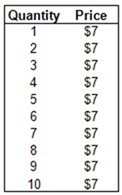
- A$10
- B$60
- C$56
- D$7
183Use the table to find the Marginal Revenue when the quantity is 5.
- A$10
- B$60
- C$56
- D$7
184Which of the following statements is true, regarding the revenues of a firm?
- AThe Marginal Revenue and the Average Revenue are equal to the price.
- BThe Marginal Revenue is greater than the Average Revenue.
- CThe Marginal Revenue is greater than the Total Revenue.
- DThe Total Revenue is less than the Average Revenue.
185A firm will maximize profits when its:
- ATotal Revenue is equal to its Total Cost.
- BMarginal Revenue is equal to its Marginal Cost.
- CThe difference between Marginal Revenue and Marginal Cost is the greatest.
- DTotal Cost is greater than Total Revenue.
186Which is the profit maximizing quantity according to the graph?
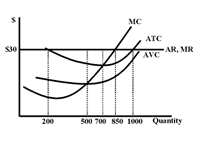
- A500
- B700
- C850
- D1000
187Based on the graph, which of the following statements is FALSE?
- AThe firm breaks even when producing 200 units.
- BThe firm breaks even when producing 1000 units.
- CThe firm minimizes its Average Variable Cost when producing 500 units.
- DThe firm maximizes its profits by producing 700 units.
188The short-run supply curve of a firm in perfect competition is the segment of its:
- Amarginal cost curve that lies above the minimum average total cost.
- Bmarginal revenue curve that lies above the minimum average total cost.
- Cmarginal cost curve that lies above the minimum average variable cost.
- Dmarginal revenue curve that lies above the minimum average variable cost.
189Which of the following is an example of a barrier to entry into a monopoly market?
- ANew technology allows ever more firms to compete ever more fiercely in information services markets.
- BThe government does not allow firms to merge in an industry.
- CA restaurant at the top of the cliff possesses the only location in town with a spectacular view.
- DDiseconomies of scale restrict the ability of firms to grow and remain competitive.
190The demand curve faced by a monopoly is:
- Avertical.
- Bhorizontal.
- Cupward sloping.
- Ddownward sloping.
191A monopoly is a ________, therefore the demand curve it faces is ________.
- Aprice taker, downward-sloping
- Bprice taker, horizontal
- Cprice setter, downward-sloping
- Dprice setter, horizontal
192As output increases in a monopoly, the firm's total revenue:
- Afirst increases and then decreases.
- Bfirst decreases and then increases.
- Cincreases continuously.
- Ddecreases continuously.
193Marginal revenue in a monopoly is:
- Aalways greater than the price.
- Balways equal to the price.
- Calways smaller than the price.
- Dsometimes greater and sometimes smaller than the price.
194Which of the following statements is true, regarding the monopoly described by the graph?
- AThe optimal quantity is 20 units.
- BThe firm will charge a price of $11.
- CThe profit per unit is $7.
- DThe firm will have losses if the quantity produced is 16 units.
195Use the diagram to calculate the profit of the monopoly.
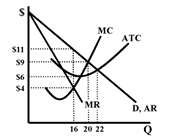
- A$80
- B$112
- C$60
- D$32
196A monopoly tends to sell a ________ quantity at a ________ price than perfect competition.
- Agreater, lower
- Bgreater, higher
- Csmaller, higher
- Dsmaller, lower
197Which of the following statements is true regarding a profit maximizing monopoly?
- AIt will cause a deadweight loss.
- BIt will produce less than perfect competition.
- CIt will sell at a higher price than perfect competition.
- DAll of the above.
198Which of the following are government policies designed to deal with monopolies?
i. Try to make monopolized industries more competitive.
ii. Regulate the behavior of monopolies.
iii. Turn some private monopolies into public enterprises.
iv. Do nothing at all.- Aonly i and ii
- Bonly ii and iii
- Conly i, ii, and iii
- Dall four policies
Information
- Description
- Economics Quiz on Economic_Final, created by Almat Tazhikenov on 16/12/2018.
- Author
- Almat Tazhikenov
- Language
- English
- Views
- 8
- Tags
- Rating
- No ratings yet Rate this quiz