
Quiz
Plasma Membrane
This quiz has question types that open in the usual player.
Questions in this quiz (18)
1Label the Plasma Membrane
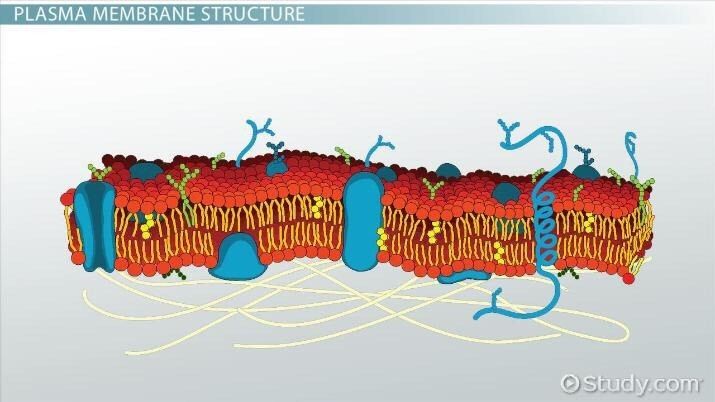
- ACholesterol
- Bintegral protein
- Cglycoprotein
- Dglycolipid
- Eperipheral protien
- Fcytoskeleton
- Gcytoplasmic side of the membrane
- Hphospholipid head
- Ifatty acid tail
- Jchannel protien
2In the [blank_start]1920s[blank_end] Gorter and Grendel proposed that the plasma membrane contained a [blank_start]bilayer[blank_end] of [blank_start]phospholipids[blank_end] when they extracted the plasma membrane of red blood cells.
- A1920s
- Bbilayer
- Cphospholipids
3In the [blank_start]1930s[blank_end] Davison and Danielle proposed a [blank_start]sandwich[blank_end] model with the phospholipid bilayer coated on both sides by [blank_start]hydrophobic[blank_end] proteins.
- A1930s
- Bsandwich
- Chydrophobic
4The current model of the plasma membrane is the [blank_start]fluid mosaic[blank_end] model which was proposed by Singer and Nicholson.
- Afluid mosaic
5The plasma membrane is composed of [blank_start]phospholipids[blank_end], glycolipids, [blank_start]proteins[blank_end], glycoproteins, [blank_start]carbohydrates[blank_end], and [blank_start]cholesterol[blank_end]. Each phospholipid has a phosphate [blank_start]head[blank_end] and two [blank_start]fatty acid[blank_end] tails and are [blank_start]amphipathic[blank_end] which means they have hydrophilic and hydrophobic regions. The phosphate head is [blank_start]hydrophilic[blank_end] an the tails are [blank_start]hydrophoibic[blank_end] which is why they are arranged in a [blank_start]bilayer[blank_end]. The phosphates face out towards the water and the tails face inwards. Phospholipids can [blank_start]self arrange[blank_end] in this layer when in aqueous regions because it is the only arrangement that shelters the tails.
- Aphospholipids
- Bproteins
- Ccarbohydrates
- Dcholesterol
- Ehead
- Ffatty acid
- Gamphipathic
- Hhydrophilic
- Ihydrophoibic
- Jbilayer
- Kself arrange
6There are two types of proteins in the plasma membrane that can be [blank_start]embedded[blank_end] in or [blank_start]attached[blank_end] to it. The [blank_start]integral[blank_end] proteins span the entire width of the plasma membrane is [blank_start]amphipathic[blank_end] and [blank_start]peripheral[blank_end] proteins are loosely bound to the [blank_start]surface[blank_end] of the membrane. These membrane proteins have many uses such as [blank_start]transporting[blank_end] substances into and out of the cell, catalyzing a [blank_start]reaction[blank_end], binding to a chemical (like a [blank_start]hormone[blank_end]) so cells can [blank_start]communicate[blank_end], serving as identification for cell-cell [blank_start]recognition[blank_end], [blank_start]joining[blank_end] two cells, helping to maintain cell [blank_start]shape[blank_end] or stabilize the [blank_start]location[blank_end] of proteins.
- Aembedded
- Battached
- Cintegral
- Damphipathic
- Eperipheral
- Fsurface
- Gtransporting
- Hreaction
- Ihormone
- Jcommunicate
- Krecognition
- Ljoining
- Mshape
- Nlocation
7Carbohydrates can be bound to [blank_start]lipids[blank_end] or [blank_start]proteins[blank_end] on the [blank_start]extracellular[blank_end] side of the membrane although the [blank_start]type[blank_end] and distribution can change between species, individuals, or cells. This distinguishes one cell from another and is involved in cell-cell [blank_start]recognition[blank_end].
- Alipids
- Bproteins
- Cextracellular
- Dtype
- Erecognition
8Cholesterol can be found wedged between [blank_start]phospholipids[blank_end] in the plasma membrane. They affect the [blank_start]fluidity[blank_end] of the membrane by controlling the movement of phospholipids. At [blank_start]higher[blank_end] temperatures cholesterol restricts the movements of phospholipids which [blank_start]decreases[blank_end] the fluidity and at [blank_start]lower[blank_end] temperatures [blank_start]increases[blank_end] it by preventing the close packing of phospholipids.
- Aphospholipids
- Bfluidity
- Chigher
- Ddecreases
- Elower
- Fincreases
9The fluid mosaic model states that the membrane is a fluid structure with a mosaic of various proteins embedded in / attached to a bilayer of phospholipids. It is fluid because the components of the membrane are in [blank_start]constant random motion [blank_end](human and mouse cell) and a mosaic because proteins are embedded in the bilayer ([blank_start]freeze fracture[blank_end]). The plasma membrane has three main functions: giving [blank_start]shape[blank_end] and [blank_start]size[blank_end] to the cell, [blank_start]separates[blank_end] it from it’s surroundings, and regulates the movement of substances [blank_start]in and out[blank_end] (selectively permeable).
- Aconstant random motion
- Bfreeze fracture
- Cshape
- Dsize
- Eseparates
- Fin and out
10The selectively permeability of the membrane is due to the [blank_start]lipid[blank_end] bilayer and/or the [blank_start]transport[blank_end] proteins embedded in it. The lipid bilayer allows some molecules to enter and leave the cell. Non-polar molecules are [blank_start]hydrophobic[blank_end] and can easily cross, polar molecules are [blank_start]hydrophilic[blank_end] and have difficulty passing, charged molecules have a [blank_start]sphere of water[blank_end] surrounding them that prevents their passage, large molecules don’ fit through the pores. Some polar and charged molecules can pass through [blank_start]integral[blank_end] transport proteins. There are two types of this: [blank_start]channel[blank_end] and carrier. Channel proteins have a [blank_start]hydrophilic[blank_end] channel that allows certain molecules through and the latter changes [blank_start]shape[blank_end] to shuttle and hold on to molecules across.
- Alipid
- Btransport
- Chydrophobic
- Dhydrophilic
- Esphere of water
- Fintegral
- Gchannel
- Hhydrophilic
- Ishape
11The molecules that make up substances in [blank_start]constant random[blank_end] motion and disperse from [blank_start]high[blank_end] to [blank_start]low[blank_end] concentration in a process called [blank_start]diffusion[blank_end]. They will eventually reach a state of [blank_start]dynamic[blank_end] equilibrium when they are equally distributed. There are many factors that affect the rate of this: [blank_start]concentration[blank_end] gradient, [blank_start]temperature[blank_end], [blank_start]distance[blank_end], [blank_start]area[blank_end] of membrane, and the [blank_start]permeability[blank_end] of membrane.
- Aconstant random
- Bhigh
- Clow
- Ddiffusion
- Edynamic
- Fconcentration
- Gtemperature
- Hdistance
- Iarea
- Jpermeability
12Passive transport is the diffusion (or [blank_start]facilitated[blank_end] diffusion) of a substance across a membrane that requires no [blank_start]energy[blank_end]. This is because the molecule moves [blank_start]down[blank_end] it’s concentration gradient which drives diffusion and represents [blank_start]potential energy[blank_end]. Each type has a different concentration gradient and move [blank_start]independently[blank_end] of the other molecules. Only [blank_start]small[blank_end], [blank_start]hydrophobic[blank_end] molecules can diffuse. Another type of diffusion is [blank_start]osmosis[blank_end] which is the diffusion of water across a semipermeable membrane. This occurs when there is a concentration gradient for a molecule that [blank_start]cannot[blank_end] diffuse. The water balances it out by changing the concentration of the [blank_start]solute[blank_end]. Membranes have channel proteins called [blank_start]aquaporins[blank_end] that allow the movement of water. [blank_start]Osmotic pressure[blank_end] is the force that pulls the water up to the areas of high concentration.
- Afacilitated
- Benergy
- Cdown
- Dpotential energy
- Eindependently
- Fsmall
- Ghydrophobic
- Hosmosis
- Icannot
- Jsolute
- Kaquaporins
- LOsmotic pressure
13The tonicity is the ability of a [blank_start]solution[blank_end] to cause a cell to gain or loose water. There are three types of solutions in regards to this. [blank_start]Hypotonic[blank_end]: there is a lower solute concentration in the solution (Animal cell = [blank_start]lysed[blank_end], Plant cell = [blank_start]turgid[blank_end]). [blank_start]Hypertonic[blank_end]: there is a higher solute concentration in the solution (Animal cell = [blank_start]shriveled[blank_end], Plant cell = [blank_start]plasmolyzed[blank_end]). [blank_start]Isotonic[blank_end]: The concentrations are equal (Animal cell = [blank_start]normal[blank_end], Plant cell = [blank_start]flaccid[blank_end]). Animal cells are particularly sensitive because they lack [blank_start]cell walls[blank_end] and they can [blank_start]swell[blank_end]/shrivel. They do best in [blank_start]isotonic[blank_end] environments. Plants have cell walls and rely on tonicity to help maintain [blank_start]internal pressure[blank_end]. Isotonic environments makes them go [blank_start]limp[blank_end] because there is no [blank_start]internal pressure[blank_end] and hypertonic ones make the cell go under [blank_start]plasmolysis[blank_end]. This is when the plasma membrane pulls away from the cell wall. So they do best in hypotonic solutions because the intake of water creates [blank_start]turgor[blank_end] pressure that pushes the cell walls out and keeps them firm.
- Asolution
- BHypotonic
- Clysed
- Dturgid
- EHypertonic
- Fshriveled
- Gplasmolyzed
- HIsotonic
- Inormal
- Jflaccid
- Kcell walls
- Lswell
- Misotonic
- Ninternal pressure
- Olimp
- Pinternal pressure
- Qplasmolysis
- Rturgor
14Active transport uses [blank_start]energy[blank_end] to move solute [blank_start]against[blank_end] their concentration gradient. It uses energy in the form of [blank_start]ATP[blank_end] and uses carrier proteins called proton pumps.
- Aenergy
- Bagainst
- CATP
15Bulk transport is the transport [blank_start]large[blank_end] molecules such as proteins and [blank_start]polysaccharides[blank_end]. They must be packed in [blank_start]vesicles[blank_end] in order to be transported across the membrane. There are two main types, [blank_start]endocytosis[blank_end] and exocytosis that both use energy in the form of [blank_start]ATP[blank_end]. Endocytosis takes [blank_start]in[blank_end] material by forming new vesicles from the plasma membrane. There are three types of this. [blank_start]Phagocytosis[blank_end]: cell eating (solids), [blank_start]Pinocytosis[blank_end]: cell drinking (liquids), [blank_start]receptor mediated[blank_end] endocytosis: aloes the cell to get specific things (lock and key). In exocytosis the cell [blank_start]exports[blank_end] material by fusing vesicles o the membrane. This cane be use to export [blank_start]waste[blank_end] and is also used by [blank_start]secretory[blank_end] cells (like releasing hormones).
- Alarge
- Bpolysaccharides
- Cvesicles
- Dendocytosis
- EATP
- Fin
- GPhagocytosis
- HPinocytosis
- Ireceptor mediated
- Jexports
- Kwaste
- Lsecretory
16Cellular metabolism is limited by [blank_start]cell size[blank_end]. In order to survive, cells must be able to efficiently take in [blank_start]nutrients[blank_end] and export [blank_start]waste[blank_end]. Cells must maximize [blank_start]SA:V[blank_end] in order to do this, which can also compare [blank_start]efficiency[blank_end]. The [blank_start]larger[blank_end] the SA:V is the more efficient the cell is. The shape of the cell can modify this because it is more important to some cells the others. cells that exchange lots of [blank_start]material[blank_end] with their surroundings need a high SA:V and achieve this by changing their shape. Plant roots have [blank_start]root hairs[blank_end], intestinal cells have [blank_start]villi[blank_end] and micro Lili, lungs have [blank_start]alveoli[blank_end], and blood vessels have [blank_start]capillaries[blank_end]. Diffusion across the membrane is [blank_start]fast[blank_end], but within the cell it’s [blank_start]slow[blank_end]. This discrepancy is due to [blank_start]concentration gradient[blank_end] and [blank_start]distance[blank_end].
- Acell size
- Bnutrients
- Cwaste
- DSA:V
- Eefficiency
- Flarger
- Gmaterial
- Hroot hairs
- Ivilli
- Jalveoli
- Kcapillaries
- Lfast
- Mslow
- Nconcentration gradient
- Odistance
17Larger organisms don’t have larger cells, they just have [blank_start]more[blank_end]. [blank_start]Multicellular[blank_end] organisms have multiple cells. If growth is due to increase cell size, SA:V is [blank_start]decreased[blank_end] but if it’s due to more cells, SA:V is the [blank_start]same[blank_end]. Multicellularity allows an organism to grow beyond the [blank_start]cell size limit[blank_end] normally imposed and have [blank_start]specialized[blank_end] cells. they can have different [blank_start]sizes[blank_end], [blank_start]shapes[blank_end], and [blank_start]numbers[blank_end] of organelles. In the human body, there are over [blank_start]200[blank_end] specialized cells. The principal of [blank_start]complementary[blank_end] states that function reflects structure and structure determines function. The process in which this happens is called [blank_start]differentiation[blank_end]. [blank_start]Stem[blank_end] cells are relatively unspecialized until they divide and differentiate. They can also [blank_start]self[blank_end]-renew to produce more. There are two. Types of stem cells: [blank_start]embryonic[blank_end] stem cells ([blank_start]totipotent[blank_end] and capable of all cell types) and [blank_start]adult[blank_end] (are [blank_start]multipotent[blank_end] and capable of multiple cell types).
- Amore
- BMulticellular
- Cdecreased
- Dsame
- Ecell size limit
- Fspecialized
- Gsizes
- Hshapes
- Inumbers
- J200
- Kcomplementary
- Ldifferentiation
- MStem
- Nself
- Oembryonic
- Ptotipotent
- Qadult
- Rmultipotent
18Multicellular organisms are in a organized structural hierarchy. 1) [blank_start]specialized[blank_end] cells: each has a different function 2) [blank_start]tissues[blank_end]: groups of similar cells of related function 3) [blank_start]organs[blank_end]: [blank_start]two[blank_end] or more tissues 4) [blank_start]organ systems[blank_end]: organs of similar function 5) [blank_start]organism[blank_end]: complex whole of all previous parts
- Aspecialized
- Btissues
- Corgans
- Dtwo
- Eorgan systems
- Forganism
Information
- Description
- Quiz on Labeling (Bio Quiz 2), created by Stephanie Macfarlane on 13-05-2019.
- Author
- Stephanie Macfarlane
- Language
- English
- Views
- 9
- Tags
- Rating
- No ratings yet Rate this quiz