
19514622
Description

Quiz by Caitlin Wringe , updated more than 1 year ago

|
Created by Caitlin Wringe
about 6 years ago
|
|
Question 1
Question
H. contorts is a major parasite of [blank_start]sheep and goats[blank_end].
H. placei is a parasite of [blank_start]cattle[blank_end].
Answer
-
sheep and goats
-
cattle
-
cattle
-
sheep
Question 2
Question
What is the prepatent period for sheep and cattle?
Answer
-
Sheep: 18 days Cattle: 25 - 28 days
-
Sheep: 25-28 days Cattle: 18 days
-
Sheep: 14 days Cattle: 20 - 25 days
-
Sheep: 28 days Cattle: 15 - 18 days
Question 3
Question
How does the larvae increase its environmental resistance for survival?
Answer
-
L3 retains the cuticle from L2
-
Nutrient stores
-
High temperature tolerance
-
Carried by paramedic host
Question 4
Question
At what stage does the infective L3 exsheath?
Answer
-
Rumen
-
Abomasum
-
Omasum
-
Large intestine
Question 5
Question
What is the infective L3 stage relatively intolerant to?
Answer
-
Heat and desiccation
-
Cold and moisture
-
Cold and desiccation
-
Heat and moisture
Question 6
Question
What are the clinical signs associated with hyperacute haemonchosis?
Answer
-
Severe hemorrhagic gastroenteritis
-
Anaemia
-
Dark feces
-
Diahorrea
-
Weight loss
Question 7
Question
What are the clinical signs associated with acute haemonchosis in sheep?
Answer
-
Weakness and lethargy
-
Anaemia
-
Hypoproteinemia
-
Black feces
-
Bottle jaw
-
High fecal egg counts
Question 8
Question
What are the clinical signs associated with chronic haemonchosis in sheep?
Answer
-
Progressive weight loss
-
Emaciation
-
Anorexia
-
Low fecal egg counts
-
Anaemia
-
Black feces
Question 9
Question
H. contortus is the most important helminth parasite of small ruminants
Answer
- True
- False
Question 10
Question
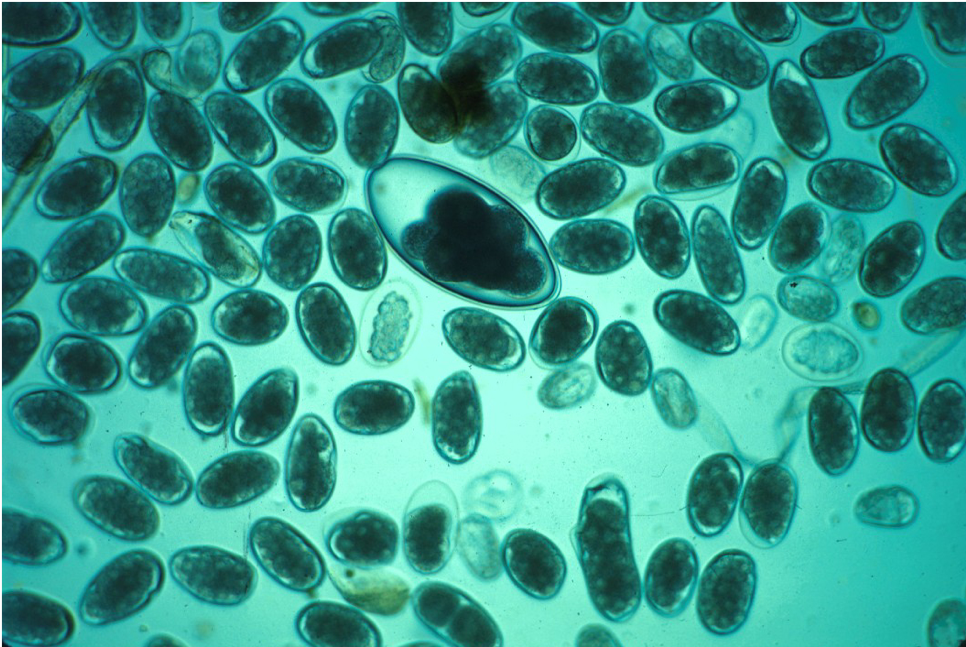
What are the best diagnostic tools for detecting Haemonchus?
Answer
-
Fecal float
-
ELISA
-
Clinical signs
-
Serology
Question 11
Question
At what stage does the larvae penetrate between the gastric epithelial cells and emerge?
Answer
-
L4 - L5
-
L3-L4
-
L3
-
L4
-
L5
Want to create your own Quizzes for free with GoConqr? Learn more.