
Quiz
TAAP002 - TAFE
This quiz has question types that open in the usual player.
Questions in this quiz (78)
1Organelle that is the power plant of a cell and provides ATP - [blank_start]Mitochondria[blank_end]
- AMitochondria
2Site of protein synthesis. Are free from floating but can attach to the plasma membrane to form the rough endoplasmic reticulum - [blank_start]Ribosomes[blank_end]
- ARibosomes
3Organelle that digests particles like bacteria, viruses, and toxins taken in by endocytosis - [blank_start]Lysosome[blank_end]
- ALysosome
4It’s ribosomes manufacture all proteins that will be secreted from cells. Ribosomes attach and detach here. - [blank_start]Rough endoplasmic reticulum[blank_end]
- ARough endoplasmic reticulum
5Like cilium but longer. E.g. sperm tail. Propels the cell - [blank_start]Flagella[blank_end]
- AFlagella
6This organelle is composed of microtubules, forms the basis of cilia and flagella, forms spindle and asters during mitosis. - [blank_start]Centrioles[blank_end]
- ACentrioles
7This organelle modifies and packages the proteins and lipids made at the rough endoplasmic reticulum - [blank_start]Golgi Apparatus[blank_end]
- AGolgi Apparatus
8This organelle is involved in lipid metabolism and the synthesis of steroid based hormones, synthesis of steroid based hormones, high in skeletal and cardiac muscle cells – important for calcium ion storage and release during muscle contraction - [blank_start]Smooth Endoplasmic Reticulum[blank_end]
- ASmooth Endoplasmic Reticulum
9Tubular extensions of the plasma membrane. Increase surface area for absorption - [blank_start]Microvilli[blank_end]
- AMicrovilli
10Cellular material between the plasma membrane and the nucleus. Contains the cytosol and cytoplasmic organelles - [blank_start]cytoplasm[blank_end]
- Acytoplasm
11Contains the genetic material of the cell, controls the cellular activities and cell division - [blank_start]Nucleus[blank_end]
- ANucleus
12Encloses the cell contents. Semi permeable, controls what enters and leaves the cell - [blank_start]Cell Membrane[blank_end]
- ACell Membrane
13Increase the surface area of the small intestine for absorption. Are tubular extensions of the plasma membrane - [blank_start]Microvilli[blank_end]
- AMicrovilli
14Short cell surface projections that move in unison – they create a uni directional current to propel substances across the surface - [blank_start]Cilia[blank_end]
- ACilia
15In this cellular process, pyruvic acid moves into the mitochrondia. H ions are removed to make CO2 and water, it releases a small amount of ATP - [blank_start]Krebs cycle[blank_end]
- AKrebs cycle
16When a small amount of ATP is made without oxygen this is called [blank_start]anaerobic[blank_end] respiration.
- Aanaerobic
17This metabolic process involves the breaking down of glucose in the cytosol of cells to form pyruvic acid which creates a small amount of ATP - [blank_start]glycolysis[blank_end]
- AGlycolysis
18This is the form of cellular energy [blank_start]Adenosine Triphosphate[blank_end]
- AAdenosine Triphosphate
19When small amounts of ATP are made in the presence of oxygen it is called [blank_start]aerobic[blank_end] respiration.
- Aaerobic
20During the formation of ATP in the mitochrondria, hydrogen atoms are split into hydrogen ions and electrons. It is the movements of electrons that produces energy – this is also know as the [blank_start]electron transport chain[blank_end]
- Aelectron transport chain
21Can be aerobic or anaerobic. It is a term that encompasaes the use of fuel molecules to produce energy in the cell - [blank_start]cellular respiration[blank_end]
- Acellular respiration
22In this process information from the DNA is copied onto the RNA to instruct the ribosome to make a specific protein - [blank_start]transcription[blank_end]
- Atranscription
23In this process the cell translates the genetic code from the RNA in order to make a specific sequence of amino acids. This process is called [blank_start]translation[blank_end]
- Atranslation
24Label the parts of the cell
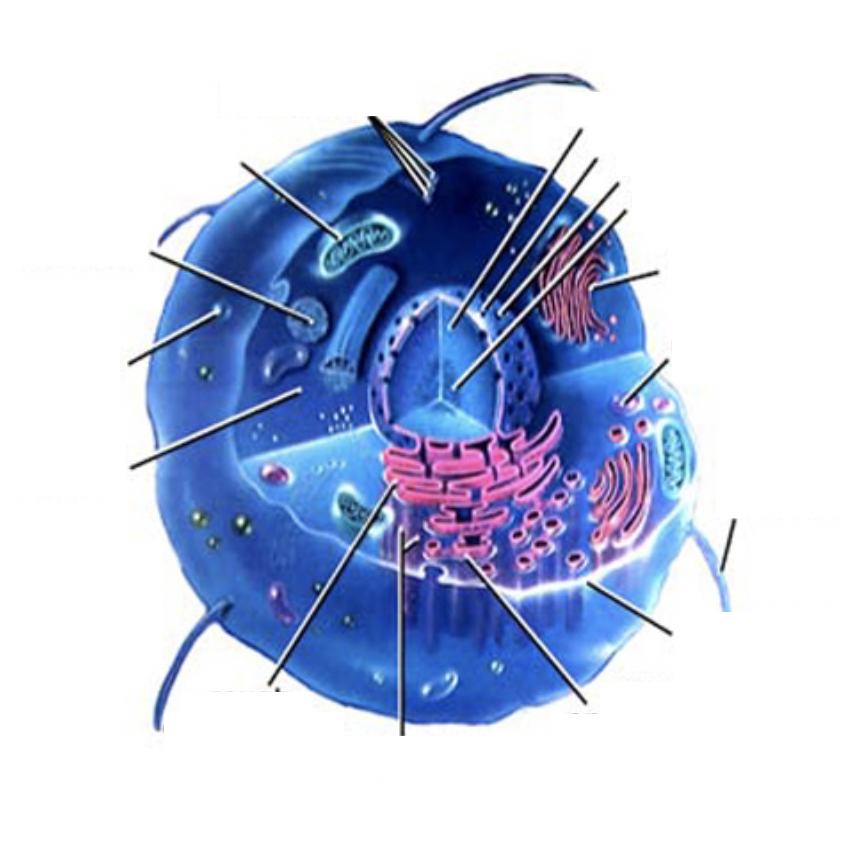
- AMitochondrion
- BCentriole
- CVesicle
- DCytosol
- ERough endoplasmic reticulum
- FRibosomes
- GSmooth endoplasmic reticulum
- Hplasma membrane
- IFlagellum
- Jlysosome
- KGolgi complex
- LNucleolus
- MChromatin
- NNuclear pore
- ONuclear envelope
- PMicrotubules
25This process is like the cell is drinking. It involves ingestion of droplets of extracellular fluid containing dissolved proteins or fats - [blank_start]pinocytosis[blank_end]
- Apinocytosis
26This method allows substances inside the cell to leave it and enter the extracellular fluid - [blank_start]exocytosis[blank_end]
- Aexocytosis
27In this process a cell ingests material as a method of moving them into the interior of the cell - [blank_start]endocytosis[blank_end]
- Aendocytosis
28This process involves the ingestion of large particles including bacteria, by the formation of cell eating vesicles or sacs, full of lysosomes - [blank_start]phagocytosis[blank_end]
- Aphagocytosis
29The membrane of the cell is said to be [blank_start]Semi permeable[blank_end]
- ASemi permeable
30Water molecules diffuse through the cell membrane by the process of [blank_start]Osmosis[blank_end]
- AOsmosis
31The spread of molecules through an area is known as [blank_start]Diffusion[blank_end]
- ADiffusion
32The passage of solutions through a membrane as a result of mechanical force is called [blank_start]Filtration[blank_end]
- AFiltration
33The cell uses energy to move substances across the membrane in a process called [blank_start]Active transport[blank_end]
- AActive transport
34Organelle that controls cell function is [blank_start]Nucleus[blank_end]
- ANucleus
35Substance that fills the cell is [blank_start]Cytoplasm[blank_end]
- ACytoplasm
36The outer covering of the cell is the [blank_start]Cell membrane[blank_end]
- ACell membrane
37Cell functions are carried out by specialised structures called [blank_start]Organelles[blank_end]
- AOrganelles
38Protein carriers on cell membranes transfer substances such as glucose and amino acids into the cell [blank_start]Active transport[blank_end]
- AActive transport
39White blood cells engulf bacteria cells [blank_start]phagocytosis[blank_end]
- Aphagocytosis
40The cell membrane engulfs minute fluid particles and carries it into the cell in a vesicle [blank_start]pinocytosis[blank_end]
- Apinocytosis
41respiratory gasses move passively from regions of higher concentration to regions of lower concentration [blank_start]diffusion[blank_end]
- Adiffusion
42hydrostatic pressure forces molecules from higher pressure regions to lower pressure regions [blank_start]filtration[blank_end]
- Afiltration
43Diffusion is a [blank_start]passive[blank_end] type of transport
- Apassive
- Bactive
44Osmosis is a [blank_start]passive[blank_end] type of transport
- Apassive
- Bactive
45Filtration is a [blank_start]passive[blank_end] type of transport
- Apassive
- Bactive
46Phagocytosis is an [blank_start]active[blank_end] type of transport
- Apassive
- Bactive
47Pinocytosis is an [blank_start]active[blank_end] type of transport
- Apassive
- Bactive
48What does a cell need to survive
- E[blank_start]nergy[blank_end] (one word)
- p[blank_start]H balance[blank_end] (two words)
- G[blank_start]enetics[blank_end] (one word)
- O[blank_start]xygen[blank_end] (one word)
- C[blank_start]ellular metabolism[blank_end] (two words)- Anergy
- Benetics
- Cxygen
- Dellular metabolism
- EH balance
49These cells continually digest the bone matrix and are essential in bone remodelling - [blank_start]osteoclasts[blank_end]
- Aosteoclasts
50These cells continually lay down bone - [blank_start]osteoblasts[blank_end]
- Aosteoblasts
51This hormone causes calcium to be removed from the blood so the calcium can build bone - [blank_start]calcitonin[blank_end]
- Acalcitonin
52This hormone causes osteoclasts to break down bone matrix so that calcium ions are released into the blood – [blank_start]parathyroid[blank_end]
- Aparathyroid
53Refers to the formation of blood - [blank_start]Hematopoiesis[blank_end]
- AHematopoiesis
54Smooth Muscle is.. (pick 1)
- Astriated
- Bvoluntary
- Cinvoluntary
55Cardiac Muscle is.. (pick 2)
- Astriated
- Bvoluntary
- Cinvoluntary
56Skeletal Muscle is.. (pick 2)
- Astriated
- Bvoluntary
- Cinvoluntary
57The [blank_start]hip[blank_end] bone is most commonly chosen to take bone marrow samples from
- Ahip
58This cell builds cartilage - [blank_start]chrondycytes[blank_end]
- Achrondycytes
59What vessel carries blood away from the heart to the body's organs - [blank_start]Artery[blank_end]
- AArtery
- BArterioles
- CCapillaries
- DVeins
- EVenules
60What vessel transports blood from the arteries and delivers it to the capillaries - [blank_start]Arterioles[blank_end]
- AArtery
- BArterioles
- CCapillaries
- DVeins
- EVenules
61What vessel brings oxygen and nutrients to tissues and removes waste - [blank_start]Capillaries[blank_end]
- AArtery
- BArterioles
- CCapillaries
- DVeins
- EVenules
62What vessel returns blood to the heart - [blank_start]Vein[blank_end]
- AArtery
- BArterioles
- CCapillaries
- DVein
- EVenules
63What vessel collects blood from capillaries and delivered it to veins - [blank_start]Venules[blank_end]
- AArtery
- BArterioles
- CCapillaries
- DVeins
- EVenules
64Arteries carry [blank_start]oxygenated[blank_end] blood
- Aoxygenated
- BDeoxygenated
65Arterioles carry [blank_start]oxygenated[blank_end] blood
- Aoxygenated
- Bdeoxygenated
66Capillaries carry [blank_start]oxygenated[blank_end] blood
- Aoxygenated
- Bdeoxygenated
67Veins carry [blank_start]deoxygenated[blank_end] blood
- Aoxygenated
- Bdeoxygenated
68Venules carry [blank_start]deoxygenated[blank_end] blood
- Aoxygenated
- Bdeoxygenated
69Blood pressure measures the [blank_start]arterial[blank_end] pressure exerted on the [blank_start]vessels[blank_end] caused by [blank_start]blood[blank_end]
- Ablood
- Bvessels
- Carterial
70If someone is having issues in the SA node in the heart the may often get a [blank_start]pacemaker[blank_end]
- Apacemaker
71an ECG reads the [blank_start]electrical[blank_end] [blank_start]activity[blank_end] of the heart
- Aelectrical
- Bactivity
72Label the heart
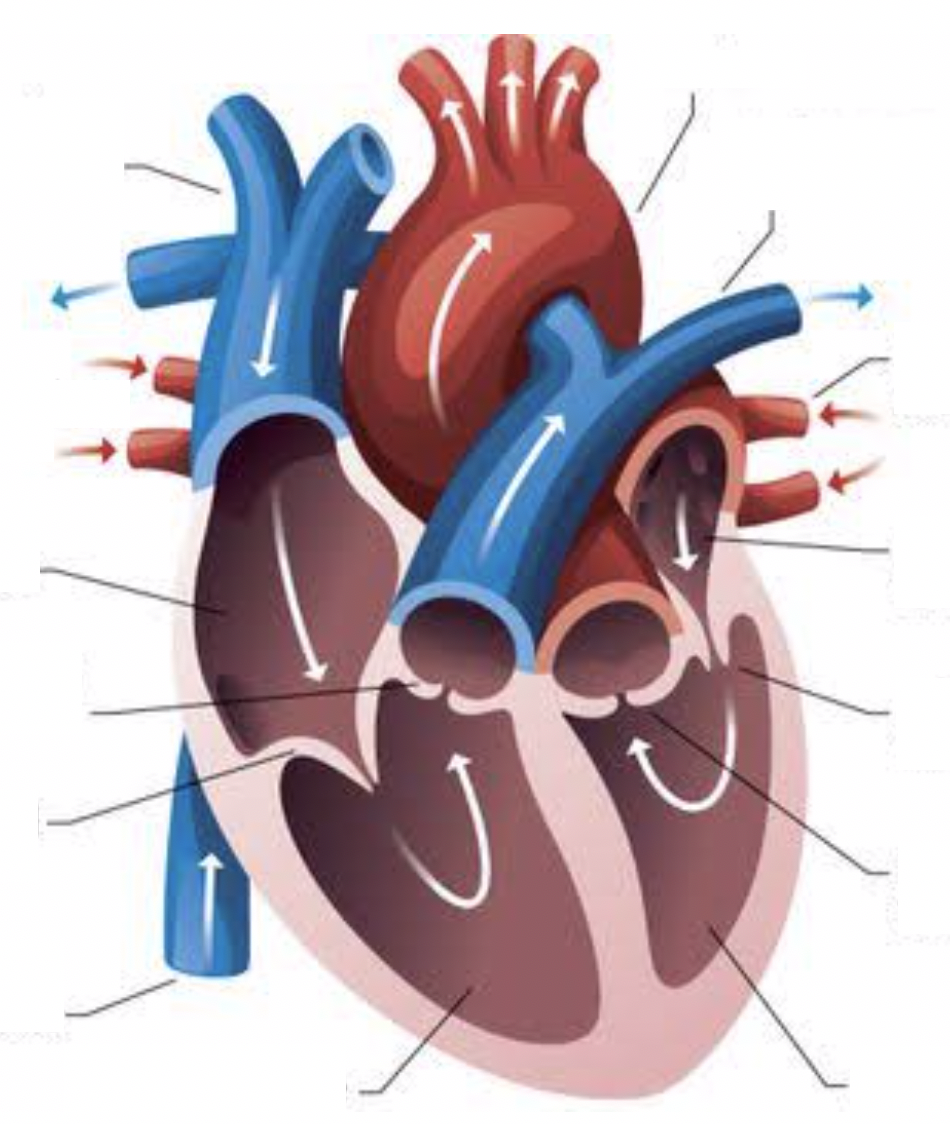
- AAorta
- BPulmonary artery
- Cpulmonary vein
- Dleft atrium
- Emitral valve
- Faortic valve
- Gleft ventricle
- Hright ventricle
- Iinferior vena cava
- Jtricuspid valve
- Kpulmonary valve
- Lright atrium
- Msuperior vena cava
73what are the 2 correct phases of the heart beat
Systolic = [blank_start]contraction[blank_end]
Diastolic = [blank_start]relaxation[blank_end]- Arelaxation
- Bcontraction
74match the correct definitions
P wave - [blank_start]depicts atrial depolarisation[blank_end]
QRS complex - [blank_start]depicts ventricular depolarisation[blank_end]
T wave - [blank_start]depicts ventricular repolarisation[blank_end]- Adepicts ventricular repolarisation
- Bdepicts ventricular depolarisation
- Cdepicts atrial depolarisation
75what part of the brain is the respiratory control centre - [blank_start]Medulla Oblongata[blank_end]
- AMedulla Oblongata
- BBrain Stem
- CCerebellum
- DTemporal Lobe
- EFrontal Lobe
- FPons
76what is the process of medication metabolism in order
1. [blank_start]Absorption[blank_end]
2. [blank_start]Distribution[blank_end]
3. [blank_start]Metabolism[blank_end]
4. [blank_start]Excretion[blank_end]- AExcretion
- BMetabolism
- CDistribution
- DAbsorption
77Click all that apply to the T cell
- Aproduce plasma that makes antibodies
- Bmature in the Bone
- Cproduces antibodies
- Ddirectly attacks and destroys foreign bodies
- Ecell-medicated immunity
- Fmature in the thymus
78Click all that apply to the B cell
- Amature in the thymus
- Bcell-medicated immunity
- Cdirectly attacks and destroys foreign bodies
- Dproduces antibodies
- Emature in the Bone
- Fproduce plasma that makes antibodies
Information
- Description
- Nursing Quiz on TAAP002 - TAFE, created by Georgia Hodgson on 02/12/2019.
- Author
- Georgia Hodgson
- Language
- English
- Views
- 46
- Tags
- Rating
- No ratings yet Rate this quiz