
Quiz
B5 Quiz
Create a free account to finish this quiz
Save your progress and see your final score.
Already have an account? Sign in
Questions in this quiz (177)
1What is the job of the skeleton?
- ATo support the body and allow it to move
- BTo protect vital organs
- CTo support the body, allow it to move and protect vital organs
2What are the advantages of an internal skeleton?
- AIt can easily grow with the body
- BIt's easy to attach muscles to it
- CIt's more flexible than an external skeleton
- DIt has more bones than an external skeleton
- EIt gives the body support and provides a framework
- FIt is more complex than an external skeleton
3Long bones are actually hollow which makes them lighter than solid bones of the same size (and stronger than solid bones of the same mass) which makes movement more efficient.
- ATrue
- BFalse
4What is bone marrow?
- AThe hole in the middle of long bones
- BA spongy substance that makes new blood cells
5The main part of a bone is called a shaft
- ATrue
- BFalse
6Things about cartilage:
- AIt is living tissue
- BIt can grow and repair itself
- CAs you grow, bone replaces a lot of the cartilage
- DBones turn into cartilage
- EIt looks like bone
7What is ossification?
- AWhen blood vessels deposit calcium and phosphorus in the cartilage which eventually turns it into bone
- BWhen blood vessels deposit calcium and potassium in the cartilage which eventually turns it into bone
- CWhen blood vessels deposit minerals in the bone and turns it back into cartilage
8You can tell if someone is still growing by looking at how much muscle is present - if there's a lot, they're still growing.
- ATrue
- BFalse
9Things about osteoporosis:
- AIt often affects elderly people
- BIt often affects young people
- CCalcium is lost from the bones
- DThe bones are made softer, more brittle and more likely to break
- EIt can be treated with phosphorus supplements
- FIt can be treated with calcium supplements
10Why shouldn't you move someone with a fracture?
- ABecause a broken bone can easily injure nearby tissue and could cause paralysis
- BBecause a broken bone can cause other bones to break and could cause paralysis
11What is the main type of joint in the body?
- ASynovial joints
- BLigament joints
- CLubricating joints
12What are ligaments?
- AThey have a high tensile strength
- BThey have a low tensile strength
- CThey hold bones together
- DThey hold muscles together
- EThey are elastic (stretchy)
13The cartilage at the ends of bones stops them rubbing together and acts as a shock absorber because it can be slightly compressed.
- ATrue
- BFalse
14What does the synovial membrane do?
- ARelease synovial fluid to lubricate the joints and allow them to move more easily
- BMoisten the cartilage to prevent friction
15Ball and socket joints:
- Ae.g. the hip or shoulder
- Be.g. the knee or elbow
- CCan move in all directions and can rotate
- DCan go backwards and forwards but not side-to-side
16Hinge joints:
- Ae.g. the hip or shoulder
- Be.g. the knee or elbow
- CCan move in all directions and can also rotate
- DCan move forwards and backwards but not side-to-side
17Bones are attached to muscles by tendons
- ATrue
- BFalse
18Antagonistic muscles:
- Ae.g. the biceps and triceps
- BBiceps contracts, lower arm pulled upwards, arm bends
- CTriceps contracts, lower arm pulled downwards, arm straightens
- DBiceps contracts, lower arm pulled downwards, arm straightens
- ETriceps relaxes, lower arm pulled downwards, arm bends
19The arm works as a lever, where the elbow is the pivot (fulcrum)
- ATrue
- BFalse
20Why do animals need a blood circulatory system?
- ATo transport materials efficiently around their bodies because diffusion would be too slow
- BTo connect the heart and lungs more efficiently
21Single circulatory systems:
- AHave a two-chambered heart (one to receive blood, one to pump blood)
- BFeature in animals with gills
- CThe overall blood pressure is low because the blood loses pressure as it is pumped to the gills and then around the body
- DFeature in mammals
- EHave a four-chambered heart
- FThe overall blood pressure is high because the blood gains pressure as it is pumped to the gills and then around the body
22Double circulatory systems:
- AFeature in humans and other mammals
- BHas a four-chambered heart to pump the blood separately to the lungs and the body
- CBlood pressure is high because the blood loses pressure in the lungs but returns to the heart before being pumped around the body
- DHas a two-chambered heart to pump the blood separately to the lungs and the body
- EBlood pressure is low because the blood loses pressure in the lungs and doesn't return to the heart before being pumped around the body
23Keeping the blood at a higher pressure allows materials to be transported around the body more slowly.
- ATrue
- BFalse
24Pressure in blood vessels from high to low:
- AArteries, capillaries, veins
- BCapillaries, arteries, veins
- CVeins, capillaries, arteries
25Unborn babies:
- ADon't need a double-circulatory system
- BNeed a double-circulatory system
- CGet their oxygen from their mother via the placenta so their blood doesn't need to travel to their lungs
- DGet their oxygen from the amniotic fluid so their blood doesn't need to travel to their lungs
- EHave a "hole in the heart" (a gap between the atria), which allows blood to bypass the lungs but closes soon after birth
26When blood flows into the two atria and they contract, pushing the blood into the ventricles:
- AThe semilunar valves are closed
- BThe semilunar valves are open
- CThe atrio-ventricular valves are open
- DThe atrio-ventricular valves are closed
27When the ventricles contract:
- ABlood is forced into the aorta and the pulmonary artery
- BBlood is forced into the aorta and the pulmonary vein
- CThe semilunar valves are open
- DThe atrio-ventricular valves close automatically
- EThe atrio-ventricular valves open automatically
- FThe blood flows along the arteries, the atria fill again and the cardiac cycle repeats
28The sequence of events in one complete cycle is called the cardiac cycle
- ATrue
- BFalse
29Blood is prevented from flowing in the wrong direction through the heart:
- ABy the atrio-ventricular and semilunar valves
- BBy the contracting ventricles
30How does the heart pump blood around the body?
- ABy contracting and relaxing the atria and ventricles in sequence
- BBy opening and closing the atrio-ventricular and semilunar valves
31Claudius Galen (ancient Greece):
- ACut up animals to study them, and so knew about chambers in the heart
- BThought arterial blood was made by the heart, while blood in veins was made by the liver and that blood was consumed by organs
- CThought the heart sucked the blood through veins
- DShowed that the heart is a pump
- EShowed blood is not manufactured and consumed
32William Harvey (1578-1657)
- AShowed the heart is a pump (not something which sucks)
- BShowed the heart valves stop the back flow of blood
- CShowed that the pulse is caused by the heart pumping blood into the arteries
- DShowed that the same blood is circulated around the body over and over again (not manufactured and consumed)
- EShowed that blood is manufactured and consumed
- FShowed that arterial blood is made by the heart
33When you exercise:
- AYour muscles need more oxygen to work harder so you need to breathe faster
- BYour heart pumps faster to deliver more oxygenated blood to your muscles
- CYour muscles produce more carbon dioxide and this change is detected by the brain, which tells your body to breathe faster
- DYour muscles need more carbon dioxide to work harder so you need to breathe faster
- EYour heart pumps faster to deliver more deoxygenated blood to your muscles
34Hormones can affect heart rate e.g. adrenaline is released when you get a shock or you're in danger so your muscles receive plenty of oxygen so you can fight or run away.
- ATrue
- BFalse
35What is a pacemaker?
- AA group of cells which produce a small electric current which spreads to the surrounding muscle cells, causing them to contract
- BA group of cells which produce a hormone which travels to the surrounding muscles in the blood, causing them to contract
36The SAN:
- AStands for sino-atrial node
- BStands for atrio-ventricular node
- CStimulates the atria to contract
- DStimulates the ventricles to contract
- EProduces an electric current first so the atria always contract before the ventricles
- FProduces an electric current second so the ventricles always contract after the atria
37The AVN:
- AStands for atrio-ventricular node
- BStands for sino-atrial node
- CStimulates the ventricles to contract
- DStimulates the atria to contract
- EIs stimulated by the SAN current to produce an electric current
- FStimulates the SAN to produce an electric current
38What is an artificial pacemaker?
- AA little device that's implanted under the skin and has a wire going to the heart. It produces an electric current to control the heartbeat if the pacemaker cells don't work properly
- BA little device that's implanted under the skin and has a tube going to the heart. It produces an electric current to make the heart beat faster if the pacemaker cells don't work properly
39What are the two main ways that doctors can measure heart function?
- AElectrocardiogram (ECG) - showing the electrical activity of the heart
- BEchocardiogram - an ultrasound scan of the heart
- CElectrocardiogram (ECG) - an ultrasound scan of the heart
- DAtrial regulator - showing the function of the atria
40Electrocardiograms can show:
- AHeart attacks - e.g. if you're having a heart attack or are about to have one
- BIrregular heartbeats and general health of the heart
- CAn enlarged heart - this could indicate heart failure
- DDecreased pumping ability - this could indicate a disease called cardiomyopathy
- EValve function - torn, infected or scarred heart valves can cause problems
41Echocardiograms can show:
- AHeart attacks - e.g. if you're having a heart attack or are about to have one
- BIrregular heartbeats and general health of the heart
- CAn enlarged heart - this could indicate heart failure
- DDecreased pumping ability - this could indicate a disease called cardiomyopathy
- EValve function - torn, infected or scarred heart valves can cause problems
42What is ventricular fibrillation?
- AVentricles contracting erratically
- BVentricles contracting too slowly
- CVentricles not contracting at all
43What is P?
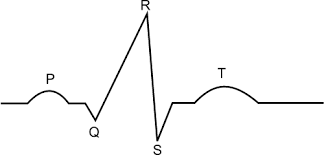
- AAtria contract
- BVentricles contract
- CVentricles relax
44Where do the ventricles contract?
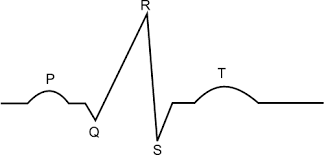
- AP
- BR
- CT
45What is T?
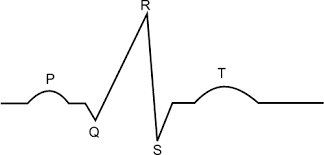
- AAtria contract
- BVentricles contract
- CVentricles relax
46What does this ECG show?
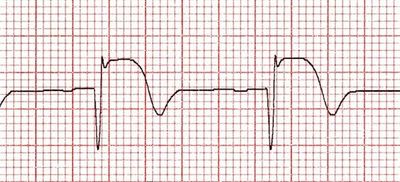
- AA heart attack
- BVentricular fibrillation
- CA fast heartbeat
47What does this ECG show?
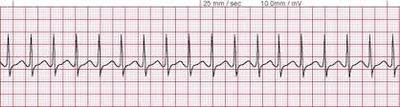
- AA fast heartbeat
- BA heart attack
- CVentricular fibrillation
48What does this ECG show?
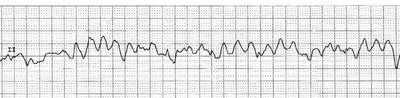
- AVentricular fibrillation
- BA heart attack
- CA fast heartbeat
49What are the three main ways your heart can go wrong?
- AHole in the heart
- BValve damage
- CCoronary heart disease (CHD)
- DEnlarged heart
- EVentricular fibrillation
50A hole in the heart:
- AIs a gap in the wall separating either the two ventricles or the two atria
- BAllows blood to flow from one side of the heart to the other which allows deoxygenated and oxygenated blood to mix, reducing the amount of oxygen in the blood being pumped around the body
- CCan be corrected by surgery
- DCan be corrected by pacemakers
- EAllows blood to flow from one side of the heart to the other which allows deoxygenated and oxygenated blood to mix, increasing the amount of oxygen in the blood being pumped around the body
51Things about valve damage:
- AThe valves in the heart can be damaged or weakened by heart attacks, infection or old age
- BSevere valve damage can be treated by replacing the valve with an artificial one
- CThe damage may cause the valve not to open properly, causing high blood pressure
- DThe damage may allow blood to flow in both directions rather than just forward so the blood doesn't circulate as effectively as normal
- EThe damage may cause the valve not to open properly, causing low blood pressure
- FThe damage may allow blood to flow in only one direction rather than both directions so the blood doesn't circulate as effectively as normal
52Coronary heart disease (CHD):
- AOccurs when the coronary arteries supplying blood to the heart muscle get blocked by fatty deposits
- BReduces blood flow to the heart muscle and often results in a heart attack
- CCan be treated by a coronary bypass operation, where a piece of blood vessel is taken from another part of the body (e.g. leg) and inserted to "bypass" the blockage
- DReduces blood flow to the heart muscle and often results in an enlarged heart
- ECan be treated by a coronary bypass operation, where the piece of blocked blood vessel is removed and sewn up to "bypass" the blockage
53Examples of surgery to put heart problems right:
- AA heart transplant - an entirely new heart from a donor
- BNew part such as valves and pacemakers
- CA heart assist device which takes over the pumping duties of a failing heart and "buys time" while the patient waits for a transplant
- DAn electrocardiogram (ECG) - shows if the patient is having a heart attack
- EA tube which can be inserted to make the pacemakers work
54What is the main advantage of a using artificial parts (valves and pacemakers)?
- ARejection isn't normally a problem because they're usually made from metals or plastics, which the body can't recognise as foreign like it does with living tissue
- BRejection isn't normally a problem because they're usually made from metals or plastics, which the body recognises as foreign like it does with living tissue
55What is an advantage of replacing valves and pacemakers?
- AReplacing a valve is a less dramatic procedure than a transplant, and inserting a pacemaker only involves an overnight stay in hospital
- BReplacing a valve is a big operation and inserting a pacemaker only involves a weekly stay in hospital
56What is the main disadvantage of new valves and pacemakers?
- AThey might not last very long and need replacing as a result
- BThey are very small and hard to implant
- CThey are not as effective as the original valves and pacemakers
57What are platelets?
- ASmall fragments of cells that help blood clot
- BSmall fragments of cells that stops blood clotting
58Blood clots:
- APrevent too much bleeding
- BAre a mesh of protein fibres (called fibrin fibres) that "plug" the damaged area
- CAre formed by a series of chemical reactions that take place when platelets in your blood are exposed to damaged blood vessels
- DAre a mesh of protein fibres (called fibrin fibres) that "unplug" the damaged area
- EAre formed by a chemical reaction that takes place when platelets in your blood are exposed to damaged blood vessels
59Too little clotting could mean:
- AYou bleed to death
- BYou get loads of bruises
- CYou have a stroke
- DYou have a deep vein thrombosis (DVT)
60Too much clotting could mean:
- AYou bleed to death
- BYou get loads of bruises
- CYou have a stroke
- DYou have a deep vein thrombosis (DVT)
61People who are at risk of strokes and DVT can take drugs to reduce their risk. Warfarin, heparin and aspirin all help prevent blood from clotting
- ATrue
- BFalse
62What is haemophilia?
- AA genetic condition where the blood doesn't clot easily because a clotting factor can't be made by the body
- BA genetic condition where the blood doesn't clot easily because a clotting hormone can't be made by the body
63The missing clotting factor for haemophilia can be injected
- ATrue
- BFalse
64What do the blood group letters refer to?
- AThe antigens on the surface of a person's red blood cells
- BThe antibodies on the surface of a person's red blood cells
65An antigen is a substance that can stop a response from a person's immune system
- ATrue
- BFalse
66Where are the anti-A and anti-B antibodies contained?
- AIn the blood plasma
- BIn the blood lymph
67What happens if an anti-A antibody meets an A antigen or if an anti-B antibody meets a B antigen?
- AThe blood clumps together. This is know as agglutination
- BThe blood clumps together. This is known as agglutinins
68Antibodies are agglutinins - things that make stuff clump together
- ATrue
- BFalse
69What is blood group O also known as?
- AThe universal donor
- BThe universal receiver
70What is blood group AB also known as?
- AThe universal donor
- BThe universal receiver
71Who can blood group A give blood to?
- AA
- BB
- CAB
- DO
- ENo one
72Who can blood group B give to?
- AA
- BB
- CAB
- DO
- ENo one
73Who can blood group AB give to?
- AA
- BB
- CAB
- DO
- ENo one
74Who can blood group O give to?
- AA
- BB
- CAB
- DO
- ENo one
75Who can blood group A get blood from?
- AA
- BB
- CAB
- DO
76Who can blood group B get blood from?
- AA
- BB
- CAB
- DO
77Who can blood group AB get blood from?
- AA
- BB
- CAB
- DO
78Who can blood group O get blood from?
- AA
- BB
- CAB
- DO
79Criteria for all organ donors:
- ARelatively young so that the organ is as fit and healthy as possible
- BA similar body weight to the patient so that the organ is a good "fit"
- CA close tissue match to prevent problems with rejection
- DA similar height to the patient so that the organ is a good "fit"
- EThe same blood type to prevent problems with rejection
80All living donors must be over the age of 18.
- ATrue
- BFalse
81Why must donors who have died have to have died recently?
- ABecause organs only stay usable for a few hours outside the body
- BBecause organs only stay usable for a few hours inside the body
82Close relatives of dead donors don't have to give their permission.
- ATrue
- BFalse
83What do success rates of transplants depend on?
- AThe type of organ (e.g. the heart is riskier than a kidney)
- BThe age of the patient
- CThe skill of the surgeon
- DThe blood type of the patient
- EThe size of the organ (e.g. the heart is bigger than a kidney)
84What is rejection?
- AWhen the patient's immune system recognises the new organ as "foreign" and attacks it
- BWhen the patient's immune system recognises the new organ as "foreign" and adapts to it
85How do doctors reduce the risk of rejection?
- ABy ensuring the donor has a similar tissue type to the patient (i.e. have similar antigens on their cell surfaces)
- BBy using immuno-suppressive drugs that suppress the patient's immune system
- CBy using immuno-suppressive drugs that help the patient's immune system
- DBy only using organs from close family members of the patient
86What is the disadvantage of using immuno-suppressive drugs?
- AThey leave the patient more vulnerable to infections
- BThey leave the patient too protected from infections
87Why do some people disagree with organ donation?
- AReligious people may believe that a person's body should be buried intact (so giving organs is wrong)
- BReligious people may believe that life or death is up to God (so receiving organs is wrong)
- CSome people worry that they will be pressured into being a "living donor" but doctors try to ensure that it's always the donor's personal choice
- DReligious people may believe that it is wrong to have part of someone else's body inside you (so receiving organs is wrong)
- ESome people may worry that doctor's would try extra hard to save them if they were critically ill and their organs were needed for transplants
88If you join the NHS Organ Donor Register to show you're willing to donate organs after you die, doctors still need your family's consent before they can use the organs for a transplant.
- ATrue
- BFalse
89What is an "opt-out" system?
- AA system to replace the "opt-in" system for organ donation which means anyone's organs can be used unless the person has registered to say they don't want them to be donated
- BA system to replace the "opt-in" system for organ donation which means no one's organs can be used unless the person has registered to say they want them to be donated
90What do heart-lung machines do?
- AKeep a patient's blood oxygenated and pumping during heart or lung surgery
- BKeep a patient's blood flowing around their body during heart or lung surgery
91What do kidney dialysis machines do?
- AFilter a patient's blood (e.g. while they wait for a kidney transplant)
- BClean a patient's blood (e.g. while they wait for a kidney transplant)
92What do mechanical ventilators do?
- APush air in and out of a patient's lungs if they stop breathing
- BPush air in and out of a patient's lungs to stop them breathing
93What are the problems with using mechanical replacements?
- AThey usually need a constant power supply
- BThey're often large and difficult to move around
- CThey must be made from materials that won't harm the body and won't degrade (i.e. break down or rust)
- DThey're often light and difficult to move around
- EThey usually use batteries and use up the power supply quickly
94Even if mechanical replacements are made from the right materials, they can occasionally cause inflammation or allergic reactions in the patient
- ATrue
- BFalse
95Things about carbon dioxide:
- AIt is a waste product of respiration
- BIt is toxic at a high level
- CWhen the brain detects a rise in the level of carbon dioxide in the blood, it responds by increasing the rate of breathing
- DIt is breathed in
- EIt is used for respiration
96Ventilation is another word for breathing.
- ATrue
- BFalse
97Inspiration (breathing in):
- AIntercostal muscles (between the ribs) and diaphragm (beneath the lungs) contract
- BIntercostal muscles (between the ribs) and diaphragm (beneath the lungs) relax
- CThe volume of the thorax increases
- DThe volume of the thorax decreases
- EThe lungs expand and the pressure inside them decreases which draws air in
- FThe lungs return to their original size and the pressure inside increases which forces air out
98Expiration (breathing out):
- AThe intercostal muscles (between the ribs) and the diaphragm (beneath the lungs) contract
- BThe intercostal muscles (between the ribs) and the diaphragm (beneath the lungs) relax
- CThe volume of the thorax decreases
- DThe volume of the thorax increases
- EThe lungs expand and the pressure inside them decreases which draws air in
- FThe lungs return to their original size and the pressure inside them increases which forces air out
99What machine do doctors use to measure lung capacity?
- AA spirometer
- BA spirometre
- CA spirogram
100What is the total volume of air you can fit in your lungs called?
- ATotal lung capacity
- BTidal air
- CResidual air
- DVital capacity air
101What is the volume of air you breathe in (or out) in one normal breath called?
- ATotal lung capacity
- BTidal air
- CResidual air
- DVital capacity air
102What is the air that's left in your lungs called?
- ATotal lung capacity
- BTidal air
- CResidual air
- DVital capacity air
103What is the total lung capacity minus the residual air called?
- AVital capacity air
- BTidal air
- CVitel capacity air
104What is the maximum volume of air that can be breathed in or out?
- ATidal air
- BVital capacity air
105Residual air makes sure the lungs stay closed.
- ATrue
- BFalse
106If someone's tidal air increases, what might it mean?
- AThey are relaxing
- BThey are exercising
- CThey have a lung disease
107Where does gaseous exchange take place in humans?
- AIn the lungs
- BIn the alveoli
- CIn the alveolus
108The blood passing next to the alveoli has just returned to the lungs from the rest of the body, so it contains lots of carbon dioxide and very little oxygen. As a result:
- AOxygen diffuses out of the alveolus (an area of high oxygen concentration) and into the blood (an area of low oxygen concentration)
- BCarbon dioxide diffuses out of the blood (high concentration of carbon dioxide) and into the alveolus (low concentration of carbon dioxide) to be breathed out
- COxygen diffuses out of the alveolus (an area of low oxygen concentration) and into the blood (an area of high oxygen concentration)
- DCarbon dioxide diffuses out of the blood (low concentration of carbon dioxide) and into the alveolus (high concentration of carbon dioxide) to be breathed out
109When the blood reaches the body cells:
- AOxygen is released from the red blood cells (high concentration) and diffuses into the body cells (low concentration)
- BCarbon dioxide diffuses out of the body cells (high concentration) and into the blood (low concentration) to be carried to the lungs
- COxygen is released from the body cells (high concentration) and diffuses into the red blood cells (low concentration)
- DCarbon dioxide diffuses out of the red blood cells (high concentration) and into the body cells (low concentration) to be used for respiration
110How are the alveoli adapted for gas exchange?
- AThey have a very large surface area to increase the rate of diffusion
- BThey have a moist surface to help oxygen and carbon dioxide dissolve
- CThey have a permeable surface to help gases exchange easily
- DThey have a thin lining (only one cell thick) so gases don't have to diffuse very far (short distance)
- EThey have a good blood supply
- FThey have a dry surface to help oxygen and carbon dioxide diffuse
- GThey have a thin lining (only two cells thick) so gases don't have to diffuse very far (short distance
111Adult amphibians:
- AHave simple lungs for gas exchange
- BHave moist and permeable skin for gas exchange
- CDo not have waterproof skin so can't live in dry environments because they would lose too much water
- DHave waterproof skin so can't live in dry environments because they would lose too much water
- EHave complex lungs for gas exchange
112Things about fish and gaseous exchange at the gills:
- AA constant supply of oxygen-rich water flows through the open mouth of the fish and is then forced over the gill filaments when the mouth closes
- BWater helps support the gills - it keeps the gill filaments separated from each other. If the fish weren't in water their gills would stick together and they would suffocate
- CA constant supply of oxygen-rich water flows through the open mouth of the fish and is then forced over the gill filaments when the mouth opens
- DWater helps support the gills - it keeps the gill filaments together. If the fish weren't in water their gills would stick together and they would suffocate
113The human respiratory tract consists of the trachea (windpipe) and bronchi (tubes to the lungs).
- ATrue
- BFalse
114How do the lungs protect themselves from dust and microbes?
- AThe trachea and bronchi are lined with cilia and mucus which catch dust and microbes before they reach the lungs
- BThe cilia waft the microbe-filled mucus out of the lungs as phlegm
- CThe cilia waft the microbe-filled mucus out of the lungs as a cough
- DThe lungs are a dead end so microbes can be easily flushed out
115What cell secretes mucus in the trachea and bronchi?
- AThe goblet cell
- BThe giblet cell
116Lung disease caused by industrial materials:
- AAsbestos causes a disease called asbestosis
- BInflammation and scarring in the lungs limits gas exchange
- CAsbestos is less tightly controlled now
- DInflammation and scarring in the lungs helps gas exchange
117Lung disease caused by genetic causes:
- ACystic fibrosis is an inherited lung condition caused by a single defective gene
- BThe lungs produce a really thick, sticky mucus that clogs up the bronchioles and this makes breathing difficult and can lead to life-threatening infections
- CCystic fibrosis is an inherited lung condition caused by defective genes
- DThe lungs produce a really thick, sticky mucus that flows through the bronchioles and this makes breathing difficult and can lead to life-threatening infections
118Lung disease caused by lifestyle:
- ASmoking can cause lung cancer
- BCells divide out of control, forming a tumour and reducing the surface area in the lungs
- CCells divide out of control, forming a tumour and increasing the surface area in the lungs
- DDrugs can cause lung cancer
119Asthma:
- AWhen asthmatics' lungs encounter certain things (e.g. pet hair, pollen or dust) the muscles around the bronchioles contract, constricting the airways
- BThe lining of the airways becomes inflamed and fluid builds up in the airways, making it hard to breathe (an asthma attack)
- CWhen symptoms appear a muscle relaxant drug is inhaled (from an inhaler) to open up the airways
- DWhen symptoms appear a muscle constricting drug is inhaled (from an inhaler) to open up the airways
- EWhen asthmatics' lungs encounter certain things (e.g. pet hair, pollen or dust) the muscles around the bronchioles relax, constricting the airways
120What are the symptoms of an asthma attack?
- ADifficulty breathing, wheezing, a tight chest
- BDifficulty breathing, coughing, a tight chest
- CDifficulty breathing, wheezing, coughing
121What is digestion?
- ABreaking down the large insoluble molecules in food into small soluble molecules so you can absorb them into your blood plasma or lymph
- BBreaking down the large insoluble molecules in food into small soluble molecules so you can suck them into your blood plasma or lymph
122Lymph is a type of fluid that carries the products of carbohydrate digestion.
- ATrue
- BFalse
123Physical digestion:
- AChewing in the mouth and churning in the stomach
- BAllows food to pass easily through the digestive system
- CProvides a larger surface area for chemical digestion
- DInvolves enzymes - biological catalysts that speed up reactions
- EWhere digestive enzymes break down molecules that are too big to pass through cell membranes
124Chemical digestion:
- AChewing in the mouth and churning in the stomach
- BAllows food to pass more easily through the digestive system
- CProvides a larger surface area
- DInvolves enzymes - biological catalysts that speed up reactions
- EWhere digestive enzymes break down molecules that are too big to pass through cell membranes
125Carbohydrases:
- ABreak down big carbohydrates (e.g. starch) into simple sugars
- BBreak starch into maltose and maltose into glucose
- CAre active in the mouth and the small intestine
- DAre active in the stomach and the small intestine
- EBreak starch into maltose
126Proteases:
- ABreak down proteins into amino acids
- BAre active in the stomach and the small intestine
- CAre active in the mouth, the stomach and the small intestine
- DBreak down proteins into fatty acids
127Lipases:
- ABreak down fats into fatty acids and glycerol
- BAre active in the small intestine
- CAre active in the stomach and the small intestine
- DBreak down fats into amino acids and glycerol
128Bile:
- AIs made in the liver and stored in the gall bladder
- BHelps fat digestion in the small intestine by breaking the fat down into tiny droplets which increases the surface area for the lipase enzymes. This is called emulsification
- CIs alkaline so it neutralises acid from the stomach to make the conditions right for the enzymes in the small intestine to work
- DIs made in the gall bladder and stored in the liver
- EIs acidic so it neutralises acid from the stomach to make the conditions right for the enzymes in the small intestine to work
129pH and enzymes:
- AThe stomach is very acidic (about pH 1-2) which is the optimum pH for protease enzymes to work
- BThe pH in the mouth and small intestine is alkaline or neutral so that other enzymes with highe optimum pHs can function there properly
- CThe stomach is very acidic (about pH 13-14) which is the optimum pH for protease enzymes to work
130Diffusion:
- AGlucose and amino acids are small enough to diffuse into the blood plasma
- BThe products of fat digestion can't get into the blood plasma so they diffuse out of the gut (intestines) and into the lymph, in the lymphatic system. From here they are emptied into the blood
- CGlucose and amino acids are big enough to diffuse into the blood plasma
- DGlucose and fatty acids are small enough to diffuse into the blood plasma
131Nutrients travel in the blood to where they are needed and then diffuse out again, e.g. glucose travels to muscles for respiration during exercise.
- ATrue
- BFalse
132Adaptations of the small intestine:
- AIt is very long. This increase the time to break down and absorb the food before it reaches the end
- BThere is a really big surface area for absorbtion - the walls of the small intestine are covered in millions and millions of villi and each cell on the surface of a villus has microvilli
- CVilli have a single permeable layer of surface cells. This provides a thin lining (short distance) to allow quick absorption
- DThere isn't a good blood supply for quick absorption
- EThere is a really big surface area for absorbtion - the walls of the small intestine are covered in some villi and each cell on the surface of a villus has microvilli
133What is excretion?
- AThe removal of waste products from the body
- BThe removal of urea from the body
134What do the kidneys do?
- ARemove urea from the blood
- BAdjust the salt levels in the blood
- CAdjust the water content of the blood
- DRemove urine from the blood
- EAdjust the mineral levels in the blood
135Urea is produced in the liver from excess amino acids.
- ATrue
- BFalse
136Where does the blood get filtered?
- AThe nephrons
- BThe kidney tubes
- CThe medulla
137What is D?
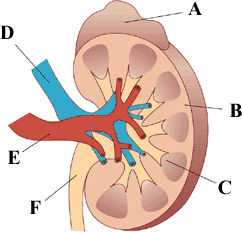
- AThe renal vein
- BThe renal artery
- CThe medulla
- DThe cortex
- EThe ureter
138Where is the renal artery?
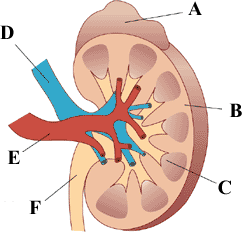
- AB
- BD
- CE
- DC
- EF
139What is F?
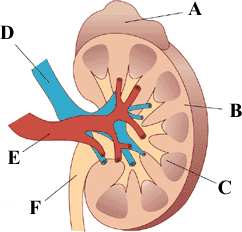
- AThe ureter
- BThe medulla
- CThe cortex
140Where is the cortex?
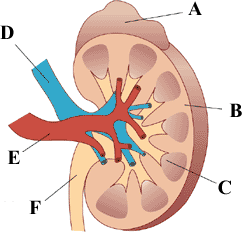
- AB
- BC
141What is C?
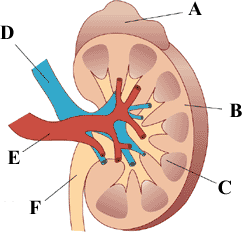
- AThe cortex
- BThe medulla
142Ultrafiltration:
- AA high pressure is built up which squeezes water, urea, salts and glucose out of the blood and into the capsule
- BMembranes between blood vessels in the glomerulus and the capsule act like filters, so big molecules like proteins and blood cells are not squeezed
- CA low pressure is built up which squeezes water, urea, salts and glucose out of the blood and into the capsule
- DMembranes between blood vessels in the glomerulus and the capillaries act like filters, so big molecules like proteins and blood cells are not squeezed
143Reabsorption:
- ASufficient water is reabsorbed, according to the level of the hormone ABH
- BAll the sugar is reabsorbed by active transport against the concentration gradient
- CSufficient salt is reabsorbed by active transport against the concentration gradient
- DSufficient water is reabsorbed, according to the level of the hormone ADH
- EAll the sugar is reabsorbed by active transport, according to the concentration gradient
144As the liquid flows along the nephron, unuseful substances are selectively reabsorbed.
- ATrue
- BFalse
145Release of wastes:
- AUrea, excess salt and excess water are not reabsorbed
- BWhatever is not reabsorbed continues out of the nephron, into the ureter and down to the bladder as urine
- CWhatever is not reabsorbed continues out of the nephron, into the ureter and down to the bladder as urea
- DUrea, excess minerals and excess water are not reabsorbed
146Why is it important to keep a constant concentration of water molecules in the blood plasma?
- ATo prevent too much water moving into or out of the tissues by osmosis and to keep the blood pressure constant
- BTo prevent too much water moving into or out of the tissues by osmosis and to keep the blood pressure high
147ADH:
- AStands for anti-diuretic hormone
- BControls the amount of water reabsorbed in the kidney nephrons
- CMakes the nephrons more permeable so that more water is reabsorbed back into the blood
- DIs released from the pituitary gland
- EControls the amount of salt reabsorbed in the kidney nephrons
- FMakes the nephrons less permeable so that less water is reabsorbed back into the blood
148Water content regulation is controlled by a mechanism called negative feedback so that if the water content gets too high or too low a mechanism will be triggered that brings it back to normal (i.e. release of ADH).
- ATrue
- BFalse
149The amount and concentration of urine is controlled by ADH. It depends on three main things:
- AHeat - makes you sweat (which evaporates, cooling down the skin) and sweat contains water causing water loss and a small amount of concentrated urine to be produced
- BExercise - makes you hot which makes you sweat (which evaporates, cooling down the skin) and sweat contains water causing water loss and a small amount of concentrated urine to be produced
- CWater intake - not drinking enough will produce concentrated urine and drinking lots of water will produce lots of dilute urine
- DSalt intake - eating too much salt will produce a small amount of concentrated urine
150Things about dialysis:
- AIt has to be done regularly to keep dissolved substances at the right concentrations, and to remove waste
- BDialysis fluid contains the same concentration of sodium and glucose as blood plasma so they are not removed from the blood
- CThere is a selectively permeable barrier which lets ions and waste substances out but not big molecules like proteins so waste substances (like urea) and excess water move accross the membrane into the dialysis fluid
- DDialysis fluid contains more sodium and glucose as blood plasma so they are not removed from the blood
- EThere is a selectively permeable barrier which lets ions and waste substances out but not big molecules like proteins so waste substances (like urea) and excess water stay in the blood
151The four stages of the menstrual cycle:
- AMenstruation - the uterus breaks down for about four days
- BUterus lining builds up - it forms a thick spongy layer full of blood vessels, ready to receive a fertilised egg for about ten days
- COvulation - an egg develops and is released at day fourteen
- DWall maintained - about fourteen days and if no egg has landed on the uterus wall after this time the spongy lining starts to break down again
- EUterus lining builds up - it forms a thin spongy layer full of blood vessels, ready to receive a fertilised egg for about ten days
- FOvulation - an egg develops and is released at day twenty-eight
152FSH:
- AIs produced in the pituitary gland
- BIs produced in the ovaries
- CCauses an egg to develop in one of the ovaries
- DStimulates the release of an egg at day fourteen (ovulation)
- EStimulates the ovaries to produce oestrogen
- FStimulates the production of LH
153Oestrogen:
- AIs produced in the pituitary gland
- BIs produced in the ovaries
- CCauses the lining of the uterus to repair (thicken and grow)
- DStimulates the release of an egg at day fourteen (ovulation)
- EStimulates the production of LH and inhibits production of FSH
- FStimulates the production of LH and inhibits production of progesterone
154LH (luteinising hormone):
- AIs produced in the pituitary gland
- BIs produced in the ovaries
- CStimulates the release of an egg at day fourteen (ovulation)
- DCauses an egg tot develop in one of the ovaries
- EIndirectly stimulates progesterone production
- FIndirectly stimulates oestrogen production
155Progesterone:
- AIs produced in the ovaries
- BIs produced in the pituitary gland
- CMaintains the lining of the uterus. When the level of progesterone falls, the lining breaks down
- DMaintains the lining of the uterus. When the level of progesterone falls, the lining is maintained
- EInhibits the production of LH
- FInhibits the production of FSH
156The production of hormones in the menstrual cycle is controlled by positive feedback. When the concentration of one hormone becomes too high, the release of another hormone will return it to a lower level.
- ATrue
- BFalse
157When there's lots of FSH:
- AOestrogen is released and FSH production is inhibited which causes the FSH level to fall
- BProgesterone is released and FSH production is inhibited which causes the FSH level to fall
- COestrogen is released and FSH production is inhibited which causes the FSH level to rise
158Contraceptives like the pill contain oestrogen - this causes the release of an egg (ovulation).
- ATrue
- BFalse
159Why can oestrogen inhibit the release of an egg?
- ABecause if the level of oestrogen if kept permanently high, it mimics pregnancy and inhibits the release of FSH. After a while egg development and production stop and stay stopped
- BBecause if the level of oestrogen if kept permanently high, it mimics pregnancy and inhibits the release of LH. After a while egg development and production stop and stay stopped
160How can infertility be treated?
- AArtificial insemination
- BFSH injections
- CIn Vitro Fertilisation (IVF)
- DOvary transplants
- EOestrogen injections
161Artificial insemination:
- AA man's sperm is placed into a woman's uterus without having sex
- BIt's used if there's some kind of problem with the sperm reaching the egg or if the man suffers from certain kinds of infertility
- CSperm from a donor can be used
- DSperm from a donor cannot be used
- EWhere a woman's eggs are fertilised outside the body
162FSH injections:
- AUsed by women who have very low levels of FSH, so their eggs don't develop properly and they can't get pregnant
- BThey increase fertility by stimulating egg production - making fertilisation more likely
- CUsed by women who have very high levels of FSH, so their eggs over-develop and they can't get pregnant
- DThey increase fertility by stimulating egg production - making fertilisation less likely
163Ovary transplants:
- AUsed by woman who either have no ovaries (e.g. due to ovarian cancer) or have damaged ones that don't produce any eggs (often due to cancer treatment)
- BUsed by woman who either have no ovaries (e.g. due to pancreatic cancer) or have damaged ones that don't produce any eggs (often due to cancer treatment)
164IVF:
- AWhere a woman's eggs are fertilised outside the body
- BThe woman is given hormones to stimulate egg production and several eggs are collected
- CThe eggs are mixed with the man's sperm and a few fertilised eggs are implanted back into the woman's uterus
- DWhere a woman's eggs are fertilised inside the body
- EThe woman is given hormones to stimulate egg production and several eggs are implanted into the woman's uterus
165For IVF you need sperm, eggs and a healthy uterus. Any of these can come from someone else:
- ASome women can't produce eggs. But they can still have a baby by using donated eggs
- BSome women can produce eggs but always miscarry. The couple's fertilised eggs can be implanted into another woman (called a surrogate mother), who gives birth to the baby
- CSome men can't produce sperm so donated sperm is used
- DSome women can't produce eggs. But they can still have a baby by using donated sperm
- ESome women can produce eggs but always miscarry. The couple's fertilised eggs can be implanted into another woman (called a surrogy mother), who gives birth to the baby
166Why do some people disagree with infertility treatment?
- ABecause in IVF, not all the fertilised eggs are implanted back into the woman. Some people think that throwing away these extra fertilised eggs (embryos) is denying a life and so morally wrong
- BBecause IVF increases the chance of multiple pregnancies (e.g. twins). This can be a danger to the mother's health and possibly a financial burden to the parents
- CBecause in IVF, all the fertilised eggs are implanted back into the woman. Some people think that throwing away these extra fertilised eggs (embryos) is denying a life and so morally wrong
- DBecause IVF increases the chance of multiple pregnancies (e.g. twins). This can help the mother's health but possibly be a financial burden to the parents
167What is amniocentesis?
- AThe main screening method where doctors use a long needle to remove some of the fluid that surrounds the baby. This contains skin cells from the baby so the doctors can analyse the chromosomes
- BThe main screening method where doctors use a long needle to remove some of the fluid that surrounds the baby. This contains blood cells from the baby so the doctors can analyse the chromosomes
168Why do some people disagree with foetal screening?
- AIf the foetus has a genetic defect, the parents may consider whether or not to continue the pregnancy
- BFoetal screening like amniocentesis can increase the risk of a miscarriage
- CFoetal screening like amniocentesis can decrease the risk of a miscarriage
- DIf the foetus has a phenetic defect, the parents may consider whether or not to continue the pregnancy
169What external factors can affect growth?
- ADiet - a poor diet, particularly if it's low in proteins (needed to make new cells) or minerals (for bone growth), may mean that a child doesn't grow as much as its genes would allow
- BExercise builds muscle and weight-bearing exercise can increase bone mass. Exercise also stimulates the release of growth hormone
- CDiet - a poor diet, particularly if it's low in proteins (needed to make new muscle cells) or minerals (for bone growth), may mean that a child doesn't grow as much as its genes would allow
- DExercise builds muscle and weight-bearing exercise can increase body mass. Exercise also stimulates the release of growth hormone
170Human growth hormone is produced by the pituitary gland. It stimulates the growth of the whole body, but especially growth of the long bones.
- ATrue
- BFalse
171What is dwarfism?
- AExtreme short stature which is caused by genetic factors and results in stunted bone growth
- BExtreme short stature which is caused by a tumour of the pituitary gland and results in stunted bone growth
172What is gigantism?
- AExtreme height which is often the result of a tumour of the pituitary in childhood which causes too much growth hormone to be produced
- BExtreme height which is often the result of genetic factors which cause too much growth hormone to be produced
173What measurements are taken of babies?
- ALength
- BMass
- CHead size
- DFoot size
- EWaist size
174Why is a baby's growth regularly monitored after birth?
- ATo make sure it's growing normally and provide an early warning of any growth problems such as obesity, malnutrition, dwarfism and water on the brain
- BTo make sure it's growing normally and provide an early warning of any health problems such as obesity, malnutrition, dwarfism and water on the brain
175Different parts of a baby (and foetus) grow at the same rate (e.g. the head grows relatively quickly)
- ATrue
- BFalse
176Why do people live longer now?
- AMedical advances mean previously fatal conditions can be treated
- BPlaces of work and housing are much safer and healthier
- CPeople are better off and can afford a healthier diet and lifestyle
- DThere's less industrial disease
- EThere's more industrial disease
- FPlaces of work and housing are much safer and happier
177What are the problems with people living longer?
- AThe population grows, leading to possible shortages of housing and more environmental pollution
- BThe number of older people increases, and the state might not be able to give pensions to everyone
- COlder people have more medical problems and need more care, increasing costs to the taxpayer
- DThe population grows, leading to possible shortages of food and housing and more environmental pollution
- EThe number of older people increases, and the state might have to give pensions to everyone
Information
- Description
- N/A Biology (B5) Quiz on B5 Quiz, created by RueFromDistrict11 on 09/03/2015.
- Author
- RueFromDistrict11
- Language
- English
- Views
- 18
- History
- Created on 9 Mar 2015 · updated on 21 Jun 2016
- Tags
- Rating
- No ratings yet Rate this quiz