
23821805
Description

Created by Siobhan Pett

|
Created by Siobhan Pett
over 6 years ago
|
|
Question 1
Question
Why is it necessary to inject two doses of 99mTc-MIBI for a myocardial perfusion study under both rest and stress conditions?
Answer
-
the physical half-life of 99mTc is too short to obtain both image sets from one injection
-
the effective half-life of 99mTc is too short to obtain both image sets from one injection
-
there is no redistribution of 99mTc-MIBI within the myocardium
-
Sestamibi is not retained by the myocardium for a sufficient amount of time
-
Images would be degraded on stress images after exercise
Question 2
Question
To help clear the thyroid, liver, and bowel when performing a cardiac perfusion study with sestamibi, a technologist may give what before imaging?
Answer
-
a high carb meal
-
dobutamine
-
dextrose intravenously
-
adenosine
-
a glass of cold water
Question 3
Question
Which of the following is an advantage of 99mTc-tetrofosmin over 99mTc-sestamibi?
Answer
-
it redistributes
-
one-day stress-rest protocol can be used
-
faster tracer clearance from the GI system
-
stress and rest images can be acquired with one tracer dose
-
higher activities may be administered
Question 4
Question
Which of the following would NOT be a characteristic of an ideal myocardial perfusion agent?
Answer
-
high first-pass myocardial extraction proportional to blood flow
-
adequate imaging window
-
high target:non-target ratio
-
ability to complete both rest and stress imaging in 2 days
-
half-life sufficient to complete the cardiac study
Question 5
Question
Why is it necessary to wait 45-90 minutes between the stress injection with Myoview and imaging?
Answer
-
to allow for respiratory motion to decrease
-
to allow for liver and lung activity to decrease
-
to allow time for uptake in the myocardium
-
to allow time to monitor the patient
-
to give the patient time to eat a fatty meal
Question 6
Question
In the 1-day protocol for myocardial perfusion imaging with a 99mTc-labelled tracer, the larger amount of activity is administered:
Answer
-
for the rest study
-
for the study performed second
-
for the study performed first
-
for the stress study
-
for the study performed third
Question 7
Question
Advantages of using 99mTc-sestamibi for myocardial perfusion imaging include all of the following except:
Answer
-
no redistribution of tracer
-
acquisition of ventricular function information
-
completion of stress and rest imaging on the same day
-
flexibility in the time of imaging following tracer administration
-
acquisition of stress and rest images with one tracer dose
Question 8
Question
A contraindication for performing a myocardial perfusion rest study is:
Answer
-
fasting 4-12 hours before the study
-
drinking cold water before the study
-
having a normal sinus rhythm
-
being NPO 4-12 hours before the study
-
having a nitroglycerin drip
Question 9
Question
Which of the following agents used for pharmacologic stress testing remain in the plasma for the greatest length of time?
Answer
-
dobutamine
-
adenosine
-
nitroglycerin
-
dipyridamole
-
regadenoson
Question 10
Question
Persantine is supplied to a nuclear medicine department in 10 mL vials, each containing 50 mg. If a patient weighs 155 lbs, how many mL must be injected for the patient to receive 0.56 mg/kg?
Answer
-
7.9 mL
-
8.7 mL
-
17.4 mL
-
39.5 mL
-
5.3 mL
Question 11
Question
Which of the following pharmacologic stress agents indirectly affects adenosine receptor sites on cell membranes?
Answer
-
dobutamine
-
adenosine
-
atropine
-
esmolol
-
dipyridamole
Question 12
Question
Which of the following agents used for pharmacologic stress testing has the longest plasma half life?
Answer
-
adenosine
-
dipyridamole
-
dobutamine
-
nitroglycerin
-
atropine
Question 13
Question
Which of the following pharmacologic stressing agents should NOT be administered to a patient with asthma or bronchospastic disease?
Answer
-
both adenosine and dipyridamole
-
both atropine and adenosine
-
dobutamine
-
adenosine
-
atropine
Question 14
Question
Treatment of the adverse effects induced by dipyridamole involves the adminstration of:
Answer
-
aminophylline
-
adenosine
-
acetazolamide
-
nitroglycerin
-
aspirin
Question 15
Question
What is an advantage of performing exercise stress testing over pharmaceutical stress?
Answer
-
it is safer
-
imaging can begin sooner after tracer injection
-
it is less technically challenging
-
a cardiologist does not need to be present
-
patients tolerate it better
Question 16
Question
Dobutamine is contraindicated for stress testing in patients with all of the following conditions except:
Answer
-
severe aortic stenosis
-
blood glucose level above 200 mg/dL
-
ejection fraction below 15%
-
unstable angina
-
severe hypertension
Question 17
Question
Caffeine is a contraindication for which of the following interventional pharmacologic agents?
Answer
-
CCK
-
adenosine
-
insulin
-
furosemide
-
captopril
Question 18
Question
The recommended dose of adenosine is:
Answer
-
140 mcg/kg/min
-
14 mcg/kg/min
-
1.4 mcg/kg/min
-
1400 mcg/kg/min
-
14,000 mcg/kg/min
Question 19
Question
Which of the following must be discontinued for at least 24 hours before administration of dipyridamole?
Answer
-
water
-
theophylline
-
insulin
-
Lasix
-
aspirin
Question 20
Question
Adenosine is contraindicated for patients with which of the following conditions?
Answer
-
asthma
-
stress-induced myocardial ischemia
-
diabetes
-
peripheral vascular disease
-
stroke
Question 21
Question
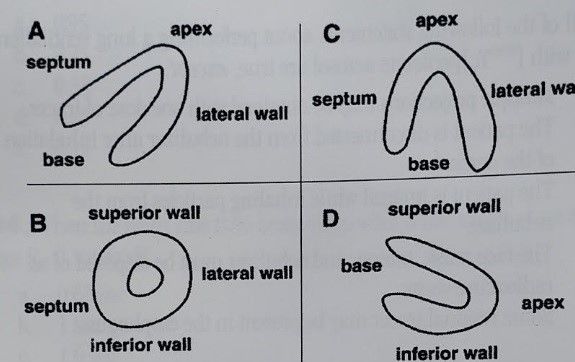
Which of the following diagrams is a correctly labelled representative slice of the horizontal long axis of the left ventricular myocardium?
Image:
E3 Q11 (binary/octet-stream)
Answer
-
A
-
B
-
C
-
D
Question 22
Question
Which tomographic plane of the heart displays all walls of the left ventricle?
Answer
-
horizontal long axis
-
short axis
-
transaxial
-
vertical long axis
-
sagittal
Question 23
Question
Mr. Brown is 65 year old man in the nuclear medicine department for a myocardial perfusion scan with 99mTc-sestamibi. During exercise stress testing he reached a heartrate of 125 bpm. His rest and stress images showed no apparent perfusion defects. How may this scan be reported?
Answer
-
Negative for coronary artery disease
-
Positive for coronary artery disease
-
Potentially a false negative for coronary artery disease due to inadequate stress
-
Potentially a false positive for coronary artery disease due to inadequate stress
-
Unequivocal for coronary artery disease
Question 24
Question
Which of the following functional images represents the magnitude of ventricular contraction?
Answer
-
non-phase image
-
paradox image
-
phase image
-
stroke-volume image
-
amplitude image
Question 25
Question
In processing a myocardial perfusion study, a slice from which body axis is used to identify the degree to which the heart points to the left and to construct slices in the three opposing cardiac planes?
Answer
-
horizontal long axis
-
transaxial
-
vertical long axis
-
short axis
-
horizontal short axis
Question 26
Question
A patient is booked for a 1 day rest-stress myocardial perfusion study, and the hybrid CT scanner is failing quality control. The cardiologist insists that the test be performed today. As the technologist, what do you do?
Answer
-
Inform the cardiologist that it will be impossible to perform the test
-
Use CT for attenuation correction
-
Perform only the rest study only today
-
Image the patient in the prone position for both rest and stress studies
-
Perform the emission imaging as normal and eliminate the transmission imaging for today's studies
Question 27
Question
Diaphragmatic attenuation may be reduced by:
Answer
-
360 degree acquisition
-
supine acquisition
-
delayed imaging
-
prone acquisition
-
giving a bolus injection
Question 28
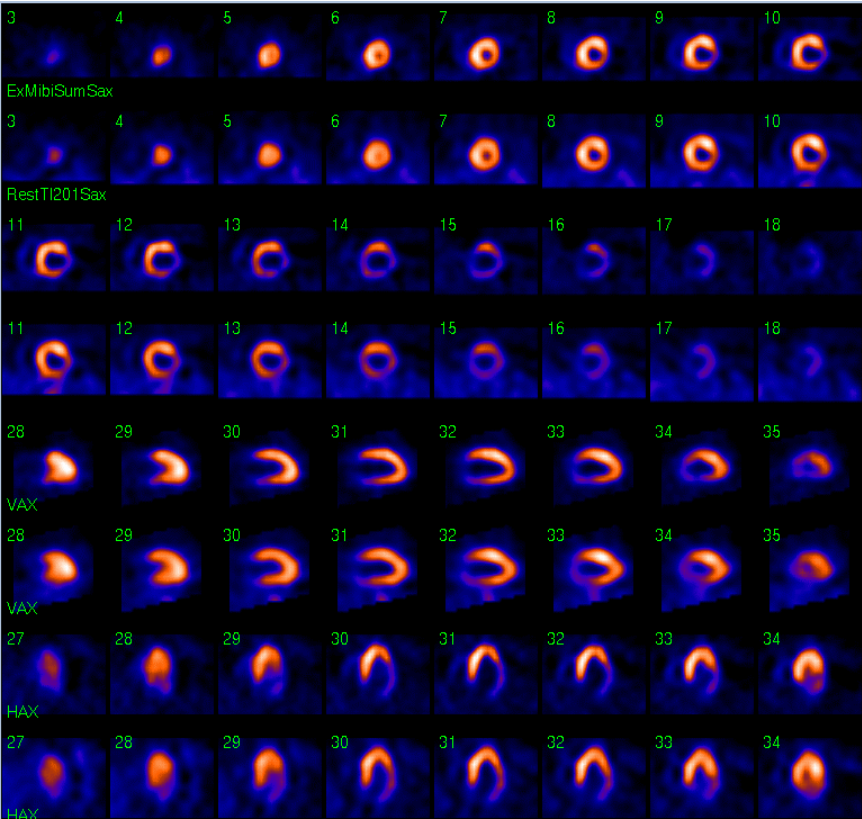
Answer
-
right coronary artery and left anterior descending
-
left anterior descending only
-
left circumflex artery and right coronary artery
-
left circumflex artery only
-
right coronary artery only
Question 29
Question
Perfusion of the ventricular septum in the heart is provided by which coronary artery?
Answer
-
right coronary
-
left circumflex
-
left anterior descending
-
left coronary
-
right circumflex
Question 30
Question
Which SPECT cardiac slice is used to generate a polar plot?
Answer
-
transverse
-
HLA
-
VLA
-
SA
-
sagittal
Question 31
Question
A disadvantage of using the polar map display to assess myocardial perfusion data is:
Answer
-
perfusion defects at the base of the heart tend to be underrepresented
-
perfusion defects at the apex tend to be underrepresented
-
the polar map display does not provide accurate quantitative information and should only be used as a visual representation of perfusion
-
stress and rest datasets cannot be accurately compared
-
the polar map display can provide information on reversible defects but not fixed defects
Question 32
Question
When assessing a myocardial perfusion study that has been processed using filtered back projection, it may be useful to compare the filtered images to the unfiltered images to rule out:
Answer
-
a processing-induced septal wall defect
-
a processing-induced inferior wall defect
-
myocardial ischemia
-
myocardial infarction
-
patient motion
Question 33
Question
Delayed improvement of perfusion after coronary artery revascularization is referred to as:
Answer
-
hibernating myocardium
-
infarcted myocardium
-
stunned myocardium
-
necrosed myocardium
-
myocarditis
Question 34
Question
Which of the following is/are advantages of G-SPECT?
1. Identification of suspected attenuation artifacts
2. Enhanced detection of multivessel CAD
3. Assessment of myocardial viability
4. Distinguishing ischemic from nonischemic cardiomyopathy
5. Simpler procedure than non-gated SPECT
Answer
-
1, 2, 3, 4, and 5
-
1, 2, 3, and 4
-
1 only
-
2 and 5
-
2, 3, and 4
Question 35
Question
Functional cardiac studies may be performed to evaluate wall-motion abnormalities caused by all of the following except:
Answer
-
aneurysm
-
myocardial infarction
-
myocardial perfusion patency
-
myocardial ischemia
-
myocarditis
Question 36
Question
Which of the following will NOT give information on left ventricular function?
Answer
-
gated equilibrium radionuclide angiography
-
gated myocardial perfusion imaging
-
ungated first-pass study
-
gated myocardial PET
-
ungated myocardial SPECT
Question 37
Question
Ischemia means:
Answer
-
necrotic tissue
-
infarction
-
decreased blood flow
-
the superior portion of the pelvis
-
scar tissue
Question 38
Question
A patient with known myocardial ischemia affecting the right coronary artery undergoes a 2 day rest-stress myocardial imaging procedure using 99mTc-sestamibi and pharmacological stressing with Persantine. How will perfusion to the inferior wall of the left ventricular myocardium differ between the rest and Persantine stress images?
Answer
-
Myocardial perfusion to the inferior wall will be mostly unchanged between rest and stress
-
Myocardial perfusion to the inferior wall will increase following administration of Persantine
-
Myocardial perfusion to the inferior wall will decrease following administration of Persantine
-
It is impossible to predict how myocardial perfusion to the inferior wall will be affected by Persantine
Question 39
Question
When processing a myocardial perfusion study using automatic edge detection software, part of the adjacent bowel is included in the inferior contour of the rest images only. What effect may this have on the results?
Answer
-
apparent dyskinesia
-
falsely elevated lung:heart ratio
-
falsely low summed difference score
-
no effect
-
falsely elevated TID
Question 40
Question
Which of the following is the most likely cause of false anterior or lateral wall defects on myocardial perfusion imaging?
Answer
-
centre of rotation error
-
respiratory motion
-
too few projections
-
attenuation by breast tissue or implant
-
multiple pulmonary emboli
Question 41
Question
Which of the following may result in a false positive result on a myocardial perfusion scan?
Answer
-
triple vessel disease
-
exercise stressing a patient with LBBB
-
radiopharmaceutical injected before the target heart rate is achieved
-
patient motion of 1 pixel
-
non-transmural infarction
Question 42
Question
Which of the following may be indicated by a reversible defect?
1. Ischemia
2. Hibernating myocardium
3. Stunned myocardium
4. Infarction
Answer
-
1 only
-
1 and 3
-
1 and 4
-
2, 3, and 4
-
4 only
Question 43
Question
Which of the following patients would benefit most from coronary revascularization?
Answer
-
A 52 year old male whose rest and stress perfusion studies show matched defects and whose gated data indicate paradoxical motion
-
A 36 year old female who demonstrates normal perfusion on both stress and rest images, but whose gated data indicate akinesis of the anterior, septal, and apical walls
-
A 64 year old female patient whose rest images appear normal but with anterior, apical, and septal defects on the stress images with matching mild hypokinesis
-
A 40 year old male whose rest images appear normal but with a large inferior wall defect on stress images and a LVEF of 65%.
Question 44
Question
Which of the following may result in a false negative myocardial perfusion imaging result?
Answer
-
A 75 year old female achieving a maximum heart rate of 124 bpm before tracer injection
-
A 46 year old patient with hypertensive myocardial hypertrophy
-
A 72 year old male patient with a left bundle-branch block
-
A 58 year old patient with balanced myocardial ischemia
-
A 60 year old female patient with aortic regurgitation
Question 45
Question
An advantage of 201Tl-thallium chloride is that it:
Answer
-
has a high photon flux at a high-energy window
-
is a calcium analogue
-
has a short half-life
-
redistributes
-
has a high first-pass extraction and stays fixed in the myocardium
Question 46
Question
In preparation for a Tl-201 stress test, patients are instructed to fast to:
Answer
-
prevent gastrointestinal upsets during exercise
-
minimize tracer uptake in the gastrointestinal tract
-
enhance myocardial tracer uptake
-
standardize test conditions among patients
-
prevent redistribution of the tracer
Question 47
Question
After stress myocardial imaging with 201Tl-thallous chloride, 37-55 MBq of 201Tl-thallous chloride may be administered before rest imaging to:
Answer
-
improve patient throughput
-
demonstrate reversible ischemia more readily
-
demonstrate infarct size more precisely
-
minimize visualization of attenuation artifacts
-
maximize visualization of attenuation artifacts
Question 48
Question
Which of the following are differences between myocardial perfusion imaging with 201Tl-chloride versus 99mTc-sestamibi?
1. A high resolution collimator should be used with 201Tl-chloride
2. There is less soft tissue attenuation with 201Tl-chloride
3. 99mTc-sestamibi results in higher photon flux
4. There is less respiratory motion with 201Tl-chloride
Answer
-
1, 2, 3, and 4
-
2 & 4
-
3 & 4
-
1 & 3
-
3 only
Question 49
Question
Which of the following protocols would be most appropriate for dual-isotope myocardial perfusion imaging?
Answer
-
Rest first: 111MBq 201Tl-chloride Stress second: 925 MBq 99mTc-MIBI
-
Rest first: 925MBq 99mTc-MIBI Stress second: 111 MBq 201Tl-chloride
-
Stress first: 925MBq 99mTc-MIBI Rest second: 111MBq 201Tl-chloride
-
Stress first: 111MBq 201Tl-chloride Rest second: 925MBq 99mTc-MIBI
-
Rest first: 925MBq 99mTc-MIBI Stress second: 925MBq 99mTc-tetrofosmin
Question 50
Question
Myocardial perfusion imaging is a relatively high radiation dose nuclear medicine procedure. All of the following are useful methods to reduce patient doses EXCEPT:
Answer
-
Using PET/CT imaging techniques
-
Using a stress-only protocol in low-risk patients with normal post-stress images
-
Encouraging the patient to stay hydrated and to empty their bladder frequently
-
Using a dedicated cardiac camera that enables shorter imaging times
-
Using a longer imaging time so that a smaller dose can be administered
Question 51
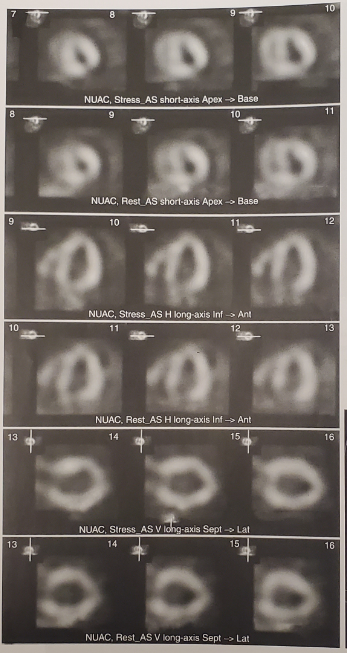
Answer
-
dilated cardiomyopathy
-
normal myocardium
-
lateral wall ischemia
-
multi-vessel ischemia
-
hibernating septal wall myocardium
Question 52
Question
A patient presents with the following quantitative results on a 99mTc-sestamibi myocardial perfusion study:
SSS = 31; SRS = 30
What is the most likely diagnosis?
Answer
-
negative for coronary artery disease
-
hibernating myocardium
-
myocardial infarction
-
myocardial ischemia
-
dilated cardiomyopathy
Question 53
Question
What is the purpose of glucose loading when assessing myocardial viability with 18FDG?
Answer
-
To decrease the absorbed dose from radiation delivered to the myocardium
-
To prevent patients with diabetes from having a reaction during the procedure
-
So that the heart switches from fatty acid to glucose utilization, increasing uptake of FDG
-
A loading dose of glucose should not be administered for myocardial viability imaging with 18F-FDG
-
To reduce extracardiac uptake of 18FDG.
Question 54
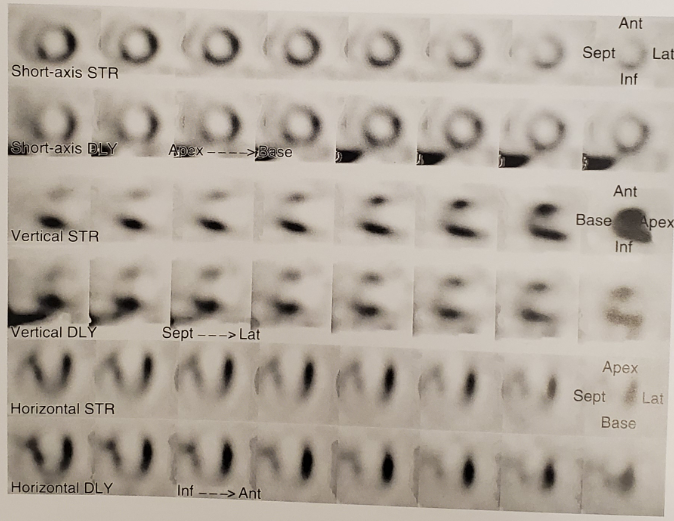
Answer
-
dextrocardia
-
breast attenuation artifact
-
diaphragmatic attenuation artifact
-
large anterior-apical infarct
-
ischemic dilatation
Want to create your own Quizzes for free with GoConqr? Learn more.