
Mind map
Evaluation: DSM and ICD and Diagnosis
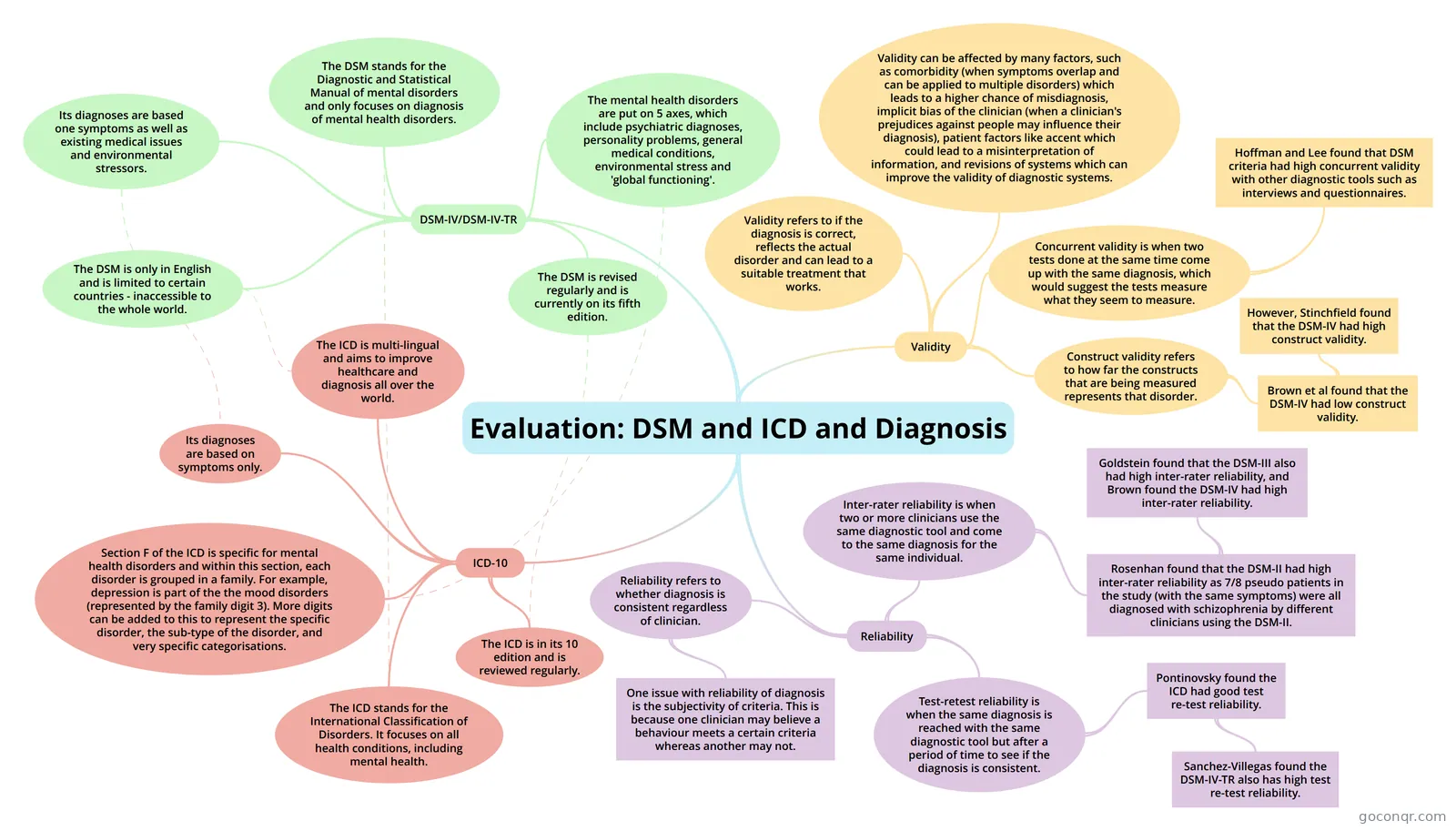
Mind map: DSM and ICD and diagnosis
Map content
Evaluation: DSM and ICD and Diagnosis
DSM-IV/DSM-IV-TR
- The DSM stands for the Diagnostic and Statistical Manual of mental disorders and only focuses on diagnosis of mental health disorders.
- The DSM is only in English and is limited to certain countries - inaccessible to the whole world.
- Its diagnoses are based one symptoms as well as existing medical issues and environmental stressors.
- The DSM is revised regularly and is currently on its fifth edition.
- The mental health disorders are put on 5 axes, which include psychiatric diagnoses, personality problems, general medical conditions, environmental stress and 'global functioning'.
ICD-10
- The ICD stands for the International Classification of Disorders. It focuses on all health conditions, including mental health.
- The ICD is multi-lingual and aims to improve healthcare and diagnosis all over the world.
- The ICD is in its 10 edition and is reviewed regularly.
- Its diagnoses are based on symptoms only.
- Section F of the ICD is specific for mental health disorders and within this section, each disorder is grouped in a family. For example, depression is part of the the mood disorders (represented by the family digit 3). More digits can be added to this to represent the specific disorder, the sub-type of the disorder, and very specific categorisations.
Reliability
- Reliability refers to whether diagnosis is consistent regardless of clinician.
- One issue with reliability of diagnosis is the subjectivity of criteria. This is because one clinician may believe a behaviour meets a certain criteria whereas another may not.
- Inter-rater reliability is when two or more clinicians use the same diagnostic tool and come to the same diagnosis for the same individual.
- Rosenhan found that the DSM-II had high inter-rater reliability as 7/8 pseudo patients in the study (with the same symptoms) were all diagnosed with schizophrenia by different clinicians using the DSM-II.
- Goldstein found that the DSM-III also had high inter-rater reliability, and Brown found the DSM-IV had high inter-rater reliability.
- Rosenhan found that the DSM-II had high inter-rater reliability as 7/8 pseudo patients in the study (with the same symptoms) were all diagnosed with schizophrenia by different clinicians using the DSM-II.
- Test-retest reliability is when the same diagnosis is reached with the same diagnostic tool but after a period of time to see if the diagnosis is consistent.
- Pontinovsky found the ICD had good test re-test reliability.
- Sanchez-Villegas found the DSM-IV-TR also has high test re-test reliability.
- Pontinovsky found the ICD had good test re-test reliability.
- Reliability refers to whether diagnosis is consistent regardless of clinician.
Validity
- Validity refers to if the diagnosis is correct, reflects the actual disorder and can lead to a suitable treatment that works.
- Validity can be affected by many factors, such as comorbidity (when symptoms overlap and can be applied to multiple disorders) which leads to a higher chance of misdiagnosis, implicit bias of the clinician (when a clinician's prejudices against people may influence their diagnosis), patient factors like accent which could lead to a misinterpretation of information, and revisions of systems which can improve the validity of diagnostic systems.
- Construct validity refers to how far the constructs that are being measured represents that disorder.
- Brown et al found that the DSM-IV had low construct validity.
- However, Stinchfield found that the DSM-IV had high construct validity.
- Brown et al found that the DSM-IV had low construct validity.
- Concurrent validity is when two tests done at the same time come up with the same diagnosis, which would suggest the tests measure what they seem to measure.
- Hoffman and Lee found that DSM criteria had high concurrent validity with other diagnostic tools such as interviews and questionnaires.
Information
- Description
- A level Psychology (Clinical Psychology) Mind Map on Evaluation: DSM and ICD and Diagnosis, created by Katie Greensted on 31/05/2019.
- Created by
- Katie Greensted
- Views
- 379
- Tags
- Rating