
Quiz
Evolution Quiz
This quiz has question types that open in the usual player.
Questions in this quiz (15)
1There are two different types of exotic cats living in Africa. One of them has spots all over making it easy to camouflage with its surroundings, which allows them to hide from their predators. The other is plain white, which in other words is more susceptible to harm as opposed to others. Although one is more favorable than the other, both of the animals have been thriving at the same rate for 5 years now. Is this particular situation a form of natural selection? Why or why not?
- AYes, because one of the exotic cats are more favorable than the other. One is going to survive and the other will cease to exist.
- BNo, because both exotic cats remain stable in the population although they have different traits in fur color.
- CYes, because one particular trait is providing an advantage to an organism in a certain environment.
- DNo, because natural selection only occurs with different species of animals; it's never for just one type of animal.
2Evolution is change over time. The leaves of trees changing color in the fall is an example of evolution.
- ATrue
- BFalse
3There are two islands separated from one another by a body of water. Elephants that once lived on the same land now differ in traits they have because of the barrier that came before them. They are no longer able to mate with each other due to their proximity. What kind of barrier does this situation represent exactly?
- AReproductive Isolation
- BGeographic Isolation
- CSpeciation
- DLand Isolation
4Rabbit's ears can be either short or floppy, where short ears are dominant over floppy ears. There are 653 individuals in a population. 104 rabbits have floppy ears and 549 have short ears.
Find: the frequency of the dominant and recessive alleles and the frequency of individuals with dominant, heterozygous, and recessive genotypes.- Ap = 0.6
q = 0.4
p^2 = 0.36
2pq = 0.48
q^2 = 0.16 - Bp = 0.4
q = 0.6
p^2 = 0.16
2pq = 0.48
q^2 = 0.36 - Cp = 104
q = 549
p^2 = 200
2pq = 549
q^2 = 1000 - Dp =0.6
q = 0.4
No, the population is not in a state of Hardy-Weinberg equilibrium because the allele frequencies are not the same as the preceding generation.
- Ap = 0.6
5Which of the following statements is TRUE?
- ALess than 60% of all natural populations of plants and animals have diversity--that is, they are not clones.
- BThe earth's environments have remained unchanged since the end of the last ice age.
- CHumans have altered the environments of some species in order to control the direction of their evolution.
- DNone of the above
6Check all the boxes that apply to this figure.
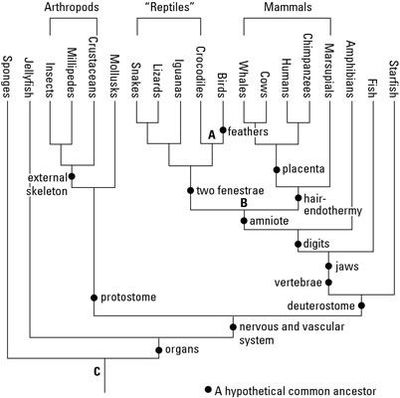
- AThe sister group to taxon B is taxon C.
- BThe trait of feathers applies to both the birds and crocodiles.
- CA represents the common ancestor for birds.
- DIn this tree, taxon A is the outgroup.
7According to the phylogenetic tree, which organisms are the least related to each other evolutionarily?
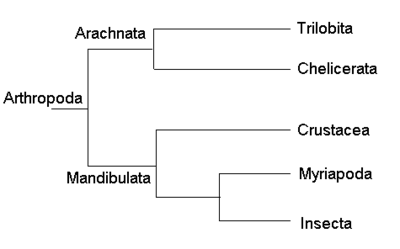
- ATrilobita and Insecta
- BInsecta and Myriapoda
- CInsecta and Crustacea
- DTrilobita and Chelicerata
8A plague that sweeps through a population and kills individuals who have a certain genetic makeup more than others is considered a bottleneck situation.
- ATrue
- BFalse
9In which population would you expect the most rapid evolutionary change?
- AA small population with a high mutation rate in a changing environment.
- BA small population with a low mutation rate in a stable environment.
- CA large population with a high mutation rate in a changing environment.
- DA large population with a low mutation rate in a stable environment.
10What is a major cause of variation within a species?
- ASexual reproduction
- BAsexual reproduction
- CExtinction
- DPhotosynthesis
11Genetic drift is a change in [blank_start]gene[blank_end] frequency within a population due to chance instead of [blank_start]natural[blank_end] selection.
- Agene
- Bnatural
12[blank_start]Speciation[blank_end] is the process by which different species emerge from a [blank_start]common ancestor[blank_end] species. Speciation generally begins when populations of the same species become [blank_start]geographically[blank_end] isolated, such as when they are separated by some [blank_start]physical[blank_end] barrier that disallows cross-breeding between individuals from one population and individuals of another population.
- Acommon ancestor
- BSpeciation
- Cgeographically
- Dphysical
13A taxon, all of whose members have the same common ancestor is....
- AParaphyletic
- BMonophyletic
- CPolyphlyetic
14Which of the following is NOT a step toward allopatric speciation?
- ATwo squirrel populations, which were previously a single population, live on opposite rims of a canyon and differ in several morphological features.
- BThe rise of an isthmus cuts a shrimp population in two, cutting off gene flow between the two new populations.
- CA river dries up; two populations of ants that had been geographically isolated since the appearance of the river come into contact but cannot interbreed.
- DPolyploidy in a hybrid plant prevents backcrossing with either parent species.
15Darwin observed that the plants and animals of the Galapagos Islands were the same as those on islands off the coast of Africa with similar environments.
- ATrue
- BFalse
Information
- Description
- Advanced placement Biology Quiz on Evolution Quiz, created by Amairani Trevino on 17/05/2016.
- Author
- Amairani Trevino
- Language
- English
- Views
- 3
- Tags
- Rating
- No ratings yet Rate this quiz