
Quiz
For Finals
Create a free account to finish this quiz
Save your progress and see your final score.
Already have an account? Sign in
Questions in this quiz (91)
1Carbon is an element that is considered to be a
- Abackbone of an organic molecule
- Bpure chemical substance consisting of only one type of atom
- Ccomponent of water
- Datom that forms 4 bonds
- Ecomponent of most proteins
2Atomic number of an element
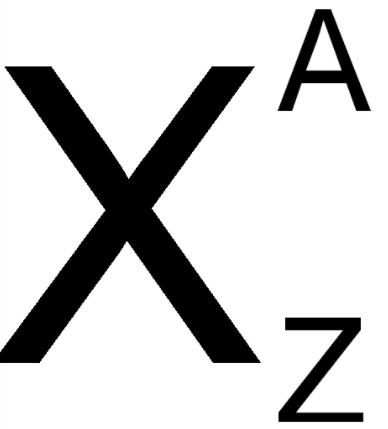
- AA
- BA+Z
- CZ
- DA/Z
- EA-Z
3Atomic mass and number of neutrons in
- AA and A-Z
- BA and A+Z
- CZ and Z-A
- DA and Z-A
- EZ and A-Z
4What is the process happening to Carbon

- AIsotopes
- BConversion
- CChange in atomic number
- DRadioisotops
- EDeacaying
5Suitable answer

- ACarbonic acid is a weak acid
- BBicarbonate ions act as a weak base
- CVertebrate blood buffer
- DpH is raised
- EpH is lowered
6choose the possible correct answer
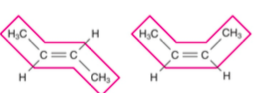
- Acis and trans geometric isomers
- Bcis and trans structural isomers
- Ctrans and cis geometric isotopes
- Dtrans and cis geometric isomers
- EEnantiomers
7Everything related to amino acids
- Acarbonyl
- Bcarboxyl
- CAmino
- DPhosphate
- ESulfhydryl
8Consists C, O and H in ratio (1:1:2)
- Acarbohydrates
- BLipids
- Cfats
- Dtriglycerides
- ESteroid
9study of interactions among organisms and their environment
- ABiotic factor
- BAbiotic factors
- CEcology
- DBiology
- Enurture
10any living component that affects another organism is called biotic factor
- ATrue
- BFalse
11Abiotic factors are non-living components of ecosystem affecting organisms
- ATrue
- BFalse
- CPartially true
- DPartially false
- EVIruses
12acts on individuals but does not changes the population
- AGene pool
- BNatural selection
- CMigration
- DMutation
- EGene flow
13To avoid competion in growth trees folow
- ARandom dispersion
- Bclump dispersion
- Cuniform dispersion
- Dcluster disperison
- Eindividual dispersion
14When organisms don't go far from parent population
check all the right ones- Aschool of fish
- Bclump dispesion
- Crandom dispersion
- Dtrees
- Euniform dispersion
- Fbirds
15Δ N
- Achanges in the number of individuals in a population
- Bchanges in the number of population
- Cchanges in the number of population over time
- Dchanges in the number of individuals over time
- Echanges in the growth rate of a population
16Change in the number of individuals in a population (Δ N),
over a given period of time (Δt )- ATrue
- BFalse
17Changes in the number of individuals in a population over a period of time, which is not affected by natality and mortality.
- AΔt/ΔN = N (d −b)
- BΔt/ΔN = N (b − d)
- CΔN = N (b − d)
- DΔt = N (b − d)
- EΔN /Δt = N (b − d)
18r=b−d
- Abirth rate change in a population per capita = birth rate - death rate
- Bchange in population per capita = birth rate - death rate
- Cchange in population = birth rate - death rate
- Dbirth rate change in a population = birth rate - death rate
- Echange in the indiviual in a population per capita = birth rate - death rate
19dispersal depends on mating but gene flow does not
- ATrue
- BFalse
20gene flow is related to dispersal
- ATrue
- BFalse
21growth rate of a population per capita = (birth rate - death rate)+(population size increase - population size decrease)
- Ar = (b − d) + (i − e)
- Br = (b − d)
- Cr = (i − e)
- Dr = (b − d) + (e− i)
- Er = (i − i)
- Fr = (e− e)
22The growth rate of bacteria shows
check all right answers- AIntrinsic rate of increase
- Bmax rate at which a the population of a given species could increase under ideal
conditions - CResources are abundant and population density is low
- DCarrying capacity
- Ethe largest population that can be
maintained for an indefinite period by a particular
environment, assuming no changes in the environment - Fpopulation crash
- Gdensity-dependent
23Where does the ribosome assembly begin
- ANucleus
- BRough ER
- CSmooth ER
- DNucleolus
- Enucleoplasm
24Which structure is important for biochemical process that provides energy for the cell
- ARER
- BSER
- CPlasma membrane
- DNucleus
- ERibosomes
25Glycogen, lipids, phosphates are used as —--— in a prokaryote
- Alysosomes
- BFood
- CEnergy
- Denzymes
- EStorage granules
26Nuclear pores are formed by
- ACarbohydrates
- BLipids
- CProtein complexs
- Dchromatins
- Enucleosomes
27Ribosomal subunits are assembled here
- ANucleolus
- BNucleus
- CEndoplasmic reticulum
- DRibosomes
- EMitochondria
28What does the lumen of the ER store
- AK+
- BCa+2
- CNa+
- DATP
- ENADPH
29Enzymatic reactions of aerobic respiration occur in
- AMatrix
- BCristae
- CRibosomes
- DNucleus
- EPlasma membrane
30Enzymatic reactions in chloroplasts occur in
- AStroma
- BLumen
- CThylakoid membrane
- DPlasma membrane
- EGranum
- FTHylakoid
31Centrioles consist of
- A3*9 sets of microtubules
- B3*6 sets of microtubules
- C9*3 sets of microtubules
- D9*6 sets of microtubules
- E3*5 sets of microtubules
32Why does ice float in liquid water?
- Ahydrogen bonds stabilize and keep the water molecules of ice farther apart than the water molecules of liquid water
- Bthe ionic bonds between the molecules in ice prevent the ice from sinking
- Cthe high surface tension of liquid water keeps the ice on top
- Dice always has air bubbles that keep it afloat
- Ethe crystalline lattice of ice causes it to be denser than liquid water
33What is the OH- concentration of a solution having a pH of 5?
- A1 x 10-9
- B1 x 10-14
- C1 x 10-10
- D1 x 10-7
- E1 x 10-5
34The nucleus of a neutral nitrogen atom contains 8 neutrons and 7 protons. Which of the following is a correct statement concerning this nitrogen atom?
- Athe nitrogen atom has an atomic mass of 15, an atomic number of 8, and 8 electrons
- Bthe nitrogen atom has an atomic mass of 15, an atomic number of 7, and 7 electrons
- Cthe nitrogen atom has an atomic mass of 8, an atomic number of 15, and 8 electrons
- Dthe nitrogen atom has an atomic mass of 15, an atomic number of 15, and 7 electrons
- Ethe nitrogen atom has an atomic mass of 7, an atomic number of 15, and 7 electrons
35Which type of bond must be broken for water to vaporize
- Ahydrogen bond
- Bpolar covalent bond
- Cionic bond
- Dnonpolar covalent bond
- EVan der Waals bond
36If atom X contains 14 protons, 14 electrons, and 10 neutrons, and atom Y contains 14 protons, 14 electrons, and 12 neutrons, then you conclude that:
- AX and Y are isotopes of the same element
- BX and Y are not the same element
- CX and Y are both ions
- DY is an ion but X is not
- EX is an ion but Y is not
37A molecule with the chemical formula C6H12O6 is probably a:
- Anucleic acid
- Blipid
- Ccarbohydrate
- Dprotein
- Etriglyceride
38The above functional group is a(n) _____ group.
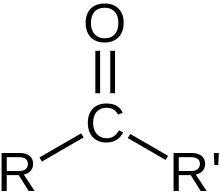
- Acarboxyl
- Bamine
- Chydroxyl
- Dcarbonyl
- Eamino
39A carbohydrate energy storage molecule found in animal liver and muscle cells is:
- Aglucagon
- Bglycogen
- Ccellulose
- Dstarch
- Egalactose
40You isolate a compound that is insoluble in water, has alternating single and double bonds, and has a bright orange color. You correctly conclude that this compound is a:
- Aphospholipid
- Btriglyceride
- Csteroid
- Dcarotenoid
- Epolysaccharide
41The hydrolysis of a triglyceride will yield:
- Athree fatty acids and one glycerol
- Bone fatty acid, one amino acid, and one glucose
- Cthree glycerols and one fatty acid
- Dtwo fatty acids and three glycerols
- Eone fatty acid, one phosphate, and one glycerol
42All of the following functions are performed by plant vacuoles except:
- Amaintaining hydrostatic (turgor) pressure
- Bstorage of nucleic acids
- Cwaste storage and recycling
- Dstorage of pigments
- Ebreakdown of unneeded cellular materials
43Which organelle is primarily involved in the synthesis of phospholipids and steroids?
- AGolgi apparatus
- Bsmooth endoplasmic reticulum
- Cperoxisome
- Drough endoplasmic reticulum
- Eribosome
44The smooth endoplasmic reticulum:
- Aprovides structural support
- Bsynthesizes proteins
- Cbreaks down glycogen
- Dis required for ribosome synthesis
- Eis absent in most plant cells
45All of the following are part of a prokaryotic cell except:
- Acell wall
- Bendoplasmic reticulum
- CDNA
- Dplasma membrane
- Eribosomes
46If a toxin, such as a bacterial toxin, destroys ribosomes, what cellular activity will be affected first?
- Amovement
- Benergy production
- Cvesicle transport
- DDNA synthesis
- Eprotein synthesis
47The process illustrated in the figure is called:
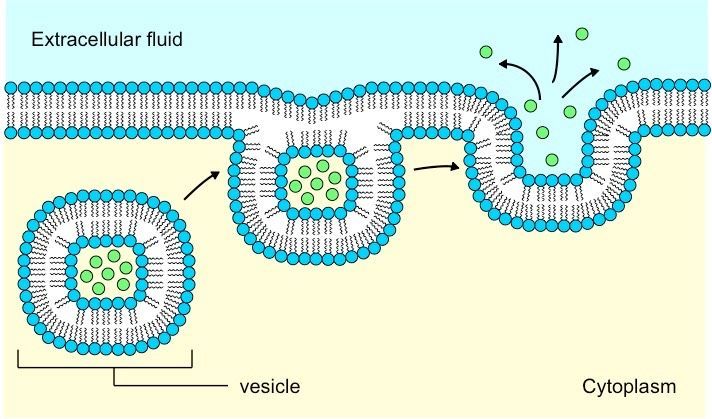
- Afacilitated diffusion
- Breceptor-mediated endocytosis
- Cexocytosis
- Dphagocytosis
- Epinocytosis
48Which of the following types of molecules are the major structural components of cell membranes?
- Aproteins and glycoproteins
- Bphospholipids and proteins
- Cphospholipids and collagen
- Dnucleic acids and proteins
- Ephospholipids and cholesterol
49The process illustrated in the above figure would most likely be used to transport:
- ACO2
- Bhormones
- CNa+
- Dglucose
- Ebacteria
50Integral proteins:
- Aare amphipathic
- Bhave no hydrophilic portions
- Chave no hydrophobic portions
- Dare immobile within the lipid bilayer
- Eare bound to the cytosolic surface of the membrane
51The small yellow dots within the membrane are most likely:
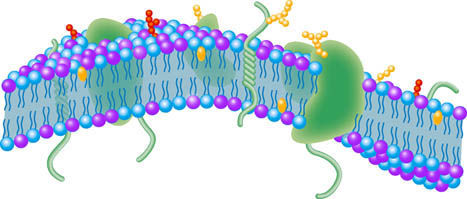
- Aphospholipids
- Bcollagen
- Cperipheral proteins
- Dglycolipids
- Echolesterol
52During the electron transport chain, H2O is formed. Where does the oxygen for the synthesis of H2O come from?
- AC6H12O6
- BO2
- Cpyruvate
- DCO2
- ENADH
53When one molecule of glucose is completely oxidized in aerobic respiration, the net amount of ATP produced is:
- A44
- B2
- C4
- D32 to 34
- E36 to 38
54Energy released by the electron transport chain is used to pump H+ ions into which location during cellular respiration?
- Athylakoid lumen
- Bstroma
- Cmitochondrial matrix
- Dmitochondrial intermembrane space
- Ecytosol
55Which of the following molecules can be used as a substrate for cellular respiration?
- Afatty acids
- Bamino acids
- Cglucose
- Dall of the choices
- Etriglycerides
56During chemiosmosis, _______ are transferred from NADH and FADH2 to complexes in the cristae, and the energy released is used to create a(n) _______ gradient across the inner mitochondrial membrane.
- Arotons; electron
- BADP molecules; ATP molecule
- Cwater molecules; oxygen
- DATP molecules; ADP molecule
- Eelectrons; proton
57Which of the following is not common to both photosynthesis and aerobic respiration?
- Aredox reactions
- BO2 as final electron acceptor
- Celectron transport chain
- DATP synthesis
- Eall are shared by both processes
58Which of the following is associated with photosystem I?
- Areceiving electrons directly from water
- Breceiving electrons directly from plastocyanin
- Cpassing electrons to plastoquinone
- DP680 reaction-center chlorophyll
- Epumping protons
59The reactants of the light-dependent reactions are:
- ACO2, ADP, and NADPH
- BH2O, ATP, and NADPH
- CH2O, ADP, and NADP+
- DH2O, CO2, and NADP+
- ECO2, ADP, and NADP+
60The overall reactions of photosynthesis are best summarized as:
- A6 O2 + 12 H2O → C6H12O6 + 6 CO2 + 6 H2O
- B6 CO2 + 12 O2 → C6H12O6 + 12 O2 + 6 H2O
- CC6H12O6 + 6 O2 + 6 H2O → 6 CO2 + 12 H2O
- D6 CO2 + 12 H2O → C6H12O6 + 12 CO2
- E6 CO2 + 12 H2O → C6H12O6 + 6 O2 + 6 H2O
61In C4 plants, reactions that fix CO2 into a four-carbon compound occur in:
- Axylem cells
- Bguard cells
- Cmesophyll cells
- Dbundle sheath cells
- Eepidermal cells
62An animal with a diploid number of 36 will have ______ chromosomes in its gametes and ______ tetrads during meiosis I.
- A18; 36
- B18; 18
- C36; 36
- D36; 18
- E36; 72
63The kinetochore serves which of the following functions?
- Akinetochores are involved in cytokinesis
- Bkinetochores anchor spindle fibers to the centrioles
- Ckinetochores attach to microtubules during mitosis
- Dkinetochores are the site of DNA synthesis
- Ekinetochores regulate the length of the cell cycle
64The sources of genetic variation during meiosis are:
- Ameiosis results in daughter cells that are genetically identical to the parent cell
- Bcrossing-over and random assortment of maternal and paternal homologs
- Crandom pairing of tetrads and random assortment of sister chromatids
- Dcrossing-over and random pairing of tetrads
- Esynapsis and DNA mutation
65Imagine a diploid nucleus with a total of four chromosomes. In this cell, there are two pairs of homologous chromosomes, one long and the other short. If this cell undergoes meiosis, which of the above cells depicts what one of the resulting daughter cells would look like at telophase I?
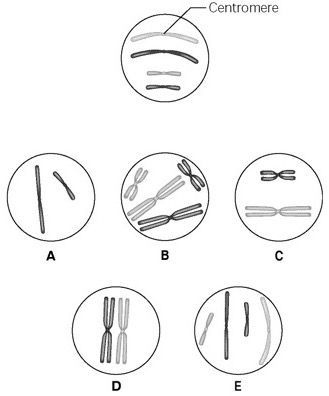
- AC
- BB
- CA
- DE
- ED
66Which of the following events does not occur in prophase II?
- Adisassembly of the nuclear membrane
- Bformation of the spindle
- Csister chromatids become visible when viewed with the light microscope
- Dformation of a synaptonemal complex
- Econdensation of chromatin into chromosomes
67In snapdragons, heterozygotes have pink flowers, whereas homozygotes have red or white flowers. When plants with red flowers are crossed with plants with white flowers, what proportion of the offspring will have pink flowers?
- A25%
- B0%
- C100%
- D50%
- E75%
68When crossing an organism that is homozygous recessive for a single trait with a heterozygote, what is the chance of producing an offspring with the homozygous recessive phenotype?
- A0%
- B75%
- C100%
- D25%
- E50%
69What is a dominant allele?
- Ait determines phenotype in a heterozygote
- Bhaving two different alleles for a gene
- Cit is the more common allele in a population
- Dthe genetic makeup of an individual
- Eit has no effect on phenotype in a heterozygote
70A Barr body in a mammalian female cell represents:
- Aa degenerate nucleus
- Ban inactivated Y chromosome
- Ca polar body
- Dan inactivated oocyte
- Ean inactivated X chromosome
71Black fur in mice (B) is dominant to brown fur (b). Short tails (T) are dominant to long tails (t). These two traits are unlinked. What fraction of the progeny of the cross BbTt × BbTt will have black fur and long tails? (Hint: you should not have to do a Punnett square to answer this question).
- A1/2
- B1/16
- C3/16
- D3/4
- E9/16
72The ends of eukaryotic chromosomes can be lengthened by:
- Areverse transcriptase
- BDNA polymerase
- Capoptosis
- Dtelomerase
- Eprimase
73Pre-mRNAs include long sequences of bases that do not code for amino acids. These noncoding sequences, called _______, are found in _______ cells.
- Aexons; prokaryotic
- Bintrons; prokaryotic
- Cintrons; eukaryotic
- Dexons; eukaryotic
- Enone of these
74One of the mRNA codons specifying the amino acid leucine is 5´-CUA-3´. Its anticodon is:
- A3´-AUC-5´
- B5´-GAU-3´
- C5´-GAT-3´
- D3´-GAU-5´
- E3´-GAT-5´
75Transcription in eukaryotes requires which of the following in addition to RNA polymerase?
- Astart and stop codons
- Baminoacyl tRNA synthetase
- Ctranscription factors
- Dan RNA primer
- Eribosomes
76What type of bonding is responsible for maintaining the shape of a tRNA molecule?
- Avan der Waals interactions between hydrogen atoms
- Bhydrogen bonding between complementary base pairs
- Cpeptide bonding between amino acids
- Dcovalent bonding between adjacent nucleotides
- Ephosphodiester bonds
77In all organisms, the AUG codon codes for:
- Athe initiation of translation
- Bthe termination of transcription
- Cthe amino acid valine
- Dthe initiation of transcription
- Ethe termination of translation
78Ribose differs from deoxyribose by having:
- Aan extra hydroxyl group
- Ban extra carbon in the ring
- Conly one ring instead of two
- Done less carbon in the ring
- Eone less oxygen
79Which amino acid would this tRNA molecule be carrying?
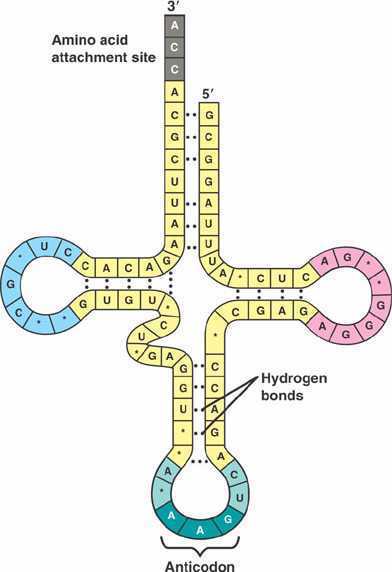
- Ause chart
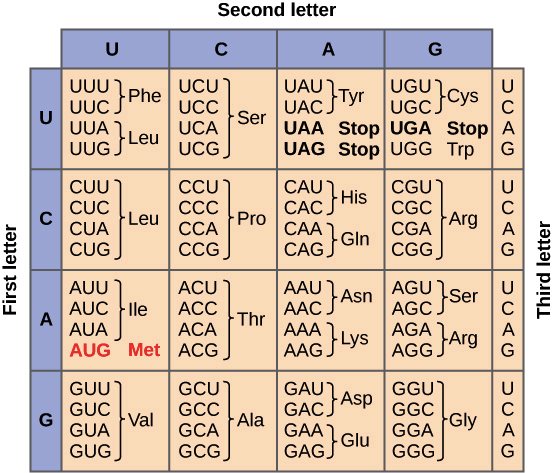
- Bglutamine
- Clysine
- Dleucine
- Ephenylalanine
- Fnone of these
- Ause chart
80In which of the following actions does RNA polymerase differ from DNA polymerase?
- ARNA polymerase uses RNA as a template, and DNA polymerase uses a DNA template
- BRNA polymerase can initiate RNA synthesis, but DNA polymerase requires a primer to initiate DNA synthesis
- CRNA polymerase binds to single-stranded DNA, and DNA polymerase binds to double-stranded DNA
- DRNA polymerase does not need to unwind the two strands of DNA in order to synthesize an RNA copy, whereas DNA polymerase must unwind the double helix before it can replicate the DNA
- ERNA polymerase is much more accurate than DNA polymerase
81A particular triplet of bases in the coding sequence of DNA is AAA. The anticodon on the tRNA that binds the mRNA codon is:
- AAAA
- BUUA
- CTTT
- DUUU
- Eeither UAA or TAA, depending on first base wobble
82Bacterial gene regulation occurs mainly at the __________ level.
- Afeedback inhibition
- Btranscriptional
- Cposttranslational
- Dposttranscriptional
- Etranslational
83Genes in euchromatic regions are:
- Arepressed
- Bactively being transcribed
- Cduplicated
- Dinhibited
- Eunregulated
84A cell may meet the need for large quantities of a specific protein by all of the following except:
- Aincreasing the half-life of the mRNA that specifies the protein
- Badding phosphate groups to inactive copies of the protein
- Ccontinuously synthesizing the mRNA molecule that specifies that protein
- Dadding ubiquitin to the protein molecules
- Eacetylating the histones that interact with the portion of DNA that codes for the protein
85Densely staining regions of highly compacted chromatin that are generally not transcribed are:
- Aconstitutively expressed
- Beuchromatin
- Cheterochromatin
- Dacetylated
- Eduplicated
86Which of the following is most likely to have a chain of small proteins called ubiquitin attached to it?
- Aa regulatory protein that requires sugar residues to be attached
- Ban enzyme only required during G1 of the cell cycle, now that the cell is in G2
- Ca cell surface protein that requires transport from the ER
- Dan mRNA that is leaving the nucleus to be translated
- Ean mRNA produced by an egg cell that will be retained until after fertilization
87Which of the following would be least likely to form a fossil?
- Aan animal with an endoskeleton
- Ban organism living in a lake
- Can organism in a tropical rain forest
- Dan animal with an exoskeleton
- Ea marine organism
88Which statement would not be supported by Darwin's concept of evolution?
- Athe offspring of three different female bears compete for the same food source
- Ba population of wolves produces 500 offspring in an environment capable of supporting only 450
- Ca population of plants adapted to dry conditions survives a draught and reproduces, while another population best adapted to rainy weather dies and becomes extinct
- Dfive generations of farmers have warts on their hands
- Eall children in the same town are genetically different
89Which of these conditions should prevent the occurrence of natural selection in a population over time?
- Athe population size is large
- Bthe environment is changing at a relatively slow rate
- Cthe environment can support many, but not all, of the offspring produced
- Dall variation between individuals is due only to environmental factors
- Ethere is intense competition for water
90Natural selection includes all of the following components except:
- Alimits on population growth
- Bcompetition among organisms
- Cacquiring traits because they are needed
- Doverproduction of offspring
- Egenetic variation among individuals
91Which of the following ideas is not part of Darwin’s concept of evolution?
- Aindividuals in a population are genetically variable
- Btraits acquired during an individual’s life are passed on to its offspring
- Ca struggle for existence exists among individuals of a population
- Da population is capable of producing more offspring than the environment can support
- Eindividuals that are best adapted to their environment are more likely to survive and reproduce
Information
- Description
- Biology (Gen Bio 2) Quiz on For Finals, created by Jennifer Samuel on 02/05/2017.
- Author
- Jennifer Samuel
- Language
- English
- Views
- 0
- Tags
- Rating
- No ratings yet Rate this quiz