
Quiz
Edexcel (9-1) Topic 8
This quiz has question types that open in the usual player.
Questions in this quiz (13)
1Which of the following gases was probably a major part of the early atmosphere?
- Acarbon dioxide, oxygen
- Bnitrogen, carbon dioxide
- Coxygen, nitrogen
- Dwater vapour, argon
2In the modern day atmosphere, oxygen takes up about 21%. What is the approximate percentage of nitrogen?
[blank_start]78[blank_end] %- A78
3What is the name of the atmospheric process which keeps the Earth warm by absorbing radiation from the Sun?
- AGlobal warming
- BGreenhouse effect
- CClimate change
- DCarbon footprint
4What is the name of the process which separates crude oil into simpler mixtures of hydrocarbon compounds?
- AFractional distillation
- BCrystallisation
- CCracking
- DPolymerisation
5Complete the diagram below
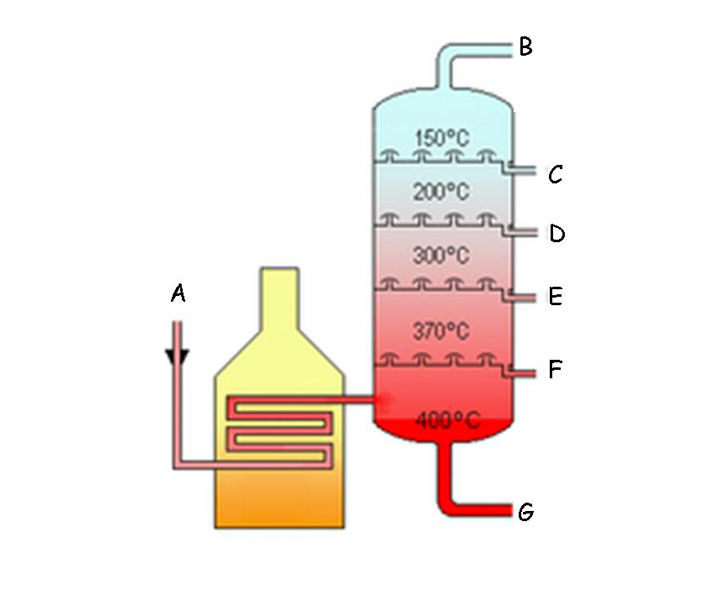
- Acrude oil
- Bgases
- Cpetrol
- Dkerosene
- Ediesel
- Ffuel oil
- Gbitumen
- Hheating
- Icooling
- Jheating oil
- Klonger chains condense here
- Lshorter chains condense here
6What term could be used to describe a resource which is being made more slowly than it is being used up?
- Afinite
- Binfinite
- Crenewable
- Dsustainable
7During complete combustion of butane, what are the chemical products?
water and [blank_start]carbon dioxide[blank_end]- Acarbon dioxide
8Sulfur dioxide gas produced by the combustion of fossil fuels is generally responsible for producing [blank_start]acid rain[blank_end]?
- Aacid rain
9When fuels burn they are reacting with the [blank_start]oxygen[blank_end] in the air. If there is an abundance of [blank_start]air[blank_end], then [blank_start]complete combustion[blank_end] will take place. This means [blank_start]carbon dioxide[blank_end] is produced. If they isn't enough air, then [blank_start]incomplete combustion[blank_end] happens and [blank_start]carbon monoxide[blank_end] is made.
- Aoxygen
- Bhydrogen
- Cair
- Dcomplete combustion
- Eincomplete combustion
- Fcarbon dioxide
- Gcarbon monoxide
10Which of the following is not an advantage to hydrogen as a fuel cells (vs petrol/diesel)?
- Achemical energy is converted straight to electrical energy, compared to a fossil fuel which converts chemical energy to heat energy first (so fewer transfer stages, and less 'lost' energy)
- Bthere are less pollutants - in fact no pollutants, as water is only product
- Crechargeable batteries have a limit on how many times they can be recharged, whereas fuel cells can keep going as long as they're refilled
- Dcurrently hydrogen gas is produced from hydrocarbons, or electrolysis of water (requires use of electricity, generally powered by burning fossil fuels)
11Rising temperatures due to the increase of [blank_start]carbon dioxide[blank_end] and methane in the atmosphere will lead to:
ice at the South Pole and in glaciers will melt, causing global sea levels to [blank_start]rise[blank_end] - this will lead to increased, and/or permanent [blank_start]flooding[blank_end] in some areas
animals will move away from their 'natural' habitats to find [blank_start]cooler[blank_end] areas to live, and some plants/animals may become [blank_start]extinct[blank_end] if they cannot survive the warmer temperatures
weather patterns will begin to change with some areas becoming [blank_start]drier[blank_end], and others much wetter - and even more extreme weather events like more frequent severe [blank_start]storms[blank_end] and heat waves/droughts
wildlife, and growth of [blank_start]crops[blank_end], will be affected by the ever-changing weather systems
as more carbon dioxide is released, more will [blank_start]dissolve[blank_end] into water systems lowering the [blank_start]pH[blank_end] - more acidic waters can harm the organisms that live in them- Acarbon dioxide
- Brise
- Cflooding
- Dcooler
- Eextinct
- Fdrier
- Gstorms
- Hcrops
- IpH
- Jdissolve
12The oldest temperature records for central England date back to 1659, but cannot be used to assess global temperature changes as they are only from one place. Temperature records from around the world have only existed from about 1880. These measurements were also not very accurate.
- ATrue
- BFalse
13Modelling climate change is easy.
- ATrue
- BFalse
Information
- Description
- GCSE Chemistry (Edexcel) Quiz on Edexcel (9-1) Topic 8, created by https:// revisechemistry.uk on 23/03/2018.
- Language
- English
- Views
- 274
- Tags
- Rating
- No ratings yet Rate this quiz