
Programming Languages
Slides in this set (7)
-
-
What is a programming language?
- A programming language is a set of words, codes, and symbols that allow a programmer to give instructions to the computer.
- Many programming languages exist, and each has their own rules, or syntax, for writing these instructions.
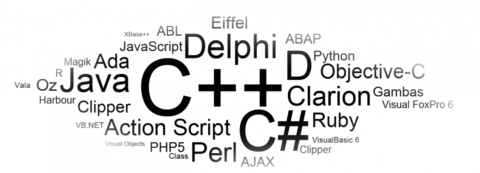
- Top 10 programming languages 2015
-
Classifications of Programming Languages
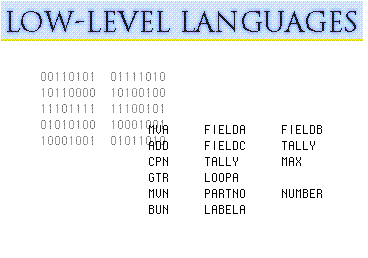
- Low-level programming languages include machine language and assembly language.
- Machine language is referred to as a first generation programming language and is used to communicate directly with the computer.
- Difficult to program due to the fact the language consists of 0's and 1's to represent the status of a switch (0 for off and 1 for on).
- Assembly language uses the same instructions and structure as machine language, but the programmer is able to use meaningful names or abbreviations instead of numbers.
-
Classifications of Programming Languages
- High-level programming languages are referred to as third generation programming languages, which were first developed in the 1950's.
- These languages have English-like instructions and are easier to use than machine language.
- High level programming languages include Fortran, C, Basic, COBOL, and Pascal.
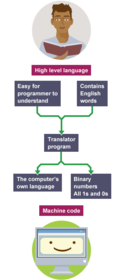
- In order for a computer to understand a program written in a high-level language, programmers convert the source code into machine language using a compiler or an interpreter.
-
- A compiler is a program that converts an entire program into machine code before the program is executed.
- An interpreter translates and executes an instruction before moving on to the next instruction.
-
- In the 1980's, (OOP) evolved out of the need to better develop complex programs in a systematic, organized approach.
- Allows programmers to create modules that can be used over and over again in a variety of programs.
- These modules contain code called classes, which group related data and actions.
- Include Java, C++, Visual C#, Visual F#, and Visual Basic.
-
- Demystifying Programming Webquest
Information
- Description
- Slide Set on Programming Languages, created by ap peter on 10/11/2018.
- Created by
- ap peter · Nov 2018
- Updated
- Nov 10, 2018
- Views
- 2
- History
-
- Created by Terri FLetcher · Jan 6, 2016
- Copied by ap peter · Nov 10, 2018
- Rating