
Untitled
Slides in this set (13)
-
- Topic 1 - Measurements and Errors
- Topic 2 - Particles and Radiation
- Topic 3 - Waves and Optics
- Topic 4 - Mechanics and Materials
- Topic 5 - Current Electricity
- Topic 6 - Further Mechanics
- Topic 7 - Fields and Consequences
- Topic 8 - Nuclear Physics
-
- Progression Waves
- Longitudinal and Transverse Waves
- Superposition and Standing Waves
- Young's Slit and Interference
- Diffraction
-
- A wave can be described as progressive if it moves outwards from the source
-
Longitudinal and Transverse Waves
- All waves are called by oscillations and all transfer energy without transferring matter
- Longitudinal Waves - a wave in which the displacement of particles is parallel to the direction of energy transfer
- when the particles are close together, we call it a compression and when they are spread out, we call it a rarefaction
- the wavelength is the distance from one compression to the next
- the amplitude is the maximum distance the particles move from its equilibrium position right or left
- sound waves / seismic P - waves
- Transverse Waves - a wave in which the displacement of particles is perpendicular to the direction of energy
- the wavelength is the distance from one peak to the next
- the amplitude is the maximum distance the particles moves from its equilibrium position up or down
- water waves / electromagnetic waves / seismic S - waves
-
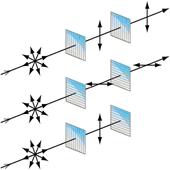
- Caption: Diagram showing polarisation
- Polarisation restricts the oscillations of a wave to one plane - in the diagrams the light is initially oscillating in all directions
- A piece of Polaroid only allows light too oscillate in the same direction as it
- in the top diagram, the light passes through a vertical plane and becomes polarised in the vertical plane so it can pass through the second Polaroid
- in the middle diagram, the light becomes polarised in the horizontal plane
- In the bottom diagram, the light becomes vertically polarised but this cannot pass through a horizontal plane Polaroid
-
Superposition and Standing Waves

- Caption: Three examples of the resultant waves: an amplitude of 1.5 , no resultant wave and amplitude of 2.0
- Superposition - the process by which two waves combine into a single wave form when they overlap
- Stationary Waves - when two similar waves travel in opposite directions, they can superpose to form a stationary wave ; these then form nodes and antinodes
- Nodes - positions on a standing wave which do not vibrate as the waves combine to give zero displacement
- Antinodes - positions of a standing wave where there is a maximum displacement
- Harmonics
- First harmonic - 2 nodes and 1 antinode
- Second harmonic - 3 nodes and 2 antinodes
- Third harmonic - 4 nodes and 3 anitnodes
-
- Interference - when two waves of the same type occupy the same space
- The two overlapping waves must be coherent
- the same frequency
- a constant phase difference
- Diffraction - spreading out of bending of waves as they pass through a gap or around an obstacle
- diffraction is greatest when the wavelength when the wavelength is approximately the same as the width of the gap
- SINGLE SLIT DIFFRACTION
- when light passes through a narrow slit, a pattern of alternate bright and dark fringes is produced
- this is called a single slit diffraction pattern
-
Comparing Progressive and Stationary
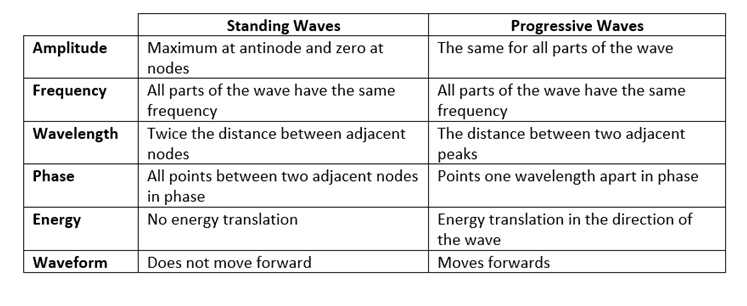
- Caption: Comparing the two types of waves
-
Topic 4 - Mechanics and Materials
- MATERIALS
- Springs
- Hooke's Law
- Young Modulus
- MECHANICS
- Vectors
- Moments
- Momentum
- Projectiles
- Newton's Laws
-
- Hooke's Law - The force needed to stretch a spring is directly proportional to the extension of the spring from its natural length; so there is the equation F = ke
- Where F = force k = spring constant e = extension of the wire
- Spring Constant - this tells use the stiffness of a material
- a small force causes a large extension the spring constant will be small - very stretchy
- a large force causes a small extension the spring constant will be large - not stretchy
- Springs in Series
-
- Current and Potential Difference
- Resistance and Ohm's Law
- Resistance and Superconductors
- Resistivity
- EMF and Internal Resistance
- Capacitors
-
Current and Potential Difference
- Current - Electrical current is the rate of flow of charge in a circuit / the rate of flow of electrons
- Potential Difference - the work done per unit charge / energy given to each electron or the pushing force of the electrons
- Resistance - How easy or difficult it is to make a current flow through a material
-
- For something to obey Hooke's Law the current flowing is proportional to the potential difference pushing it
- Taking Measurements
- To measure the potential difference, we use a voltmeter connected in parallel
- To measure the current, we use an ammeter connected in series
- I - B Graphs
Information
- Description
- Slide Set on Untitled, created by Hannah Krasner on 20/03/2019.
- Created by
- Hannah Krasner
- Views
- 0
- Rating